
What this guide answers
- What is the difference between SportMember and Spond?
SportMember is a freemium club management platform built around a website builder, operating across many country sites and languages.
- Is Spond really free?
There is no subscription for the organiser, which is genuinely unusual; the one paid line is the optional Club Website add-on, at £19 + VAT (A$22) a month after a free trial (checked October 2026).
- How much does SportMember cost?
It is freemium. 0%.
- Can a club run both?
Yes, and plenty do — a website from one product and team organisation from another is a very common arrangement.
- Do we still need a website if the app works well?
Almost always, because an app only reaches people who have already joined.
Picture a fourteen-team soccer club at the end of a season. Its public presence is a club page somebody's dad set up years ago and a website that still lists a treasurer who resigned two committees back. Its actual communications live in fourteen separate group chats, one per team, each with its own screenshotted draw, its own running joke and its own person who has muted it.
Both halves of that are broken, and they are broken in opposite directions. One is a shop window with nothing in it. The other is a set of conversations nobody outside the team can see, search or inherit. SportMember and Spond are two of the most common answers clubs reach for, and they fix precisely one half each. SportMember leads with a club website. Spond leads with the app that is already on every parent's phone. Neither is a bad choice — but choosing well means being honest about which half is currently costing you more.
Our interest, declared early: we are ClubHelix, an all-in-one club platform, so we are a third option and we will say clearly at the end what these two do better than us. Everything about both products comes from public information current as at July 2026. Where a figure is not published or not verifiable, we say so rather than repeating a number from a directory listing. Both companies change their packaging regularly, so check anything decision-critical with them.
Two products, two definitions of free
SportMember is made by Holdsport in Copenhagen and is a freemium club management platform with a website builder at the front of it. Its most striking characteristic is reach: it operates across roughly fifteen or more country sites, with per-country domains and language versions, and it is one of the very few products that has built a genuine, dedicated landing page for the term "club website builder". A free core with paid upgrades is the model. When we re-read its UK pricing page in October 2026 there was a £0 plan, and paid plans were priced per member (£0.16 a member was shown, £32.00 a month at the default count) with a £22.00 monthly minimum, ex VAT. A CMS/Premium Website add-on was £25 a month, widgets £10 a month, and a payment and ticket admin fee of £0.35 + 1.0% applied.
Spond comes from Oslo and takes the opposite approach — app first, with no subscription for the organiser. Since our first check it has added a paid Club Website for Spond Club, at £19 + VAT (A$22) a month after a free trial (checked October 2026). It organises events, collects RSVPs, runs group and guardian messaging, handles payments and offers fundraising. It has become something close to the European standard for team organisation, and its adoption is enormous because there is no purchase decision to make. Its RSVP and attendance experience is, in our assessment as a competitor, best in class. Its home market is the Nordics with a strong presence across the United Kingdom and Europe, and some footprint in Australia.
The word "free" is doing different work in each case. One means a free tier with paid upgrades. The other means no subscription for the app, with the business model living somewhere else, plus an optional paid website — which we will come to.
Side by side
| Area | SportMember | Spond |
|---|---|---|
| Leads with | A club website plus club management | An app for teams and clubs |
| Base | Copenhagen, Denmark (Holdsport) | Oslo, Norway |
| Market shape | Around fifteen or more country sites, per-country domains and languages | Nordics, United Kingdom and Europe, some Australian presence |
| Public website | Yes — the front of the product | Paid Spond Club add-on, £19 + VAT a month (October 2026) |
| RSVP and attendance | Not something we can verify from public sources | A core strength, and very well executed |
| Native mobile apps | Not something we can verify from public sources | Yes, and central to the product |
| Guardian and junior messaging | Not something we can verify from public sources | A noted strength |
| Team tooling | Includes a lineup builder | Event and availability focused |
| Commercial model | £0 plan; paid per member, £22 a month minimum ex VAT (Oct 2026) | Free organiser; website add-on £19 + VAT a month |
| How the money is made | Paid plans, add-ons and a £0.35 + 1.0% payment admin fee | Payment processing, fundraising and the website add-on |
| Fundraising | Not a headline capability | Superdraw — the club keeps 65% of ticket sales, per their site |
| Shop, raffles, donations | Not the product's emphasis | Not beyond the fundraising product |
| Competitions, ladders, finals | Not the product's emphasis | Not the product's emphasis |
| Facility booking, governance | Not the product's emphasis | Not the product's emphasis |
Two readings of that table to head off, because comparison pages are usually unfair in both directions. "Not the product's emphasis" describes what each is built and marketed around, not a claim of total absence. And "not something we can verify" means exactly that — we could not find it stated in a source we trust, which is not the same as it being missing. If one of those rows decides your purchase, ask the vendor, not a comparison page.
The shop window and the group chat
The clearest way to separate these two is by who they talk to.
Spond talks to people who have already joined. It is superb at the questions that consume a team manager's week: are you available on Saturday, who is short, who has not replied, where are we meeting, has the venue changed, has the under-12s' parent group been told. It reaches phones, it gets answers, and it does it without asking anyone to learn a new habit.
SportMember talks to people who have not joined yet. A public site is how a stranger finds you, how a new family judges whether you look organised, how a sponsor decides you are worth two thousand dollars, and how a grant assessor confirms you exist as a real organisation rather than a rumour. It also holds the archive — the honour boards, the history, the constitution, the contact that does not change when a committee does.
| The job | Who it serves | Which shape does it better |
|---|---|---|
| "Who is available Saturday?" | Existing members | App-led |
| "Training is cancelled, tell everyone now" | Existing members | App-led |
| "Where do juniors register?" | Strangers | Website-led |
| "Is this club still running?" | Strangers | Website-led |
| "Here is our sponsorship pack" | Local businesses | Website-led |
| "Attendance for the grant acquittal" | The committee | App-led |
| "The constitution and last year's minutes" | Members and regulators | Website-led |
| "What does membership cost, exactly?" | Both | Website-led |

The trap worth naming is the one clubs fall into most often: "we will just use the app." It feels like a decision because engagement improves immediately — attendance goes up, the group chats calm down, the team managers stop chasing. But every improvement lands inside the membership you already have. To a family that has just moved into the suburb and is googling on a Sunday night, a club that lives entirely inside an app is indistinguishable from a club that has folded.
The reverse trap is real too. A website nobody updates is a liability with a domain name attached, and a beautiful site with last season's draw on it does more damage than a sparse one that is current. Whichever way you lean, resource the cadence, not just the build. Our comparison of a club app against a club website works through the trade-off in more depth, and how to build a sports club website covers what the public half actually needs to contain.
How each handles money
This is where the two diverge most sharply, and where committees should read slowly.
Spond charges no subscription for the organiser. The app is free, its Club Website is a paid add-on (£19 + VAT, A$22 or €15 a month after a free trial, checked October 2026), and the business model sits on the money moving through it — transaction fees on the payments clubs collect, plus its Superdraw fundraising product, where the club keeps 65% of ticket sales according to Spond's own material. There is an older transaction-fee figure that circulates online; we could not verify it against a current primary source, so we will not repeat it. Ask Spond for the current effective rate in your currency before you budget.
SportMember is freemium, with a free core and paid upgrades. When we re-read its UK pricing page in October 2026 there was a £0 plan, and paid plans were priced per member (£0.16 a member was shown, £32.00 a month at the default count) with a £22.00 monthly minimum, ex VAT. A CMS/Premium Website add-on was £25 a month, widgets £10 a month, and a payment and ticket admin fee of £0.35 + 1.0% applied. Check the page for your own country, because SportMember prices per country site.
The general principle matters more than either specific. When a platform costs nothing up front, the cost has not disappeared — it has moved to the flow. That is not sinister and it is often the right deal for a small club, but it changes how you compare. A subscription is a fixed, predictable, budgetable line. A transaction rate is a variable cost that scales with exactly the thing you are trying to grow.
Run your own arithmetic before you decide. Here is the shape of it, using an illustrative club and illustrative rates that belong to nobody — substitute the real figures once you have them:
| Subs collected in a season | At 1.5% | At 2.0% | At 2.5% |
|---|---|---|---|
| $18,000 | $270 | $360 | $450 |
| $36,000 | $540 | $720 | $900 |
| $72,000 | $1,080 | $1,440 | $1,800 |
Two things fall out of that table. First, a growing club can pass the cost of a mid-range subscription without noticing, because the meter runs quietly. Second, a small club genuinely is better off on a flow-based model, which is exactly why free platforms win the small end of the market so decisively.
Fundraising deserves its own look. Keeping 65% of ticket sales on a run-your-own-draw product is a real number to compare against, and the comparison is not simply "higher is better" — a club running its own raffle keeps more of the gross but carries the licence, the prizes, the sellers and the acquittal itself. Our guide to running a club raffle sets out what that actually involves before you decide which way is cheaper.
The last money question is breadth. Subs are one revenue line. A club that also sells uniforms, runs a canteen, tickets a presentation night, takes donations and invoices sponsors will find that neither of these products is built to be its commerce system, and will end up with a separate arrangement for each.
Built for many countries at once, and what that costs
SportMember's multi-country footprint is unusual, and it is worth understanding what a product shape like that gives and takes.
What it gives you: software that has been through many league structures, many languages and many currencies, and is usually better tested for it. Localisation at that scale is genuine engineering, not a translation file, and a club in a smaller market benefits from a maturity it could never have funded locally.
What it costs you is specificity, and clubs feel it in small, constant ways:
- Vernacular. A platform serving fifteen markets cannot call it a canteen, a sign-on day, a pennant, a ladder or a working bee, because those words mean nothing in most of its territories. So it uses the generic term, and every screen reads like a translation of your club rather than a description of it.
- Season shape. Northern-hemisphere seasons run inside one calendar year; plenty of southern-hemisphere seasons straddle two, and some sports run summer and winter competitions in parallel. Rollover logic built for the first case creates awkward workarounds for the second.
- Payment rails and tax. Local card schemes, local bank transfer habits, local tax treatment of member subscriptions and merchandise — these are the last things a multi-country product localises, and often the first thing a treasurer needs.
- Roadmap gravity. Features get prioritised for the biggest markets. If you are not in one, you wait.
The fair counterweight is that "local" is not automatically better. A small local product with three developers can be less reliable, less secure and less well supported than a mature international one. Localisation is a spectrum, not a switch. What you are really testing is whether the product's assumptions match your season and your money — so test those directly:
| Test this | What good looks like |
|---|---|
| Season crossing a new year | Rollover works without a manual rebuild |
| Currency and card handling | Your members' usual payment methods, priced in your currency |
| Tax on subscriptions and merchandise | Handled where it applies, or clearly out of scope |
| Date and phone formats | Match local convention without editing |
| Junior age-group rollover | Matches how your sport actually ages players up |
| Privacy expectations | Data handling you can explain to a parent |
Who should pick which
Pick Spond if your loudest pain is availability, attendance and last-minute communication across many teams, you want zero subscription cost for the app, and your public web presence is either fine already, simple enough for Spond's paid website add-on, or genuinely not a priority this year. The engagement job is the one it does best, and it does it very well.
Pick SportMember if you want a public website and basic club management from one free-ish product, you are comfortable with modest depth in each area, and multi-language support is useful to you. It is a reasonable answer for a club that has nothing and needs something credible quickly.
Look wider if your club sells things, runs its own competitions and ladders, books courts or fields, tracks waivers and accreditations, or carries governance obligations that need real tooling. Those jobs sit outside what either product is built around, and stitching four free tools together has a cost of its own — usually paid by the one volunteer who understands how they connect. If you want to see how an app-first product compares against another club-admin platform, Team App against Spond covers that angle, and running a soccer club sets out the full operating year the software has to survive.
Doing both jobs without running two systems
The reason this comparison is hard is that clubs genuinely need both halves — a public front that convinces strangers, and an engagement layer that reaches the people already inside. ClubHelix is built to hold both: a real branded site through the canvas page editor on your own custom domain, with RSVPs and attendance for the availability grind, and a club shop for the commerce most free platforms leave out.
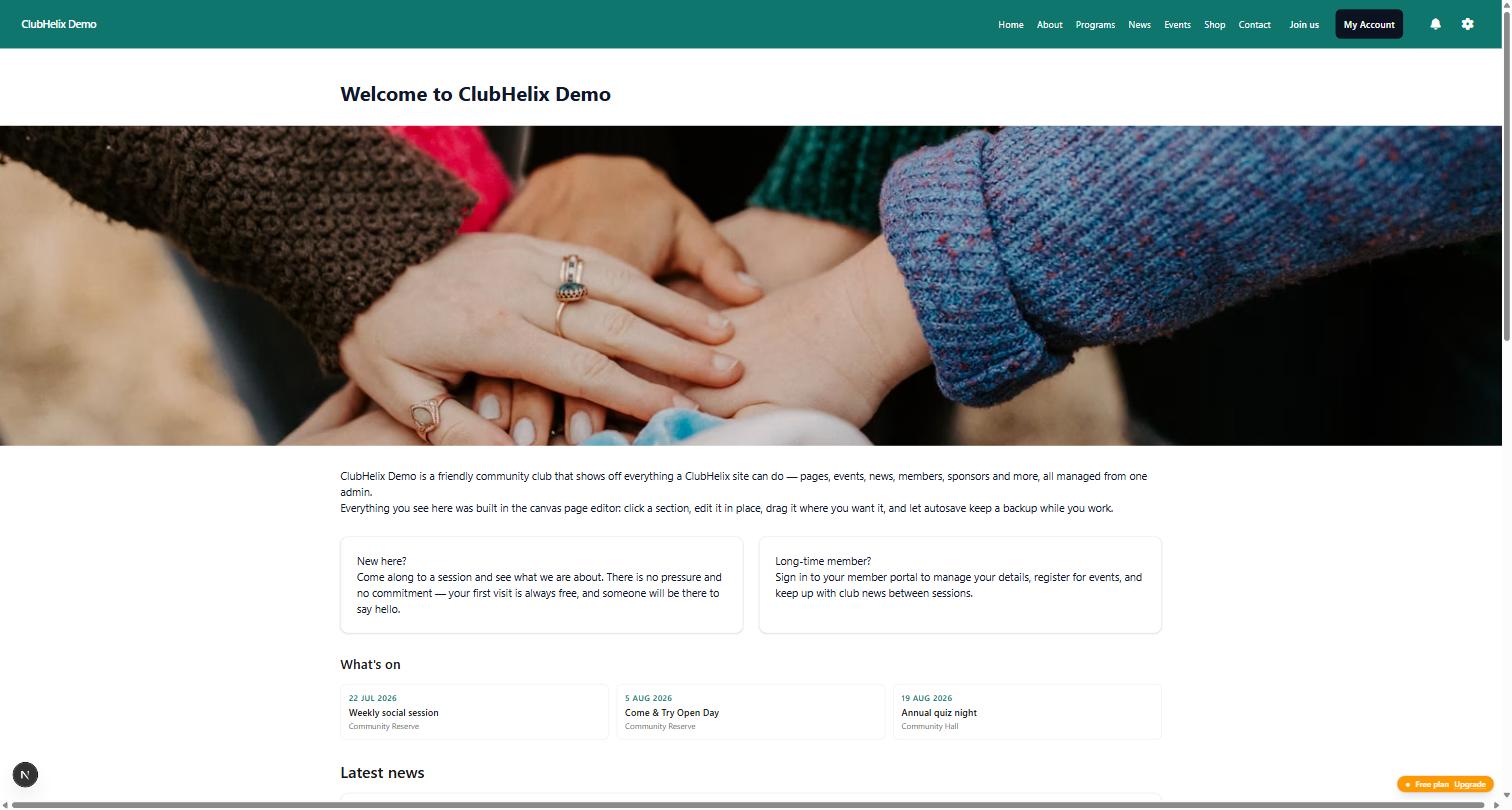
A free tier means you can build the public half properly and test the engagement half against real fixtures without opening the chequebook. No sales call stands between you and the pricing page, the platform is Australian-built and hosted on Australian infrastructure, and starting from a template rather than a blank page means most clubs set up their site in one sitting. Our fuller take on the app-first category sits at /compare/spond-alternative.
Where we do not compete, honestly: we have no native app-store apps — our mobile experience is an installable web app, which is a real difference if your members expect a store download. Spond's RSVP experience, guardian messaging polish and enormous free adoption are genuine advantages, and its zero-subscription organiser is hard to beat on price alone for a small club. SportMember's multi-language, multi-country reach is beyond us: the ClubHelix admin, club websites and member accounts are English-only today, and only our own marketing site has Spanish and Brazilian Portuguese previews. If your club needs three languages or an app-store icon more than it needs commerce, competitions and governance, those products are the better fit and we would rather you knew.
Frequently asked questions
What is the difference between SportMember and Spond?
SportMember is a freemium club management platform built around a website builder, operating across many country sites and languages. Spond is a free, app-first organiser built around events, RSVPs, messaging, payments and fundraising, with no subscription for the app and a paid Club Website add-on. The short version is that one leads with your public face and the other leads with your members' phones.
Is Spond really free?
There is no subscription for the organiser, which is genuinely unusual; the one paid line is the optional Club Website add-on, at £19 + VAT (A$22) a month after a free trial (checked October 2026). The business model sits on money flowing through the platform — payment processing on the fees clubs collect, plus its Superdraw fundraising product, where the club keeps 65% of ticket sales according to the company's own material. Ask for the current processing rate in your currency, because a variable cost on a growing revenue line deserves a place in your budget.
How much does SportMember cost?
It is freemium. On its UK pricing page in October 2026 there was a £0 plan, and paid plans were priced per member with a £22.00 monthly minimum ex VAT (£32.00 a month at the default member count), plus a £25-a-month CMS/Premium Website add-on and a payment and ticket admin fee of £0.35 + 1.0%. Prices vary by country site, so check yours, and ask specifically which capabilities sit behind the paid tier, since that is where freemium comparisons usually go wrong.
Can a club run both?
Yes, and plenty do — a website from one product and team organisation from another is a very common arrangement. The cost is the seam: members exist in two places, nobody is certain which list is current, and every committee handover has to explain both. If you go that way, write down which system owns the member list and keep it true.
Do we still need a website if the app works well?
Almost always, because an app only reaches people who have already joined. Prospective members, sponsors, grant assessors and local media all arrive through search, and a club with no public page is invisible to every one of them. The app improves the club you have; the site is how you get the club you want.
Which is better for a club with juniors?
App-led products tend to shine here because guardian messaging and availability are exactly the junior-club grind. But juniors also bring the highest intake of new families, and those families find you by searching before they ever install anything. If your club is junior-heavy, treat the public page as a recruitment tool rather than a brochure and make registration the most obvious thing on it.
Keep reading — club app vs club website unpacks the trade-off in detail, and how to build a sports club website covers what the public half needs to contain.


