
What this guide answers
- How do you decide which child is the second child?
Count from what the household has already paid for, never from the order the payments happened to arrive in.
- Should a sibling discount be applied with a discount code?
No. A code has to be typed, which means the household who remembers pays less than the household who forgets, and a shared code leaks into group chats.
- Does the family discount recalculate when somebody withdraws?
That is your decision, not a technical one, and the only wrong answer is not having made it.
- Who counts as one household for a family rate?
Attach the rate to the person paying rather than to an address or a relationship.
- Does a family rate cover coaching terms and court bookings too?
Not unless you set that up separately, and most clubs do not.
South Africa edition. This guide is written for volunteer-run clubs in South Africa. Where rules differ — grants, tax, incorporation, safeguarding — follow the South Africa-specific pointers below or check with your national body.
Your committee has voted. The minutes say "third child free", or "family cap at two and a half fees", and everyone went home pleased with themselves. What nobody in the room decided is which child is the third one when they sign on in March, June and August, whether the cap survives a withdrawal in round four, and who is going to discover in October that eleven households were charged the wrong amount.
This guide is the runbook for that second job. If you are still choosing between a cap and a sibling ladder, or working out what either one would cost your club, stop here and read how to price family memberships first — it owns the strategy, the worked cost modelling and the wording of a definition that survives modern households. Every strategy question belongs there. What follows assumes the number is settled and asks one thing only: how do you make it happen at every sign-up, all season, without anybody hand-editing an invoice?
Because that is where household pricing actually fails. Not in the policy. In the gap between the policy and the sign-up form.
Turning a resolution into a rule
A resolution is a sentence. A rule is a mechanism, and the translation loses something every time. Here are four typical committee resolutions and what each one actually needs before it can charge anybody.
| The resolution as minuted | What it really is | What you have to set up | The decision it hides |
|---|---|---|---|
| "Third child free" | A sibling ladder with one tier | 100% off from the third person onwards | Is the fourth child free too? Almost certainly yes — say so |
| "20% off each extra child" | A sibling ladder with one tier | 20% off from the second person onwards | Does it deepen further down the household, or stay flat forever? |
| "Family cap at 2.5 fees" | A household maximum | A cash maximum per household, per season | A cap on what — your own fee, or the total including per-head levies |
| "A flat family membership" | A product, not a discount | A separate price a household buys instead | Which household shapes it fits, and what the ones that don't fit pay |
Two of those four are the same mechanism with different numbers, which is worth knowing before anybody argues about them. The third is a genuinely different mechanism. The fourth is not a discount at all — it is a second line on your fee schedule, and it is the only one of the four that needs no ordinal logic, because a household buys one product regardless of how many people it contains.
Write the translated version into the minutes, not just the resolution. "Third child free" is a slogan. "100% off the third and every subsequent registration paid for by the same person, on the season form, to a maximum of four people" is a rule — and a rule is the thing you can set up, test and defend at a general meeting.
Who counts as one household
This is the question that eats volunteer evenings, and its operational answer is not the same as its policy answer.
The ordinal problem
A club with a sibling ladder has to answer a question a cap never asks: which child is the second child? If the answer depends on the order the payments arrived, your pricing is a lottery. A household that signs three children on in one sitting gets the ladder; a household that signs one on in March, one in June and one in August pays full price three times and then sends a refund request in September — quite reasonably, because the policy on your own fee page promised them a discount.
So the rule has to count everyone the household has already paid for, not just everyone on the sign-up in front of it. That is the single most important mechanical requirement in this article, and it is the one most likely to be missing from whatever you are using now. Test it before the season opens: take one household, register one member, pay, then register a second member in a separate transaction and read the price.
The other half of the same rule is which earlier sign-ups count. Only ones actually paid, or part-paid, should — otherwise anybody can earn the third-child rate by opening two checkouts they never finish. That choice has a cost and you should know it: a household that leaves one sign-up unpaid and starts another does not earn the sibling rate on the second. The fix there is a phone call and a manual credit, not a looser rule.
The awkward cases, decided in advance
| Situation | Treated as | Why |
|---|---|---|
| Two children signed on a month apart, same payer | One household | The count follows the payer, never the transaction |
| Separated parents, each paying for one child | Two households | Two payers, two bills — offer the rate to whoever registers both |
| A cousin at the same address, paid for by their own parent | A different household | The address is not the test; the payer is |
| An adult in the same household who also plays | Counts only if your policy says adults count | Decide it, because a senior fee is usually a different number |
| A child signed on at the clubhouse desk by a volunteer | Whichever adult's account the sign-up sits under | This is how households get split by accident — brief volunteers |
The payer test does almost all the work, and it spares you asking anybody for a birth certificate or a tenancy agreement. Two follow-on rules keep it honest: cap how many people one household rate can cover, and keep a line of committee discretion for the case nobody predicted, minuted each time you use it.

Part-season and late joiners
A late joiner raises two questions at once, and they are separate. What do they pay — a full fee, or a reduced one because half the season has gone? And do they count towards the household's number? Answer both, in the minutes, before the season.
The defensible combination for most clubs is that a late joiner pays a reduced fee and still counts. It is defensible because the household has already demonstrated the thing the discount is buying: more than one member. The alternative — a reduced fee that does not count — is easier to explain and quietly punishes the family who came back with a second child. Either is arguable. The unforgivable option is having no answer when a parent asks in week nine.
Refunds and withdrawals, decided before the first one
Somebody will withdraw. A wrist gets broken, a family moves, a season gets cut short. If the household had a family rate, the arithmetic becomes interesting: a three-child household paying a capped total loses one child, and is now a two-child household that paid a three-child price.
There are three honest policies, and you only have to choose one.
| Policy | What happens when one member withdraws | Best for |
|---|---|---|
| No recalculation | Refund the withdrawn member's own share; everyone else keeps their price | Almost every club — simplest to explain, cheapest to run |
| Recalculate down | Rework the household total as if that member never registered, then refund the difference | Clubs with a generous cap and a low withdrawal rate |
| Recalculate both ways | As above, but the household is also re-billed when it drops below a threshold | Nobody — the re-bill is a call no volunteer should have to make |
Then publish the choice. The practical answer to almost every question in this section is the same three steps: decide it, write it down, tell families before they ask. A policy discovered at the moment of a refund request reads as an improvisation even when it isn't. Our guide to refunds for club registrations covers the wider policy this sits inside.
One thing to insist on whichever you pick: changing the rule this year must never rewrite what somebody was charged last year. If your setup re-rates historic sign-ups when you edit a rate, you do not have a pricing policy — you have a time machine, and the treasurer's reconciliation will never balance again.
How it sits beside everything else on your fee page
A family rate is rarely the only thing happening at sign-up. Settle each of these interactions once, then run a test registration and see what your own form actually does.
| Also running | The question to settle | What to do |
|---|---|---|
| A promo code | Does a code stack on top of the family rate, or replace it? | Either way, cap its uses and set its window so it cannot escape into a group chat |
| An early-bird window | Does the family rate come off the early-bird price or the standard one? | Publish both deadlines together — a household chasing two discounts needs to know which one to hurry for |
| A member rate versus a casual rate | Does a casual sign-up count towards the household number? | Usually no; the discount is a membership benefit, so say that on the page |
| Instalments or a payment plan | Is the discounted total the number that gets divided? | Run a three-child test sign-up and read the schedule it produces before you publish |
| Classes, terms, clinics, court hire | Does the family rate reach them at all? | Usually not — and if not, say so plainly rather than letting a parent assume |
That last row is the one families complain about. A household rate on season registration is not a discount on a term of coaching or an hour on a court, and a parent who read "family discount" on your website will reasonably expect both. One sentence on the fee page — "the family rate applies to season registration; coaching terms and court hire are priced separately" — prevents the entire conversation.
The reconciliation the treasurer inherits
If the rate was applied by hand, the bill arrives months later as a spreadsheet that does not tie out. Here is the monthly check, whichever way you set the rule up.
| Check | Where to look | What a problem looks like |
|---|---|---|
| Multi-member households all sitting at full price | Your sign-up list, grouped by payer | A ladder that isn't firing — usually a household split across two accounts |
| Manual credits and refunds issued this month | The refund log | More than a couple means the rule is not doing its job |
| Households billed above the family maximum | Total paid per payer | A cap that was missed on a second transaction |
| Discounts given away against what the committee expected | Gross fees less discounts | A drift of more than a percent or two is worth an evening |
| Codes redeemed alongside a family rate | Redemption counts | A code being used as the family discount — a different mechanism entirely |
Four households with the wrong price is an afternoon in November. Forty is the reason the next treasurer says no. If chasing the gaps is already your monthly job, how to track who has paid club fees is the companion piece.
Putting it on the fee page
A parent should be able to work out their own total before they start, on a phone, without ringing anybody. That means the page carries the fee, the rule stated as arithmetic, a worked example, and the boundaries.
A worked example does more than the rule does. Say the junior fee is $180, with 25% off the second child and 50% off the third and subsequent:
| Household | Full price | With the ladder | They save |
|---|---|---|---|
| One child | $180 | $180 | — |
| Two children | $360 | $315 | $45 |
| Three children | $540 | $405 | $135 |
| Four children | $720 | $495 | $225 |
Then the three sentences most fee pages leave out: what the rate applies to, who counts as one household ("registrations paid for by the same person"), and what happens if somebody withdraws. A fee page that answers those three never generates an email. See how to collect club membership fees online for the mechanics of the page itself, and how much should club membership cost for the base fee all of this is a multiple of.
Setting it up in ClubHelix
Household, sibling and family rates are set up on your club's Discounts admin page, alongside promo codes, and they apply automatically at checkout — second child, third child and onwards, or a family maximum — with no code to type. Four things about how they behave answer most of what this article has asked you to decide:
- They count everyone a household has already paid for, so a third child signed on a month later is still charged as the third child. The ordinal never depends on the order the payments arrived.
- The highest matching rule wins. Set one tier from the second person and a deeper one from the third, and the third child gets the deeper rate.
- Only paid and part-paid orders count towards a household's person number, which is what stops an abandoned checkout earning a discount.
- An order keeps a copy of the rules that priced it, so a later change to the policy never rewrites what somebody was charged. That is the treasurer's protection, and it is why a rate can be adjusted between seasons without fear.
These rates apply to registration — season and event sign-up through a registration form, which also supports pro-rata mid-season pricing and early-bird windows. They do not price a program or term enrolment such as a class, clinic or coaching term, and they do not price a facility booking; those are priced separately, and deciding what a household pays for them is the club's own job.
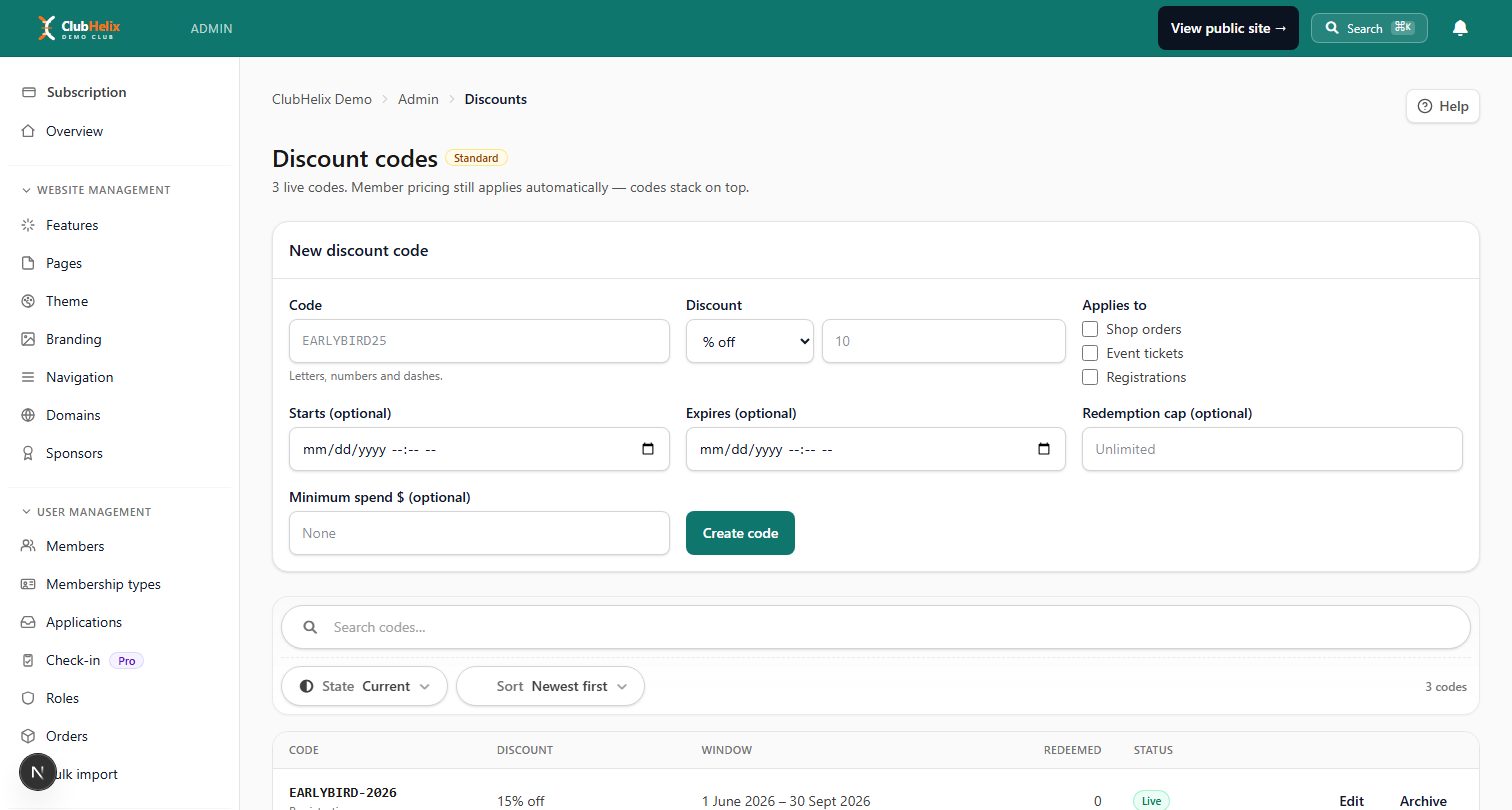
Discount codes are the other half of the same page and a genuinely different mechanism: a code carries validity windows, usage caps and redemption counts, and a buyer types it in. Promo codes stack on top of a household rate, which is useful and worth a deliberate decision. A code is not how you run a sibling rate, though — if a household has to remember a code, the family who forgets pays more than the family who remembers, which is the exact opposite of a pricing policy.
What no system does is decide anything for you. It will not work out which households deserve a lower price, and there is no built-in reduced-rate scheme for households that cannot meet the full amount — a club that wants one runs it by hand, on its own terms, and minutes the decision. Nor should you promise a parent a report telling them which person number they hold; the ordinal is bookkeeping, not a customer-facing figure. What you do get is that every order records what it was discounted and the rules that produced the figure, so the cost of the policy is recorded rather than estimated — which is the number you were guessing at when you set it, and the club's reports are where the committee reads its money back. Plans are on the pricing page, and you can start a club site on the free tier.
The annual review
Twenty minutes, once a year, before renewals open.
- Count households by size from last season's list. Your roster shape is what makes a cap or a ladder the cheaper option, and it moves every year.
- Total what the discount cost and express it as a share of gross fees. More than about a tenth deserves a vote rather than a quiet renewal.
- Count the manual exceptions. Every one of them is a rule that failed to cover a real household.
- Re-read the fee page as the parent of three. If you cannot reach your own total inside a minute, rewrite it.
- Change the number before renewals open, never during, and honour every price already paid.
Then set it up once and let it charge, correctly, all season, without you in the loop.
Frequently asked questions
How do you decide which child is the second child?
Count from what the household has already paid for, never from the order the payments happened to arrive in. If the second child is whoever turns up second in a single transaction, then a household registering its children a month apart pays full price twice and has a legitimate complaint — so the rule has to look at the household's paid history, not just the sign-up in front of it.
Should a sibling discount be applied with a discount code?
No. A code has to be typed, which means the household who remembers pays less than the household who forgets, and a shared code leaks into group chats. Household rates and promo codes are different mechanisms for different jobs: use an automatic household rate for your standing family policy, and keep codes for time-limited offers you actually want people to enter.
Does the family discount recalculate when somebody withdraws?
That is your decision, not a technical one, and the only wrong answer is not having made it. Most clubs refund the withdrawn member's own share and leave everybody else's price alone, because recalculating a whole household's total for every withdrawal costs more volunteer time than it saves money. Whatever you choose, put it on the fee page before the season starts.
Who counts as one household for a family rate?
Attach the rate to the person paying rather than to an address or a relationship. That single test handles separated parents (two payers, two bills), blended households, grandparent carers and a cousin at the same address without anybody having to interrogate a parent at the sign-up desk — and it avoids asking for documents you have no business holding.
Does a family rate cover coaching terms and court bookings too?
Not unless you set that up separately, and most clubs do not. A household rate on season registration is one thing; a discount on a term of classes or an hour of court hire is another, decided and priced on its own. Say which is which on the fee page, because a parent who read "family discount" will assume it covers everything until you tell them otherwise.
Keep reading — how to price family memberships works through the strategy and the cost of the number you are setting up here, and club membership types and tiers covers the fee structure it all sits inside.

