
What this guide answers
- What should be in a committee induction pack?
A one-page role brief, the constitution or rules, the current committee list, the last three sets of minutes, the most recent annual report and financial statements, the current budget and year-to-date position…
- How long should induction take for a new committee member?
Treat it as a 90-day arc rather than a single meeting. Access and the pack land in the first three days, the handover session and buddy introduction in the first week, orientation at the first meeting, a small…
- Who should run the induction — the outgoing office holder or the president?
Both, doing different jobs. The outgoing holder runs the handover, because they know where everything is and what is outstanding.
- What access should a new committee member be given?
Their own account on every club system at the level their role genuinely needs, a role-based club email address, the document folders relevant to their portfolio, and whatever banking view or authority the position…
- How do we induct someone who joins mid-year to fill a vacancy?
Exactly the same way, compressed. Send the same pack, do the access on day one, assign a buddy, and run the 30-day check-in.
UK edition. This guide is written for volunteer-run clubs in the UK. Where rules differ — grants, tax, incorporation, safeguarding — follow the UK-specific pointers below or check with your national body.
The most damaging thing that happens to a club committee usually happens quietly, about ten weeks after the annual general meeting. Someone who put their hand up with real enthusiasm — often the person you were most pleased to recruit — works out that they do not understand what they agreed to, cannot find the documents everyone refers to, has not been given access to the systems they need, and is too embarrassed to keep asking. They do not complain. They just start missing meetings, and by the middle of the season they have resigned or gone silent.
Clubs read that as a volunteering problem. It is almost always an induction problem. The person was handed a title and a folder of last year's paperwork and left to reverse-engineer the job from a group chat. Nobody ever told them what decisions were theirs to make, what the club's actual financial position was, who to ring about the ground, or what the first three months were supposed to look like.
This guide is the fix — an induction pack you assemble once and reuse for every new office holder, plus the three things that make it work rather than just exist: access granted properly on day one, a named buddy who is not the person they replaced, and a deliberate plan for the first three meetings. It is written for clubs that recruit their committee from their own membership and have no staff to lean on.
Handover and induction are two different jobs
Most clubs do half of this and wonder why it does not take. Handover is about the club's property. Induction is about the person.
| Handover covers | Induction covers |
|---|---|
| Bank accounts, signatories, keys, logins, documents | What the role is actually responsible for, in plain words |
| Where things are stored and what is outstanding | How decisions get made here, and which ones are theirs alone |
| The state of live issues at the moment of transition | The context behind those issues, and who the people involved are |
| A single meeting or handover session | A structured first 90 days |
| Owned by the outgoing office holder | Owned by the president and the committee as a whole |
The distinction matters because handover has a natural deadline and induction does not. Nobody notices an induction that never happened until the person disappears. Our committee handover checklist covers the property side item by item; everything below assumes that has been done and picks up from there.
The induction pack, document by document
Assemble this once, keep it in club-owned storage, and update it as things change. New office holder, whatever the role — send the same pack. Aim for a bundle someone can read in ninety minutes.
| Document | Why it is in the pack | Owner |
|---|---|---|
| One-page role brief | The single highest-value item — what this role does, decides and reports (template below) | President |
| Constitution or rules | The club's actual governing document, not the folklore version | Secretary |
| Current committee list with contacts | Names, roles, photos if you have them, and how each person prefers to be contacted | Secretary |
| Last three sets of minutes | The fastest way to learn what the committee is actually working on right now | Secretary |
| Last annual report and financial statements | The honest picture of the club's size, money and year | Treasurer |
| Current budget with year-to-date position | What is committed, what is discretionary, and where the pressure is | Treasurer |
| The club's annual calendar | So they can see what is coming rather than reacting to it | Secretary |
| Delegation and spending limits | What they can approve alone, what needs two signatures, what needs the committee | Treasurer |
| Policy set | Code of conduct, complaints, child safety, privacy, reimbursement, social media | Secretary |
| Reimbursement form plus how to claim | Removes the most common quiet resentment in volunteer clubs | Treasurer |
| Key external contacts, annotated | Association, facility owner, insurer, major sponsors, the electrician who knows the wiring | President |
| Live issues memo | The one-page honest list of what is unresolved and what has been promised to whom | President |
| Systems and access list | What they will be given access to, at what level, and who to ask when it breaks | Secretary |
| The club's short history | Founding, honours, the things members are proud of and the things that are sensitive | Anyone |
That last one gets skipped and should not be. A new committee member who does not know why the club stopped running the winter carnival in 2019, or why one family's name is on the pavilion, will step on something in their first month and never know why the room went quiet.
A note on vernacular for the pack itself — write it in the words your club actually uses. If members pay subs, do not write "membership dues" in the induction pack and something different on the website. Where the group is a committee rather than a board of trustees, keep it a committee throughout, and be precise about which one you mean if your structure has both. It sounds trivial, and it is the difference between a document that reads like the club and one that reads like it was downloaded.
The one-page role brief
If you only make one new document, make this. It replaces a title with a job, and it is the single best predictor of whether someone lasts the year.
[CLUB NAME] — Role brief: [role]
Purpose in one sentence. [Why this role exists — "keeps the club's money accurate, visible and legal".]
You are responsible for. [Five to eight specific duties, each starting with a verb. Not "oversee finances" — "reconcile the bank account monthly and present a one-page report to each committee meeting".]
You decide alone. [The genuine authority — e.g. approving reimbursements up to the delegation limit, scheduling the roster, replying to routine correspondence.]
You recommend, the committee decides. [Fee changes, contracts, anything over the limit, policy changes.]
You must escalate. [Anything involving a member's safety, a child, a legal threat, a media enquiry, or a sum above the threshold — straight to the president, same day.]
Time commitment, honestly. [Hours per week in season and out of season, plus the two or three weeks a year that are genuinely heavy.]
You work most closely with. [Two or three roles, and what the handoffs between you are.]
Systems you will use. [Each system and the access level you will be given.]
What good looks like at the end of the year. [Three or four outcomes the committee would call a successful year in this role.]
The "time commitment, honestly" line is the one clubs are tempted to soften, and softening it is a false economy. People forgive a demanding role they were warned about. They do not forgive a role that was described as two hours a month and turned out to be six hours a week in August. The volunteer position descriptions template has the longer form of this document, and the committee roles guide covers what each office typically carries.

Access and logins — granted properly, revoked reliably
This is where induction most often fails in a way that costs the club money later. Two rules cover almost all of it.
Rule one — everyone gets their own login, at the level their role needs. Shared passwords are the reason clubs cannot tell who changed the fee table, cannot remove a departed member's access, and cannot let a new person try something without the risk of them breaking something else. A proper club platform gives each committee member their own account with role-based permissions, so the canteen coordinator sees the roster and the shop, the registrar sees members and payments, and nobody has to be given the keys to everything to do a small job.
Rule two — every grant is written down with its matching revocation. Keep a two-column list: what was granted, and what has to be removed when this person leaves. Access that is not on a list is access nobody remembers to remove.
Here is the day-one access checklist to work through with each new office holder:
- Club platform or website admin — their own account, at the role level in their brief, never a shared login.
- Role email address — the club-owned address for their office, forwarding to them, so external contacts never need updating again.
- Club document storage — the folders their role needs, in the club's account rather than shared from a personal drive.
- Banking view or authority — read-only, dual-authorisation or full signatory as the role requires, with the paperwork lodged in the first fortnight.
- Association or governing body portal — the club's login, with their own user where the system supports it.
- Social accounts — admin or editor level as needed, always through the platform's role system, never by handing over the password.
- Two-factor authentication turned on wherever it is offered, and recovery contacts pointed at club-owned addresses.
- Removals done the same day — every access the outgoing holder had that is no longer appropriate.
The revocation half is the half clubs skip. Departed committee members holding live admin rights years later is astonishingly common, and it is a genuine risk rather than an embarrassment. A platform with an audit log makes both directions verifiable — you can see what access exists and who used it, rather than trusting a memory of who was given what in 2023.
Some access has a screening prerequisite attached rather than just a permission level. Committee members in roles involving juniors generally need a DBS check at the appropriate level before they start, and most national governing bodies also require a named welfare officer with specific safeguarding training. Confirm the current standard with your governing body, and record checks and their renewal dates in the club's register on day one rather than the week before finals.
A buddy, and why it should not be your predecessor
Pair every new office holder with an experienced committee member for their first three months. One rule about who: not the person they replaced. The predecessor is the right person for handover — they know where everything is — but they are the wrong person for induction, because a new treasurer will not ask the old treasurer the questions that reveal they are lost. There is too much pride in the room, in both directions.
A buddy from a different portfolio works far better. The job is small and specific:
- A fifteen-minute call the week before each of the first three meetings — "what is coming up, anything you want to ask before you have to ask it in front of everyone?"
- Sitting next to them at the first meeting and quietly translating the shorthand. Every club has fifty acronyms and three long-running situations that make no sense to a newcomer.
- Being the person who says "that is a normal question" the first two times.
- Nudging the president at the 30-day mark if the new person has gone quiet.
Buddying costs about ninety minutes across a quarter, and it is the cheapest retention mechanism a volunteer club has. Pair it with the thinking in our succession planning guide and you get a committee that grows its own replacements instead of scrambling every year.
The first three meetings
Do not aim for competence at meeting one. Aim for orientation at meeting one, contribution at meeting two, and ownership at meeting three.
Meeting one — orientation. Before it, the buddy call and the pack. At it, a two-minute round of introductions even if everyone knows each other, the chair naming which items are relevant to the new person's role, and no expectation that they speak on anything else. After it, the buddy checks what did not make sense. The president's job here is to protect the new person from being handed a project in week one, which is the classic way to lose them.
Meeting two — contribution. They deliver their first report, which should be short and structured to a template rather than free-form. Give them one small, finishable task with a clear owner line in the minutes — something that will visibly be done by meeting three. Early completed work is what converts a title into an identity.
Meeting three — ownership. They bring one decision item of their own with a paper attached, and the committee treats it exactly as it treats anyone else's. From here they are a full committee member and the buddy arrangement can taper off, with one final check-in at 90 days.
Running that arc requires the meeting itself to be organised — a predictable agenda, papers in advance and reports on templates. Our committee meeting agenda template covers the shape, and the monthly report pack gives your new office holder a form to fill in rather than a blank page to fear.
The first 90 days at a glance
| When | What happens | Who leads |
|---|---|---|
| Day 0 | Election confirmed; welcome message to the new committee; pack sent | President |
| Day 1–3 | Access granted at role level; removals for departing members done; role email pointed at them | Secretary |
| Week 1 | Handover session with the outgoing holder; buddy introduced; role brief walked through | Predecessor |
| Week 2 | Officer records updated externally; banking paperwork lodged; screening records confirmed | Secretary |
| Meeting 1 | Orientation; no project handed over | Chair |
| Day 30 | Check-in — what is still confusing, what access is missing, is the time commitment as described | President |
| Meeting 2 | First report delivered; one small finishable task assigned | Chair |
| Day 60 | Buddy call; one gap in the pack identified and fixed for next year | Buddy |
| Meeting 3 | First decision item brought and handled normally | New holder |
| Day 90 | Formal check-in; role brief updated to match reality; induction closed | President |
The day-60 line is quietly the most valuable row in the table. The person best placed to improve your induction pack is someone who used it eight weeks ago and can still remember exactly which parts were useless.
Nothing on that timeline slips as often as the paperwork the club does not control. Where your club is a charity or a company, changes of trustee or director have to be notified to the relevant regulator within the prescribed period, and a Community Amateur Sports Club needs its details kept current with HMRC. Banks will not act on a change of signatory without the AGM minutes and identification for each new signatory. Both take longer than people expect, so start them in the first fortnight.
Inducting a whole committee at once
After an AGM that turns over several positions, run one 90-minute session for everyone rather than seven separate conversations. A run sheet that works:
- Fifteen minutes — the club by the numbers. Members, teams, income and expenditure, the three biggest costs, the assets. Everyone leaves knowing the scale of what they are governing.
- Twenty minutes — how decisions are made here. Meeting rhythm, the agenda shape, delegation limits, what needs the committee and what does not, and how conflicts of interest are declared.
- Twenty minutes — the year ahead. Walk the annual calendar; each person marks the dates their role owns.
- Twenty minutes — the live issues memo. The honest list. This is the part that cannot be written down completely, and the reason a session beats a document.
- Fifteen minutes — access and admin. Logins created in the room, on people's own phones, so nothing is "I will send that through later". Removals for departing members done in the same sitting.
Serve something. It is a volunteer organisation, and the session where the new committee first talks to each other properly is worth the price of a platter.
Making induction the platform's job, not a folder's
Half of an induction pack is really an access problem, and access problems disappear when the club runs on one system it owns. In ClubHelix, a new office holder is added with their own login and exactly the permissions their role needs, sees the meeting agendas, minutes and action items going back years without anyone digging through an inbox, and can pick up the volunteer roster their portfolio owns from day one. When they hand over next year, you change the access rather than the passwords.
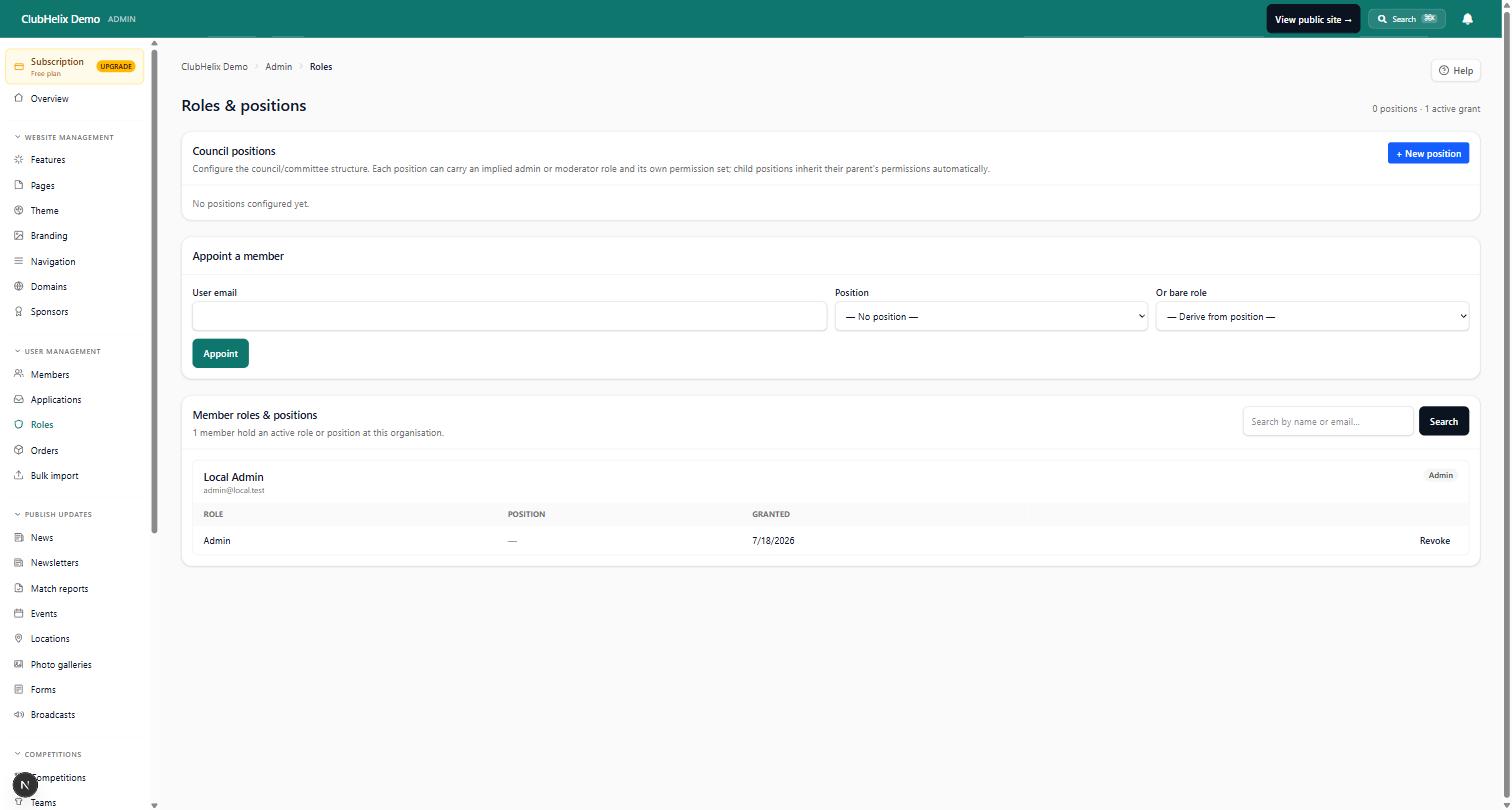
Every club that has done a bad handover has quietly promised to fix it before the next one. Doing it on a platform the club owns is the version of that promise that actually holds. The smallest tier costs nothing, every plan is listed openly on the pricing page, and you can set your club up in an afternoon — well before the next AGM makes it urgent.
Frequently asked questions
What should be in a committee induction pack?
A one-page role brief, the constitution or rules, the current committee list, the last three sets of minutes, the most recent annual report and financial statements, the current budget and year-to-date position, delegation and spending limits, the policy set, the annual calendar, annotated key contacts, a live issues memo, the systems and access list, and a short club history. Aim for something readable in about ninety minutes — a pack nobody finishes is the same as no pack at all.
How long should induction take for a new committee member?
Treat it as a 90-day arc rather than a single meeting. Access and the pack land in the first three days, the handover session and buddy introduction in the first week, orientation at the first meeting, a small finishable task at the second, and their own decision item by the third. A check-in at 30 days and again at 90 days closes it out, and the 90-day conversation is where you update the role brief to match what the job turned out to be.
Who should run the induction — the outgoing office holder or the president?
Both, doing different jobs. The outgoing holder runs the handover, because they know where everything is and what is outstanding. The president owns the induction, because it involves the culture of the committee, the authority of the role and the early check-ins. The buddy should be a third person from a different portfolio, since new people ask a peer the questions they will not ask their predecessor.
What access should a new committee member be given?
Their own account on every club system at the level their role genuinely needs, a role-based club email address, the document folders relevant to their portfolio, and whatever banking view or authority the position carries. Shared passwords should not be part of the answer. Record every grant next to the removal it will need later, and do the removals for departing members on the same day you do the additions.
How do we induct someone who joins mid-year to fill a vacancy?
Exactly the same way, compressed. Send the same pack, do the access on day one, assign a buddy, and run the 30-day check-in. The one addition is context about the vacancy itself — a mid-year appointee inherits both a role and a situation, and being told candidly why the position became vacant saves them from finding out sideways. Confirm the appointment in the minutes so the record of who holds the office is unambiguous.
Keep reading — the handover checklist covers the property side of a committee change, and the committee roles guide sets out what each office actually carries.

