
What this guide answers
- Is Jackrabbit Class suitable for a community club?
It can be, if the club is functionally a class business — paid staff, enrolment as the main revenue line, and skills progression at the centre of the parent relationship.
- How much does class management software cost?
It varies by model. Jackrabbit Class publishes pricing by student count, from US$49 per month for up to 100 students to US$245 per month at 3,001 or more, as checked on their pricing page on 24 July 2026, with a…
- What is the difference between term enrolment and membership?
Membership is an ongoing relationship with the organisation — a roll, usually a membership year, often a category and sometimes voting rights.
- How should a club handle make-up classes?
Write the policy before you choose software, not after. Decide what counts as a valid absence, how much notice is required, what window a make-up must be taken in, whether it must be the same level, and whether unused…
- Can one system handle both classes and competition squads?
Yes, if it is built around a member record rather than around a class list.
Most gymnastics, dance, swim-school and cheer organisations are two things wearing one name. On weekday afternoons they are a class business — twelve week terms, levels, fees per enrolment, waiting lists, a make-up policy and a coaching wage bill. On weekends and at the annual general meeting they are a club — members, a committee, competition squads, a constitution, insurance, volunteers, a public website and a treasurer's report.
Software vendors pick one of those and build for it. Class-business software builds for the weekday half and does it very well. Club platforms build for the weekend half and add program handling for the weekday. Both work, but they work for different organisations, and the money and the misery both flow from choosing the wrong half. This guide compares Jackrabbit Class — the best-known name in class-business management — with club-side program and term-enrolment tools, on the three things committees get caught out by: how the price scales, how enrolment and make-up sessions behave, and where a volunteer committee runs out of road.
Two disclosures. We make one of the options being compared, so read us as an interested party and check everything. And this is not a case where one product is better than the other — it is a case where the right answer is determined by what your organisation actually is. All facts here are public information current as at July 2026; pricing pages change, so verify before you commit, and let us know via contact if anything below has moved.
The question underneath the comparison
Before any feature list, answer this: are the people who walk through your door customers or members?
A customer buys a term of classes. They may love the place, but the relationship is transactional and renews term by term. They do not vote, they do not have a membership category, and when they stop enrolling, the relationship ends cleanly.
A member joins the organisation. They have a membership year, possibly a category, maybe voting rights at the annual general meeting, an entry in a roll that survives between terms, and an expectation of being communicated with about things other than classes. When they stop enrolling in a program, they are often still a member.
Plenty of organisations are honestly both. But most lean, and the lean tells you which software to buy:
| If this describes you | You lean |
|---|---|
| Paid staff run classes; enrolment is the main revenue line | Class business |
| Skills, levels and progression drive most parent conversations | Class business |
| A committee is elected annually and reports to members | Club |
| You field competition teams and affiliate with a governing body | Club |
| Volunteers run the organisation and classes are one of its activities | Club |
| Members remain members between terms and pay a membership fee | Club |
If four or more of those land on the class-business side, specialist class software will fit you better than anything a club platform can do, and no amount of loyalty to the club idea changes that.
What each option actually is
Jackrabbit Class, based in Huntersville, North Carolina, is class-business management software for gymnastics, swim schools, dance studios and cheer programs. Its scope is enrolment, billing and skills tracking — the operating system of a business that sells classes. Skills and level tracking in particular is genuine depth: recording where each student sits against a progression, which is the thing parents ask about most and the thing most general software handles poorly or not at all.
Club program and term-enrolment tools are a feature inside a broader club platform. The organisation's member roll, fees, website, communications, committee and competitions live in the same system, and programs are one of the things the club runs. Enrolment sits on the same member record as everything else, so the child in the Thursday recreational class and the gymnast in the competitive squad are one person in one system.
The scope difference is not subtle. Class software is deep on the class and does not attempt membership, competitions or governance. Club software is broad across the organisation and less deep on class-specific mechanics such as skills progression.

Per-student pricing versus a club plan
The two options do not just charge different amounts. They charge on different axes, which is what makes side-by-side comparison misleading unless you model your own numbers.
Class software is generally priced by how many students you have, because that is a fair proxy for the value a class business gets from it. As checked on jackrabbitclass.com/pricing on 24 July 2026, Jackrabbit Class charges by student count, from US$49 per month for up to 100 students, rising to US$245 per month at 3,001 or more. A branded app sits on its Plus offering, from US$93 per month with a US$169 setup fee. Those are published figures, which is more transparency than a lot of this category offers, and worth acknowledging.
Club platforms typically charge a plan price for the organisation, with programs included in the plan. The bill is driven by the plan you are on rather than by how many children enrolled this term.
The practical difference shows up as you grow. A worked example with illustrative enrolments:
| Stage of growth | Students | Per-student model | Club-plan model |
|---|---|---|---|
| Starting out | 90 | Entry tier | Free or entry plan |
| Established | 260 | A step up as you cross the band | Same plan |
| Two venues | 640 | Another step up | Same plan, possibly one step for storage |
| Regional operation | 1,800 | Near the top of the scale | Still a club plan |
Neither is wrong. If enrolment is your revenue, a bill that scales with enrolment is defensible and predictable, and you are buying depth you actually use. If classes are one activity of a club funded partly by membership fees, grants and a canteen, a bill that scales with student head count taxes the activity that carries the least margin.
One thing to model honestly before you decide: what proportion of your income actually comes from class fees? A club where classes are 80% of income should think like a business. A club where classes are 25%, membership is 30%, and the rest is competitions, grants, sponsorship and fundraising should think like a club — and should read our guide to collecting membership fees online alongside this one, because the fee structure is the actual decision.
Enrolment, waitlists and make-up sessions
This is where class-business mechanics get intricate, and where club software has to prove it is not a toy.
Four mechanics matter, in roughly this order of pain:
Enrolment into a limited class. A term class has a cap, a level, a day and a time, and a parent enrolling three children needs to do it in one transaction and pay once. If the system makes them enrol each child separately and pay three times, you will hear about it.
Waitlists. Thursday 4pm intermediate fills first, every term, everywhere. A waitlist that automatically offers the place to the next family when someone withdraws, with a time limit on the offer, saves your administrator an entire week of phone calls each term.
Make-up sessions. The hardest one. A child misses a class through illness; your policy allows a make-up in another class of the same level with space available, within the term. Every part of that sentence is a rule, and enforcing it manually is where administrators lose their evenings.
Pro-rata and mid-term joiners. A family joining in week five pays for six weeks, not ten. Whether the system calculates that or a human does is a real difference in workload.
| Mechanic | What class software is built for | What to check in club program tools |
|---|---|---|
| Multi-child enrolment | A core, everyday flow | Can one parent enrol siblings and pay once |
| Caps and levels | Native to the product | Are per-class caps and level restrictions enforced at checkout |
| Waitlists | Expected functionality | Does a withdrawal automatically offer the place onward |
| Make-up sessions | A defined policy engine | Often a manual credit — decide if that is acceptable at your size |
| Skills progression | A genuine strength | Usually not present — this is the clearest gap |
| Pro-rata joiners | Standard | Check whether it calculates or expects a manual adjustment |
Be honest about make-ups and skills tracking in particular. If your make-up policy is generous and heavily used, or if parents expect a formal skills report each term, class-business software earns its price on those two features alone. If make-ups are occasional goodwill and progression is tracked by coaches on a clipboard, you are paying for machinery you will not run.
Where a volunteer committee gets stuck
Assume for a moment that the class side fits perfectly. Here is what a volunteer committee still discovers, and it is rarely in the evaluation checklist.
- The member roll is not the student list. Life members, non-participating parents, committee members, coaches, past gymnasts who still vote — none of them enrol in a class, so none of them exist in class software. Your annual general meeting notice has to go somewhere else, from a list someone maintains separately.
- Governance leaves no trail. Committee minutes, elected positions, conflict-of-interest declarations, policy versions and the audit trail your constitution implies are club functions, not class functions. They end up in a shared drive that changes hands every November and loses something every time.
- Competition is a different world. Squad selection, entries, results, team management and the travel logistics around them are club work. Class software is not built for them and does not claim to be.
- The public website is separate. A parent portal is not a club website. Sponsors, grant assessors, new families and the local paper all form their opinion from a public site with news, photos, a committee page and contact details.
- Volunteers, not staff, do the admin. This is the deepest one. Class-business software assumes a paid administrator who uses it daily and gets good at it. A club hands it to a volunteer who touches it twice a term and hands it to a different volunteer next year. Software that rewards daily expertise punishes annual turnover — which is why handover-friendly systems matter more in a club than raw capability.
- Two systems, two truths. Once the roll lives in one place and enrolments in another, the reconciliation job appears — and it never goes to the person best placed to do it.
None of this is a criticism of class software. It is a description of the work class software was never intended to do.
Side by side
As at July 2026, from public information.
| Area | Jackrabbit Class | Club program and term-enrolment tools |
|---|---|---|
| Built for | Class businesses — gymnastics, swim school, dance, cheer | Clubs that also run programs |
| Enrolment and billing | Deep, class-business grade | Term and program enrolment on the member record |
| Skills and level tracking | A real strength | Generally not offered — the clearest gap |
| Membership roll | Not its scope | Core |
| Competitions and teams | Not its scope | Core |
| Governance and committee | Not its scope | Core |
| Public website | Not its scope | Included |
| Pricing basis | By student count, US$49–245/mo (checked 24 July 2026); branded app from US$93/mo plus US$169 setup | A club plan, programs included |
| Best suited to | Paid staff running a class business | Volunteer committees running a club with programs |
When the club is the customer
If your enrolment side is thriving and your committee side is a folder of spreadsheets, the fix is not a better class product — it is putting the club and its programs in one place. ClubHelix runs programs and term enrolment with caps, waitlists and per-term pricing on the same record as membership and self-registration, so a family enrols siblings and pays once, and the child in Thursday recreational and the gymnast in the competitive squad are one person. Around it sits the rest of a club — the public website, competitions, the committee's reports, and forms for everything from medical details to volunteer sign-ups. What we do not offer is skills and level progression tracking, so if formal skills reporting is central to your parent relationship, weigh that gap seriously.
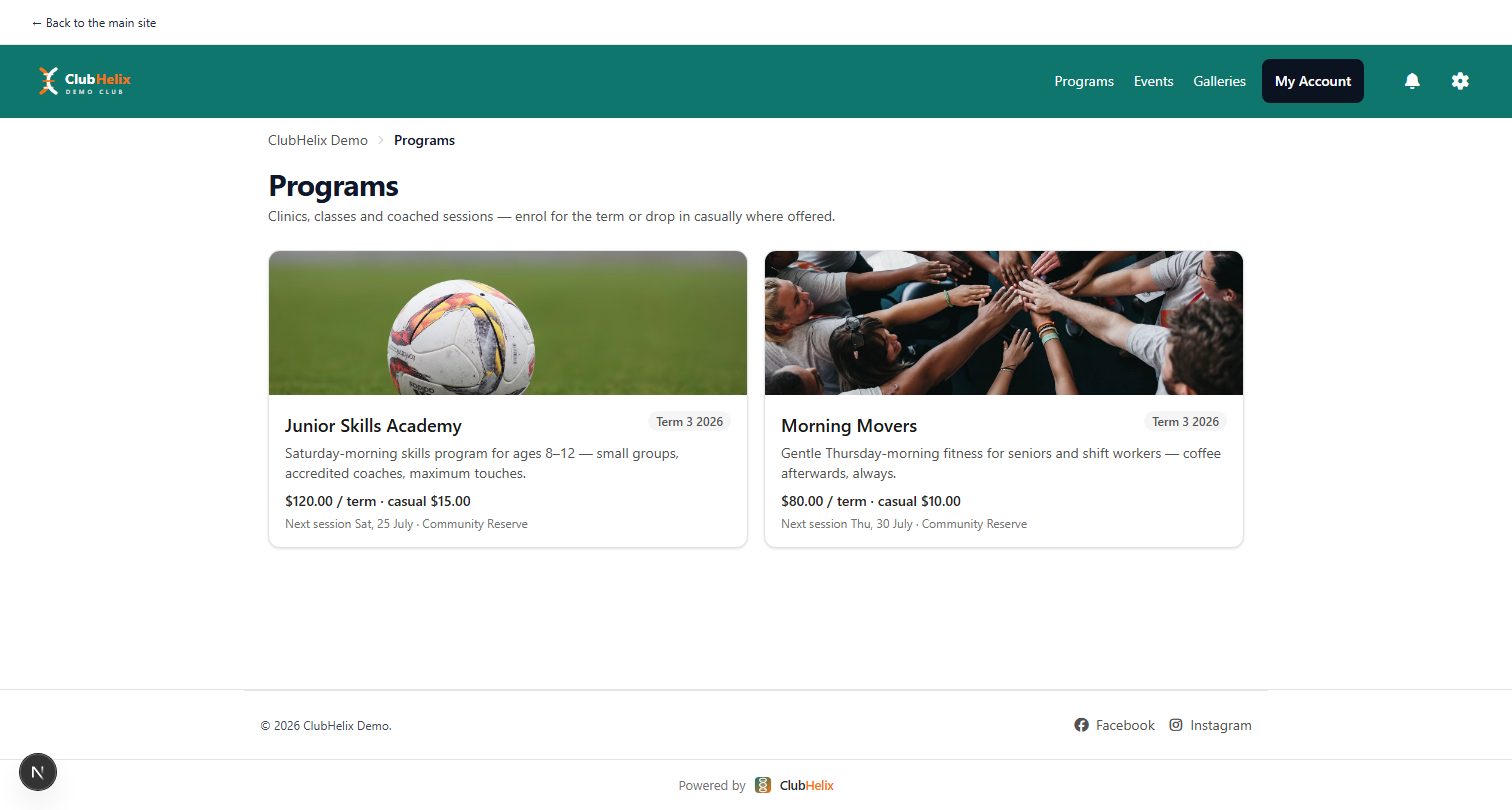
Pricing is per club and published on the site — no student-count bands, no quote to request, and a free tier to start on. The platform is Australian-built and Australian-hosted, which matters more than it sounds when you are handling children's details. See how it fits a gymnastics club or a performing arts group, or set your club up and load next term's classes this week.
Frequently asked questions
Is Jackrabbit Class suitable for a community club?
It can be, if the club is functionally a class business — paid staff, enrolment as the main revenue line, and skills progression at the centre of the parent relationship. It is not built for the club half of the job: membership rolls, committee governance, competition teams and a public website are outside its scope. Clubs that lean that way typically end up running a second system anyway, which is the outcome worth avoiding.
How much does class management software cost?
It varies by model. Jackrabbit Class publishes pricing by student count, from US$49 per month for up to 100 students to US$245 per month at 3,001 or more, as checked on their pricing page on 24 July 2026, with a branded app from US$93 per month plus a US$169 setup fee. Club platforms more commonly charge a plan price for the organisation with programs included. Model both against your own enrolment numbers before comparing headline figures.
What is the difference between term enrolment and membership?
Membership is an ongoing relationship with the organisation — a roll, usually a membership year, often a category and sometimes voting rights. Term enrolment is a purchase of a block of classes with a start date, an end date, a cap and a price. Many people are both, and the mistake to avoid is treating one as a substitute for the other, because your annual general meeting notice and your term reminder go to different lists.
How should a club handle make-up classes?
Write the policy before you choose software, not after. Decide what counts as a valid absence, how much notice is required, what window a make-up must be taken in, whether it must be the same level, and whether unused make-ups expire. Then check whether your system enforces those rules or whether an administrator will apply them by hand — that answer, not the feature list, tells you the true workload.
Can one system handle both classes and competition squads?
Yes, if it is built around a member record rather than around a class list. What to test is whether the same person can hold a term enrolment, a squad place and a membership at once without being duplicated, and whether fees for all three can be collected in one place. Systems built purely for classes tend to model a student in a class rather than a person in an organisation, which is where the duplication starts.
Worth reading next — how to run a gymnastics club covers the committee side of the same organisation, and how to start a junior program covers building the enrolment side from scratch.

