
What this guide answers
- What is a hat league in ultimate?
A hat league is a season where players register as individuals rather than as teams, and the organisers draw them into balanced sides — historically by pulling names from a hat, now almost always by rating and drafting…
- How do you make hat-league teams fair?
Collect a self-rating against published anchors, have experienced captains calibrate the obvious outliers, then band the ratings and deal each band evenly across the teams before honouring any friend requests.
- How do spirit scores work?
After each game, each captain scores the opposition across categories such as rules knowledge, fouls and body contact, fair-mindedness, attitude and communication.
- Does an ultimate club need a website when everyone is in a group chat?
Yes, for the people who are not in the chat yet. New players search for the sport in their area and either find a page with training times, costs and a join button, or they find nothing and do something else.
- How many players do you need to start a club?
Enough for a weekly pickup game is the honest answer — roughly fourteen on the field with a few spare.
UK edition. This guide is written for volunteer-run clubs in the UK. Where rules differ — grants, tax, incorporation, safeguarding — follow the UK-specific pointers below or check with your national body.
Registration for the summer hat league closed on Sunday night with ninety-six names in the spreadsheet. Eight teams have to exist by Thursday. Each one has to be balanced enough that nobody spends fourteen weeks convinced they were stitched up, and every one of those ninety-six people has a self-rating they may or may not believe, a preferred position, one mate they want to play with, and a strong opinion about last season's draft. That week — not the games — is the hardest week of the ultimate club year.
Ultimate is unusual twice over. There are no referees: players call their own fouls under Spirit of the Game, which means club culture is not a pleasant extra, it is the officiating system. And at community level the club generally invents its own competition rather than entering a draw somebody else runs. So the admin sits in places other sports never think about — rating players, drafting teams, collecting spirit scores, holding field permits across a season, and getting a travelling squad to a tournament without the treasurer fronting money nobody has paid.
This guide is for the committee of five who run all of that between jobs. It covers the layers of a healthy ultimate club, how to build hat-league teams that people re-enter next season, how to make spirit scores an actual system rather than a form nobody fills in, how to hold fields and lights, how to fund tournament travel, and how to get the whole thing off a group chat and onto something new players can find.
The five layers of an ultimate club
Most clubs run some mix of five products. Naming them separately matters, because each has a different money shape and a different volunteer load, and the classic failure is letting one layer quietly consume every hour the committee has.
| Layer | Who it is for | Who runs it | Money | Admin load |
|---|---|---|---|---|
| Pickup | Anyone, drop-in, no commitment | A roster of hosts | Free or a small casual fee | Low, but needs a host every week |
| Hat league | Social and new players | League coordinator plus captains | Entry fees — usually the club's main income | High and front-loaded |
| Club season squads | Competitive players | Squad captains and coaches | Squad levies plus travel costs | Spiky — quiet, then brutal around tournaments |
| Juniors or school program | Under-18s | Juniors coordinator plus screened volunteers | Subsidised, sometimes free | Medium, compliance-heavy |
| Masters and social mixed | Returning and older players | Social coordinator | Low fee | Low |
Write down which layers you actually run this year and who owns each one. A club with four hat-league nights and no juniors coordinator has made a choice, whether or not it has admitted it. If your committee is thin, recruiting volunteers into narrow, named jobs beats hoping the president absorbs another portfolio.
Most clubs affiliate to the national governing body, which administers the tour and league structure, university competition and the junior pathway, and which is also the usual route to insurance cover for training and fixtures. Clubs commonly run as unincorporated members' clubs or CIOs, and it is worth looking early at whether Community Amateur Sports Club status suits you, since it affects rates relief and donations.
Ratings, drafts and the art of a hat league nobody complains about
A hat league only works if the teams are close. One runaway side and half your league checks out by round four. The mechanism that gets you there is a rating system people trust, applied through a draft people can see.
Rate on what decides points, not on vibes
Ask for a self-rating on a published 1-5 scale with written anchors. Anchors are the whole trick — without them everybody rates themselves a 3.
| Rating | Anchor |
|---|---|
| 1 | First or second season. Still learning the stall count, the pivot and the sideline rules. |
| 2 | Reliable short throws under light pressure, knows the rules, plays a defined role. |
| 3 | Two-sided player. Can handle or cut, wins some matchups, rarely turns it over cheaply. |
| 4 | Controls a point. Throws long under pressure, reads defence, can carry a line. |
| 5 | Plays top-division club or representative ultimate. Changes a game on their own. |
Collect two more fields at registration and your draft gets far easier: preferred role (handler, cutter, either) and seasons played. Then run a calibration pass — the league coordinator and two or three experienced captains review the list together and adjust obvious outliers, both the modest and the optimistic. Do it privately, publish only the team lists, and say up front in the registration form that ratings may be adjusted for balance.
Three ways to actually build the teams
| Model | How it works | Time to run | Transparency | Best for |
|---|---|---|---|---|
| Captains' snake draft | Captains pick in order 1-8, then 8-1, from the full pool | Two hours | High | Leagues where captains know most players |
| Bucket balance | Split players into rating bands, deal each band evenly across teams | Thirty minutes | Medium | Big leagues and new-player-heavy seasons |
| Budget draft | Each captain gets the same spend and bids on players | Two to three hours | High | Small leagues with a strong social scene |
The hybrid most clubs land on: bucket the top band so no team collects three 5s, then let captains snake-draft the rest. You get the balance of the maths and the ownership of the draft night.
A worked draft (illustrative numbers)
Ninety-six registrations, eight teams of twelve, mixed division.
- Split registrations into the two matching-gender pools so every team can field the ratio the division uses. Deal each pool separately.
- Sort each pool by rating, then band them: 5s and 4s in band A, 3s in band B, 2s and 1s in band C.
- Deal band A across the eight teams in snake order. Record each team's running rating total.
- Honour pair requests here, capped at one pair per player and two per team. A pair costs the receiving team its next pick in the same band — that is what stops five friends colonising one side.
- Deal bands B and C, alternating the snake direction each round.
- Check the totals. If any two teams differ by more than three rating points, swap two same-band players between them and re-check.
- Give each captain one swap request, approved or refused by the coordinator, then lock it.
Publish the rules before registration opens, not after
- Late registrations join the team with the fewest players, not the team they ask for.
- Season-ending injuries are replaced from the waitlist at the same band.
- One pair request per player. Requests are honoured where possible, never guaranteed.
- No trades after round two.
- Withdrawal with a refund up to the draft; credit to the next season after that.
- A minimum number of games played to be eligible for finals, so the ring-in problem never arises.
A one-week run sheet keeps that week sane: registrations close Sunday night, ratings calibrated Monday, captains meet Tuesday, draft Wednesday, teams and fixtures published Thursday evening, first round Saturday. If you are building the fixture yourself, how to make a fixture draw covers the round-robin maths and the bye handling.

Spirit scores: turning the culture into a system
Self-officiating is the sport's best feature and its most fragile one. It holds when the club treats spirit as something it measures, publishes and acts on — and it decays quietly when spirit is a form captains fill in at midnight if they remember.
After every game, each captain scores the opposition across the standard categories. What matters administratively is less the number than the collection rate and the follow-up.
| Category | What captains are judging | A low score usually means |
|---|---|---|
| Rules knowledge and use | Do they know the rules and apply them honestly | Newer team, or a captain calling to win |
| Fouls and body contact | Physicality and how contact is handled | A mismatch in division, or one player |
| Fair-mindedness | Retracted calls, honest resolutions | Win-at-all-costs creeping in |
| Positive attitude | Self-control after a contentious call | Frustration with the draw or the division |
| Communication | Calm calls, listening, resolving on field | Nobody appointed as spirit captain |
Four practical moves make it real:
- Gate the result. Scores are not confirmed on the ladder until both captains submit their spirit score. Two seasons of that and submission stops being a problem.
- Publish a spirit ladder next to the points ladder. Visibility does most of the work.
- Appoint a spirit captain per team, separate from the playing captain. They do the pre-game introduction, run the post-game circle, and give the committee a two-line note when something needs looking at.
- Act at thresholds, not at the end of the season. Agree them in advance.
| Season average | Committee response |
|---|---|
| 9.5 and above | Name it at presentation night |
| 8.0 to 9.4 | Normal range, no action |
| 7.0 to 7.9 | Quiet word from the spirit lead to the captain, plus a look at the fixture |
| Below 7.0 | Committee meeting with the captain, game reports reviewed, sanctions on the table |
Back it with a written escalation ladder — on-field resolution, then captains, then spirit captains, then the committee, then the governing body — and a code of conduct every player accepts at registration. Our player code of conduct template is a reasonable starting point to adapt. Run a rules night before each season, publish which edition of the rules you play under, and hand new players a one-page card covering the stall count, the travel rule and how to make and contest a call. Most low spirit scores in social leagues are not bad behaviour, they are people who genuinely do not know the rule.
Fields, lights and holding a permit all season
An ultimate field is a big rectangle, and big rectangles are the most contested asset in community sport. Getting one for the same night for fourteen straight weeks is a bigger achievement than most clubs give themselves credit for.
Most clubs hire from the local authority, a school or a leisure trust, and 3G or all-weather surfaces are worth paying more for because they survive a wet winter when grass pitches close. Block bookings across a term are cheaper per hour than casual hire, but read the cancellation clause: some venues charge the full block even when they close the pitch.
Whatever your arrangement, run the same setup discipline every game night. A published run sheet turns a two-person scramble into a fifteen-minute job.
| Time | Task |
|---|---|
| T-45 | Gear out of storage, cones set for all fields, discs and bibs sorted |
| T-30 | First aid kit and water out, incident forms in the kit |
| T-20 | Captains check in, late registrations allocated, spirit cards handed out |
| T-10 | New-player briefing at the sideline — rules card, stall count, safety |
| T-0 | First pull |
| Post | Spirit circles, scores and spirit submitted, gear back, bins cleared |
Wet weather deserves a written policy rather than a group-chat argument: who decides, by what time, on what basis, how it is communicated, and whether a washed-out round is credited or absorbed. Our wet weather communication plan has a decision tree you can adapt in an afternoon.
Your season shape is dictated by daylight and drainage. Outdoor leagues run through the lighter months, indoor and turf keep the club alive through winter, and the wet-weather policy will be exercised often enough that it needs to be genuinely clear. Clubs that book an indoor slot for the dark months hold members far better than clubs that go quiet from November.
Tournament travel without a treasurer meltdown
Travel is where small clubs get financially hurt, because the money goes out in a lump long before it comes in from twenty players with different pay cycles.
| Cost line | Notes |
|---|---|
| Tournament entry | Usually per team, due early, rarely refundable |
| Transport | Vans, fuel, tolls, or flights and baggage for a discs-and-kit squad |
| Accommodation | Book for the roster you have collected money from, not the roster you hope for |
| Kit | Two jerseys per player, light and dark, plus spares |
| Medical | Taping, ice, a stocked kit, and a physio if the event does not provide one |
| Contingency | Ten per cent, held by the treasurer, unspent by default |
The rule that prevents every travel disaster: the club never commits money it has not collected, unless the committee has voted an explicit subsidy from a named budget line. Enforce it with a deposit ladder published at selection.
| Milestone | Payment |
|---|---|
| Squad selection | Non-refundable deposit — covers entry share |
| Six weeks out | Second instalment — covers accommodation |
| Two weeks out | Balance, including kit |
| After the balance date | Player is replaced from the standby list |
Alongside the money, hold the roster properly: emergency contacts, dietary needs, medical notes, signed waivers, and a check that everyone's membership and insurance is current. Collect it once at registration rather than chasing it the week of the tournament.
Most tournaments are driveable, so vans, fuel and a shared house are the cost base, and the per-player number in pounds is usually modest compared with flying squads elsewhere. That makes travel the easiest thing to under-plan. Set the deposit ladder anyway, because a van booked for fourteen and filled by nine is still a bill the club has to absorb.
Fees and the money shape
Ultimate clubs habitually undercharge, partly because the sport's culture is generous and partly because the committee is embarrassed to ask. The fix is transparency rather than austerity: publish what each fee covers, and the resistance largely disappears.
| Fee line | Covers |
|---|---|
| Annual membership | Affiliation and insurance, club overheads, gear replacement |
| Hat league entry | Field hire for the season, discs, bibs, finals night |
| Casual pickup | Marginal field cost only — deliberately low as a recruiting tool |
| Squad levy | Entry fees, coaching, kit, travel contribution |
| Junior program | Subsidised, usually the club's investment rather than income |
Three habits worth adopting. Charge concession rates through a published discount code rather than case-by-case negotiations, so nobody has to ask for a favour. Sell discs and jerseys at a small margin — an ultimate club is one of the few where merchandise genuinely moves, because everyone needs a disc. And be realistic about sponsorship: local businesses buy visibility, and a sport played on a suburban rectangle offers little of it, so pitch participation and community programs instead of signage.
Communication when the whole sport lives in a group chat
Ultimate runs on messaging apps, and that works right up until it does not. Fixtures scroll away. A new player who found you through a search cannot see when you train. Nobody can find last season's constitution, the waiver, or the rules night slides. And when the chat admin moves cities, the club's institutional memory goes with them.
The pattern that works is simple: the chat stays for banter and the last-minute stuff, and everything durable lives on a site with an address. Fixtures, teams and ladders published where they can be linked. A join page that takes payment. The wet-weather call sent as a push notification and an SMS at the same moment it goes to the chat, so people who are not in the chat still get it. And an events page for pickup, so "when is pickup" has one answer.
That also solves discoverability. People search for the sport in their suburb, find nothing, and never turn up — the club that ranks for its own name plus its city gets the walk-ins. Team rosters, session RSVPs and attendance tracking then give you something you can actually use in a grant application, which is a much better argument than a screenshot of a chat thread.
Running the season from one place
Everything above is admin: registrations and ratings collected, teams drafted and published, fixtures and ladders maintained, spirit scores gathered, pickup RSVPs counted, wet-weather calls pushed out, travel deposits tracked. ClubHelix does that work on a club website you control — competitions with fixtures, ladders and finals, team management for squads and hat-league sides, online registration with payments so the league fills without a bank-transfer chase, and RSVPs and attendance for pickup and training. The ultimate frisbee club management software page shows how a league and its pickup nights sit on it.
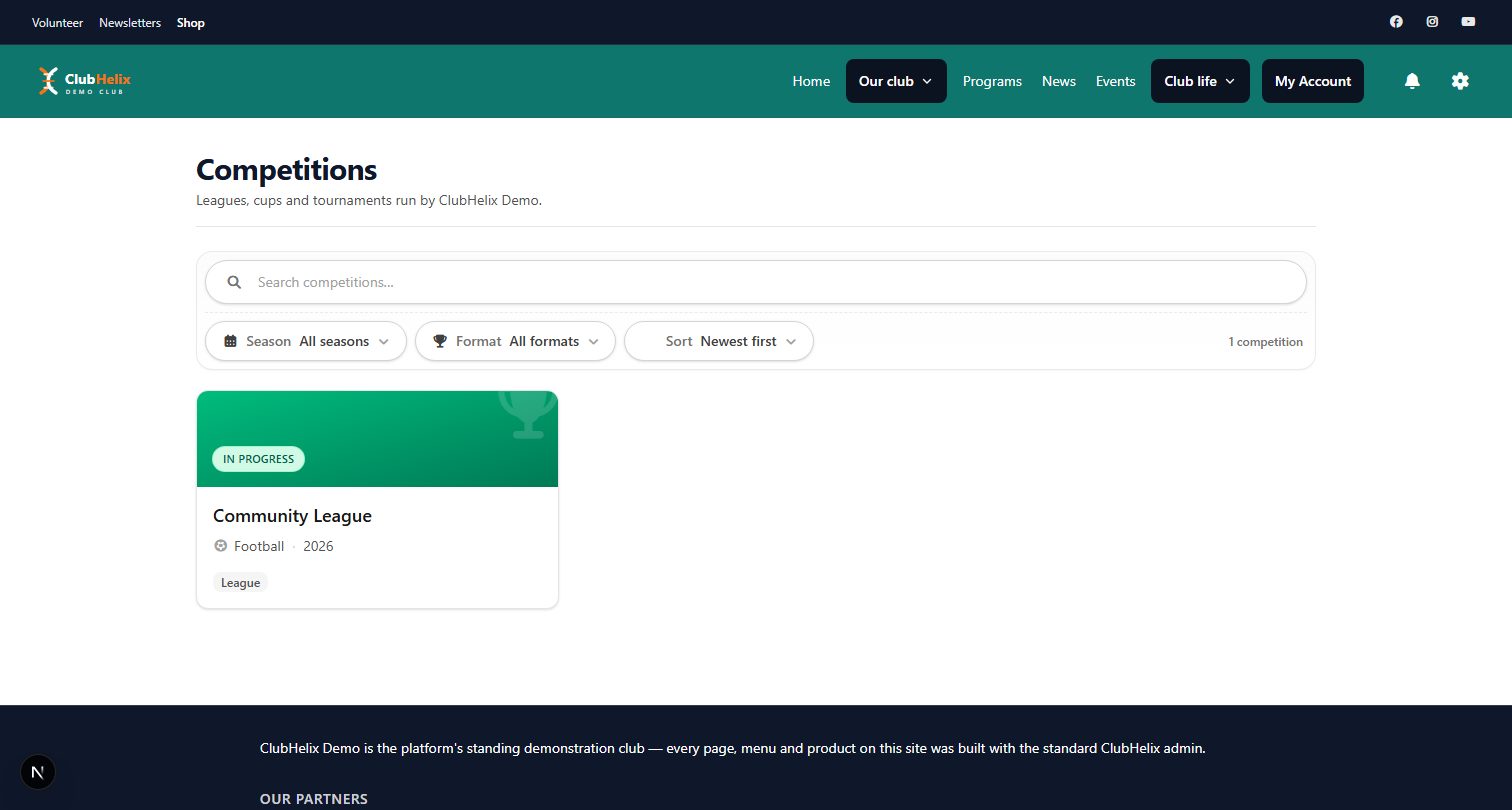
Start on the free tier — it is enough for a club running one hat league and a pickup night — and you will have somewhere for registrations, ratings and pair requests to land before the next draft week arrives. Every tier above it is set out on one pricing page, and if nobody on the committee wants to be the person who builds the site, our done-for-you setup will do it instead. Start your club site now and by next season the spirit ladder will be keeping itself.
Frequently asked questions
What is a hat league in ultimate?
A hat league is a season where players register as individuals rather than as teams, and the organisers draw them into balanced sides — historically by pulling names from a hat, now almost always by rating and drafting them. It is the main social product of most community ultimate clubs, because it lets a complete beginner and a representative player end up on the same side without either having a bad time.
How do you make hat-league teams fair?
Collect a self-rating against published anchors, have experienced captains calibrate the obvious outliers, then band the ratings and deal each band evenly across the teams before honouring any friend requests. Publish the team lists and the rules you used. Fairness in a hat league is as much about visible process as it is about the maths.
How do spirit scores work?
After each game, each captain scores the opposition across categories such as rules knowledge, fouls and body contact, fair-mindedness, attitude and communication. The scores are averaged over a season and usually published alongside the ladder. They only work if the club collects them reliably and acts on low scores early, rather than reading them at the end of the year.
Does an ultimate club need a website when everyone is in a group chat?
Yes, for the people who are not in the chat yet. New players search for the sport in their area and either find a page with training times, costs and a join button, or they find nothing and do something else. A site also keeps fixtures, ladders, waivers and policies somewhere permanent when a committee changes over.
How many players do you need to start a club?
Enough for a weekly pickup game is the honest answer — roughly fourteen on the field with a few spare. From there the usual progression is a regular pickup night, then a short hat league of four teams, then squads that travel. Trying to run a competitive squad before a reliable pickup night exists is the most common way new clubs burn out their founders.
Keep reading: how to run a touch football club for the referee and wet-weather side of a self-organised competition, and how to run a club registration day for the week your season actually begins.


