
What this guide answers
- How many referees does a touch competition need?
Every game needs officials, so a comp with four fields and three timeslots needs 12 or more referee slots covered weekly.
- When should we make the wet-weather call?
Set a fixed decision time — commonly 4pm for a twilight comp — name who makes the call, and publish it to the website, email and SMS simultaneously.
- How do mixed divisions work?
Mixed touch requires a minimum number of each gender on the field at all times, with the exact split set by your competition rules.
- What should a touch football club website include?
Comp nights, divisions and pricing, nomination dates with an obvious nominate button, the live draw, results and ladders, wet-weather status on game day, and referee sign-up details.
Touch football's accessibility is the whole point — mixed teams, minimal gear, everyone from teenagers to over-50s on the same fields — and it's why touch competitions grow faster than almost any other community sport.
It is the great social sport of the Australian summer evening: workmates, families and mates' teams jogging onto ovals at twilight, three or four games deep on a Tuesday night, sausages on the barbecue by the canteen. Your competition almost certainly already exists and is probably oversubscribed — the committee's job is running it well, not building demand.
But the things that make touch easy to play make it demanding to run. A twilight competition is a weekly logistics operation: dozens of teams, fields to mark, lights to switch on, referees to cover every game, wet-weather calls to make by 4pm, and two season cycles a year instead of one. This guide covers how to run a touch football club (or the competition itself) across all of it — affiliation, nominations, referees, fields, fees, communication and the online presence that keeps the draw full.
Getting set up: affiliation and how touch is organised
Touch football sits in a slightly unusual structure: local clubs and associations run their own competitions, affiliated with state and national governing bodies. Your club might be a team-entering club (nominating teams into someone else's comp) or a competition-running club (owning the venue, draw and referees yourself). Many are both. Affiliation gets you insurance cover arranged through the governing body, sanctioned referee accreditation, representative pathways, and the rulebook everyone plays to.
If you run the competition, your other foundational relationship is with the council: an allocation for the ovals, lighting access and payment arrangements, and clarity about who marks the fields. If your club is new, consider incorporating as an association so it can sign that allocation, hold a bank account and apply for grants in its own name — requirements vary by state, so start with your regulator, for example NSW Fair Trading.
This is general information, not legal or financial advice — check the current requirements with the official body linked above.
Two seasons, twilight timeslots: planning the touch year
Most touch comps run two seasons a year — typically two series with a break between them — with each cycle needing its own nominations, grading and draw. That double cycle is a blessing (two recruitment windows, two grand finals) and a workload (everything happens twice).
| Phase | When (typical) | What has to happen |
|---|---|---|
| Nominations open | 6–8 weeks pre-season | Team nomination forms, division choices, early-bird pricing |
| Grading rounds | Weeks 1–2 | Sort A/B/C divisions in men's, women's and mixed |
| Regular season | 8–12 weeks, one night per week | Draw published, referees rostered, canteen open |
| Finals | Last 2 weeks | Qualification rules enforced, extra referees, biggest canteen night |
| Off-season gap | 2–6 weeks | Ground rest, presentation night, next cycle's nominations |
Twilight timeslots (roughly 6pm–9pm) are touch's signature and its pinch point: three timeslots across four fields caps your comp at 24 teams a night, so field count and lighting determine growth. Publishing the draw early and keeping it stable matters more in touch than in weekend sports — players are coming straight from work, arranging kids around a 6:20pm game. Build the draw properly (our guide on how to make a fixture draw covers the round-robin mechanics) and push any change loudly the moment it happens.
Team nominations, mixed divisions and registration
Touch registration runs through teams: a captain nominates "the team", picks a division — men's, women's or mixed, graded A to C, plus juniors, seniors/masters where numbers allow — and then every player must individually register for insurance and eligibility. Chasing fourteen individual registrations per team is the classic touch admin headache.
Solve it with self-service: captains nominate and pay (or split payment) online, each player completes their own online registration from a link the captain shares, and the club sees exactly which teams are complete and which players are missing. Mixed divisions need their gender-on-field rules stated up front on the nomination form, and finals eligibility (a minimum number of regular-season games played) should be published at nomination time, not discovered in week eleven. A well-run registration day at the venue in the pre-season window still earns its keep for scooping up new and social teams.
Referee coverage: the make-or-break of every touch comp
Nothing determines a touch competition's quality — or its reputation — like referee coverage. Every game needs officials; a comp running four fields across three timeslots needs a dozen-plus referee slots filled every single week. There are three ways clubs cover it, and healthy comps use all three:
- A paid referee squad. Accredited referees paid per game, coordinated by a referee director. Reliable, professional, and worth every dollar for A-grade and finals.
- Duty-referee obligations. Each team owes referee duties across the season — commonly refereeing a game in the timeslot before or after their own. Enforce it with a published roster and a forfeit-of-points penalty for no-shows, or it collapses by round three.
- Growing your own. Subsidise governing-body accreditation courses each season, target teenagers and parents, and pay junior referees promptly — it's many kids' first job, and clubs that treat them well keep them for a decade.
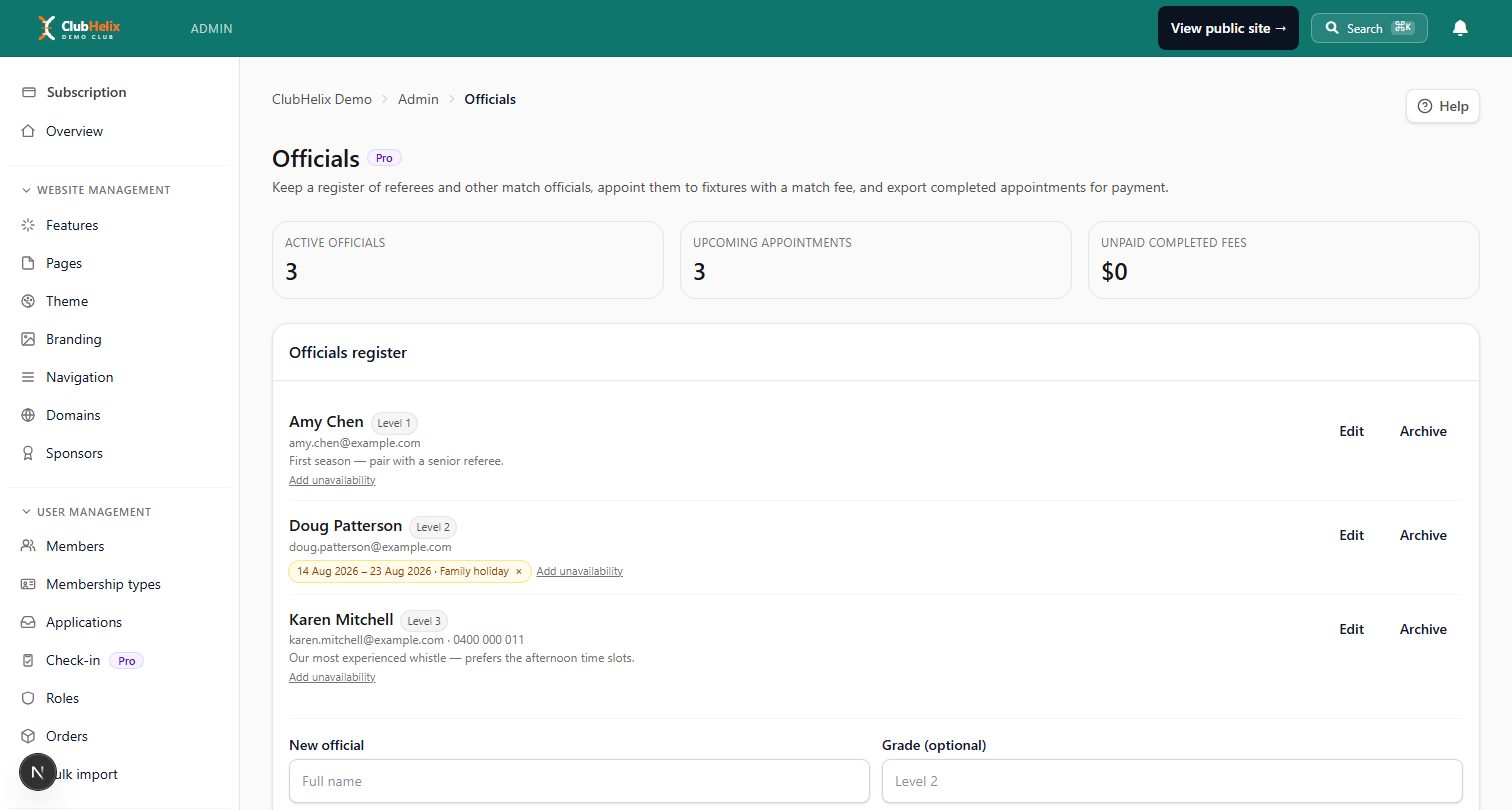
Rostering officials through a proper match officials tool — allocations by field and timeslot, visible to every referee and captain — replaces the whiteboard-and-group-chat scramble that burns out referee directors.
Game night: fields, lights, canteen and the wet-weather call
A twilight comp lives on a tight weekly routine. Fields marked (touch fields fit sideways on football ovals — a line-marking trailer and a laminated measurements card make it a 90-minute job), lights booked and switched, scorecards or an app ready at each field, and the canteen and barbecue rolling from the first timeslot — on a three-timeslot night the barbecue is both your community heart and one of your best earners.

Then there's the 4pm problem: summer storms. A touch club needs a wet-weather protocol that names who inspects the grounds, who makes the call, by what time, and exactly where the decision is published — because 300 players are leaving work based on it. One announcement pushed to the website, email and SMS at the same moment beats rumours in fourteen team chats. Our wet-weather communication plan guide has a ready-to-adopt template, and captains tracking their own team's availability each week through RSVPs saves the 5:45pm "who's actually coming?" panic.
Money, fees and fundraising
Touch's money model is straightforward: team nomination fees plus individual registrations in; ground and lighting hire, insurance and affiliation, referee payments, balls and bibs, and finals trophies out. Price the team fee so a full squad splits it painlessly, offer early-bird nomination discounts to smooth your cash flow, and keep the canteen cashless and simple — cold drinks, sausage sandwiches and icy poles outsell everything fancy on a hot night.
Sponsorship suits touch's audience of young working adults: a local physio sponsoring the comp name, field-side signage under lights, or a sponsor's voucher for player-of-the-final. Presentation night — both cycles combined, at the clubrooms or a local venue — is your flagship social event and a natural fundraiser.
Your touch football club online
Touch teams form around a link. Someone at work says "we should enter a team", and whoever googles the comp needs to land on a page that answers everything: which nights, which divisions, what it costs per team, when nominations close, and a big obvious nominate button. If that page is out of date, the team enters a different comp — twilight sport is a competitive market.
A touch football club website should also carry the live draw, results and ladders for every division, the wet-weather status front and centre on game day, and referee sign-up information. Touch football club management software that runs nominations, registrations, fixtures, ladders and payments behind the same website means the draw you publish is always the real draw. See how touch clubs and comps set it up on our touch football club management software page.
If your committee is reffing the admin as well as the games, ClubHelix handles the lot — team nominations and player registration, fixtures and ladders, referee rosters, one-hit email and SMS for wet-weather calls, and a professional website — with a free tier to start on. See pricing or set up your club before nominations open.
Frequently asked questions
How many referees does a touch competition need?
Every game needs officials, so a comp with four fields and three timeslots needs 12 or more referee slots covered weekly. Healthy comps combine a paid accredited squad, enforced team duty-referee obligations and a steady pipeline of newly accredited teenagers and parents.
When should we make the wet-weather call?
Set a fixed decision time — commonly 4pm for a twilight comp — name who makes the call, and publish it to the website, email and SMS simultaneously. Players are leaving work based on your announcement, so one loud official channel beats many quiet ones.
How do mixed divisions work?
Mixed touch requires a minimum number of each gender on the field at all times, with the exact split set by your competition rules. State the rule on the nomination form so captains build compliant squads from the start.
What should a touch football club website include?
Comp nights, divisions and pricing, nomination dates with an obvious nominate button, the live draw, results and ladders, wet-weather status on game day, and referee sign-up details. Keeping it connected to your competition system means it never drifts out of date.


