
What this guide answers
- What does an equestrian club need to run its own competition day?
Grounds prepared and hazard-walked, arenas set and dragged, insurance and affiliation current, judges and officials booked and confirmed in writing, entries closed and a draw published, a gear-check station, scoring…
- How should a riding club handle entries?
Online, with payment taken at the point of entry, opening about four weeks out and closing firmly a week before.
- Who is responsible for gear checks and welfare at a competition?
The club running the event is responsible for the environment, and the specific gear, headgear and eligibility standards come from your affiliation and event rules rather than from the committee's preference.
- How much of a club's income comes from competition days?
For most clubs, entry fees plus the canteen make up the largest share of annual income, well ahead of membership subscriptions, with sponsorship and grounds hire behind them.
- How should a club handle a scoring protest?
Publish the process in the schedule before entries open — who receives a protest, in what form, within what time of the class being posted, and who decides it.
Ireland edition. This guide is written for volunteer-run clubs in Ireland. Where rules differ — grants, tax, incorporation, safeguarding — follow the Ireland-specific pointers below or check with your national body.
At half past five on the morning of a competition day, an adult riding club stops looking like a club and starts looking like a small business. Someone is dragging the arena. Someone else is putting out the judge's car space, the timing gear and the running order board. A float is already reversing through the gate because the driver would rather be three hours early than late, the canteen urn has not boiled, and the first question of the day is not about horses at all — it is whether the ground behind the top arena will take twenty vehicles after Thursday's rain.
That is the honest shape of an adult riding club. It is three enterprises wearing one committee. It is a venue operator, responsible for arenas, fencing, water, yards and parking. It is an event promoter, running competition days for entrants who are often not members and who have paid to be there. And underneath both it is a member club, with a training calendar, a social life and a duty of care to every horse and rider on the property. Most clubs run into trouble because they staff the third role and improvise the first two.
This guide is written for committees running adult riding, dressage, show jumping, eventing or general equestrian clubs — the ones that hold their own grounds or hire them, and run their own competition calendar. It covers the maintenance roster that keeps the grounds usable, how to run a competition day from entries through to results, and welfare, gear checks and incident reporting at an event where a large proportion of the horses on site belong to people you have never met. If your club is a junior instructional one built around rallies and certificates, how to run a pony club is the closer fit and covers that model in depth.
Three enterprises, one committee
Naming the three roles changes how you staff the club. A committee that lists a president, secretary and treasurer and then hopes for the best will run out of people by the third competition day. A committee that assigns each enterprise an owner survives the season.
| Enterprise | What it actually involves | The role that must exist |
|---|---|---|
| Venue operator | Arena surfaces, fencing, water, yards, parking, machinery, buildings, hazards | Grounds coordinator |
| Event promoter | Calendar, entries, classes, judges, scoring, canteen, sponsors, prizes | Events coordinator |
| Member club | Membership, training days, clinics, coaching, social, communications | Membership and training officer |
| Underneath all three | Insurance, welfare, incidents, risk assessments, records | Safety and welfare officer |
The fourth line is the one clubs most often leave unfilled, and it is the one that matters most on the day something goes wrong. It does not need to be a large job — it needs to be a named person who owns the risk assessment, the incident book, the emergency plan and the gear-check standard, and who is not simultaneously running the canteen.
Most clubs here affiliate to a national body through a regional structure, which sets competition eligibility and provides the insurance most grounds owners will ask to see. Clubs commonly run as unincorporated clubs or as companies limited by guarantee registered with the CRO once there is a lease or serious money involved. Get the written constitution and members' register in place before applying for any grounds funding.
Grounds, arenas, yards and the maintenance roster
Your grounds are your product, your largest liability and your biggest recurring cost. The clubs that manage them well do not work harder — they work to a written schedule, so that the jobs which only matter cumulatively actually get done.
Build a single maintenance register listing every asset, the task, the frequency and the owner. Publish it, and put the next four weeks of it on the noticeboard.
| Asset | Task | Frequency | Owner |
|---|---|---|---|
| Competition arena | Drag or harrow, level, check depth and edges | Before every use | Grounds coordinator |
| Competition arena | Top-up surface material, check drainage, repair scour lines | Annually, plus after heavy rain | Grounds coordinator |
| Warm-up arena | Drag, check for holes at gate and corners | Before every use | Duty roster |
| Jumps and equipment | Inspect for splinters, cracked cups, damaged wings, missing pins | Monthly and pre-event | Equipment officer |
| Dressage arena | Boards straight, markers present and correct, judge's box safe | Pre-event | Events coordinator |
| Fencing | Walk full boundary, check for wire, protruding nails, loose rails | Monthly | Duty roster |
| Yards and stables | Muck out, check latches, water, matting, mesh | After every use | User plus duty roster |
| Water troughs | Clean, check float valves, confirm flow | Weekly | Duty roster |
| Manure management | Move to pad, arrange removal or composting | Per agreed cycle | Grounds coordinator |
| Weeds and pasture | Inspect for toxic plants, spray or pull, rest paddocks | Monthly in growing season | Grounds coordinator |
| Machinery | Service tractor and drag, check tyres, log hours | Per service schedule | Grounds coordinator |
| Parking and access | Grade tracks, mark float parking, check gate hinges | Quarterly and pre-event | Grounds coordinator |
Four things distinguish the clubs whose grounds hold up:
- Someone owns the surface, not just the mowing. Arena footing is an engineered thing — depth, material, moisture and drainage. Know what yours is made of, how deep it should be, and what it costs to top up, and set money aside annually rather than discovering the answer when it becomes unrideable.
- A closure rule that is written down and applied without debate. Decide in advance what conditions close the arenas, who makes the call, and by when it is communicated. A club that rides a saturated arena once will spend three months repairing it.
- Working bees are scheduled, specific and short. "Working bee Sunday" gets six people. "Sunday 8-11am, fence line from the top gate to the creek, bring a hammer, morning tea provided" gets twenty. How to organise a working bee covers running them well.
- The hazard walk before every event. One person, a clipboard, the whole site, an hour before the first entrant arrives. It takes twenty minutes and it is the cheapest risk control you own.
If your grounds sit idle midweek, they are also an income line. Arena hire to non-members, coach hire for lessons, clinic days and float parking all turn a fixed cost into revenue — and taking those bookings online with payment attached, through something like facility and arena booking, removes the phone tag that otherwise stops the idea before it starts.

Running a competition day
A competition day is a production with a fixed start, an unmovable finish and a hundred moving parts. Run it as a sequence of deadlines rather than a single day of effort.
Entries and the draw
Open entries online, with payment, at least four weeks out and close them firmly a week before. Late entries are where a well-run day comes apart: they break the draw, they arrive unpaid, and they land on the one volunteer who was supposed to be doing something else. If you accept them, charge a late fee, cap them, and close absolutely at a stated hour.
Capture everything you need in the entry form itself, so nobody is chasing paperwork on the morning: rider name and contact, horse name and identification, membership or registration number, class selections, grade or level, emergency contact, any current vaccination or health documentation your rules require, and acceptance of the club's conditions of entry. An online entry form with conditional fields means a competitor entering two classes sees two sets of questions and nothing else.
Publish the draw and running order two or three days out on your club website, not only in a social post. Entrants plan their travel around it, and a draw that is only findable in one platform's feed will be missed by somebody.
Classes and the program
Design the class list around who actually enters. Most clubs run a spread that lets a green horse, a returning adult rider and a serious competitor all have a productive day:
| Class type | Purpose | Practical notes |
|---|---|---|
| Introductory | First-timers, young or green horses | Keep it genuinely low-key, allow a support person |
| Graded classes | The core of the day, by level or height | State the grading rule clearly on the schedule |
| Championship class | Top of the day, decided from graded results | Publish qualification rules before entries open |
| Non-competitive | Clear round, arena familiarisation, training | Often the most popular and least stressful line item |
| Combined or series | Points across multiple days towards a trophy | Needs a published points table and one keeper of it |
Two scheduling rules save the day itself. Build in a real break — a scheduled hour when the arena is dragged, judges eat and the timetable resets — because a day that runs late from mid-morning stays late until dark. And publish approximate class start times rather than a rigid clock, with a stated policy that classes will not start early. That single sentence prevents the most common competitor complaint at a small show.
Judges and officials
Book judges early, in writing, and confirm the week before. Your confirmation should cover the date and times, discipline and levels, the fee or honorarium and travel arrangement, meals, whether a writer or penciller is provided, and the parking and arrival instructions. Keep a judges and officials register with contact details, accreditation levels and expiry dates so you are not reconstructing it each season.
On the day, the officials your event needs will typically include a judge per arena with a writer, a steward or ring master, a gear checker, a scorer, an announcer, a first aid provider and — for jumping — course builders and a course designer. Some of those roles carry accreditation requirements set by your affiliation, so confirm what your competition level requires rather than assuming a willing volunteer can fill it. Rostering them in advance through a volunteer roster with reminders is far more reliable than a group chat on the Friday.
Scoring and results
Scoring is a small system that deserves a named owner and a spare. Whether you score on paper or on a tablet, the principles hold: one person enters, a second checks, scores are posted publicly as each class finishes rather than all at the end, and the original sheets are retained until the protest window closes. Publish a protest process in the schedule — who receives it, in what form, within what time, and who decides. Post final results on your club website the same evening, because that is what entrants share, what sponsors see, and what tells next month's competitors your day is worth entering.
Welfare, gear checks and the incident book
A competition day is materially different from a members' training day, because a large share of the horses and riders on site are not yours. You have not seen the horse before, you do not know the rider's experience, and you are nonetheless responsible for the safety of the environment they are in. Treat the following as general information — the specific standards for gear, headgear, vaccination and competition eligibility are set by your affiliation and by your event rules, and they are revised, so work from the current published version and take advice where you are unsure.
Gear check as a stewarding function. At a members' day, gear check is coaching. At a public competition, it is a control. Set it up as a defined station that every competitor passes through before entering the arena, staffed by a named checker, working from a printed checklist derived from your governing body's rules. Cover headgear standard and condition, footwear, body protectors where required for the discipline, bit and bridle legality, spurs and whips, saddle fit and girth condition, and boots or bandages permitted for that class. Give the checker explicit authority to refuse entry to the arena and explicit backing from the committee when they use it.
Welfare on site. Publish your welfare expectations in the conditions of entry and enforce them consistently: no horse left tied to a float unattended in the heat, shade and water available, a clear rule on when a horse is withdrawn, and a named welfare officer who can direct a rider to stop. Have a vet and a farrier contactable and their numbers printed on the day sheet, and know in advance where the nearest equine hospital is and how a horse ambulance would get onto your site.
The incident book. Every fall, injury, near-miss, loose horse, vehicle incident and welfare concern gets written up on the day, on the same form, whether or not anyone was hurt. Record who, when, where, what happened, what was done, who was notified and what follow-up is required. Review the register at every committee meeting. Two reasons: your insurer and your affiliation will ask for it if a claim ever arises, and the pattern in it — the same corner, the same gateway, the same class — is invisible until it is written down. Our incident report form template gives you a workable form, and incident reporting built into your club admin keeps the register in one searchable place instead of a folder in the clubhouse.
Equine identification documentation and current influenza vaccination records are routinely required at affiliated competitions here, and organisers are generally expected to check them at the gate. Put the requirement in the schedule and conditions of entry so nobody arrives without it, build gate time into the timetable, and confirm current requirements with your governing body and the relevant agriculture authority each season.
Where the money actually comes from
An equestrian club's finances look unusual next to a field-sport club, because a competition day can turn over a meaningful sum in a single Saturday while the members-only side of the club barely breaks even. Understand the shape before you set fees.
| Income line | Character | Notes |
|---|---|---|
| Membership subscriptions | Steady, modest | Covers affiliation, insurance and core admin, rarely more |
| Competition entry fees | Largest single line for most clubs | Per class, plus a ground or administration fee per horse |
| Canteen and bar | High margin, volunteer-intensive | Often the difference between a break-even day and a good one |
| Arena and grounds hire | Underused, low effort | Midweek hire, coach hire, clinics, float parking |
| Clinics and training days | Moderate margin, strong for retention | Book the coach on a guaranteed minimum, not a maybe |
| Sponsorship | Lumpy, relationship-driven | Class sponsorship, arena signage, rug and ribbon sponsors |
| Grants | Capital, not operating | Arena surfaces, fencing, lighting, yards, accessible toilets |
The cost side is dominated by grounds maintenance and machinery, insurance and affiliation, judges and officials, ribbons and trophies, and utilities. Two habits keep it healthy. Cost each competition day separately, including judges, ribbons, first aid and the arena preparation, so you know which days in your calendar actually make money and which you are running for love. And run a sinking fund for the arena surface — it is the single largest predictable expense a club faces, and the clubs that handle it calmly are the ones that started putting money aside years earlier.
Entry fees for a club-level day here are usually a modest per-class figure in euro plus a ground fee per horse, with affiliated classes costing more. Local sponsorship comes from feed and agricultural merchants, saddleries, transport operators and veterinary practices, and sponsoring a class or a championship rug for a low three-figure amount is an easy first conversation.
Volunteers, and the members who never enter a class
Competition days are won and lost on the roster. The pattern every club knows is that eight people set up at dawn, thirty enjoy the day, and four are still pulling up dressage boards at six o'clock. Fix it structurally rather than by asking harder.
Roster by named shift, with a start time and an end time, and publish the roster a fortnight out. Split the day into blocks — setup, morning arena, morning canteen, lunch reset, afternoon arena, afternoon canteen, pack-down — and let people claim a block rather than "the day". Build the pack-down block into the entry conditions for members who compete, so it is understood rather than negotiated. And feed your volunteers properly; it costs very little and it is remembered.
The other structural issue is the membership itself. In most riding clubs a substantial share of members never enter a competition. They joined for the grounds, the training, the company and somewhere safe to ride. If your entire calendar is competition days, those members quietly lapse. Give them their own program: monthly clinics with a booked coach, a social trail ride, arena hire evenings, a beginner adult returning-to-riding series, and non-competitive clear-round or arena familiarisation options inside your competition days. Ask them once a year what they want — the answer is rarely what the committee assumes.
Running the whole showground from one place
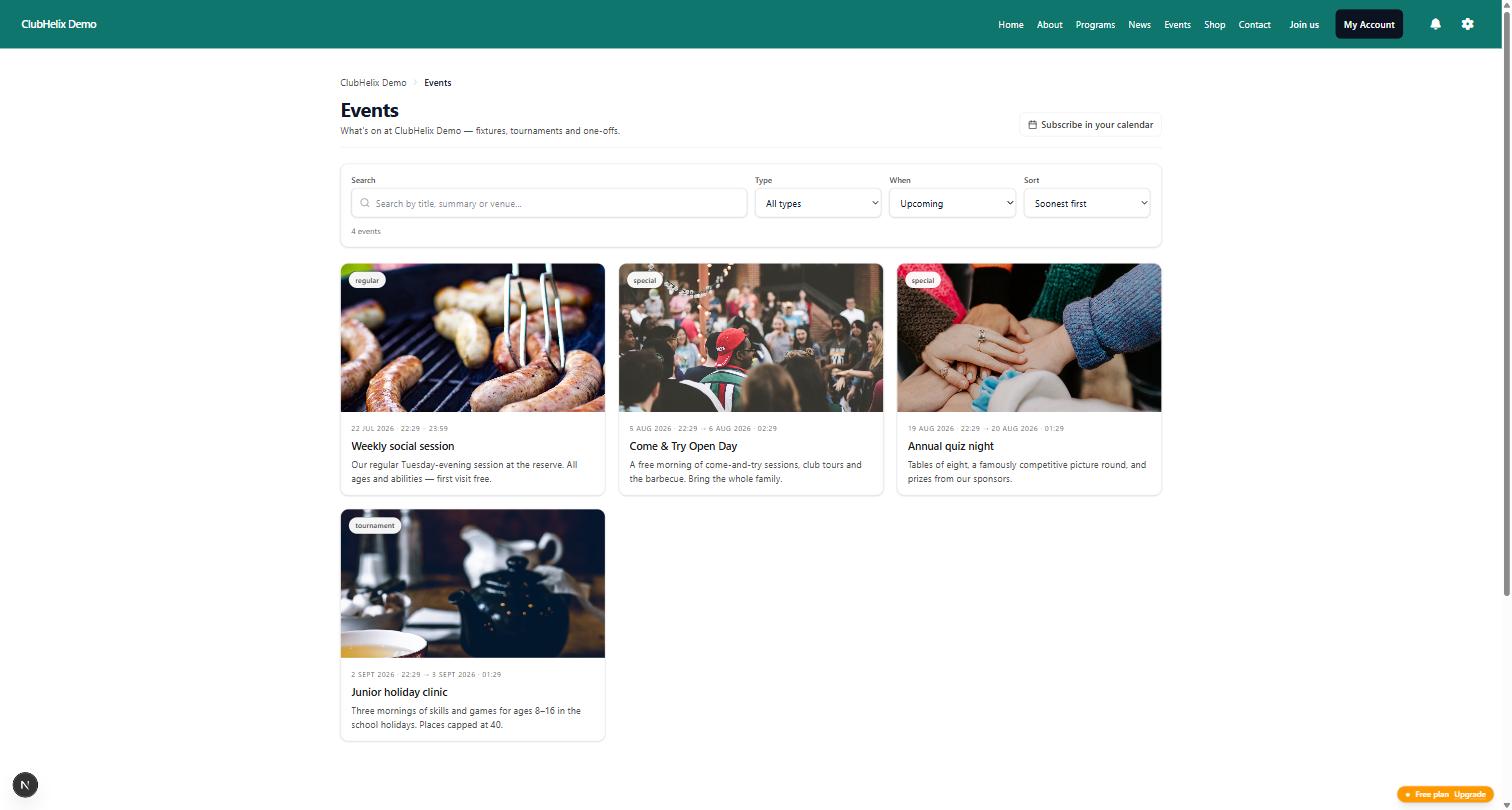
Between entries, class lists, draws, results, arena bookings, membership renewals, judge contacts, volunteer rosters and the incident register, an equestrian club generates more paperwork per member than almost any other kind of club — and most of it currently lives in a spreadsheet, an inbox and a folder in the clubhouse. ClubHelix brings it onto one club website: events and online entries with payment taken at entry and a published program, arena and facility booking so midweek hire runs itself, forms with conditional fields for entry declarations and clinic sign-ups, and incident reporting that keeps the register searchable and in one place. The equestrian solutions page walks through the same setup from a riding club's point of view.
The pricing is published in full, and there is a free tier that will comfortably carry a small club's website and membership list. If your entries currently arrive as bank transfers with a name in the reference field, this is the change that gives your secretary their Saturday nights back — create your club site and put your next competition day's entries online.
Frequently asked questions
What does an equestrian club need to run its own competition day?
Grounds prepared and hazard-walked, arenas set and dragged, insurance and affiliation current, judges and officials booked and confirmed in writing, entries closed and a draw published, a gear-check station, scoring with a named owner and a checker, first aid on site, a canteen, a volunteer roster by shift, and an incident process. The published schedule and conditions of entry should state your documentation requirements and your protest process.
How should a riding club handle entries?
Online, with payment taken at the point of entry, opening about four weeks out and closing firmly a week before. Capture rider and horse details, registration or membership numbers, class selections, emergency contact, required health documentation and acceptance of the conditions of entry in one form. Publish the draw and running order two or three days ahead on the club website so competitors can plan travel.
Who is responsible for gear checks and welfare at a competition?
The club running the event is responsible for the environment, and the specific gear, headgear and eligibility standards come from your affiliation and event rules rather than from the committee's preference. Run gear check as a staffed station every competitor passes through, using a printed checklist from the current rules, with a named checker who has explicit authority to refuse entry to the arena.
How much of a club's income comes from competition days?
For most clubs, entry fees plus the canteen make up the largest share of annual income, well ahead of membership subscriptions, with sponsorship and grounds hire behind them. Cost each day individually — judges, ribbons, first aid, arena preparation and utilities — so you know which events in your calendar fund the club and which you run for other reasons.
How should a club handle a scoring protest?
Publish the process in the schedule before entries open — who receives a protest, in what form, within what time of the class being posted, and who decides it. Retain the original score sheets until the window has closed, post results class by class as they finish rather than all at the end, and have the decision made by someone who was neither judging nor scoring that class. A written process turns an argument in the car park into a short administrative step.
Keep reading — how to organise a sports carnival for the multi-arena run sheet, and how to get sponsors for a sports club for turning class sponsorship into a season-long relationship.


