
What this guide answers
- How many volunteers does an athletics meet need?
A typical Little Athletics meet needs somewhere between 30 and 50 adults on duty across timekeeping, starting, jumps, throws, marshalling, set-up and the canteen.
- What's the difference between a Little Athletics centre and an athletics club?
A centre is the junior competition body that runs the weekly meet and affiliates with the state association; it may contain one club or several.
- When does the athletics season run?
Outdoor track and field runs through a short spring and summer window, with provincial and national championships concentrated in it.
- What should an athletics club website include?
Online registration with payment, the season calendar and weekly program, the volunteer duty roster, results and records, fee information and a contact point.
Canada edition. This guide is written for volunteer-run clubs in Canada. Where rules differ — grants, tax, incorporation, safeguarding — follow the Canada-specific pointers below or check with your national body.
Running an athletics club is a different beast to running most other sports clubs. There is no single team playing a single match: a typical Saturday meet has sprints, middle distance, hurdles, jumps and throws all running in parallel, across a dozen age groups, with every event needing timekeepers, starters, measurers and marshals. The clubs that run smoothly aren't the ones with the fastest athletes — they're the ones that have cracked the volunteer duty roster and the meet-day program.
This guide covers athletics club management end to end: how clubs and centres are organised, the committee you need, age groups and registration, officials and duty rosters, planning your season of meets, and the athletics club website that ties the whole operation together.
How athletics clubs are organised
Athletics runs on two overlapping structures almost everywhere, and it pays to know which one you're operating in — or whether you're straddling both.
The club-versus-school split. School programmes carry a large share of competitive athletics here, and community clubs live alongside them. Clubs affiliate through their provincial or territorial association to the national body, which provides insurance, sanctioned meets, age-group rules and the qualifying pathway to provincial and national championships. The season is shaped by the weather more than by the rulebook: expect a substantial indoor season through the winter months, which means booking indoor facility time is one of the club's biggest annual decisions.
The seniors club. Open-age clubs affiliate with the state or regional body for track and field, cross country and road running. Their season revolves around interclub competition in summer and a winter program of cross country and road races.
Many organisations now run both under one banner — juniors on Saturday morning, seniors at interclub — which is great for the athlete pathway but doubles the admin. If that's you, keep one committee and one set of books rather than duplicating everything. If you're still at the formation stage, start with our guide to how to start a sports club before coming back here.
The committee behind a good meet
Beyond the standard president, secretary and treasurer (see club committee roles and responsibilities), athletics clubs and centres need a few sport-specific roles filled before the season starts:
| Role | What they own |
|---|---|
| Competition/arena manager | The meet-day program, event order and track/field rotations |
| Chief official or officials coordinator | Recruiting, training and rostering officials across events |
| Registrar | Registrations, age-group placement, proof of age, transfers |
| Records and results officer | Results entry, PBs, centre records, championship point scores |
| Equipment officer | Timing gates, hurdles, shots, discus, high-jump mats, line marking |
| Canteen coordinator | The thing that actually funds the club |
The competition manager role is the one most clubs underestimate. A meet with 200 athletes across 12 age groups only works if the program — which age group is at which event, in which order — is published before the day and visible to every family.
Age groups, registration and fees
Athletes compete in single-year age groups, and everything flows from getting registration right: age-group placement, event eligibility, championship entries and insurance all depend on it. Run registration online, before the season, and collect everything once — athlete details, date of birth, medical notes, parent contact details and the volunteer duty preferences you'll need later.
Fee structures in athletics are usually simple: an annual registration fee per athlete (often with a family discount for the third or fourth child), which bundles the state body's affiliation component with your centre's operating costs. Some centres add a small per-meet fee for visitors or come-and-try athletes. Whatever you choose, publish it plainly on your website and let families pay at the point of registration — chasing cash at the gate on a Saturday morning is how treasurers burn out. Our guide to how much club membership should cost walks through setting the number.
With online registration on your club site, families register and pay in one pass, the registrar sees age groups calculated from date of birth, and your start-of-season registration day becomes a welcome event instead of a paperwork queue.
Officials and the volunteer duty roster
Here's the uncomfortable arithmetic of athletics: a single meet can need 40 or more adults on duty — timekeepers on each lane, a starter and starter's marshal, judges at walks, measurers and rakers at each jumps pit, throws officials at the circle and the cage, age-group marshals, set-up and pack-up crews, and the canteen. No other community sport asks this much of its parent body every single week.
The clubs that cope treat officiating as a rostered duty, not a favour. The usual pattern for a Little Athletics centre is a duty roster by age group: each week, one or two age groups supply the parents for set-up, timekeeping and pack-up, and the roster is published for the whole season so nobody is ambushed. Seniors clubs roster qualified officials across interclub dates instead. Either way, the roster must live somewhere every member can see it — not in a spreadsheet on the secretary's laptop.
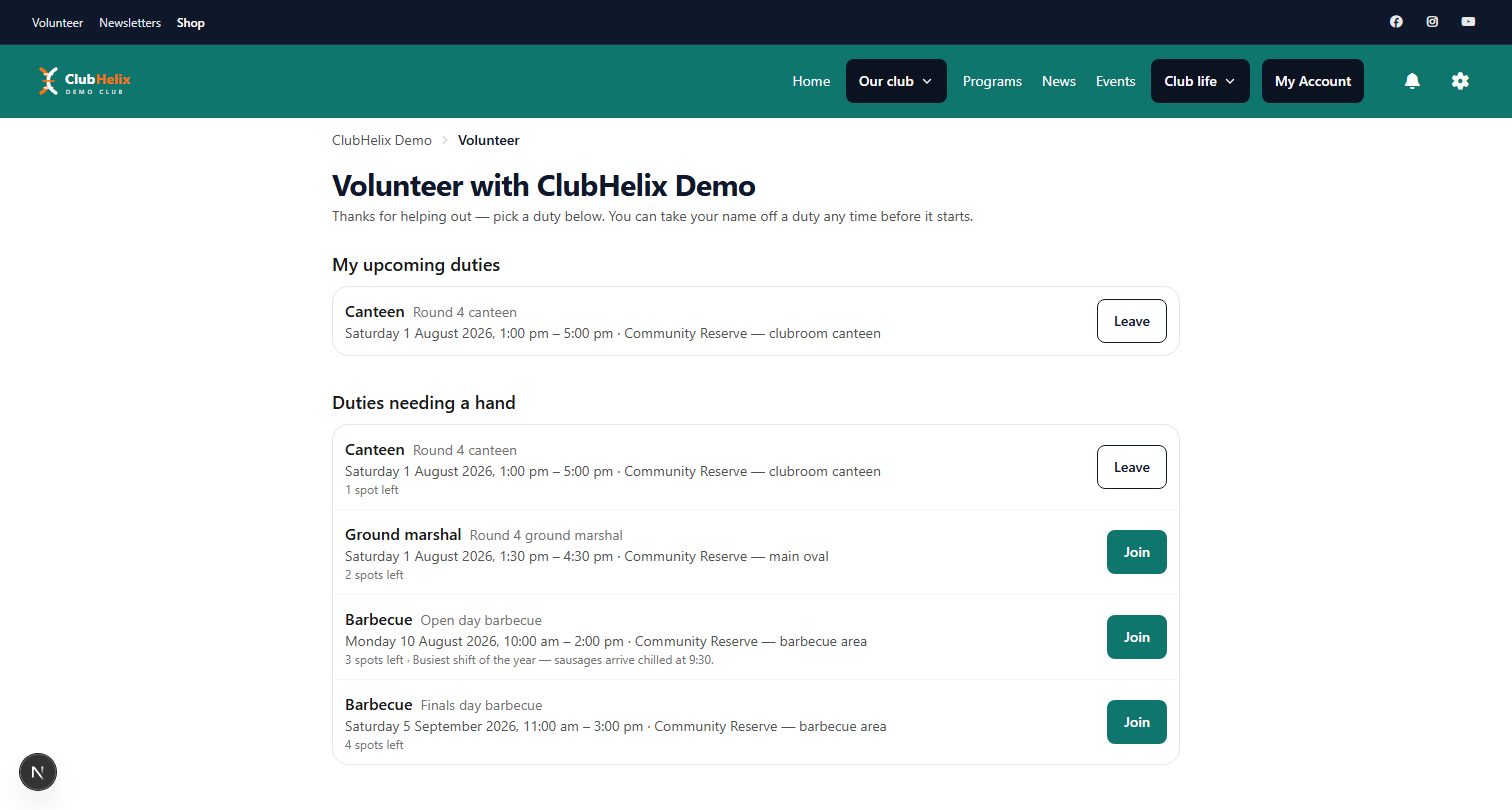
A volunteer rostering tool takes most of the pain out of this: publish the duties for each meet, let parents claim slots or accept assignments, and send automatic reminders the day before. Pair it with a culture piece — thank officials publicly, run a starter's course for interested parents, and read our guide on how to recruit club volunteers before the season, not mid-crisis.
Planning the season: meets, programs and championships
A track and field season is really a calendar problem. Map it out before round one:
- Weekly meets — set the event program for each week so every age group rotates fairly through track and field events across the season.
- Special meets — club or centre championships, relay days, twilight meets, and any open days or carnivals you host. If you're hosting something big, our guide to organising a sports carnival is written for exactly that.
- Representative pathway — zone, region and state championship dates, with entry deadlines published well ahead. Missing an entry cut-off is the fastest way to upset a family.
- Winter program — cross country and road racing venues if your club runs through winter.

Publish the whole season on your club website's events calendar — every meet, program, venue and wet-weather call in one place. Athletics families juggle multiple children in multiple age groups; a calendar they can check on their phone (with RSVPs and attendance for championships and relay teams) saves your secretary a hundred messages a season.
Results deserve the same discipline. Athletes stay in this sport for PBs, so get results and records published quickly after each meet — a results page on the club site beats a laminated sheet on the clubhouse window.
Communication that parents actually read
Athletics clubs live and die on Friday-night communication: is the meet on, what's the program, which age groups are on duty. Pick one authoritative channel — your website plus an email or push notification — and be relentless about it. A wet-weather communication plan matters more in athletics than almost any sport, because hundreds of families are deciding at 7am whether to pack the car.
Money, fundraising and the canteen
Most athletics clubs run lean: registration fees cover affiliation and equipment, and the canteen plus a sausage sizzle or two covers the rest. Equipment is the sneaky cost — timing systems, hurdles, mats and throws implements wear out, and championship hosting has real costs. Build an equipment replacement line into the budget (our club budget template has one), pursue local sponsors for age-group patches and event naming, and check your state association's advice on grants for equipment and facilities.
Your athletics club website
Everything above — registration, the duty roster, the season calendar, the program, results and records — needs a home that isn't a chat thread. A proper athletics club website gives families one link for everything: register and pay online, check the program, see the duty roster, RSVP for championships, read results. ClubHelix was built for exactly this: see the athletics club management software page for how clubs and Little Athletics centres set it up, and pricing for what it costs (there's a free tier to start on).
If your committee is short on time — most are — you can sign up and have a respectable athletics club website live in an evening, then grow into registrations, rostering and events as the season demands.
Frequently asked questions
How many volunteers does an athletics meet need?
A typical Little Athletics meet needs somewhere between 30 and 50 adults on duty across timekeeping, starting, jumps, throws, marshalling, set-up and the canteen. That's why almost every centre uses a rostered duty system by age group rather than calling for volunteers on the day.
What's the difference between a Little Athletics centre and an athletics club?
A centre is the junior competition body that runs the weekly meet and affiliates with the state association; it may contain one club or several. Seniors clubs compete in open-age interclub, cross country and road events. Many organisations run both under one committee.
When does the athletics season run?
Outdoor track and field runs through a short spring and summer window, with provincial and national championships concentrated in it. The indoor season through the winter is correspondingly important, and booking indoor facility time is one of the club's biggest annual decisions. Cross country fills the autumn. Plan your coaching cover and volunteer roster around three seasons a year, not one.
What should an athletics club website include?
Online registration with payment, the season calendar and weekly program, the volunteer duty roster, results and records, fee information and a contact point. If a family can do all of that from their phone, your committee's workload drops dramatically.


