
What this guide answers
- How do you start an archery club?
Secure a site with a safe shooting envelope first, because everything else depends on it, then affiliate with your governing body for insurance and accreditation pathways, and get at least two or three people qualified…
- How many range officers does a club need?
Aim for three qualified people per regular session slot, not one.
- Do beginners need their own equipment?
No, and a club that requires it will not recruit. Run a loan pool covering the beginners' course and ideally the first season of membership, tracked as an asset register with named borrowers and due dates.
- How do you convert a beginners' course into members?
Make the offer in the middle of the course rather than at the end, when people already know they enjoy it and have not yet filed the course as finished.
- What is a postal league?
A competition in which clubs shoot the same round at their own range inside an agreed window and exchange scores rather than travelling.
UK edition. This guide is written for volunteer-run clubs in the UK. Where rules differ — grants, tax, incorporation, safeguarding — follow the UK-specific pointers below or check with your national body.
Two whistle blasts, and eight people walk to the line carrying bows they were handed forty minutes ago. One blast, and the first arrows go down the field. It is week three of the beginners' course, and every single person on that line is a potential member for the next twenty years — or someone who will finish the course, enjoy it enormously, and never come back, because nobody told them what happened next.
Archery clubs have an unusual shape. The scarce resource is not players and it is not a ground. It is qualified people who can run a shooting line, and a safe envelope to shoot into. Everything else — membership growth, competition, the junior squad, income — is downstream of those two. A club with three range officers can open three sessions a week; a club with one can open when that person is free, which is another way of saying the club belongs to one volunteer's calendar.
This guide is for committees running a community archery club: the range and the discipline that keeps it safe, a range officer roster that survives someone moving away, the beginner-course-to-membership pipeline that most clubs leak from, how to run an equipment loan pool that actually gets its gear back, and what the indoor and record-shoot season asks of your administration. Safety and regulatory specifics are general information here — your national body's rules of shooting and your insurer are the authority on the details.
What makes an archery club different
Five things shape almost every decision a committee makes.
- One club, several sports. Target, field, clout, 3D and indoor are different disciplines with different venues, distances and scoring. Layer bow styles over the top — recurve, compound, barebow, longbow — and a modest club is running a matrix of categories, not one competition.
- Equipment is the entry barrier. Nobody turns up with a bow. Your loan pool is your recruitment pipeline, not a side project.
- Everything happens inside a safety envelope. The range dictates your capacity, your session times, your insurance and your layout. You cannot squeeze in extra participants the way a training night can.
- Members shoot as individuals but belong as a club. Scores are personal, classifications are personal, and the social glue has to be built deliberately or people drift after their first plateau.
- Sessions are supervised, always. Which brings you straight back to the roster.
Where the club sits in the wider structure decides your competition calendar and how scores are recognised.
Most clubs in the UK affiliate through a county and regional association to a national governing body, which is the route to insurance, coach and judge qualifications, and the classification, handicap and record schemes that give scores standing outside your own field. Clubs commonly run as unincorporated members' clubs or CIOs, and Community Amateur Sports Club status is worth investigating early. See how to start a sports club in the UK for the structures.
The range — layout, discipline and the safety envelope
Your range is the club's licence to operate. Whatever your governing body's rules of shooting specify, the elements below are the ones a committee has to actively manage, and they should be inspected and signed off on a schedule rather than when somebody remembers.
| Element | What to check | How often |
|---|---|---|
| Shooting line and pegs | Distances correct and clearly marked, line straight, lanes numbered | Before each session |
| Waiting line | Far enough back that nobody stands beside a drawn bow | Before each session |
| Target bosses and stands | Stands angled and stable, bosses not shot through, faces pinned square | Before each session |
| Overshoot and side margins | Clear of people, kept to your body's specified dimensions | Set once, checked weekly |
| Backstop netting or bank | No holes, tension good, fixings sound | Monthly and after storms |
| Access points and signage | Warning signs displayed, gates or barriers in place on public routes | Before each session |
| Orientation and light | Sun low in the archers' eyes at certain times, wind across the lanes | Seasonal review |
| First aid and comms | Kit stocked and in date, phone signal known, emergency access mapped | Monthly |
Two layout decisions cause the most grief later. The first is orientation — a range facing into a low sun for an hour of every winter session will quietly cost you attendance, and it is nearly impossible to fix afterwards. The second is public access: any path, fence line or neighbouring property inside or beside your overshoot area needs a physical control and signage, not a note in the minutes.
Shooting-line discipline
Discipline on the line is what makes a range with sharp objects and beginners safe. Almost all clubs run a whistle or light protocol — commonly two blasts to bring archers to the line, one to begin shooting, three to go forward and collect, and a continuous series to stop everything immediately. Confirm the exact convention with your governing body and then never vary it, because muscle memory is the point.
The rules that a committee should insist on, session after session:
- Nobody nocks an arrow off the shooting line, ever, including experienced members setting up.
- Anyone may call an emergency stop. A beginner who sees a dog on the field must feel entirely comfortable shouting, and must be thanked for it afterwards.
- Bows down and stepped back the moment the stop signal sounds, arrows unnocked, nobody walking forward.
- Retrieval discipline — walk, do not run; pull with a hand behind the arrow; nobody stands directly behind the person pulling.
- The line does not open without a named officer present. No exceptions for "just a few of us having a quiet shoot".

The range officer roster
The single most useful thing a small archery club can do in its first two years is qualify more range officers than it needs. A club with one is one holiday away from cancelling a month of sessions.
Build the roster like a duty roster, not a favour:
- Count your sessions. Every session that opens the line needs a named, competent officer plus ideally a second qualified person present.
- Target three deep per regular session. Primary, backup and a reserve who is being developed. Rotate so nobody does more than one weekend in three.
- Publish the roster a full term ahead and let people swap between themselves rather than through the secretary.
- Track qualifications and expiry dates centrally. Officer and coach accreditations, first aid certificates, and any screening required to work with juniors all have dates on them, and the club — not the individual — should be the one that notices they are approaching.
- Debrief anything that went wrong. A near miss recorded and discussed is worth more than a policy nobody reads.
That last point about expiry tracking is where most clubs quietly fail an audit. Keeping accreditation records with expiry reminders, and building the session roster in volunteer rostering rather than a group chat, turns two recurring anxieties into a page somebody glances at once a month. If recruiting the people is the harder half, how to recruit club volunteers has the playbook for slicing roles small enough that people say yes.
Screening requirements for adults working with juniors are set nationally, and there are usually rules about where bows may be discharged and how equipment is transported to and from a range. Treat both as things to confirm rather than assume — your national governing body and the relevant authority are the places to check, and the answer should be written into your club's induction so every new officer gets the same version.
From come-and-try to member — the pipeline that leaks
Almost every archery club gets enough interest. Very few convert it, because the path from curious to member has four handovers and each one loses people.
| Stage | What happens | Where it leaks | The fix |
|---|---|---|---|
| Enquiry | Someone emails or fills in a form | No reply for a week; no dates published | Publish course dates a term ahead with a book button |
| Come-and-try | A one-off taster session | They leave with nothing to book | Take the course booking on the day |
| Beginners' course | Four to six supervised sessions | Sessions clash with school terms or holidays | Run cohorts that fit the local calendar |
| Course to membership | Course ends, membership begins | The biggest leak — nobody asks | Membership offer made in session two, not the last one |
| First season as a member | Loan gear, club sessions, first competition | No bow available, nobody to shoot with | Guaranteed loan slot plus a named buddy |
The single highest-return change is the fourth row. Make the membership offer in the middle of the course, not at the end. By session two people know whether they enjoy it, and they have not yet mentally filed the course as a completed activity. A join link, the price, and a clear statement of what happens on the first Saturday after the course finishes is all it takes.
A course structure that works for a six-week cohort:
- Week one — safety brief, range walk-through, equipment fitting, first arrows at short distance.
- Week two — shot sequence and consistency; the membership conversation, with dates and prices.
- Week three — distance increases, scoring introduced, first taste of a round.
- Week four — bow styles explained, club disciplines introduced, a look at what members actually do.
- Week five — a scored round, with handicaps so nobody is embarrassed.
- Week six — a small graduation shoot, membership forms completed on the spot, the loan pool explained and the next four club sessions in everyone's calendar.
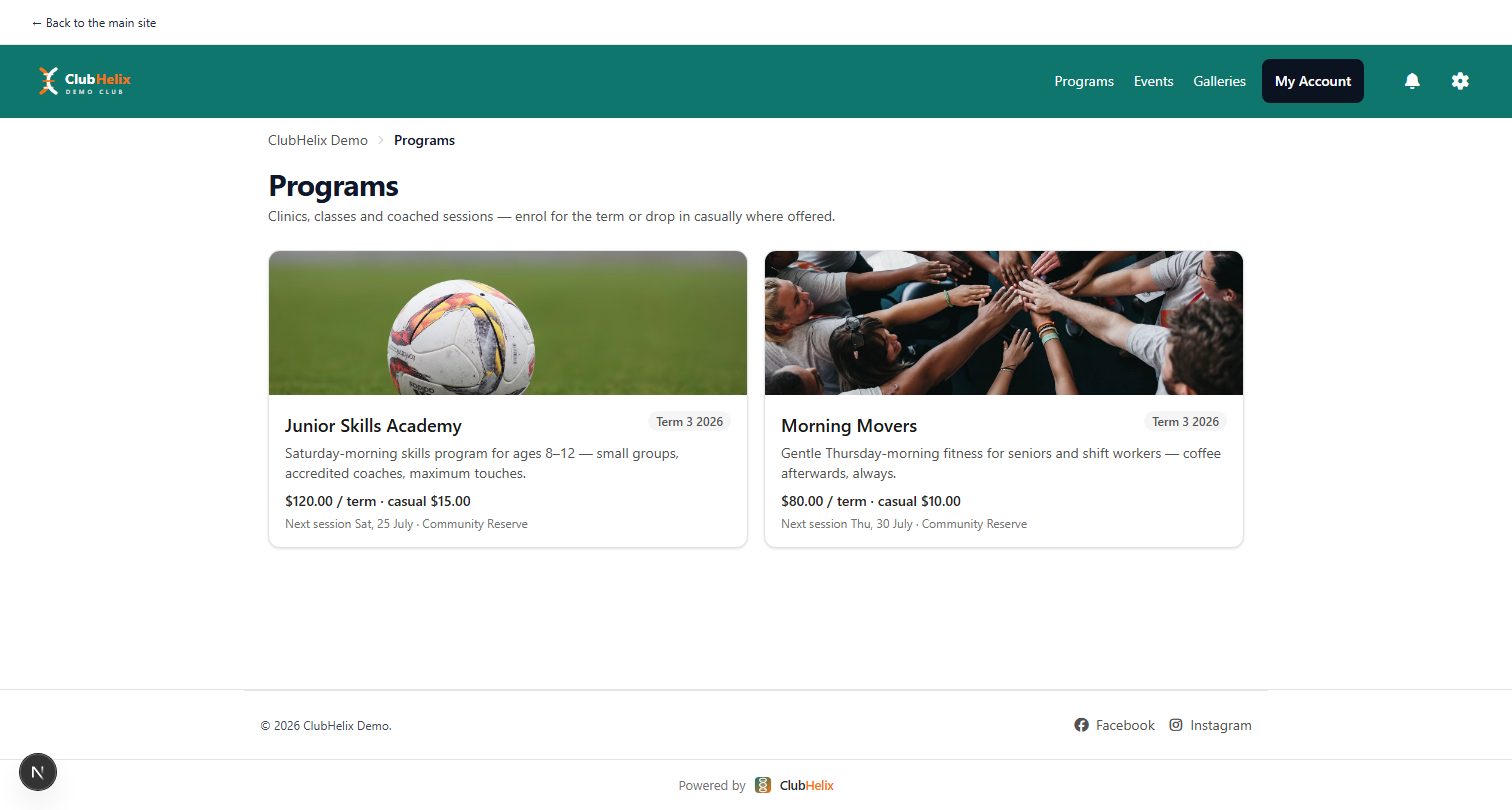
Take the bookings and payments online rather than on a clipboard. Programs and term enrolment handles cohort capacity, waitlists and payment for exactly this shape of course, which matters because a beginners' course is capacity-limited by lanes and officers — you need the eleventh person to land on a waitlist, not in your inbox. If you are also running open days, how to run a come-and-try day covers the format.
The equipment loan pool
Loan gear is what makes archery accessible and what makes committees despair. Run it as an asset register, not a cupboard.
Record, for every item: an ID number, type and specification (draw weight, length, handedness), condition rating, purchase date, who it is currently issued to, when it is due back, and the date of its last inspection. The club equipment register template gives you the columns.
Practical rules that keep a pool alive:
- Issue against a person, not a session. A named borrower with a due date gets equipment returned; "the club bows" do not.
- Take a refundable bond for take-home loans, and be consistent about it. It is not about the money, it is about the psychology of ownership.
- Inspect on return, not before the next issue. Strings, limbs, rests and nocks fail progressively, and manufacturer guidance on service life should drive retirement rather than appearance.
- Cap the loan period — typically the first season of membership — and pair the cap with a clear pathway to buying. Publish a starter kit list at two or three price points so nobody has to ask.
- Split the pool by purpose. Beginner-course sets that never leave the range, and club loan sets that graduates may take to competitions. Mixing them means the course is short of gear the week someone travels to a tournament.
The indoor season, postal leagues and record shoots
The outdoor field is the club's summer face. The other half of the year is where clubs either build depth or lose members to hibernation.
Indoor shooting takes place at short distance in a hall, which changes the administration completely. You are now a tenant with a booking, a lane count, a hard finish time and a per-session cost. That means capacity management: bookings, not turn-up-and-hope.
Indoor runs through the cold months, when the outdoor field is frozen, waterlogged or dark by mid-afternoon, and it is the backbone of the club calendar rather than a stopgap. Book the hall for the entire block before the season starts, because community halls and school gyms get committed months in advance. Members who shoot through winter return to the field in form and still connected to the club.
Three formats are worth running, and each has a different administrative load.
| Format | What it is | Admin load |
|---|---|---|
| Club night scoring | Members shoot a standard round and record their score | Light — a scoring sheet and someone entering results |
| Postal or virtual league | Clubs shoot the same round at their own range and exchange scores | Moderate — a fixed calendar, verified scoring, results published |
| Record status shoot | A formally run event where scores can count for classification | Heavy — judges, equipment inspection, paperwork, entries |
Postal leagues are underrated. There is no travel, no venue cost, and no clash with anybody else's calendar — clubs shoot the same round on their own range within a window and submit scores. For a club with distance or transport constraints, a postal league is the cheapest competitive calendar available, and it gives your members something to train for through the indoor block.
Record and classification shoots are the ones that require care. The requirements — who may officiate, how equipment is checked, how scores are witnessed and submitted — are set by your governing body and change from time to time, so confirm the current version before you advertise a shoot as record status. Get it wrong and you will be explaining to a member why a personal-best score does not count.
Whichever formats you run, publish the results the same day. Event pages that take the entries and the fees beforehand, and a news post that carries the score sheet afterwards, mean the shoot organiser is not also the person retyping a spreadsheet at ten at night — and members see where they finished before they have taken the roof rack off the car.
Membership, money and the shape of the budget
Archery suits a layered membership because people use the club in genuinely different ways.
| Category | Who it suits | Usually includes |
|---|---|---|
| Full senior | Regular target archers | All sessions, competition eligibility, voting rights |
| Junior or cub | School-age archers | Supervised sessions, coaching, restricted equipment options |
| Family | Households with two or more archers | Bundled pricing across categories |
| Course graduate | First-year members off a beginners' course | Loan equipment included for a defined period |
| Non-shooting or social | Parents, past members, supporters | Social events and voting, no shooting entitlement |
| Country or distance | Members who live far from the range | Reduced fee, limited sessions |
On the cost side, an archery club's budget is dominated by things that wear out and things that are hired. Target bosses degrade with every arrow and are a recurring expense rather than a capital one; netting, stands, faces and the indoor hall hire follow. Affiliation and insurance are usually fixed. Build a replacement schedule for bosses and faces the same way a tennis club budgets for resurfacing — a small annual provision beats an emergency in March. For pricing your fees against all of that, how much should club membership cost works through the method.
As an illustration, if a six-week beginners' course is priced at £90 and includes equipment use and temporary membership, ten participants a cohort covers coaching costs and a boss replacement, and converts a few into full members worth several years of fees each. Capital items — netting, a shelter, secure equipment storage — are typical targets for National Lottery sport funding and local authority grants in the UK, and indoor hall hire is often the single largest recurring line.
Communication, bookings and the club website
An archery club's website has an unusually specific job list, because the questions newcomers ask are practical and safety-shaped: when is the next beginners' course, do I need my own equipment, can my twelve-year-old shoot, where exactly is the range, and is there parking. A site that answers those five without an email exchange will fill your courses.
Internally, the recurring jobs are session bookings against a limited lane count, the officer roster, course cohorts and results. Put session and lane bookings online — facility booking gives each lane or bay its own clash-proof slots with separate member and casual pricing, so a coaching block or a club shoot cannot be booked over — and publish the roster where members can see it and swap shifts themselves.
Taking the paperwork off the shooting line
Most of what makes an archery committee tired is not archery. It is chasing course payments, rebuilding a roster because someone cannot make Saturday, checking whether a coach's accreditation has lapsed, and typing scores twice. ClubHelix puts those in one system with your website — programs and term enrolment for beginner cohorts with capacity and waitlists, volunteer rostering for the range officer duty roster, accreditation tracking with expiry reminders for officers, coaches and judges, and facility booking for lanes and indoor sessions. The archery club management software page shows how a range and its courses sit on it.
Start on the free tier, look at pricing when the club has grown into it, and know that it is built for volunteer committees rather than for professional administrators. A committee member can have the range, the courses and the joining page live before the next indoor block opens — create your club site and start with your next beginners' course.
Frequently asked questions
How do you start an archery club?
Secure a site with a safe shooting envelope first, because everything else depends on it, then affiliate with your governing body for insurance and accreditation pathways, and get at least two or three people qualified to run a shooting line. After that it is the ordinary club work — a legal structure, a bank account, rules, a small equipment pool and a beginners' course to bring the first members in.
How many range officers does a club need?
Aim for three qualified people per regular session slot, not one. A single officer means the club opens only when that person is available and closes when they are away, which is the most common reason small clubs stall. Rostering three deep also lets you rotate duties so nobody is at the range every weekend, which is how volunteers last.
Do beginners need their own equipment?
No, and a club that requires it will not recruit. Run a loan pool covering the beginners' course and ideally the first season of membership, tracked as an asset register with named borrowers and due dates. Pair the loan period with a clear buying pathway — a published starter-kit list at two or three price points — so people know what comes next.
How do you convert a beginners' course into members?
Make the offer in the middle of the course rather than at the end, when people already know they enjoy it and have not yet filed the course as finished. Give them dates, a price, a guaranteed loan bow and a named person to shoot with on their first ordinary club session. Taking the join and the payment online during the course removes the last piece of friction.
What is a postal league?
A competition in which clubs shoot the same round at their own range inside an agreed window and exchange scores rather than travelling. It costs almost nothing, suits clubs a long way from their neighbours, and gives members a reason to train through the indoor block. Agree the round, the scoring verification and the submission deadline before the first leg.
Keep reading — how to run a come-and-try day covers filling that first session, and club equipment register template gives you the loan pool spreadsheet columns.


