
What this guide answers
- What structure should a new UK sports club use?
Most start as an unincorporated association with a constitution and a committee, then incorporate later if the club takes on leases, staff or significant assets.
- What is a community amateur sports club (CASC)?
CASC is a long-standing UK registration that gives eligible amateur sports clubs certain tax reliefs in exchange for meeting ongoing conditions, such as being open to the whole community.
- How much does it cost to start a grassroots sports club?
The main first-season costs are governing-body affiliation, league entry, venue hire, kit and insurance.
- Do we need a welfare officer?
If you'll have junior members, almost certainly — most governing bodies require a named welfare officer and appropriate vetting checks for volunteers working with children.
Grassroots sport in the UK runs on volunteer-founded clubs — the Sunday league side that started in a pub, the parkrun-adjacent athletics group, the netball club born from a workplace team. If you're thinking about starting one, the good news is that the path is well worn: pick a light structure, form a small committee, secure a venue, and get people playing before you get buried in admin.
This guide covers the practical steps to start a grassroots sports club in the UK, in roughly the order you'll meet them — from first meeting to first fixture.
Why start a club rather than just a team?
A casual team can enter a league; a club can grow. Forming a proper club — with a name, a committee, a constitution and a bank account — is what lets you affiliate with your sport's governing body, enter sanctioned competitions, hire council pitches, apply for grants, take out insurance, and run junior sections. It also spreads the load: a club survives its founder moving away; a WhatsApp team usually doesn't.
Start by proving demand. Run open training sessions for a month, keep a list of names, and see who shows up twice. A committed core of ten to fifteen people is a solid foundation for a first season.
Choosing a structure
Most new UK clubs begin as an unincorporated association — a group of people with a constitution, a committee and a members' bank account. It's free, quick, and fine for a small club with modest assets. As the club grows, many move to an incorporated form (such as a charitable incorporated organisation or a company limited by guarantee) so the club becomes a legal entity that can hold leases and contracts itself, rather than in committee members' names.
Two things are worth knowing about early, both explained on gov.uk:
- Unincorporated associations and how they're treated for tax and liability purposes — the default structure most small clubs start with.
- Community amateur sports club (CASC) status — a long-standing registration that gives eligible amateur clubs certain tax reliefs. It has ongoing conditions, so read the current guidance before applying.
Clubs with charitable purposes can also consider charity registration, which brings its own regulator and obligations. Your national governing body will usually have a view on which structure suits clubs in your sport — ask them before you commit, because changing structure later is more work than choosing well once.
This is general information, not legal or financial advice — check the current requirements with the official body linked above.
Build your committee and constitution
Three roles get a club off the ground: a chair to lead, a secretary for correspondence, fixtures and paperwork, and a treasurer for the money. Add a welfare officer early if you'll have junior members — most governing bodies require one, along with appropriate vetting checks for volunteers working with children. Our committee roles guide covers each job in detail.
Your constitution doesn't need to be long: name and purpose, membership classes and fees, how the committee is elected, how meetings are called, and what happens to assets if the club folds. Governing bodies and league handbooks often provide a model constitution — start there rather than from scratch, and see how to write a club constitution for what belongs in each clause.
Funding your first season
A first UK season typically has to cover affiliation fees, league entry, pitch or court hire, kit and equipment, and insurance. Budget those before you set membership fees — subs priced to cover known costs are the difference between a calm treasurer and a mid-season crisis.
Beyond subs, grassroots clubs draw on a familiar mix:
- Grants. National Lottery community funding, sport-specific foundation programmes and local authority grants have supported grassroots clubs for decades. Criteria and rounds change, so always check the current details on the funder's official site — and never spend a grant before it's confirmed.
- Sponsorship. Local businesses are the classic kit sponsor. A well-run club with a visible website and social presence is an easy yes — our guide on getting sponsors shows how to pitch it.
- Fundraising. Quiz nights, race nights, raffles and matchday teas are small money but great glue.
Insurance pointers
At minimum, most clubs consider public liability cover for injury or damage arising from club activity, and personal accident cover for players. Many governing bodies bundle insurance into affiliation, which is usually the cheapest and simplest route — check exactly what's included and what's excluded before assuming you're covered. If the club employs anyone, even part-time coaches, employers' liability insurance is a legal requirement in the UK. When in doubt, talk to your governing body first, then a broker.
This is general information, not legal or financial advice — confirm current requirements with your governing body and insurer.
Affiliate and enter competition
Once the committee and constitution exist, contact your sport's national or county governing body about affiliation. Affiliation is what makes your club "official" in the eyes of the sport: it typically unlocks league entry, sanctioned fixtures, coaching courses, model policies and (often) insurance schemes. Expect to provide your constitution, named officers, a safeguarding contact if you'll run junior sport, and an affiliation fee. League entry usually runs on its own calendar with a deadline months before the season starts — find that date first and work backwards, because missing it can mean a year on the sidelines. If a full league season feels like too big a first step, many sports run development leagues, midweek small-sided formats or festival days that let a brand-new club compete without needing a full squad every week.
Finding a pitch, court or venue
Local authority pitches and leisure centres are the backbone of UK grassroots sport — councils allocate seasonal bookings, often with a formal application window before each season, so contact them early. School and academy facilities are widely available for community hire in the evenings, and 3G/artificial pitches let winter sports train reliably when grass is waterlogged. Sharing an established club's facility one night a week is often the cheapest first step and comes with changing rooms and floodlights included. Get every arrangement in writing: dates, cost, cancellation terms and responsibilities.
Growing your first members

Launch loudly and locally. A free open day or taster session — gear provided, all ages welcome, tea urn on — beats any amount of posters. Ask the local paper and community Facebook groups to share it, put flyers through doors near your ground, and talk to schools about taster sessions. Then make joining effortless: capture details on the day and send one clear follow-up with session times, fees and a registration link. Momentum matters more than polish in season one; see how to grow club membership for what to do after the first rush.
Get your club online before your first fixture
When someone hears about your new club, the first thing they do is search for it. You want them to find a page that answers what, where, when and how much — and lets them join on the spot rather than emailing a stranger.
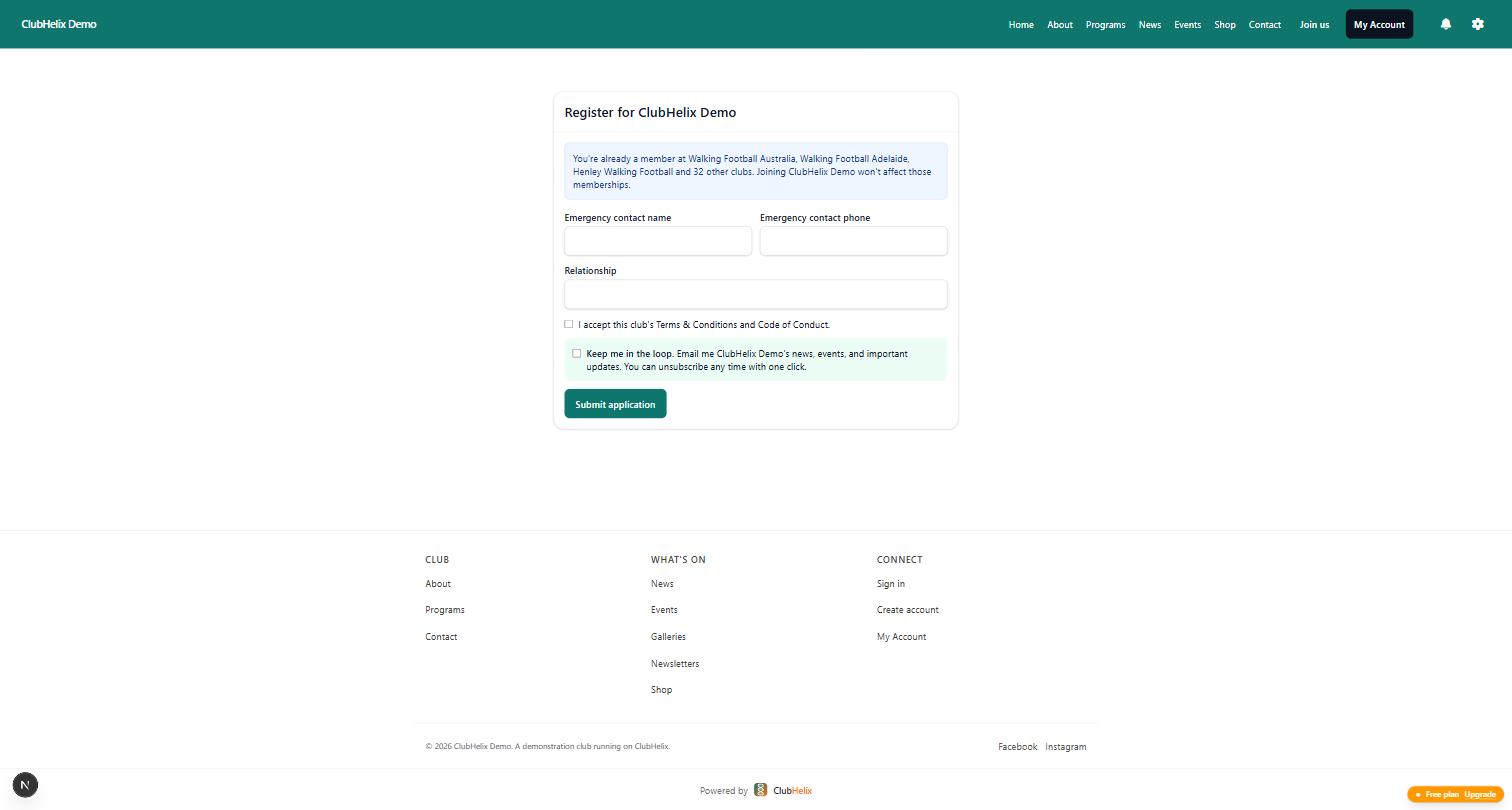
ClubHelix gives a new club all of that in an afternoon: a proper website via the page editor, online registration with payments handled, and — once you're competing — published fixtures and league tables that keep members coming back to your site instead of asking in the group chat. There's a free tier for brand-new clubs and pricing that grows with you. You can create your club today and have the site live before your first committee meeting ends.
Frequently asked questions
What structure should a new UK sports club use?
Most start as an unincorporated association with a constitution and a committee, then incorporate later if the club takes on leases, staff or significant assets. Read the current guidance on gov.uk and ask your governing body what they recommend for clubs in your sport.
What is a community amateur sports club (CASC)?
CASC is a long-standing UK registration that gives eligible amateur sports clubs certain tax reliefs in exchange for meeting ongoing conditions, such as being open to the whole community. Check the current eligibility rules on gov.uk before applying, as registration is difficult to reverse.
How much does it cost to start a grassroots sports club?
The main first-season costs are governing-body affiliation, league entry, venue hire, kit and insurance. Most new clubs cover these through membership subscriptions plus a small amount of sponsorship or fundraising.
Do we need a welfare officer?
If you'll have junior members, almost certainly — most governing bodies require a named welfare officer and appropriate vetting checks for volunteers working with children. Set this up before your first junior session, not after.


