
What this guide answers
- How many volunteers does an AFL club need on match day?
A senior home game typically needs a dozen or more: timekeepers, goal umpires, interchange steward, runner, water carriers, trainers, canteen and barbecue crews, gate and vote steward.
- What does it cost to run a footy club?
Major costs are league and insurance levies, ground hire and utilities, guernseys and equipment, trainer coverage and umpire fees.
- How do best-and-fairest votes work at club level?
After each game the coaches (or nominated voters) award votes — commonly 3-2-1 — which a vote steward records and keeps sealed through the season.
- Do we share our ground with a cricket club?
Most footy ovals are council grounds shared with cricket across the summer, with a handover each autumn and spring.
South Africa edition. This guide is written for volunteer-run clubs in South Africa. Where rules differ — grants, tax, incorporation, safeguarding — follow the South Africa-specific pointers below or check with your national body.
A local footy club is one of the most demanding volunteer operations in community sport. A single senior home game needs more officials and helpers than most sports need for a whole round: timekeepers, goal umpires, boundary runners, an interchange steward, a team runner, water carriers, canteen and barbecue crews, a gate roster and someone collecting the best-and-fairest votes before the coach leaves the rooms. Multiply that by juniors in the morning and reserves before the seniors, and you can see why an Australian Rules football club lives or dies on its volunteer system.
One thing to say up front, because it changes how you should read this guide: outside its heartland, Australian Rules is a growing amateur code played by a mix of expatriates and — increasingly — local players who have never seen a game on television. Your club is almost certainly smaller than the one this guide's full match-day roster describes, running a combined men's and women's programme out of a shared ground, in a national league whose season is compressed into a handful of carnival weekends rather than a long home-and-away run. Take the structure below as the mature version to grow towards, and scale each role to what you actually have. The parts that transfer immediately are the volunteer-role naming, the registration and fees machinery, and the online presence — because a code most people in your country have never heard of lives or dies on being findable and looking legitimate.
The good news: footy club management is a known machine. The jobs repeat every week and every season, which means they can be named, rostered and handed over. This guide walks the whole operation — affiliation and the season, the oval and the cricket handover, committee and match-day roles, registration and fees, juniors, guernseys and gear, money, and the online presence that makes everything else lighter.
Affiliation, the league and the footy season
Affiliation enters your sides in the competition, covers players under the sport's registration and insurance scheme, and binds you to league rules — team nominations, clearances for players moving between clubs, tribunal processes and ground standards.
Your club affiliates directly with the national body for the code, which runs the competition — a much flatter structure than in the sport's heartland, and one where the national body is usually genuinely pleased to hear from a new club.
The season runs roughly April to September, matching the code's traditional winter calendar, though many clubs play a compressed schedule built around a handful of tournament weekends rather than a full home-and-away run. The committee's real season starts at the post-season AGM: ground booking, league nomination, coach appointments, registration open well before the first practice match, and the volunteer roster drafted early. Your scarcest resource is players, so recruitment is a year-round job, not a pre-season one.
The oval, the cricket club and the ground handover
Week to week, ground duties are their own roster: boundary and goal-square lines marked, post pads on, coaches' boxes and interchange benches out, sheds unlocked and clean, scoreboard working.
Outside the code's heartland the facility problem is different and harder: there is almost certainly no oval anywhere near you. Clubs here play on whatever large rectangular space they can book — a rugby or football pitch, a cricket outfield, a park sports field — marking an oval-ish playing area inside it and accepting the compromise. Two practical consequences. First, portable goal posts become one of your most valuable assets: budget for them properly, work out where they're stored, and name the person responsible for putting them up and taking them down, because that job silently falls on the same one or two people otherwise. Second, your ground booking is a booking, not a home — so confirm it in writing for the whole season, arrive early enough to mark out, and have a fallback venue, since a groundskeeper who has never heard of the code will not treat your fixture as sacred.
Rain policy is set by whoever owns the field, not by you. Find out their closure rules before the season, and have your wet-weather communication plan ready before you need it.
Committee and the match-day army
Beyond president, secretary and treasurer, a footy club needs its distinctive roles filled by name:
| Role | What they do |
|---|---|
| Football manager | Team sheets, league paperwork, clearances, tribunal liaison |
| Team managers (per side) | Availability, guernseys, match-day officials sorted for their game |
| Timekeepers and goal umpires | Every game needs them — home clubs typically supply their share |
| Interchange steward and runner | Rotations managed, coach's messages delivered legally |
| Trainers / first-aid | Qualified coverage every game, concussion protocols observed |
| Canteen and barbecue coordinators | The club's biggest fundraiser, rostered across every team |
| Vote steward | Collects best-and-fairest votes after every game, sealed until count night |
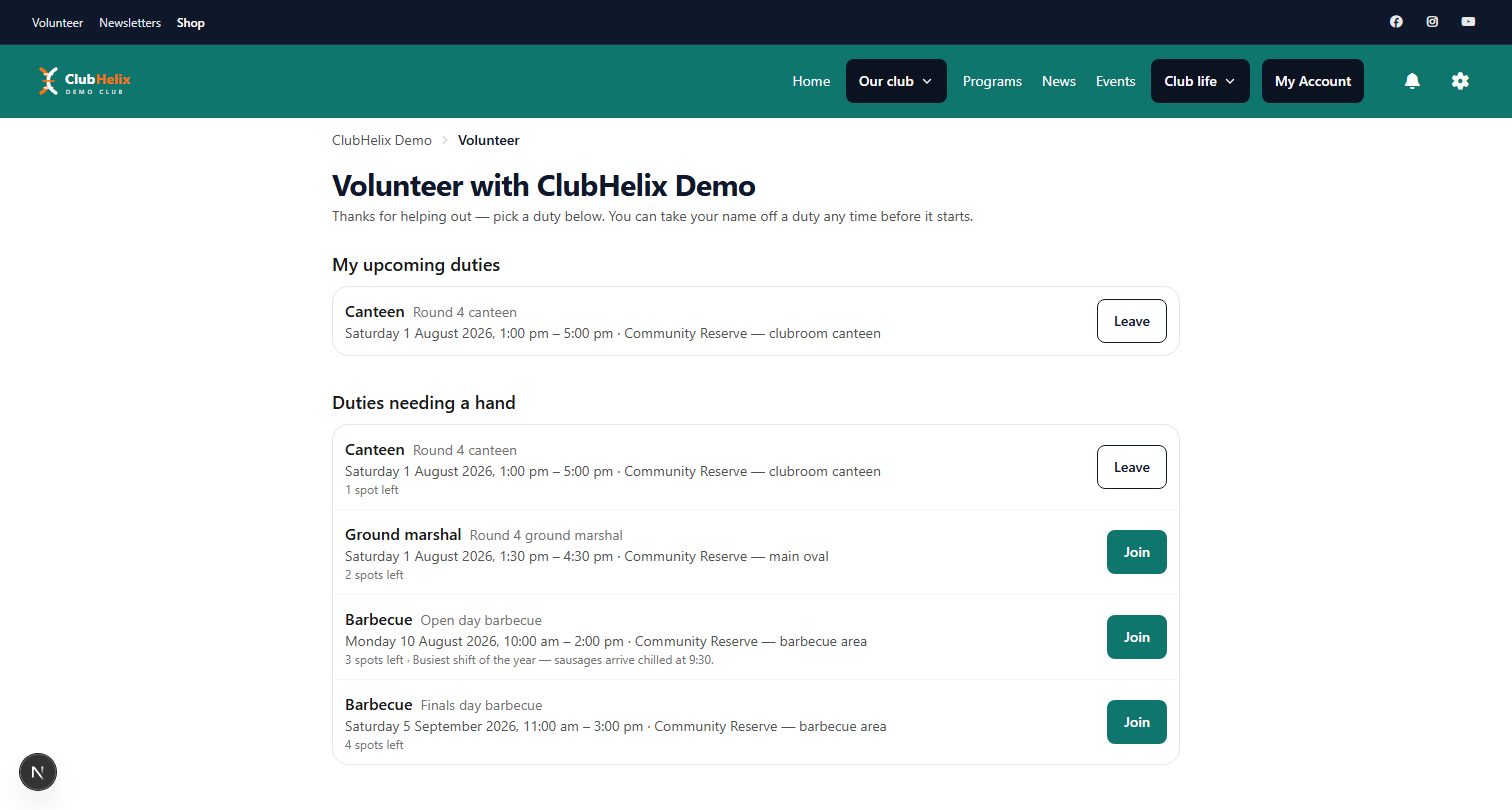
The trap is letting all of this default to the same six people. Break it down, publish the roster, and make every family's duty visible weeks ahead. ClubHelix's volunteer rostering is built for exactly this — named duties per game, reminders sent automatically, gaps visible before Saturday instead of at 8am. Our guide on recruiting club volunteers covers filling the roster in the first place.
Registration, membership and fees
Every player registers through the sport's national registration system before playing; the club separately tracks who has paid, which side they're selected in, and whose parents are contactable. Add social memberships — the supporters, past players and sponsors who buy in without playing — because footy clubs run on their social base as much as their playing list.
Fee-setting deserves a real committee conversation. Senior players typically pay more than juniors; many clubs discount for students, apprentices and families; some tie a canteen levy or a club membership into the playing fee. Publish the structure and what it covers. With ClubHelix, online registration takes payment at sign-up (instalments included), writes players into the roster with a paid-until date, and gives the treasurer a live picture instead of a shoebox of receipts.
Juniors: from first kicks to senior footy
Junior footy starts with entry-level clinics for five-to-eight-year-olds — small groups, modified balls, games-based skills, no tackling — then moves through modified-rules age competitions where field size, numbers and contact scale up gradually. No ladders or finals at the youngest ages; the design goal is confidence and fun, because a kid who loves under-9s is your under-17s captain in eight years and a senior player after that.
For the club, juniors mean Sunday-morning logistics (multiple games, parent goal umpires, a busy canteen), a coaching pool built mostly from accredited parents, and working-with-children checks tracked for everyone involved. Junior fees should stay low and first-season entry easy — see our guide on increasing junior participation for programs that grow the base.
Guernseys, gear and club identity
The guernsey is the club. Number allocation, milestone guernseys for 100-gamers, junior sizes that actually fit — someone (usually a property steward) owns the kit: guernseys washed and back in the bag, footballs pumped and counted, training cones and bags accounted for, first-aid kits stocked. Budget for a guernsey refresh every few seasons and order three months before the season, not one — suppliers jam up in every pre-season.
Identity extends past the kit: the song after a win, the milestone banners, the best-and-fairest count. These traditions are cheap to run and priceless for retention — put one committee member in charge of making sure they happen.
Money: canteen, sponsors and the social calendar
A footy club's economy has four pillars: player fees, the canteen and barbecue, sponsorship, and the social calendar. The canteen out-earns almost everything when every team takes rostered turns and it runs at every home game, juniors included.

Sponsorship is footy's traditional strength — the pub, the bakery, the local trades. Build tiered packages (guernsey, ground signage, scoreboard, website), invoice once a year, and give sponsors a genuine social return: invitations, public thanks, a sponsors' day at a home game. ClubHelix's sponsor management tracks packages, renewals and invoices so nothing lapses through forgetfulness — and our sponsorship guide covers the pitch itself.
The social calendar closes the loop: season launch, ladies' day, past-players' day, trivia night, and the presentation night where the best-and-fairest is counted vote by vote. Run them through your website's events and ticketing so RSVPs and payments handle themselves — and see our presentation night guide for the big one.
Your footy club website
When a family moves into the area and searches for junior footy, or a new sponsor googles the club before saying yes, your website is the first impression. A proper AFL club website shows training times, fixtures and results, takes registrations and payments around the clock, sells event tickets, and gives every sponsor logo a permanent public home.
ClubHelix builds the site and the club engine behind it — registration, rosters, volunteer duties, events, sponsors and comms in one admin, with a free tier to start (pricing). See the AFL club management software page for how footy clubs set it up, or get your club online before the practice matches.
Frequently asked questions
How many volunteers does an AFL club need on match day?
A senior home game typically needs a dozen or more: timekeepers, goal umpires, interchange steward, runner, water carriers, trainers, canteen and barbecue crews, gate and vote steward. The clubs that cope are the ones that roster named duties weeks ahead rather than asking for hands on the day.
What does it cost to run a footy club?
Major costs are league and insurance levies, ground hire and utilities, guernseys and equipment, trainer coverage and umpire fees. Most clubs balance the budget through canteen and barbecue trade, sponsorship and social events on top of player fees.
How do best-and-fairest votes work at club level?
After each game the coaches (or nominated voters) award votes — commonly 3-2-1 — which a vote steward records and keeps sealed through the season. Votes are tallied and revealed at the presentation night count, so keeping the collection process consistent every week matters.
Do we share our ground with a cricket club?
Most footy ovals are council grounds shared with cricket across the summer, with a handover each autumn and spring. Agree the handover details in writing — pitch protection, turf repair, storage — with the council and the cricket club before each season.

