
What this guide answers
- How is an academic society actually different from a normal student society?
The catchment and the second stakeholder. Your membership is bounded by enrolment in a degree, so you compete for penetration of a fixed cohort rather than attention across a whole campus, and your success measure is…
- Should we host past papers and shared notes on our own site?
Signpost, do not host. Past papers are usually the university's copyright and are already published wherever the institution wants them, so your value is making them findable, not keeping a parallel copy that goes stale.
- An employer wants to sponsor our careers night — who actually signs the agreement?
Almost never an individual student. Most societies have no separate legal existence, so a committee member signing personally can be exposed personally, and the umbrella body usually reserves the right to contract on…
- Our whole committee disappears during exam term. How do we cope?
Stop treating it as failure and schedule around it. Publish the quiet period in advance so members know the society has not collapsed, run one low-effort thing during it — a booked study room and a weekly signposting…
- How much should we charge a cohort we see every day?
Less than you think per year, and more than you think in total.
South Africa edition. This guide is written for volunteer-run clubs in South Africa. Where rules differ — grants, tax, incorporation, safeguarding — follow the South Africa-specific pointers below or check with your national body.
A faculty or course society is the strangest thing on campus: a club with a fixed catchment. Nobody outside the degree can meaningfully join, everybody inside it already half-belongs, and a committee of eight is somehow expected to run a careers night for 200 people, a mentoring scheme for the first years, a resources page that peaks at 11pm the night before an exam, and a ball that has to break even in a room the department did not book for you.
You also carry a second stakeholder no other society manages: the academic staff who teach you. They can hand you a lecture theatre for nothing, a mention in the enrolment pack and $800 towards a careers evening — or they can quietly stop replying, which is far worse than your student association saying no, because there is nobody else to ask.
This guide covers what is different about running one: thinking in cohorts rather than members, building a department relationship that survives your handover, running careers events employers will genuinely pay for, handling past papers and shared notes without walking into an academic-integrity problem, and getting through the exam period that deletes your entire membership for six weeks every year. The general mechanics — affiliation, elections, committee structure — are in the complete student society guide.
Your membership is a cohort, and the number that matters is penetration
An interest society can always recruit more people. You cannot. If 185 students enrol in your degree each year and the course runs three years, your entire addressable population is roughly 555 people minus those on exchange or placement, and it will never be bigger. That one fact changes almost every decision a committee makes.
It changes the metric first. Raw member count is close to meaningless — 300 members from a cohort of 2,400 is a poor year, and 120 from a cohort of 200 is extraordinary. Track penetration: paid members as a percentage of enrolled students, broken down by year group. Above about 40% you have a genuine mandate when you sit down with a head of department; below 20% you are a small club that happens to share a timetable, and you should say so rather than claim to speak for the cohort.
It also means your year groups behave completely differently, and a single program will always fail at least one of them.
| Year group | What they actually want | What they will not do |
|---|---|---|
| First years | Friends, reassurance, "how do I study for this?" | Pay $40, or attend anything alone |
| Middle years | Internships, skills, a committee position | Turn up to a first-year social |
| Final years | Employers, referees, contacts, a good ball | Anything in the six weeks before finals |
| Placement and exchange | To not be forgotten while they are away | Anything at all that happens on campus |
| Postgraduates | Peers, seminars, one event that is not a pub crawl | Sit through anything pitched at 19-year-olds |
The third consequence is the clock. On a three-year degree your entire membership turns over in three years and your committee in one, so institutional memory has to live somewhere other than people. On a five- or six-year professional degree — medicine, dentistry, veterinary science, architecture — the same faces stay for years but vanish into clinical placements or studio blocks partway through, and the society ends up run by whoever is least busy rather than whoever is best.
Write your penetration figures down every year and leave them where the next committee will find them. They are the most persuasive number in any funding request, sponsorship approach or meeting with the department, and no general-interest society on campus can produce anything like them.
The department is your co-founder, whether it wants to be
Every academic society has two parents. The students' organisation that affiliates clubs gives you insurance, a stall at the start-of-year club fair and grant money. The department gives you everything else, and it is the relationship committees consistently neglect until the week they need something.
Be clear about what each side is trading. The department wants, whether or not anyone says it out loud: a student presence at open days, someone to run the welcome event so staff do not have to, honest feedback that is not a formal complaint, and graduates who stay contactable. You want a teaching room at no cost, a mention in the enrolment material, a staff contact who replies to email, a modest annual contribution, and the endorsement that makes an employer take your careers night seriously.
Two practical moves make it work.
Find the departmental administrator. Not the head of department, not your favourite lecturer — the professional staff member who books the rooms, holds the budget code and sends the cohort announcements. That person can solve four of your five recurring problems in one email. Introduce every incoming committee to them in person within the first fortnight, before you want anything.
Separate the two hats. In many departments the society president is also the student representative on a staff–student committee. Those are different jobs: one is a service provider who needs the department's help, the other is an advocate who sometimes has to be difficult with the same people. Split them across two committee members if you can; if you cannot, say out loud at the start of each meeting which hat you are wearing.
Then write the arrangement down — one page, refreshed at every handover, covering the staff contact, what room you have and on what basis, any money the department contributes, what you provide at open days, and how it will pass messages to your members. It prevents the annual collapse in which a new head of department has never heard of your society. Put it in the handover pack with everything else.
That last point — how the department passes messages to your members — deserves its own conversation, because the answer is almost never "they will give you the class list".
Do not expect the department to hand over the cohort's email addresses. Under POPIA the university is the responsible party for student contact details, it processes them for its own stated purposes, and handing them to a society for a mailing list is a further purpose students never consented to. Your contact will say no, and they are right to. What a department can do instead is more useful anyway: forward your message to the cohort under its own name, link your society from the program page, include your sign-up link in the orientation and registration material, and give you three minutes at the start of the first lecture of the year. Ask for those four things specifically, in writing, and offer to supply the wording so it costs staff nothing. A departmental announcement outperforms anything a society sends. Then build your own list from your own sign-up form, with a QR code on the lecture-theatre slide and a record you control from the moment somebody joins. Capture a personal email alongside the university one — student addresses are switched off after graduation, which is how a course society loses its whole alumni network in one graduation round. This is general information rather than legal advice; the university's information officer can confirm what applies to a recognised society.
Careers nights are your flagship, and they are a service
For most academic societies the careers event is the thing the cohort genuinely wants and cannot get anywhere else. It is also the only thing your society does that an outside organisation will pay real money for. Treat it as a service you deliver competently rather than a social with a guest speaker.
The most reliable format is a panel of four or five graduates of your own degree, three to eight years out, doing visibly different things — one in the obvious career, one in an adjacent industry, one who changed direction entirely, one still studying. Add a staff member to open for two minutes and a chair who has written actual questions instead of "so, tell us about your journey". It costs almost nothing, it fills a room, and it feeds the alumni network you need for everything else. A single employer buying the whole evening pays better and draws worse — students smell a recruitment pitch from the corridor — so if you sell one, put two other organisations on the bill or attach the money to a mock assessment centre, a CV clinic or a technical workshop rather than to a talk.
Then there is the request that arrives in every sponsorship conversation: can we have the attendee list? The answer is no. Offer instead a sign-up people knowingly opt into on the night, two minutes for the recruiter to explain how to apply, and a follow-up email from you carrying their link. That converts better than a list of addresses nobody consented to hand over, and it keeps you on the right side of your association's rules and your members' trust. Set the expectation in writing before money changes hands — the sponsorship guide has the rest of the negotiation.
One planning number to hold on to: free RSVPs convert to attendance at roughly 55–70%, so a 120-seat room needs about 180 registrations before you cater for it, and a $3 or $5 ticket lifts that above 90% while paying for the coffee.
Timing matters more than anything else you control, because graduate recruitment here runs early in the year and finishes long before graduation. Graduate program applications at the large mining, engineering, financial services, auditing and consulting employers typically open between February and April for intakes the following year, and many close by mid-year. Bursary and vacation-work applications run on their own earlier cycle, with a lot of vac-work deadlines falling around August and September for the December break — and vacation work is often the direct pipeline into a graduate offer, so first and second years need to hear about it too. That puts your two highest-value careers events in the first six weeks of the first semester and again in August, and never in June or the October–November exam block. Coordinate with the university's careers or graduate recruitment office before approaching employers directly: they run the campus fairs, they hold the employer relationships, and corporate recruitment budgets for careers evenings are generous when the request comes through a recognised channel. Their co-brand makes an unfamiliar employer far more likely to accept an invitation from a society. This is general information — the careers office and societies council set the actual rules.
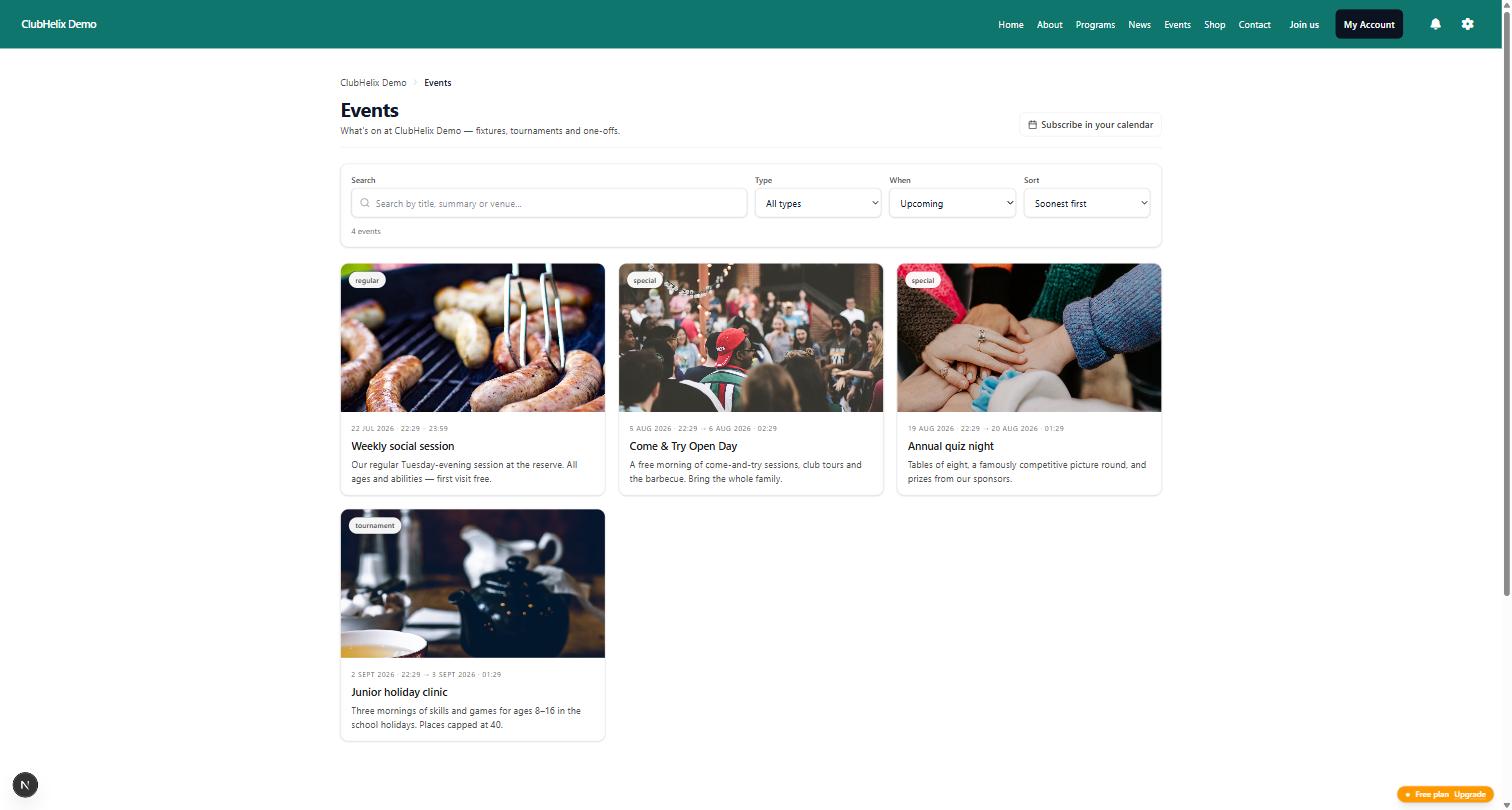
Whatever the format, run the whole thing off one page: date, room, who is speaking, access information, dietary options, and the sign-up in the same place. Every hop you add — a chat message pointing at a form pointing at an external ticketing site — costs you a chunk of the audience. Putting events and RSVPs on your own site also produces the attendance record you will need later, because "we ran six careers events with 780 total attendances" is the sentence that wins your next grant and your next sponsor. The full mechanics are in the end-to-end event guide.
Past papers, notes and the line you must not cross
At 11pm the night before an exam, your society's resources page is the most visited thing you own. It is also the fastest route by which a well-meaning committee ends up in an academic-misconduct meeting.
Sort everything into three tiers and hold the line publicly, so members know the rules before they ask.
Safe. Signposting official material: the library's past-paper archive, the department's exam repository, the study-skills service, the referencing guide, the academic-integrity policy itself. A post describing in general terms how the year above approached a subject — what they read, how they structured revision, what they wish they had started earlier. A revision session in a booked room with a tutor or a willing postgraduate present.
Grey, so ask first. Student-written notes shared free within the cohort, recordings of your own sessions, anything summarising taught material. Ask the department in writing and accept the answer — some are enthusiastic, some firmly against, and the difference is usually assessment design rather than generosity.
Off-limits. Model answers to past papers. Worked solutions to any assessment currently running. Anything submitted for marking this year. And anything your society charges for: the moment a resources page becomes a paid notes market you have created a commercial operation your association almost certainly forbids, plus a liability nobody on a student committee should carry.
Past papers are generally the university's copyright, published where the university wants them published. Your job is to make them findable, not to host a copy. A short resources page plus a news post at the start of each assessment period — what is open, where the papers live, which revision sessions you are running, who to contact for study support — is more useful than a folder of files and carries none of the risk.
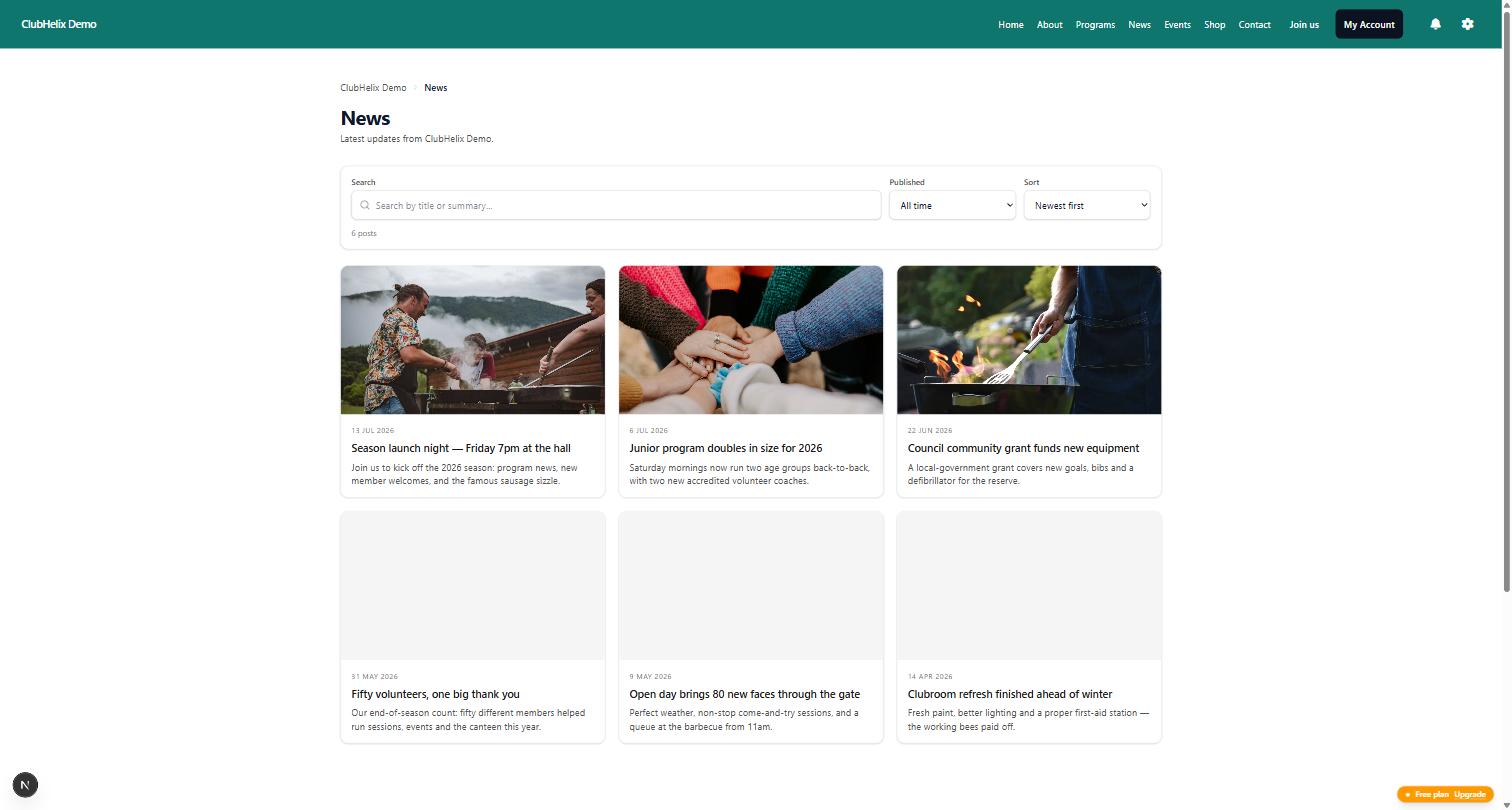
Publishing that as dated news posts rather than chat messages has a second benefit that shows up years later: the next committee can see exactly what was promised and when, and the department can check what you said without asking you.
Mentoring, exam term and the shape of your year
A mentoring scheme that does not need a matching algorithm
Peer mentoring is the highest-value thing an academic society does for its first years, and it needs no software and no training budget.
Open two forms in the first fortnight — one for mentors, one for mentees — asking for year group, subject stream, whether they commute or live on campus, and one line on what they want out of it. Match on three criteria and no more: stream, availability, and anything about circumstances that will make the pair click (first in family, international, mature-age, part-time). Perfect matching is a myth; a fast, decent match beats an elegant one that launches in week seven. One mentor to two or three mentees survives attrition far better than one-to-one.
Brief mentors for forty minutes on exactly one thing: you are a student who did this last year, not a counsellor, an academic adviser or a crisis service. Give every mentor a card listing the four services they should hand people to — student counselling, disability and access, academic skills, and the department's advising contact — and tell them that using it is success, not failure.
Then launch, prompt three check-ins across the term, and finish. Expect roughly 60% of first years to sign up and about a third of pairs to still be talking at the end of term; twenty-five active pairs is a strong first year. Sign-ups, preferences and check-in prompts all run off forms and surveys plus a custom field on the member record holding who is paired with whom.
The year, and why exam term breaks it
| Period | What an academic society does | The trap |
|---|---|---|
| Before teaching starts | Affiliation renewal, department meeting, book the careers night speakers | Everyone is away; speakers get booked by someone else |
| Weeks 1–4 | Club fair, welcome event, mentoring launch, first paid memberships | Mentoring launches too late to matter to first years |
| Peak recruitment weeks | The careers evening, employer workshops, alumni panel | Scheduled against a compulsory lab or an assessment deadline |
| Mid-year | Skills sessions, the academic quiz or symposium, sponsor delivery | Committee burnout, and nobody has started ball planning |
| Exam period | Revision signposting, a study space, quiet operation | Running events nobody can attend and reading it as decline |
| Immediately after exams | The ball or dinner, the awards, the graduation send-off | Ball tickets go on sale far too late |
| End of year | AGM and elections, annual report, handover | Elections held after final years have already left campus |
The exam block is the structural difference between an academic society and every other club on campus. Your members do not drift away — they vanish, all at once, for four to six weeks, and hardest exactly when your final-year committee is under the most pressure. Plan for it instead of fighting it: run nothing but a quiet study space and a weekly signposting post, publish the dates in advance so nobody feels abandoned, and hold your AGM and elections before the exam block or in the fortnight after it, never during. Committees that schedule elections for the last week of the year routinely discover their final years have already gone home.
The placement and exchange gap deserves the same treatment. Students on a year out are still members, often still paying, and are the best source of internship advice you have. A short message each term, a seat on the careers panel when they return, and a way to keep their contact details current costs almost nothing. Our email and newsletters guide covers the rhythm that survives a cohort's timetable.
Money: sell a membership for a degree, not a year
Course societies have one pricing option nobody else on campus can use: because your members are with you for the whole degree, you can sell a single membership that lasts all of it. Charging $25 once at enrolment for three or four years beats $10 a year on every measure — it is bought in the one week people are most willing to say yes, it removes the renewal chase entirely, it front-loads the cash your committee needs for the careers night, and a second-year has no decision to make in week one.
Model both before you choose. A cohort of 185 first years converting at 45% to a $25 degree-long membership is $2,081 in a single week. The same cohort at $10 a year converts a bit higher, maybe 55%, but yields $1,018 and decays to perhaps 30% by third year. Add a life membership for graduating students at three or four times the annual figure and you have started your alumni list at the moment people feel most sentimental about the place. Work the numbers with the budget template and the membership fees guide.
Two more income lines are unusually strong here. Cohort merchandise works because the identity is real and specific — a hoodie carrying the degree and graduating year sells to 60–70% of a final year at a $15–20 margin, often the most profitable thing a course society does. And the ball or graduation dinner is frequently the biggest event of the cohort's entire degree; price it against the venue minimum rather than last year's ticket, sell in waves, and read the ball ticketing guide before signing anything.
Beyond your own income, an academic society draws on three pots. The SRC allocates society budgets annually against a submitted plan, usually released in tranches with a report required before the next one, so late reporting genuinely costs you the following year's money. Your faculty or school often holds a small engagement fund, and here is the useful part: faculties very often prefer to pay a supplier directly on an internal order rather than hand cash to a student committee, so ask for the catering to be paid rather than for R6,000 — the answer is yes far more often. The third pot is employer sponsorship, and this is where academic societies out-earn everyone: graduate recruitment budgets in mining, engineering, financial services and auditing are substantial, and a discipline-specific evening is exactly what those recruiters are trying to buy. Expect the money to run through a student affairs account rather than a committee bank account, expect the university to want to see the agreement, and check whether the careers office already has an arrangement with that employer. VAT registration is very unlikely at typical society turnover. General information only, not tax advice.
A careers night run sheet you can copy
Adjust the weeks to your term dates, give every line a named owner, and keep it in the handover pack so next year's committee starts from a working document rather than a memory.
Eight weeks out. Fix the date against the cohort's timetable and the recruitment cycle. Book the room for 45 minutes longer than the event so you are not thrown out mid-conversation. Confirm the staff contact will open the evening. Set the budget and the break-even number.
Six weeks out. Invite six speakers for a panel of four or five, because two will drop out. Alumni first, employers second. Confirm in writing what each is agreeing to: date, format, length, whether they can pitch a role, and whether they may collect details.
Five weeks out. Sponsorship documented, including the explicit line that no attendee list will be shared. Catering quoted with vegetarian, halal and gluten-free options as standard. Accessibility checked — step-free access, a hearing loop if the room has one, and a named contact for access questions on every promotional item.
Four weeks out. Registrations open on your own site, with room, start and finish times, access information and the dietary question on one page. Announce to members, and ask the department to forward it to the cohort under its own name.
Two weeks out. Second reminder. Speaker briefing sent: audience size, year groups present, the three questions they will be asked, arrival time, building access, your mobile number.
Week of. Numbers to the caterer using the 55–70% conversion rule, not the raw registration figure. Run sheet to the committee with times against names. Chair writes ten questions and rehearses the opening ninety seconds.
On the night. Two people on the door from 30 minutes before. One person shadowing each external speaker so nobody stands alone holding a coffee. A five-minute "how to follow up" segment before the room breaks, because the conversation afterwards is the whole point. Three usable photographs, with consent.
Within 48 hours. Thank-yous to speakers and sponsors with the attendance figure and a photo. Follow-up to attendees carrying the application links. Three feedback questions, no more. Numbers, spend and lessons in a debrief note the same week, while you still remember what went wrong. A member survey at the end of term will tell you which events were worth repeating.
Frequently asked questions
How is an academic society actually different from a normal student society?
The catchment and the second stakeholder. Your membership is bounded by enrolment in a degree, so you compete for penetration of a fixed cohort rather than attention across a whole campus, and your success measure is the percentage of that cohort you reach. You also answer to a department as well as to your student association, which brings rooms, endorsement and money other societies cannot get — and an obligation to be useful in return. Nearly everything distinctive about running one flows from those two facts.
Should we host past papers and shared notes on our own site?
Signpost, do not host. Past papers are usually the university's copyright and are already published wherever the institution wants them, so your value is making them findable, not keeping a parallel copy that goes stale. Student-written notes are a grey area worth asking your department about in writing first. Model answers, worked solutions to live assessments and any paid notes arrangement are where societies get into genuine trouble, and no committee should carry that risk on a cohort's behalf.
An employer wants to sponsor our careers night — who actually signs the agreement?
Almost never an individual student. Most societies have no separate legal existence, so a committee member signing personally can be exposed personally, and the umbrella body usually reserves the right to contract on your behalf anyway. Send the draft up the chain early — approvals routinely take a fortnight — and expect it to be checked against existing exclusive commercial partners. If a department is funding you instead, it will normally pay a supplier directly rather than sign anything at all.
In practice student affairs or the SRC signs on the society's behalf, since a recognised society has no separate legal personality. Send the draft through early and expect it to be checked against the university's sponsorship policy and any existing arrangement the careers office holds with that employer.
Our whole committee disappears during exam term. How do we cope?
Stop treating it as failure and schedule around it. Publish the quiet period in advance so members know the society has not collapsed, run one low-effort thing during it — a booked study room and a weekly signposting post is plenty — and move everything that needs energy into the weeks either side. Critically, hold your AGM and elections before the exam block or in the fortnight after it, never in the final week of the year, because your outgoing final years will already have left campus and your quorum walks out with them.
How much should we charge a cohort we see every day?
Less than you think per year, and more than you think in total. A single membership covering the whole degree, sold in the first fortnight at two or three times a one-year price, converts better than any renewal you will ever chase and delivers the cash when your committee actually needs it. Keep a concession rate, make it obvious nobody is excluded for cost, and remember the fee's real job is telling you who your genuine members are — 45% of a cohort who have paid something beats 90% who ticked a box at a stall.
Where ClubHelix fits
An academic society's fragility is almost entirely administrative: the resources page living in one person's drive, careers night registrations spread across a form and a chat thread, an alumni list that expired with everyone's student email, a department relationship stored in a graduate's inbox. ClubHelix gives the society one site it owns, with member records holding year group and stream, self-serve paid membership at enrolment, events with RSVPs and ticketing, news posts for revision and resources, forms for mentoring sign-ups, and per-role access that changes cleanly at handover.
If your society sits under a students' association that affiliates dozens of others, that structure exists too — a parent organisation above its societies, each running its own site and records. See how it fits on the university clubs page; if you are heading towards chapters, membership grades and CPD, the professional society guide covers what comes next, and grant advice is in the funding and grants guide. The pricing page has a free tier for building the site and trying it out, with online payments and search visibility on the paid plans.
ClubHelix gives your society one home for events and ticketing, news and resource posts and forms for mentoring and feedback. Start free before your next careers night.


