
What this guide answers
- How much should a professional society charge for membership?
Anchor the standard grade on something the member already values rather than on your costs — roughly the price of a single day at your own conference, or an hour of the member's own charge-out rate, is a defensible…
- Should our branches have their own bank accounts?
Only if you can see them. A branch float of $500 to $2,000 with a mandatory one-page quarterly return is a reasonable arrangement that gives branch committees the autonomy they need to buy a room and a round of…
- How do we keep the member register out of one person's spreadsheet?
Move it to a system the society owns rather than a file a person owns, then give access by role — membership secretary, treasurer, branch chair — instead of by password.
- Can a volunteer society really run CPD records without a secretariat?
Yes, provided members do the data entry and the system does the reminders.
- Should we register as a charity or seek tax-exempt status?
It depends on your purposes, not your size. A body that mainly advances the interests of its members' profession is a different thing from one that mainly advances a field of knowledge for public benefit, and the…
A learned society with 620 members usually has exactly one person who understands how the membership works. She has been honorary membership secretary for nine years. The register lives in a spreadsheet she maintains beautifully. Renewal notices go out from her personal email address in the second week of the subscription year, and each of the six branches sends her a balance when she asks twice. Nothing is broken. Everything is fragile.
Professional and learned societies occupy an awkward middle ground. You carry the obligations of an institution — a register of members, grades that people put after their names, CPD records members produce at audit, a council with real legal duties, a conference with a five- or six-figure exposure, sometimes a journal with a century of back issues. You carry them on the resources of a club: volunteers with day jobs, an honorary treasurer, and a council that meets four times a year.
This guide is about carrying institutional obligations on volunteer capacity. It works through membership grades and admissions, the subscription cycle that funds everything else, CPD records that survive an audit, branches that do not quietly become three sets of books, a council that renews itself, and the two activities — the conference and the publication — most likely to sink a society that gets them wrong. It assumes you have no secretariat, because most societies do not.
Get the membership ladder right before anything else
Every other decision in a professional society is downstream of its grades. Grades set the price list, the admissions workload, the post-nominals, the voting rights, the renewal notice wording and the numbers your council actually looks at. Societies that drift do so because the ladder stopped describing the profession years ago and nobody rebuilt it.
A workable ladder for a mid-sized society looks like this.
| Grade | Who it is for | Evidence you should ask for | Share of a mature register |
|---|---|---|---|
| Student | Enrolled in a relevant qualification | Proof of current enrolment, re-checked annually | 10–20% |
| Graduate or Associate | Qualified, under about five years in practice | Qualification plus one proposer | 15–25% |
| Member | The standard working grade | Qualification plus set years of practice | 40–55% |
| Fellow | Distinguished contribution to the field | Nomination, CV, panel decision | 5–10% |
| Retired | Left practice, wants to stay connected | Self-declared, usually at a reduced fee | 5–15% |
| Honorary or life | Conferred by council for service | Council resolution, no fee | Under 1% |
| Institutional or supporting | Employers, departments, libraries, small consultancies | An agreement plus named contacts | Few records, 10–30% of income |
Three practical rules keep that ladder honest. Write the admission criteria down and publish them, because "the panel knows one when it sees one" is how societies acquire an accidental reputation for being closed. Give the admissions panel a service standard — a decision within one council cycle, or six weeks, whichever is shorter — and tell applicants what it is; a three-month silence loses more good members than a rejection ever does. And run an annual eligibility sweep, which is the single most neglected process in professional societies. Someone admitted as a graduate at 24 is still sitting at graduate grade at 41 because nobody ever invited them to move up. Query the register once a year for everyone who has been in a junior grade longer than the criteria require, and send them an upgrade invitation with a pre-filled form. You will move 5–10% of your register up a grade and increase subscription income without recruiting anybody.
Post-nominals are the part members care about most and societies police least. Be explicit in your rules that the entitlement to use them ends when membership lapses, publish a searchable "check a member" page if your profession has any public-facing risk, and make the register the authority. If your only record of who is currently a fellow is a mailing list, you cannot answer the question an employer asks.
The register of members is the society
The register is not a mailing list with extra columns. It is the thing your constitution, your council, your auditor and often your legislation all refer back to. At minimum it should hold: legal name and preferred name, grade and the date that grade was conferred, the date of first admission, a personal email that will still work after the member changes employer, a postal address if you publish anything physical, the subscription status with a paid-until date, and consent flags for member directory listing and for non-essential email.
What it should not hold: opinions in free-text notes, health information you have no plan for, or a decade of employer email addresses you never cleaned up. Every field is a field the next honorary secretary inherits and has to protect. Our member records and privacy guide works through the practical minimum, and the privacy policy template gives you the public-facing half.
Your register sits under the Privacy Act and the Australian Privacy Principles, and if the society is an incorporated association, your state's associations legislation almost certainly requires you to keep a register of members and make it available to members for inspection — while also restricting what a member may then do with it. Those two obligations pull in opposite directions, so write a short register access policy: who may inspect, on what notice, and a signed undertaking not to use it for anything unrelated to the society's purposes. Marketing email is governed separately by the Spam Act, which requires consent, clear identification of the sender and a functioning unsubscribe honoured within five working days — a renewal notice is a service message, but a conference promotion to lapsed members is not. Name one council member as accountable for the register, keep it out of personal drives, and never send a branch newsletter with 200 addresses visible in the To field. General information only; check your own rules and, where it matters, take advice.
The subscription year is the society's heartbeat
Subscriptions are rarely a society's largest income line — a conference often out-earns a whole year of dues — but they are the only income that arrives whether or not anybody organises anything. Protect the cycle first.
The first structural decision is common renewal date or anniversary billing. A common date (everyone renews on 1 July, or 1 January) gives you a clean "membership as at" number for the annual report, a single campaign, and a council that can see where it stands. It also gives you one brutal six-week period a year. Anniversary billing spreads the work, suits self-serve payment and never has a cliff, but you lose the clean snapshot and members compare notes and get confused. Most societies under about 1,500 members are better off with a common date and pro-rata joining after the halfway point of the year.
The second decision is the lapse ladder, and it should be written down rather than improvised by whoever is free. A ladder that works looks like: a renewal notice 30 days out, a reminder 7 days out, one on the due date, a "your membership has expired" note at day 14, a grade-specific note at day 30 explaining exactly what has stopped (journal access, member rate at the conference, entitlement to post-nominals), and one final personal message at day 60 from a real person in their branch. Typical performance: 55–65% renew before the due date, another 20–25% inside six weeks, and 12–18% never renew at all. That last figure is your true attrition, and a society of 600 needs roughly 80–110 admissions a year just to stand still.
Three cheap decisions that measurably improve renewal:
- A hardship or career-break rate, granted without an explanation form. Parental leave, redundancy, illness and study all cost societies members permanently, and a $0 or half-price year keeps someone who would otherwise leave and never come back.
- Rejoining should not mean re-admission. Anyone lapsed under three years rejoins at their previous grade by paying; only after that do they go back through the panel. Otherwise the effort of rejoining exceeds the value and the member simply does not.
- Pay the conference and the subscription in the same transaction. A non-member rate set higher than the member rate plus a full year's subscription makes joining the rational choice at the moment someone is most engaged. That single pricing decision recruits more members than most campaigns.
Institutional and corporate memberships deserve their own treatment: an agreement, a named billing contact separate from the named member contacts, a seat count, and a renewal conversation that starts 90 days out rather than a notice that lands in a general inbox. They are a small number of records and often a large share of income.
Whether you charge GST on subscriptions depends on registration, and registration depends on turnover — the threshold is higher for not-for-profit bodies than for businesses, so plenty of mid-sized societies sit below it while a society running a large annual conference sits well above. Once registered, subscriptions, conference registrations and journal sales generally carry GST and you must issue tax invoices, so build the tax treatment into the price list rather than discovering it after the fact. On the member's side, a subscription to a professional association is commonly claimable as a work-related deduction where it relates to how they earn their income, so state the amount and the society's ABN plainly on every receipt — it costs you nothing and members notice. If the society has charitable purposes, registration with the national charities regulator and its annual information statement are a separate matter again, and deductible gift recipient status is harder to obtain than most councils assume. General information only, not tax advice — take it from an accountant before you set prices.
Collect the money in the same place the register lives. A self-serve join and renewal flow that writes straight to the member record removes the reconciliation that eats an honorary treasurer's evenings — no bank statement matching, no "did this transfer come from Dr Patel or her department?", no 200 manual receipts. The mechanics are covered in our collecting membership fees online guide, and the retention half in how to retain club members.
CPD records that survive an audit
For a great many societies, CPD is the reason members stay. It is also the obligation most often held together with sticky tape: certificates emailed as PDFs at some point after each event, a sign-in sheet photographed on someone's phone, and a member ringing you in a panic because a regulator has sampled them and they need proof they attended your symposium four years ago.
Be clear which of three roles your society plays, because they carry different duties. You may be the regulator setting a mandatory requirement, which is rare and comes with formal obligations. You may be a provider of accredited activity, which usually means naming learning outcomes, keeping attendance records for a set number of years and issuing certificates that carry your provider or accreditation identifier. Or you may simply be the place members record and store their own activity, which is the least regulated and often the most valued.
Whatever the role, the record itself needs the same fields: the date, the activity title, the category (formal or structured versus self-directed), the hours or points claimed, the evidence — a certificate, a link, a reflective note — and the cycle it counts towards. Attendance is what makes this cheap: if your event system records who actually came, certificates can be issued from that data within 48 hours instead of reconstructed from a photograph months later. Keep the records for the length of the regulator's cycle plus one, which in practice means five to seven years for most professions.
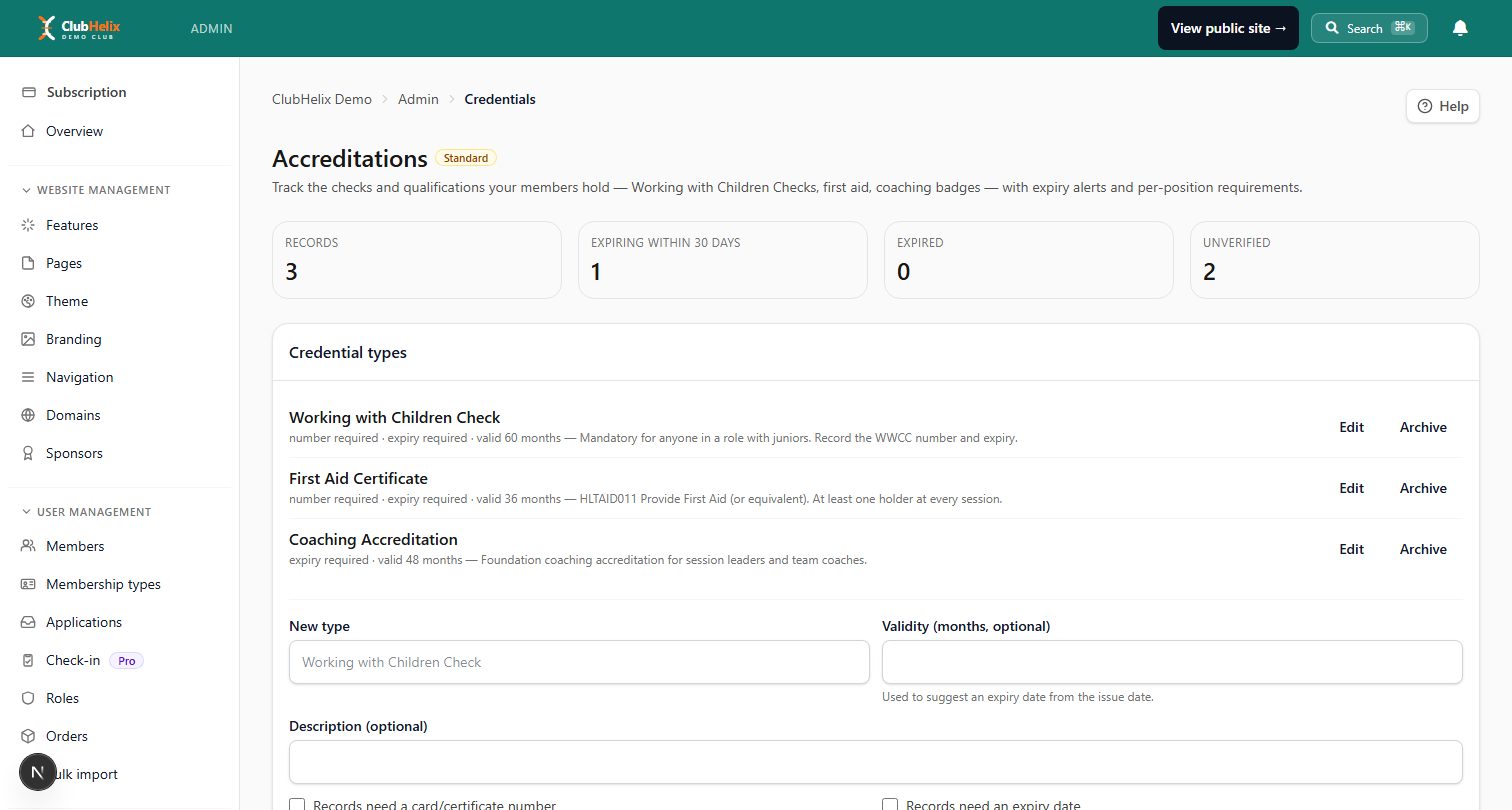
The other half of CPD is expiry. Practising certificates, first aid, ethics modules, insurance and specialist endorsements all lapse, and a society that tracks expiry dates and warns members 90, 30 and 7 days out is doing something genuinely useful that no spreadsheet does well. Accreditation and CPD tracking with expiry reminders is exactly this job — a record per member, with the evidence attached and a reminder that fires without anyone remembering to send it.
Who mandates CPD depends entirely on the profession: registered health practitioners work to annual requirements set by their national board, legal practitioners accrue units against a practising certificate year, and engineering, accounting, planning and surveying bodies each run their own schemes with their own units and cycles. Some regulators audit a small random sample of registrants each year and expect the registrant, not the society, to produce evidence — so your job is to make evidence easy to retrieve, ideally by the member themselves from their own account. If you want your activity recognised, check whether the relevant board or body requires endorsement or simply accepts activity that meets its criteria; the difference determines whether you can print an accreditation number on your certificates. State the hours, the date, the title and the learning outcome on every certificate regardless. General information — confirm the requirement with the relevant board.
Branches and chapters without three sets of books
The moment a society has geography, it has branches — and the classic mature failure is six branches, four bank accounts, two of which nobody on council can see, and a branch treasurer who has held the signature since 2014 and does not answer emails in winter.
There are three workable models, and the wrong one is "whatever happened".
- Centralised. Branches spend by reimbursement against receipts. Simplest and safest, and the least popular with branch committees because it slows everything down. Works well if the centre can pay within a week and everyone knows it.
- Float and return. Each branch holds a small working float — typically $500 to $2,000 — and submits a one-page quarterly return: opening balance, income, expenditure, closing balance, events held, attendance. Best balance for most societies.
- Separate entities. Branches are their own legal bodies affiliated to the centre. Occasionally necessary for historical or regulatory reasons, always more work, and it makes consolidated reporting an annual negotiation.
Whichever you choose, hold two lines firmly. Branch income is society income — a branch surplus is not the branch's money, and saying so calmly in the second year avoids saying it awkwardly in the tenth. And membership belongs to the society, not the branch: a member who moves cities updates their branch and keeps their number, their grade and their history. Nobody should ever rejoin because they changed jobs.
Branch autonomy should be about program, not money. Let branches decide their own events, speakers and rhythm; do not let them decide their own member list, their own price list or their own privacy practice. In practice that means each branch needs its own visible presence — its own page, its own events, its own local newsletter — with the register held once at the centre. A parent-and-child structure where the society sits above its branches does exactly that: each branch runs its own site and its own events, while the centre sees the whole register and the consolidated numbers without asking anyone twice.

A council that renews itself
Most professional societies are governed by a council or board of nine to fifteen people meeting quarterly, with an executive that meets more often between times. The structure is rarely the problem. Renewal is.
The pattern to avoid is familiar: the same five people hold eleven roles, the council has met for fourteen years without a term limit, and nominations attract nobody because the work is invisible and the commitment is undefined. The fixes are unglamorous and they work.
- Terms and limits. Two- or three-year terms, a maximum of two consecutive terms in the same role, staggered so you never lose the whole council at once.
- A presidential line. President-elect, president, immediate past president is the single best succession device a volunteer society has. The incoming president spends a year learning the job with no responsibility for it, and the outgoing one is still in the room for a year afterwards.
- Standing committees with written remits. Finance and audit, membership and admissions, conference, publications, awards, and conduct. Each with a chair, a page describing what it does, and a report into every council meeting.
- A register of interests, declared at the top of every meeting and refreshed annually. Professional societies award prizes, appoint editors and buy services from members' employers; the register is what makes those decisions defensible.
- Papers out seven days before the meeting, and a decision log kept separately from the minutes so that "what did we agree about the journal in 2023?" takes thirty seconds rather than an afternoon.
Records are the institutional memory: agendas, minutes, resolutions, the register of interests, annual accounts and the register of members. Keeping them in one place with meeting and governance records means an incoming honorary secretary inherits a complete set rather than an inbox archaeology project.
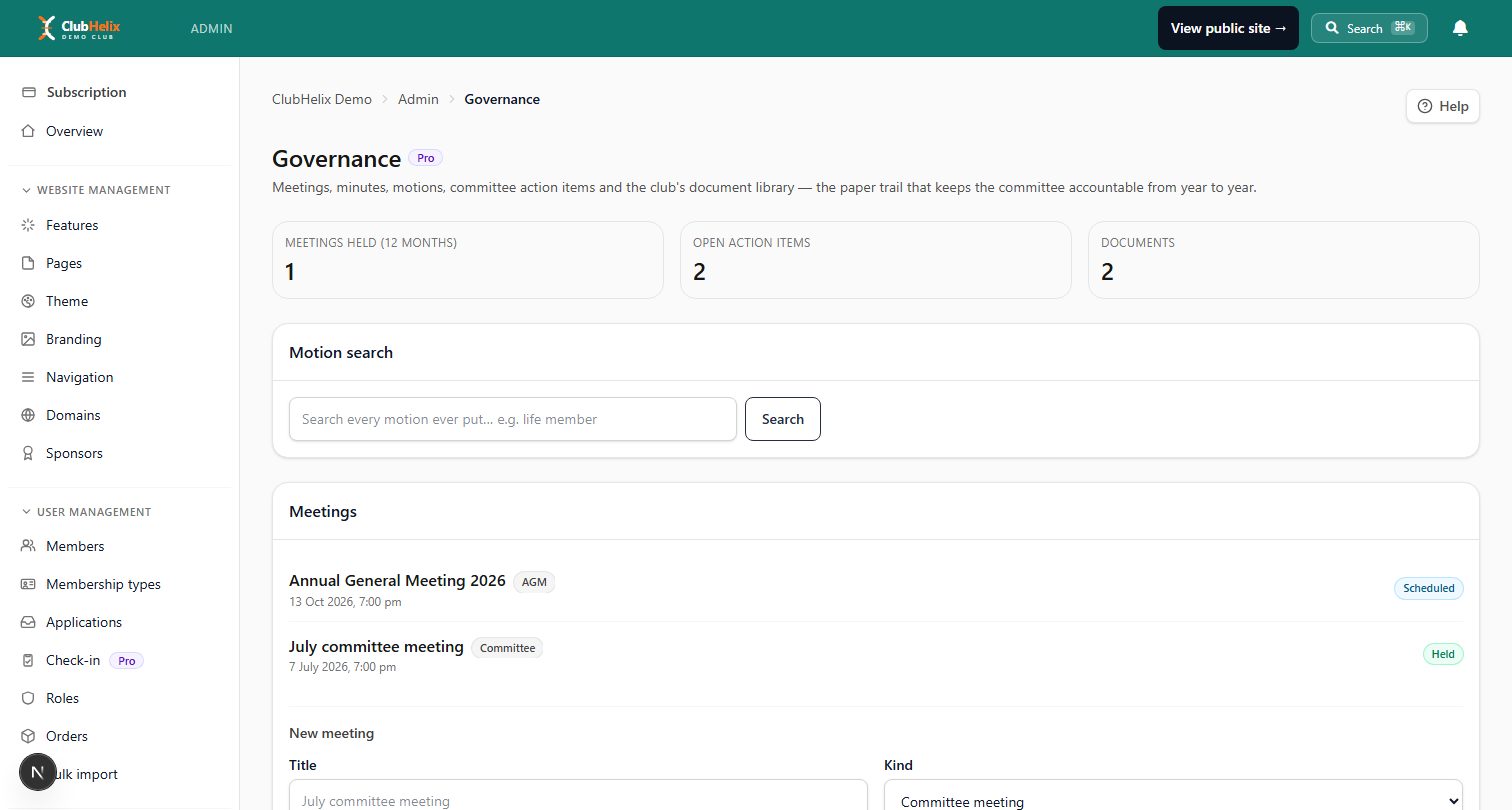
Most societies of this size are incorporated associations under their state or territory's associations legislation — a public officer, rules that align with the model rules, an annual general meeting, and annual financial statements with a review or audit once revenue passes the tier thresholds. A society operating across several states, or one that wants a single national identity, often moves to a company limited by guarantee registered nationally instead, which brings directors' duties, a constitution and annual obligations to the corporate regulator. If your purposes are charitable, registration with the national charities regulator and an annual information statement sit on top of, not instead of, your incorporation duties. Whichever shape you take, the practical governance obligations are the same: hold the AGM your rules require, give proper notice, keep the register, and file on time. Our AGM guide covers notice and quorum in detail. General information, not legal advice.
The conference and the journal
These are the two activities that make a professional society feel like an institution, and the two most capable of consuming a volunteer council whole.
The conference is almost always your largest single financial exposure. Three numbers govern it. The venue minimum is what you owe whether or not anyone comes. The catering guarantee is the head count you confirm seven to ten days out and pay for regardless. And break-even is fixed costs divided by (registration price minus variable cost per head). Work that out before you announce anything: if break-even sits above about 65% of last year's realistic attendance, you are placing a bet rather than making a plan, and the honest response is a smaller venue, not a bigger marketing push.
A workable timeline for an annual conference is twelve months, and the milestones are unforgiving: venue and dates locked at month twelve, call for abstracts at month eight with a six-week window, program drafted at month five, early-bird registration opening at month four and closing eight to ten weeks out, the final program at month two, and the catering guarantee confirmed in the final fortnight. Sponsorship and exhibition income should cover your fixed costs; registration income covers the variable costs and the surplus. And set the non-member registration rate above the member rate plus a full year's subscription — every single time.
The journal or publication is a different animal. Its problems are editorial continuity (an honorary editor who has held the role for eleven years and has no successor), peer review turnaround, and the strategic question of whether it is a member benefit behind a login or open access with a different funding model. Whichever you choose, treat the back issues as an asset: a properly indexed, searchable archive on your own site is often the most-visited part of a learned society's website, and it is the thing that brings non-members into contact with you in the first place. Awards and prizes deserve the same treatment — a published nomination window, a panel with a written remit, and a citation that becomes a news item.
Both activities need a named owner, a written run sheet and a budget the council has actually approved. Our treasurer's report template gives the council a format it can read in five minutes, and the meeting minutes template keeps the record of what was approved.
The society's operating year
Most councils rediscover their own calendar every year. Write it down once, put it somewhere the whole council can see, and it becomes an inheritance rather than a memory.
| When | What has to happen | The failure it prevents |
|---|---|---|
| 3 months before renewal | Price list approved by council, concession rates confirmed, renewal notices drafted | Prices set in a hurry and announced late |
| Renewal month | Renewal campaign runs the full lapse ladder; institutional renewals handled personally | 18% attrition becoming 30% |
| 6 weeks after renewal | Lapsed list worked personally by branch, not by another mass email | Losing members who simply forgot |
| Quarterly | Council meets; committee reports; branch returns in; register of interests refreshed | Branch balances nobody has seen |
| Annually, after year end | Accounts prepared, reviewed or audited to your threshold, and filed | A late filing that costs money and credibility |
| Annually, before the AGM | Notice issued to the period your rules require; nominations opened; annual report drafted | An AGM that is technically invalid |
| At the AGM | Elections, accounts adopted, subscription rates set for the coming year | Rates that never rise and a society that slowly goes broke |
| Within two weeks of the AGM | Handover: access, records, bank signatories, supplier contacts, obligations outstanding | The outgoing officer who "will send it through" |
| Once a year, any month | Eligibility sweep for grade upgrades; register cleaned; dead addresses removed | A register that overstates the society by 15% |
Two rows carry more weight than the rest. Set the subscription rate every year, even if the answer is no change — societies that skip the decision go a decade without an increase and then need a 40% jump that costs them members. And do the handover inside a fortnight, with access granted per person rather than by passing on a shared login; the committee handover checklist works just as well for an honorary secretary as for a club committee, and club succession planning covers the longer horizon.
Frequently asked questions
How much should a professional society charge for membership?
Anchor the standard grade on something the member already values rather than on your costs — roughly the price of a single day at your own conference, or an hour of the member's own charge-out rate, is a defensible starting point for most professions. Then check it against the ladder: students at 15–25% of the standard rate, associates at 50–70%, retired at 30–50%, fellows sometimes at a premium that reflects status rather than cost. The mistake is not being too expensive; it is leaving the rate untouched for eight years and then needing a step change. Review it annually at the AGM even when the answer is no change.
Should our branches have their own bank accounts?
Only if you can see them. A branch float of $500 to $2,000 with a mandatory one-page quarterly return is a reasonable arrangement that gives branch committees the autonomy they need to buy a room and a round of sandwiches. A branch account with no reporting line, one signatory and no visibility from the centre is a governance problem that becomes a crisis roughly the year that signatory stops answering email. If you cannot get quarterly returns reliably, move to reimbursement from the centre and pay within a week so nobody resents it.
How do we keep the member register out of one person's spreadsheet?
Move it to a system the society owns rather than a file a person owns, then give access by role — membership secretary, treasurer, branch chair — instead of by password. That change alone fixes three problems at once: the register survives the volunteer, several people can work on it without emailing versions around, and you can remove a former officer's access in one action rather than changing a password everyone shares. It also means a member can maintain their own contact details, which is the only email-address cleaning method that actually scales.
Can a volunteer society really run CPD records without a secretariat?
Yes, provided members do the data entry and the system does the reminders. The workable division is that your society records attendance at its own activities automatically and issues certificates from that data, members log their external activity themselves against their own record, and the system handles expiry warnings and cycle totals. What does not scale is a volunteer reissuing certificates on request, chasing expiring credentials by hand, or reconstructing attendance from photographs of sign-in sheets. Get the attendance capture right and the rest follows.
Should we register as a charity or seek tax-exempt status?
It depends on your purposes, not your size. A body that mainly advances the interests of its members' profession is a different thing from one that mainly advances a field of knowledge for public benefit, and the second is much more likely to qualify. Do not chase the status for its own sake — it brings real annual reporting, and it can restrict activity you currently take for granted. This is general information, not legal or tax advice: get a determination once, properly, and write it into your constitution.
For a body with charitable purposes, that means registration with the national charities regulator and an annual information statement, with income tax exemption following. Deductible gift recipient status is a further and much narrower category that most professional bodies will not meet. Take advice before applying rather than after.
Where ClubHelix fits
Almost everything that makes a professional society fragile is administrative: a register in one volunteer's spreadsheet, renewals sent from a personal address, CPD certificates that exist only in members' inboxes, branch balances nobody has seen, and governance records scattered across a decade of handovers. ClubHelix puts the society's website, member register with grades and custom fields, self-serve joining and renewal, event registration and attendance, accreditation and CPD tracking, email to the whole list and role-based committee access in one place that belongs to the society rather than to whoever set it up.
Because a parent organisation can sit above its branches in the same structure, each branch can run its own page, events and local mailing while the centre keeps one register and one set of numbers. If you also run an alumni or graduate network, the same approach is covered in our alumni association guide, and course and faculty bodies are covered in the academic society guide. Have a look at the ready-made site templates and the pricing page before you commit to anything.
ClubHelix gives your society one home for joining and renewals, CPD and accreditation records and council meetings, minutes and resolutions. Start free and move the register off the spreadsheet this month.


