
What this guide answers
- How much should university sports club subs be?
Work from the season's real cost rather than from what feels fair.
- What do we do when we cannot field a team on Saturday?
Act on Wednesday, not Saturday morning. If availability closes mid-week and you are short, work the reserve list first, then the second team, then ask the opposition whether they will play a reduced-numbers or…
- How do we get more training time?
Bring evidence, ask early, and be the club that is easy to allocate to.
- Do we need our own insurance, or does the university cover us?
Almost never in the way a committee assumes, and "the university covers us" is the most expensive sentence in student sport.
- Should we run our own website when we already have a page on the association's site?
The association's directory page is a listing, not a home: you cannot take subs through it, publish a fixture list on it, or hand it to next year's committee with the data intact.
New Zealand edition. This guide is written for volunteer-run clubs in New Zealand. Where rules differ — grants, tax, incorporation, safeguarding — follow the New Zealand-specific pointers below or check with your national body.
A university sports club is six people on a committee, a squad list of forty-five, two hours of court time on a Tuesday night, and a competition entry form that closes in the middle of a break while everyone is at home. Nobody on the committee has run one before. Two of them will have graduated before the season they are entering has finished.
That is what separates a sports club from the societies around it. A society that has a quiet term loses momentum. A sports club that has a quiet term forfeits a fixture, pays the fine, loses its Tuesday slot to the club that filled theirs, and turns up to next year's allocation meeting with a weaker case. Sport runs on commitments made months ahead by people who will not be there to see them through — entries, bookings, kit orders, coaching hours, registrations and cover — and it punishes a committee that treats the admin as something to do once training is finished.
This guide is about that half of the job: the slots, the squad list, the entry deadlines, the kit order, the money, and the turnover that takes a third of your playing members away every twelve months. It assumes you are unpaid, time-poor and running the club from your phone between lectures, because that is who runs university sport.
The three calendars, and not one of them is yours
Nearly every deadline that matters to your club is set by somebody else, and the three that matter most rarely line up with each other — or with your committee year.
| Calendar | Who sets it | When it usually bites | What it costs to miss |
|---|---|---|---|
| Facility allocation | the campus sport or recreation service | 8–16 weeks before teaching starts, sometimes at the end of last year | You train in whatever is left: 9pm Friday, or nothing |
| Competition entry | the league, association or governing body | 2–4 months before the first fixture, usually over a break | A season in a lower grade, or no season at all |
| Member registration | your student association plus the sport's governing body | The first weeks of term, then rolling all year | Unregistered players, which usually means uninsured players |
| Your own committee year | your constitution | AGM and handover late in the year | The people who made the commitments have already left |
Read that table twice, because the collision in it is the single most common way a university sports club has a bad year. Your entry and allocation deadlines almost always fall before the committee that will live with them is elected, let alone trained. A club that only starts thinking about next season after its AGM has already lost the argument for court time and missed at least one entry window.
There are two fixes and you want both. Move your AGM early enough that the incoming and outgoing committees overlap for a real handover rather than a cliff. Then write into your standing orders exactly which role submits which form and by when — facility bookings by the secretary, competition entries by the club captain, registration renewals by the membership officer — and give the outgoing committee an explicit final task list with dates on it. Keep a one-page sheet of fixed dates somewhere the whole club can see it, on the club's own website rather than in one person's phone, so next year's committee inherits them instead of rediscovering them the hard way. The broader version of this annual rhythm is in our guide to running a student society.
Training slots are the club's real currency
Ask a committee what its biggest problem is and you will hear "money". Watch the club for a term and the answer is almost always time on a surface: court hours, pool lanes, a pitch in winter, a hall with a decent floor, a strength room at a civilised hour.
Facility allocation is rarely a lottery. Most campus sport services rank clubs on four things: paid member numbers, competitive commitments (a club with fixtures beats a club with vibes), attendance history, and whether last year's slots were actually used. That last one is where clubs quietly lose. A slot you booked and half-filled is a slot you will not be given again, and "we had a slow term" is not an argument anybody records.
So take an attendance register from the first session of the year. It is not bureaucracy — it is the evidence you will need. "We averaged 31 across eleven Tuesdays and turned people away twice" wins a second slot; "we're really popular" does not. The same register tells you who was in the building when somebody rolled an ankle, backs up a grant application, and settles selection arguments.
A few habits make a scarce slot go further:
- Split the block rather than crowding it. Two hours with 45 people is not a session. Run the competitive squad for the first hour and the development group for the second, or overlap them in halves with a shared warm-up.
- Cap sessions and let people sign up. A free-for-all gives you 60 one week and nine the next, and no way to plan.
- Publish the whole term at once as a recurring schedule, not as eleven separate messages that only reach whoever has notifications on.
- Assume four to six weeks of nothing around exams, when facilities are reallocated or closed, and plan an off-season: a social, a conditioning program, an equipment audit.
- Never hand a slot back casually. Clubs that give up a booking in a quiet week routinely find it gone permanently.
If your club runs its own space or its own booking sheet — a shed, a court, a gym you sublet — the same discipline applies, just with you doing the allocating. Our campus room booking guide covers the mechanics of holding a recurring slot.
Membership, registration and the cover that comes with it
University sport almost always has two memberships, and new committees collide with this in about week three, when a player is told at the ground that they cannot take the field.
The first is your club subscription — the money you set, collect and spend. The second is registration with the sport's governing body or the competition itself: a separate fee, a separate portal, a separate deadline, and usually the thing that carries the playing insurance. Some campuses add a third layer, a sport centre membership or facility pass that every player needs simply to get through the door. None of the three know about each other, and no one will tell you when a player has only done one of them.
Treat registration as part of joining rather than an afterthought. One sign-up flow that takes the subs, records the governing-body number, captures an emergency contact, asks the medical question and flags who is not yet cleared to play will save your captain an entire season of chasing. What to hold on a playing member:
- Name and preferred name, a university email and a personal email that survives graduation.
- Membership type — playing, social, development, life — and the date it expires.
- Governing-body registration number and its expiry date.
- Emergency contact, with the member's agreement that you may use it.
- Medical information you will actually act on: asthma, a serious allergy, a concussion history. Nothing you have no plan for.
- Consent flags for photography and for non-essential email.
- Kit size — collected once at sign-up, which saves a spreadsheet later.
Your club affiliates through the campus students' association, and usually also deals with a separate university recreation or sport service that controls the gym, the courts and the fields. The association will want a constitution (most publish a template you can adopt almost as-is), a committee list, a minimum number of enrolled student members and sign-off on its club policies. The recreation service runs its own facility allocation round and often holds the coaching budget, so make yourself known there early rather than at your first crisis. Player registration normally happens on the national body's portal via your regional or district association, and that registration is usually what carries the playing cover — a player who has not completed it should not take the field. Public liability for approved activities generally comes through the association's own policy instead. Ask both for the certificate at the start of every year and read what is excluded, particularly for travel. This is general information — your association's clubs coordinator and your regional body set the actual rules.
Collecting subs at a trestle table in cash is how clubs end up with a treasurer holding $900 in an envelope and no record of who paid. Take it online at sign-up instead — our membership fees guide works through the pricing, and collecting fees online covers the mechanics.
Squads, availability and selection
The most time-consuming job in a university sports club is not coaching and it is not money. It is finding out who is available on Saturday.
The pattern is identical everywhere. The captain posts on Wednesday. Fourteen of forty reply. A reminder goes out Thursday night. On Friday three people remember an assignment. On Saturday morning somebody drives to the ground with nine players for an eleven-a-side fixture, and the club pays the forfeit.
Structure fixes this far better than nagging does:
- Set a closing time and honour it. Availability closes Wednesday at 6pm; silence means unavailable. Say it once at the start of the season, then actually hold the line — the first week you pick someone who did not reply, you have taught everybody that the deadline is fictional.
- Ask for the term, not the week. A single start-of-term form ("which Saturdays are you away? any placement or work commitments?") removes most of the weekly churn before it starts.
- Keep two named reserves per fixture, contacted in order, rather than a general plea to the group chat at 9pm on Friday.
- Publish selections on the same day each week. People plan their weekend around it, and predictability is retention.
- Record who actually played. You need it for selection fairness, for governing-body eligibility checks, for awards and colours at the end of the year, and to notice the promising second-year who played four games early in the year and has not been picked since.
The other structural decision is how many teams you run. The most common failure mode in a university club is being, in reality, one first team with thirty people watching. If you have more than about twenty playing members and only one team, you are training people to leave. A second team, a mixed or social side, or a genuine beginners' session gives everyone a game and gives you next year's firsts.
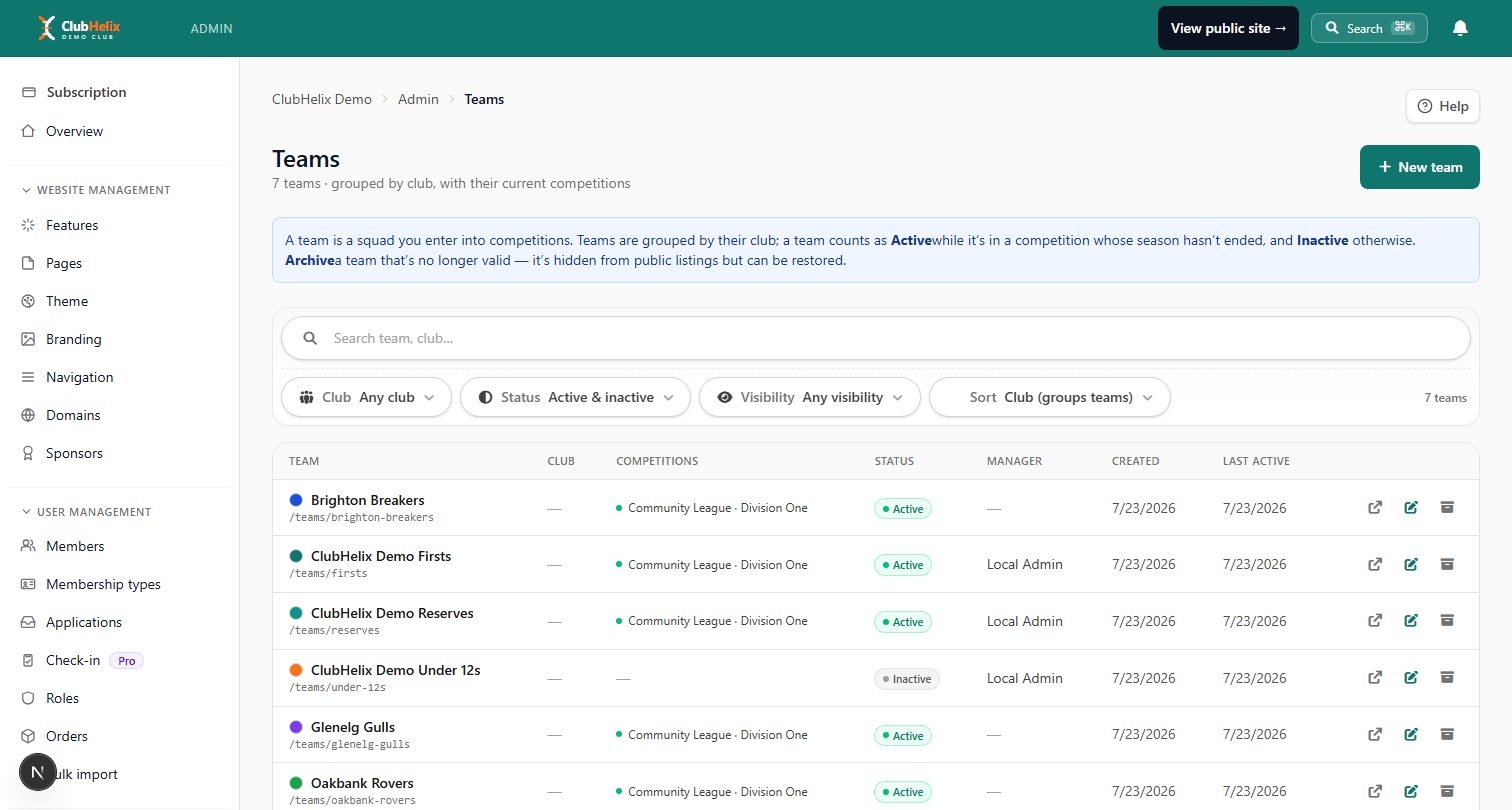
Running each squad as its own team with a roster, staff and schedule means the captain sees availability, selections and attendance in one place rather than reconstructing them from three chat threads, and it stays with the club when the captain graduates.
Entering a league and running a season
Entering a competition is the biggest commitment a student committee makes, and it is usually made before anyone has seen the squad. The entry is a promise to field a team every week for months, on dates you do not control, with officials to pay and results to file.
Before you enter anything, get last season's fee schedule and write down the true cost of a season: team nomination, per-player registration, officials' fees per fixture, any bond or levy, travel, and the fines schedule. Then work out what that is per playing member, because that number — not a feeling — is what your subs need to cover.
Most clubs play in a regional or district association competition, nominating a team before the season and registering every player on the national body's portal. Entry usually means a nomination fee, a per-player registration, and referee or umpire levies charged per fixture or up front. Alongside that sits the tertiary sport calendar — national university championships in individual sports and the multi-sport tournament weeks that clubs enter as a team — with entries, levies and travel due months ahead, generally over a break when the committee is scattered across the country. Results are usually filed online within a day or two, with default fees or points deductions for late results and for defaults; a default commonly costs the fee plus the officials' fees plus your standing in the grade. Ask the association for last season's fee schedule before you set subs, and put break-period entries on the outgoing committee's list. This is general information — the association's by-laws govern.
Two roles make a season run. The fixture secretary owns the calendar, the opposition contacts and the results submissions, and files every result inside the league's window — usually 24 to 48 hours, with a fine attached to lateness. The home fixture host owns everything that makes a home game happen: keys, line marking, nets or goals, a scorer, a stocked first aid kit, the officials' payment, and directions and parking sent to the opposition two days ahead.
When you genuinely cannot field a team, withdraw properly and early rather than defaulting on the day. A withdrawal before the league's deadline usually costs a fee; a no-show costs the fine, the officials, the opposition's travel and a reputation that takes two seasons to repair.
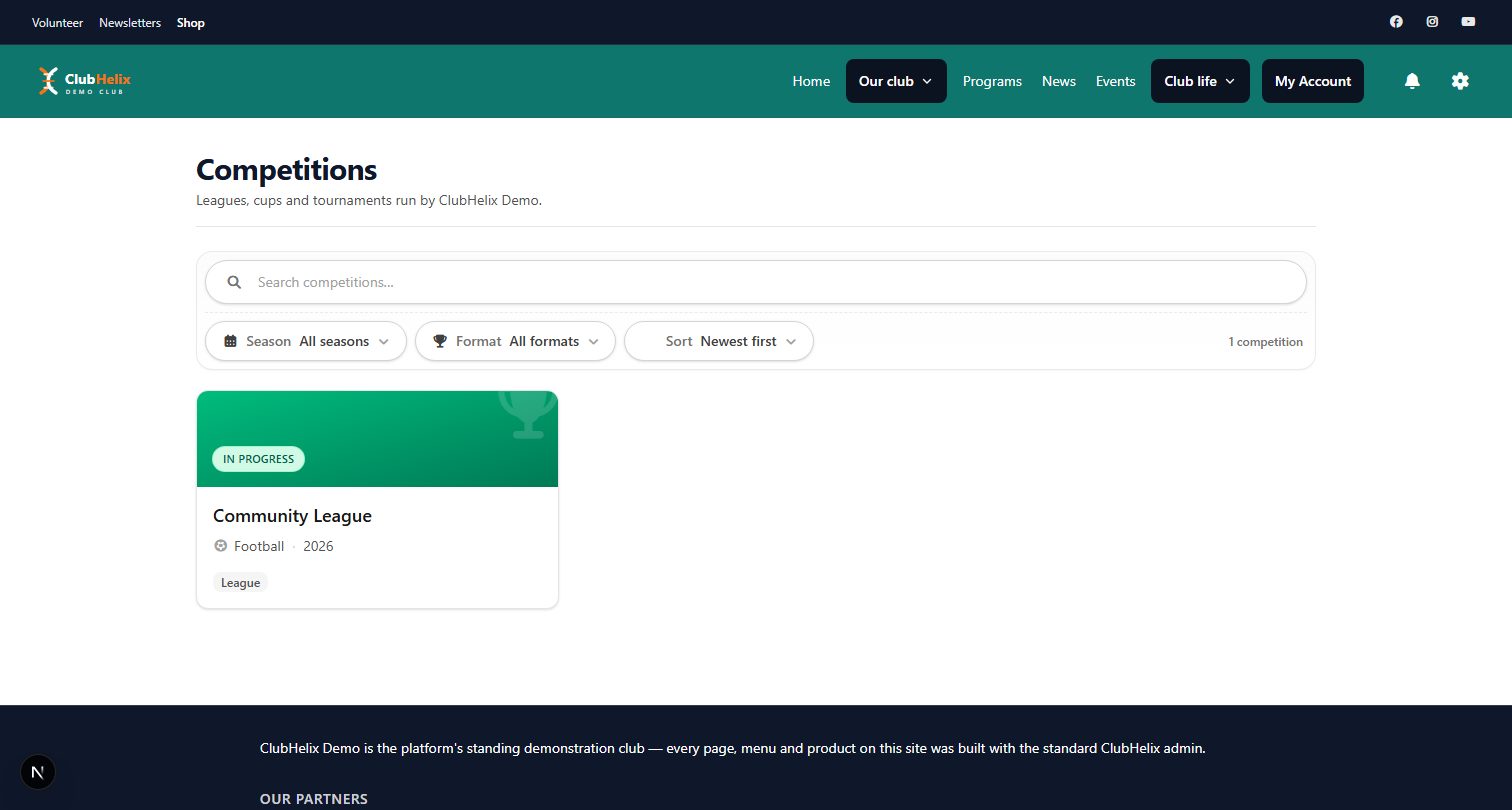
Keeping fixtures, results and ladders on your own site rather than only in the league's portal means members, parents and prospective players can see the season without a login, and next year's committee inherits the record instead of the story.
Coaches, kit and the money that leaves before it arrives
University sports club money has an awkward shape: almost all of the income arrives in the first month, and almost all of the spending happens in the first six weeks. A club with 45 members paying $60 has $2,700 in hand — and a season that might cost $400 in league entry, $300 in officials' fees across ten fixtures, $1,200 for a coach at $60 an hour for twenty sessions, plus balls, tape, a first aid restock and a kit order. You can be broke by week six while feeling rich in week two.
Two numbers keep you solvent. The float is the cash you need before subs arrive — the deposit, the entry fee, the fair stall. The reserve is what you deliberately leave for next year's committee so they can pay an entry fee in July without a bake sale first. Write the reserve into the budget as a line item, somewhere between $500 and $1,000 for a competitive club, or it will be spent on pizza in week nine. Our budget template is built for exactly this kind of term-by-term cash view.
Kit is where clubs lose money quietly. Suppliers want six to ten weeks, and often a minimum order quantity. The classic mistake is ordering thirty hoodies, selling twenty-two, and carrying the rest as dead stock the treasurer inherits. Run kit as a pre-order with a hard closing date, take the money before you place the order, and add only two or three spares in the most common sizes. Numbered playing kit belongs to the club, not the player: issue it against a deposit or a signature, and record who has what, because at least three sets will otherwise leave with graduating members every year.
Coaches are the other large line. Some clubs get by on an alumnus who turns up on Tuesdays, and there is nothing wrong with that as long as you say thank you properly and cover their costs. If you pay someone, the arrangement needs to be in writing before the season: how many sessions, what the hourly rate is, what is included (session plans? match day? selection?), and how they are paid. Paying a coach cash from the subs tin with no record is the single most common way a student committee creates a problem for the committee after it.
Money beyond subs mostly comes from association club grant rounds funded by the student services levy, released against receipts and generally favouring equipment, entry fees and travel over wages. Community trusts and gaming trusts fund gear and one-off projects and are worth a proper application rather than a rushed one, and regional sport trusts sometimes run participation funding. Local sponsorship — a venue, a physio, a business that wants a few hundred students — is realistic at a few hundred dollars a season if you can show reach and attendance. On coaches: ask the association's finance staff whether the coach should invoice as a contractor or go on a payroll with tax deducted, because that choice has consequences that are not yours to guess at. Anyone coaching children needs a children's worker safety check, which takes weeks to come back. GST is very unlikely at typical club turnover. General information only, not tax or legal advice.
If subs and grants do not cover the season, sponsorship is the next lever, and university clubs sell better than they think: a few hundred students, a weekly audience and a website with real traffic. Our sponsorship guide covers building an offer worth paying for.
Injuries, safety and the culture question
Sport hurts people occasionally, and a student committee is what stands between an ordinary injury and a bad one.
Carry a stocked first aid kit to every session and fixture, and make sure at least two people know where it lives and what is in it. Check the contents monthly — the kit that has been in the cupboard since 2023 has expired tape and no ice. If your sport has any contact or speed in it, have a currently qualified first aider on the committee and put the cost of that course in the budget as a fixed line, not an afterthought.
Concussion deserves its own paragraph because student committees routinely get it wrong. If a player takes a knock to the head and shows any sign of concussion, they do not return to play that day — not for the last ten minutes, not because it is a big game. The graduated return-to-play protocol is set by your sport's governing body: follow theirs rather than something from the internet, write down who was assessed, when, and by whom, and tell the player's captain and coach so nobody quietly picks them next week. This is general information; the governing body's protocol is what applies to you.
Write an incident report for anything that needed first aid, anything that involved an ambulance, any near miss and anything that might later become a claim or a complaint. Notes written on the night are worth ten times a recollection three months later, and a club that can produce a clear, contemporaneous record is in a completely different position from one that cannot. Keeping incident records and event risk assessments in the club's own system rather than in a captain's notes app is a five-minute decision that occasionally matters enormously.
Then there is culture, which is the risk that actually ends university sports clubs. More clubs are disaffiliated for what happened at a social than for anything that happened in competition. Initiations — in any form, however affectionately described — are banned by most student associations and are grounds for losing your affiliation, your funding and your slots in a single meeting. Write a code of conduct that explicitly covers socials and tours, name a sober committee member as responsible on every social night, always run an alcohol-free alternative, and make the first social of the year one that a nervous first-year can attend without drinking. It costs nothing and it changes who stays. If you tour, the trips and tours guide covers consent, transport and the paperwork your association will want first.
The three-year clock, and the handover that beats it
Here is the arithmetic no other kind of club has to live with. A three-year degree means you lose roughly a third of your playing members every year, and your best and most reliable players are usually the ones closest to leaving. A club that recruits only at the start-of-year club fair will halve within two years, no matter how good its season was.
Three habits hold the numbers up. Recruit twice — at the fair and again at the start of the second half of the year, when the people whose first choice did not work out are looking for somewhere to go. Run a genuine beginners' pathway, a session where turning up having never played is normal and the club lends you the gear, because that is where your next three years of members come from. And appoint vice-captains and deputies from first and second years deliberately, as apprenticeships, so that by the time nominations open there are two or three people who already know how the club runs. Our retention guide has more on keeping the people you already recruited.
Then hand over properly. Hold the meeting within two weeks of the AGM, with both committees present, and tick each item only when the incoming holder has personally logged in, opened the folder or spoken to the contact.
- Facility bookings — the slots you hold, their reference numbers, the login for the booking system, and the date the next allocation round opens.
- Competitions — what you entered, the entry deadlines and fees, the results portal login, your club's registration number, and any outstanding fines.
- Player registration — what each player must complete, when it expires, who administers it and where the portal is.
- Cover — what you have, through whom, what it excludes and the claim contact.
- The squad list and playing records, transferred inside the club's own system rather than exported to a personal spreadsheet.
- Money — the balance, the reserve you are leaving, subs collected against subs owed, unpaid invoices, and any player who still owes for kit.
- The coach arrangement — hours, rate, how they are paid, the agreement in writing, and whether they are returning next season.
- Kit — supplier account, lead time, sizing chart, current stock, and who is holding numbered playing kit.
- Equipment inventory and where it physically lives, plus the key or the door code to the cage.
- Venues and opposition contacts — who to ring at each club, what the parking is like, which ground has no changing rooms.
- Incident records and anything still open.
- Access, not passwords — create accounts for the incoming committee and remove the outgoing ones the same afternoon.
That last item is the one clubs get wrong most often. A shared login means you cannot remove one person without disrupting everybody, you cannot see who did what, and a graduate keeps access to forty-five members' emergency contacts indefinitely. The full agenda, with the meeting structure, is in our society handover checklist, and the general committee handover checklist covers the same ground for community clubs.
Frequently asked questions
How much should university sports club subs be?
Work from the season's real cost rather than from what feels fair. Add the competition entry, per-player registration, officials' fees, facility hire you actually pay for, coaching hours and consumables, divide by a conservative estimate of playing members, then add a margin for the reserve. Most university clubs land far higher than a social society — a coffee-and-a-half membership does not fund a coach — so be upfront about what the money buys, offer a lower social or non-playing rate, and quietly offer a concession to anyone for whom cost is the barrier. Our membership fees guide has the full pricing walkthrough.
What do we do when we cannot field a team on Saturday?
Act on Wednesday, not Saturday morning. If availability closes mid-week and you are short, work the reserve list first, then the second team, then ask the opposition whether they will play a reduced-numbers or shortened fixture — many will, and most leagues would rather see a game than a default. If none of that works, tell the league and the opposition as early as the rules allow, because an early withdrawal usually costs a fee while a no-show costs the fine, the officials and the opposition's travel. If it happens twice, the problem is not availability, it is that you have entered more teams than your squad supports.
How do we get more training time?
Bring evidence, ask early, and be the club that is easy to allocate to. Take an attendance register from week one, so you can show average numbers, the weeks you turned people away and your growth on last year. Submit your request in the allocation round rather than by email in week four, name the specific slots you want and the ones you would accept as a fallback, and demonstrate that you used last year's time properly. Volunteering to take an unpopular early or late slot for one term is also a surprisingly effective way to build a case for a better one.
Do we need our own insurance, or does the university cover us?
Almost never in the way a committee assumes, and "the university covers us" is the most expensive sentence in student sport. Cover usually arrives in layers from different places — your student association, the sport's governing body registration, and sometimes the campus sport service — and each layer has its own exclusions. Ask for the certificate in writing at the start of every year, and specifically check what applies on tour and at off-campus events. This is general information rather than advice.
Personal injury from an accident is covered by the national accident compensation scheme regardless of your club, which is why most clubs carry no personal accident policy — but public liability for approved activity comes through the association, and your national body's registration may add cover of its own. Get the certificates and read the travel clauses.
Should we run our own website when we already have a page on the association's site?
The association's directory page is a listing, not a home: you cannot take subs through it, publish a fixture list on it, or hand it to next year's committee with the data intact. A club site of your own gives you sign-ups and payments in one flow, a live fixtures and results page prospective players can find, a training schedule that is not eleven chat messages, and a member list that belongs to the club. It also gives you something to show a sponsor. Our rowing club guide covers the same ground for community clubs with squads and early starts.
Where ClubHelix fits
Most of what makes a university sports club fragile is administrative: the squad list in a graduating captain's spreadsheet, the registration nobody checked, the subs collected in cash, the fixture list that only exists in a league portal. ClubHelix puts the club's website, member register with paid sign-ups, teams and squads, fixtures, results and ladders and availability and attendance in one place that belongs to the club rather than to whoever set it up — so the handover is a permissions change, not an excavation. A student association or campus sport service can sit above its affiliated clubs in the same structure, each club running its own site and records.
If you want to see what that looks like before committing to anything, browse the ready-made site templates, read how it fits university clubs and societies, and check the pricing page — the free tier is for building the site and trying it out, and taking sign-ups and payments online starts on the paid plans.
ClubHelix gives your club one home for squads and team schedules, fixtures, results and ladders and availability, RSVPs and attendance. Start free before your next allocation round.


