
What this guide answers
- How far ahead should we start planning a society trip?
Eight weeks is the working minimum for an overnight trip in your own country, and six months is realistic for an overseas tour with flights.
- What happens if not enough people sign up?
Decide the answer before you announce the trip. Set a minimum viable number equal to break-even plus two, put a date on it — usually four weeks out, when balances are due — and say publicly that the trip runs only if…
- Do we have to charge tax on trip tickets?
Almost certainly not at typical society turnover, but the answer depends less on your society than on who actually holds the money.
- Should committee members and trip leaders get free places?
Free places are a real cost, so treat them as a budget line rather than a perk that appears at the end.
- Someone pulled out and wants their money back — what do we actually owe them?
Whatever your published cancellation ladder says, applied consistently to everyone.
A society trip starts as the best idea anyone has had all year. Four weeks later it is a spreadsheet with 22 names on it, a coach quote that expires on Friday, an accommodation deposit that has to be paid before anyone has actually handed over money, and a treasurer asking — reasonably — whether the $1,400 goes out of the society's account or someone's personal card.
Trips are the events members still talk about at the AGM three years later, and the events that expose everything a committee has been quietly getting away with. A social night with a bad head count costs you leftover pizza. A weekend away with a bad head count costs you the difference between 28 beds booked and 19 people who turned up. What follows is the order you actually have to do it in, written for a committee with no travel experience — because that is who runs almost every society trip.
Four tiers of trip, and what each one triggers
Work out which tier you are in before you plan anything, because each step up adds a whole category of obligation rather than more of the same.
| Tier | Typical shape | What it adds on top of the tier below |
|---|---|---|
| Day trip | Out at 8am, back by 8pm, no overnight | Risk assessment, emergency contacts, a named leader, a head count discipline |
| One night away | Hostel or bunkhouse, 20–40 people | Accommodation deposit, room lists, an overnight duty roster, a written position on alcohol |
| Multi-day trip, same country | 3–7 nights, two or more transport legs | Staged payments, a published cancellation policy, a leader per vehicle or group, spare cash |
| Overseas tour | Flights, 5–14 nights, sometimes a competition | Travel approval, passports and visas, travel and medical cover, currency, a six-month lead time |
The jump that catches committees out is not the last one — it is the second. The first night away is where you stop being a group of adults who met at a venue and become a group with a duty of care overnight, a bill you signed for, and a member locked out of their room at 2am.
Whatever the tier, a trip sits inside your society's ordinary event process rather than outside it: write the risk assessment as you would for any event, and use the same end-to-end event checklist for everything that is just an event with a longer travel leg. What follows is the extra layer travel adds.
Your guild or student association's clubs and societies (C&S) office is the gate. Expect an off-campus activity or travel approval form, a risk assessment, a participant list and — for anything overnight — a named trip leader, lodged two to four weeks ahead. Overseas travel almost always goes through a second, slower process: the university's travel approval and traveller registration system, which can want six to eight weeks and may refuse a destination outright based on the official travel advisory level. Several guilds subsidise travel from grants funded by the student services and amenities fee, but the grant round usually closes long before you have a firm quote, so submit an indicative budget in the round and refine it after. Two practical points. Approval is not insurance: an accepted form means the form was accepted, and whether cover applies is a separate question you have to ask separately. And the C&S handbook's trip rules are usually a short annexe most committees never open — read it once at the start of your term rather than the week you need it. This is general information; your C&S office is the authority for your campus.
Cost it so it cannot lose money
Every trip cost is either fixed (you owe it whether 12 or 45 people come) or variable (it scales with heads). Sorting your quotes into those two columns is the most useful half-hour of the project, because fixed costs are the only thing that can hurt you. Here is a real-shaped cost sheet for a two-night weekend trip on a 49-seat coach:
| Line | Type | Amount |
|---|---|---|
| Coach hire, return, one driver | Fixed | $1,900 |
| Bunkhouse, 40 beds, whole-site, 2 nights | Fixed | $2,400 |
| First-aid kit, printing, signage, float | Fixed | $300 |
| One catered dinner | Variable | $22 a head |
| Self-catered breakfasts and lunches | Variable | $6 a head |
| Fixed total | $4,600 | |
| Variable per head | $28 |
Now the only formula that matters:
Break-even heads = fixed costs ÷ (ticket price − variable cost per head)
At $150 a ticket each person contributes $122 towards the fixed pile, so you need $4,600 ÷ $122 = 38 people — 78% of a 49-seat coach before you stop losing money. That is not a plan; that is a bet. The working rule: if break-even sits above about 65% of hard capacity, the trip is a gamble, where hard capacity is the smallest of the seats, the beds and the room the venue will actually give you.
You have exactly three levers. Raise the price: at $170 break-even drops to 33 heads, or 67%. Cut the fixed commitment: hire two smaller vehicles you can book progressively rather than one coach you must commit to in full. Or subsidise: apply a $1,200 grant or reserve to the fixed pile and the same $150 ticket breaks even at 28 heads — 57% of capacity, and a trip you can sleep through. Our budget template has the term-by-term cash view this drops into.
Two costs committees consistently forget. Leader places are not free — five committee members riding free on a 49-seat coach remove 10% of your sellable capacity and add $140 of catering, an $890 decision at a $150 ticket, and it belongs in the cost sheet as a line. The float is not the budget: the accommodation deposit falls due before any ticket money arrives, so if your society cannot put $500 on the table today, take deposits before you sign anything at all.
The cancellation ladder you write before you take a cent
Here is the thing nobody tells a first-year treasurer: the moment you pay a supplier's deposit, your refund policy has already been decided for you. You cannot refund money you no longer have. Write the ladder first, publish it at the point of sale, and let it follow the real dates on your supplier contracts rather than how sorry you feel for whoever is asking.
| When they pull out | What they get back | Why |
|---|---|---|
| Before you pay any supplier deposit | Everything | The society has committed nothing |
| After deposits, before the final numbers date | Everything except a stated flat share of deposits ($30) | Catering and beds can still be reduced |
| After the final numbers date | Only if their place is taken from the waiting list | Your bill is fixed from that date onwards |
| No-show on the day | Nothing | The seat and the bed were both paid for |
Three details make that ladder work. Put one calendar date on the "final numbers" row and repeat it in every message about the trip. Keep a genuine waiting list, so the "if your place is resold" clause is real rather than theoretical — on a popular trip it converts most late withdrawals into full refunds at no cost to you. And make places transferable to another member up to that date, which settles half your withdrawals without any money moving through your account.
Collect the money in two steps: a deposit that secures the place, then the balance by a stated date. Sell them as two separate paid registrations — a deposit ticket and a balance ticket — so both are real, receipted transactions rather than a promise in a chat thread. Set the deposit at whatever you must pay suppliers up front divided by expected heads (owe $1,200 in booking deposits, expect 33 people, charge $40), and put the balance date a week before your supplier's final numbers date so you have time to chase.
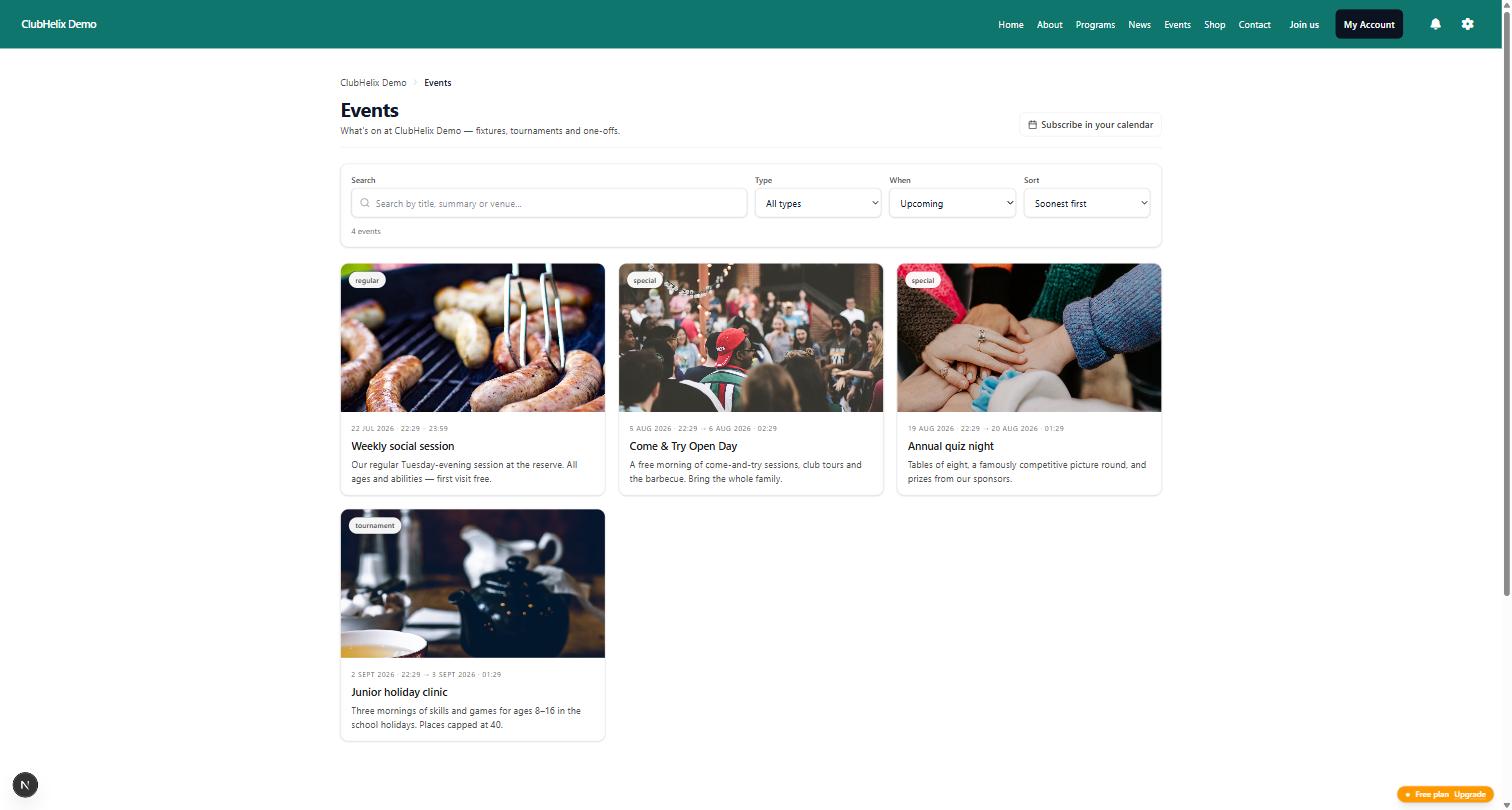
Run the whole thing off one page: date, departure point and time, price, what is included, the cancellation ladder, the final numbers date and the sign-up, with a link you can paste into every message. Sending members from a chat post to a form to an external ticketing site to a payment link loses people at every hop and leaves the treasurer reconciling three lists by hand. Events with ticketing and RSVPs built in keep sign-ups, payments and head count as one record.
Insurance: five questions to ask before you book anything
Do not ask "are we insured?" You will get a yes, and the yes will not mean what you think. Ask these five, in writing, and keep the reply.
- Does our cover apply off campus, and does it still apply overnight? Many umbrella policies are written around on-campus activity and treat residential trips separately.
- Is this specific activity on the covered list or the excluded list? Water, height, snow, motorised anything and contact sport are the usual exclusions.
- Does cover travel with us, and what does it do about medical costs where we are going? Public liability and personal medical cover are different products, and the second generates the frightening bills.
- Who is the organisation named on the policy — us, or the body above us? This decides who may sign the venue contract; a student signing in their own name has taken on personal liability.
- What must we lodge before departure for cover to apply? A form, an itinerary, a participant list, a declared activity, a named leader — cover that exists but is void because a form was late is worse than no cover, because you planned around it.
Question five is the one that catches societies. Ask it early, do what it says, and keep the acknowledgement email in the society's own records folder rather than a personal inbox.
Your guild's public liability policy usually covers approved club activity including approved off-campus events, but personal accident, personal property and travel cover are separate products that may or may not be included. Adventure activities — climbing, caving, water sport, snow, anything motorised — are commonly excluded unless declared and approved in advance, and some are excluded outright unless run by a qualified commercial provider carrying its own cover. Overseas travel is a different conversation again: it normally runs through the university's corporate travel insurance, which typically requires traveller registration before departure and may exclude destinations above a given advisory level. Domestic interstate travel is usually fine under the same guild cover, but confirm rather than assume. Where a commercial provider runs the activity, ask for their certificate of currency and keep a copy — your guild will often ask for it anyway, and it is the fastest way to answer question two. This is general information rather than insurance advice; your guild's insurance contact and the university's travel office can confirm what applies to your society.
Transport is where trips go wrong
More society trips are ruined by transport than by weather, venues and money combined, and almost always in one of four ways.
Self-drive in members' own cars is the most common way a society's cover quietly stops applying. A private motor policy generally covers social and domestic use, not organised group activity, and the moment money changes hands for a seat you may be somewhere the insurer never intended. If you cannot get a straight yes from your umbrella body, do not organise a convoy — and never post a "meet at the car park and we'll sort lifts" plan, because that is organising one without the paperwork.
Hire company rules are stricter than the law: expect a minimum driver age of 21 to 25, a minimum period the licence has been held, and a flat refusal on larger vehicles for anyone under 25. Book the vehicle and name the drivers early.
Licence categories are the second trap — the vehicle that seats your whole society is usually not one a standard car licence covers, and the entitlement is not something you can arrange in a week.
Fatigue is the one that actually hurts people. Two hours' driving at 9am and two hours' driving at 11pm after a full day are different activities. Write hard rules into the trip brief: a break every two hours, two named drivers on any leg over three hours, and nobody drives home the same night after an event that finishes late. If the schedule only works with a tired driver, the schedule is wrong.
Then the maths: a coach with a driver is expensive per seat below about 25 passengers and cheap above 40, so hired vans usually win under 25 heads and lose badly over 35. Whichever you pick, put a named person on each vehicle holding the list of who is on it, and do a head count at every departure — including the service station, because the trip that loses someone does not lose them at the destination.
A standard class C licence covers a vehicle up to 4.5 tonnes carrying up to 12 adults including the driver, which rules out most true buses — those need a light rigid or medium rigid class, obtained through a separate test that takes weeks. Many guilds go further than the law and prohibit members driving their own cars on club activity entirely, or require the vehicle to be declared, roadworthy and comprehensively insured with the driver named. Check that rule before you plan around private cars. Rental companies commonly set 21 as a floor with a surcharge under 25, and 12-seater vans are often 25-plus only. On long interstate legs, treat the heavy-vehicle fatigue guidance as your model even though it does not apply to you: a break every two hours and a hard stop on late-night driving. Toll accounts and fuel cards are worth sorting in advance so one committee member is not personally $300 out of pocket for a fortnight. This is general information; confirm licence requirements with your state or territory road authority.
Who is coming, and what you need to know about them
Collect participant information once, in a single form, at the moment someone pays their deposit. Chasing 34 people for an emergency contact in the last week before departure is a job nobody has time for and a third of them will not do.
What you genuinely need: full name as it appears on identification if a booking or border requires it, the preferred name you will actually shout at a service station, a mobile number, an emergency contact's name, number and relationship, dietary requirements, accessibility requirements, and one carefully worded optional free-text field — "anything a first aider would need to know if you were unwell: conditions, allergies or medication". Add agreement to the code of conduct and the cancellation ladder, both ticked at sign-up.
What you do not need: a full medical history you have no plan for, home addresses, next-of-kin details beyond the one emergency contact, or a stored copy of anyone's passport. If a booking genuinely requires passport details, collect them once, use them, and delete them the day the booking is confirmed.
Then do two things with it. Print one emergency sheet for the trip leader to carry, because phones die and reception fails in exactly the places that generate emergencies — one copy, one holder, destroyed on return. And delete the medical and emergency-contact fields about 30 days after you get home: long enough for any claim, short enough that the next committee does not inherit health data about people who have graduated. Our member records and privacy guide covers the wider habit.
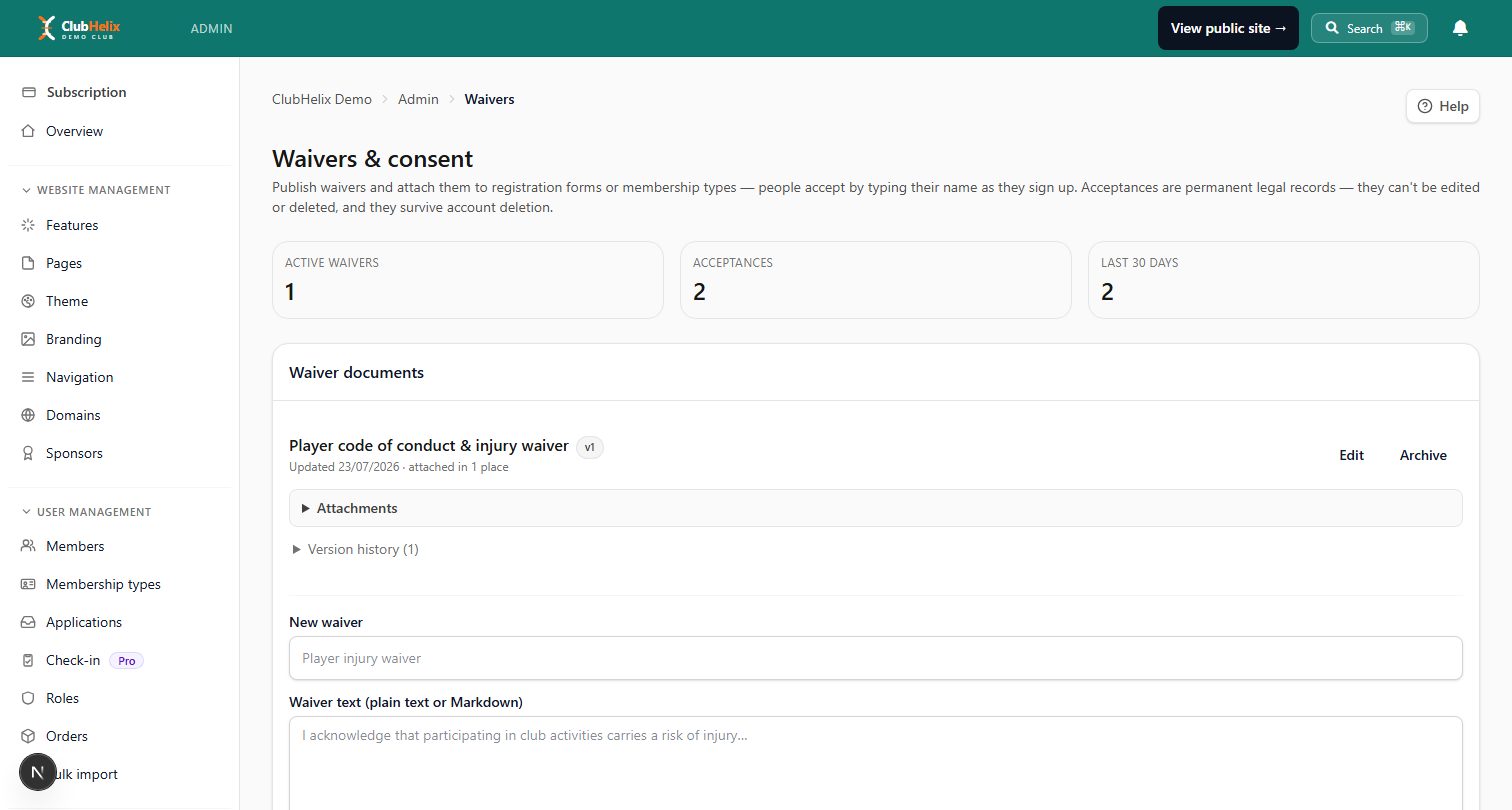
A waiver is not a magic shield — you cannot sign away a duty of care. What it does do is make the risks explicit, record that each participant read them, and give your association the evidence it will ask for. Digital waivers collected at sign-up beat a clipboard at the departure point, which is where you discover that six people have not signed while the coach driver's clock is running. Pair them with self-serve paid registration so the deposit, the form and the waiver are one action for the member and one record for you.
Your society sits under privacy obligations flowing from the Privacy Act and your state's information privacy legislation, and — more immediately — from the guild and university privacy policies your affiliation binds you to. Trip data raises the stakes because health information gets special treatment: collect it only for the trip, keep it only as long as the trip plus a short claims window, restrict it to the leaders who need it, and delete it after. If anyone under 18 is travelling, expect the guild to require a working with children check for the committee members supervising, plus parental consent and a stricter supervision ratio — and start that early, because state processing times are rarely quick. Never email the participant list as an attachment to a group; never put 34 addresses in the To field. Name one committee member as accountable for the trip's information from sign-up to deletion. This is general information rather than legal advice; your guild's privacy contact can confirm what applies to your society.
The eight-week countdown
Trips fail from optimism about time. Work backwards from departure and put every one of these dates in the shared committee calendar the day you decide to go.
- Eight weeks out. Pick dates that dodge exams and other societies' flagship events, get three quotes each for transport and accommodation, build the cost sheet, submit the approval form and risk assessment, and ask the five insurance questions. Announce nothing yet.
- Six weeks out. Publish the trip page with the cancellation ladder on it and open deposits. Book suppliers on deposits actually received, not numbers you hope for. Name a trip leader, a second, and a driver per vehicle.
- Four weeks out. Balances due — and the decision point, below.
- Two weeks out. Final numbers to the venue and caterer, room lists out, leaders briefed on the emergency plan and meeting points, the last three people chased for their form.
- One week out. Send the trip brief: departure point with a photo of exactly where to stand, departure time with a stated cut-off, return time, what to bring, the leader's phone number and the plan for anyone who misses the vehicle. Send it as a broadcast to the trip's registered list so it exists in writing, then post the same thing in the chat, because that is where people will actually look.
- Departure day. Head count before you leave, at every stop and before every departure. Printed emergency sheet with the leader, first-aid kit in the vehicle, leader's phone charged.
- On return. Head count, a message confirming everyone is home, and any incident written up within 24 hours while memories are accurate — the risk assessment guide covers what counts as an incident and who sees it.
- Within a week. Reconcile the money, refund exactly what the ladder says, acquit the grant, and write a ten-line debrief: real cost per head, attendance against break-even, what went wrong, what you would change. File it where next year's committee will find it rather than in a personal drive — the whole point of running the society as an institution rather than a group chat.
Milestone three deserves its own paragraph. If you are below break-even at four weeks, cancel. A trip cancelled at four weeks costs a deposit and some disappointment; a trip cancelled at four days costs everything you have committed, and the committee spends the rest of the year paying it off. Nobody has ever regretted cancelling early.
Frequently asked questions
How far ahead should we start planning a society trip?
Eight weeks is the working minimum for an overnight trip in your own country, and six months is realistic for an overseas tour with flights. The constraint is rarely the booking — it is the approval chain, which routinely wants two to four weeks domestically and six to eight for anything international, plus driver assessments or background checks on top. Suppliers hold quotes for days, so lock the approval before you chase the price.
What happens if not enough people sign up?
Decide the answer before you announce the trip. Set a minimum viable number equal to break-even plus two, put a date on it — usually four weeks out, when balances are due — and say publicly that the trip runs only if that number is reached by then. If you are short on the date, cancel and refund in full, because at four weeks you have usually only committed deposits. The failure mode is holding on for another fortnight in hope, which is how committees turn a $400 loss into a $3,000 one.
Do we have to charge tax on trip tickets?
Almost certainly not at typical society turnover, but the answer depends less on your society than on who actually holds the money. If your funds sit in an account run by your student association or the university, their tax position may apply to what you charge rather than yours, and that can genuinely change a ticket price on a large tour. Ask the relevant finance staff before you publish a price. This is general information, not tax advice.
GST only applies if the society itself is registered, which requires turnover above the registration threshold — well beyond almost every society's income. If your money is held in a guild sub-account, the guild's registration may apply to what you charge, so ask the C&S finance staff before pricing a large tour.
Should committee members and trip leaders get free places?
Free places are a real cost, so treat them as a budget line rather than a perk that appears at the end. The defensible version is that the trip leader and any qualified first aider travel free because they are working, and everyone else pays — five free committee places on a 49-seat coach remove 10% of sellable capacity and push break-even up by several heads. If you want to recognise the organisers, a partial discount funded explicitly from the reserve is honest and easy to explain at the AGM. What is not defensible is a quiet arrangement nobody can find in the accounts.
Someone pulled out and wants their money back — what do we actually owe them?
Whatever your published cancellation ladder says, applied consistently to everyone. That is the entire answer, and it is why the ladder has to exist before you sell the first place. If they withdrew before you committed money, refund in full; if after, refund everything except the stated share of committed costs, and the rest too if their place is taken from the waiting list. Making an exception because someone is upset is how a committee ends up refunding money it has already paid a coach company, and how the next person to ask learns the policy is negotiable.
Where ClubHelix fits
A trip is just an event with a longer tail: money taken in two stages, a form nobody wants to chase, a waiver, a head count and records the next committee needs. ClubHelix keeps all of that in one place that belongs to the society rather than to whoever set it up — the trip page with its date, price and cut-off, the deposit and balance as real paid registrations, digital waivers and participant details captured at sign-up, and the attendance record that becomes evidence in your next grant application.
The same setup handles the ordinary weeks between trips — see how it fits university clubs and societies, browse the site templates, or check the pricing page. Clubs with fixtures and away trips will also want the university sports club guide.
ClubHelix gives your society one home for trip and event sign-ups, waivers and participant details and paid registration that reconciles itself. Start free before you book the coach.


