
What this guide answers
- How many members does a university esports club actually need?
Far fewer than your server count and far more than your competitive rosters.
- Our best player is not enrolled any more — can they still play?
Almost certainly not, and playing them anyway is the most common way student teams lose a season.
- Do we need our own gaming PCs, or is bring-your-own enough?
Bring-your-own is enough for the first two years of almost every club, and buying machines early is how committees strand their whole budget.
- Can we run a paid-entry tournament with a cash prize pool?
Usually yes if the outcome is decided by skill, but the answer changes the moment chance is involved and the money almost never stays in the club's hands.
- How do we stop the club being just the top team?
Give the casual layer a named owner on the committee, a fixed weekly slot and a share of the budget that is written down before the season starts.
Canada edition. This guide is written for volunteer-run clubs in Canada. Where rules differ — grants, tax, incorporation, safeguarding — follow the Canada-specific pointers below or check with your national body.
Your chat server has 940 members. Eleven people came to the last casual night. And at nine o'clock the evening before your first league match, someone works out that the substitute who has played every scrim for six weeks is not actually enrolled any more — he finished his degree in the winter — so the match you are about to play is a forfeit whether you win it or not.
That is the esports club problem in one paragraph, and it is not a discipline problem. It is structural. The game already supplies the venue, the scoreboard, the social space and the schedule, so an esports club can run for a whole year on nothing but a server and goodwill. A rowing club needs a committee before anything can happen at all; you don't. Right up until something asks you to behave like an organisation: a league that wants proof of enrolment, a student association that wants a signed office-bearer list and a budget, a venue that wants a room plan and a risk assessment, and a graduating president who happens to personally own the server your entire membership lives in.
This guide is about closing that gap without killing the thing that made the club fun. It covers the three clubs you are actually running at once, turning a server into a member list, rosters and eligibility checks that decide whether your results count, the weekly rhythm and the room to run it in, a budget with real numbers in it, moderation, and a handover that includes the assets only esports clubs have.
You are running three clubs at once
Almost every failing esports club is failing because the committee has silently picked one of these three layers and let the other two rot. Almost every good one names all three out loud and gives each an owner.
| Layer | Roughly | What they actually want | How it fails |
|---|---|---|---|
| Community / casual | 60–75% of your server | Somewhere to be on a weeknight, no audition, no commitment | Nothing physical ever happens and the server becomes a meme channel |
| In-house ladder | 20–40 people, 4–8 squads | A fixture, an opponent, a result posted somewhere public | Fixtures stop getting scheduled around week three |
| Competitive rosters | 5–15 players per title | Scrim blocks, an in-game leader, verified eligibility, a shot at a final | One player leaves, there is no registered sub, the season ends in forfeits |
The tension is money and attention, and it is worth being honest about it early. Your competitive rosters generate the prestige, the highlight clips and the sponsorship conversations while serving perhaps 5% of your members. Your casual layer generates the attendance numbers that every grant application and affiliation renewal is judged on. A committee that spends 60% of its budget on jerseys and entry fees for fifteen players will be asked awkward questions by a funding panel and, sooner, by its own members.
A workable split for a mid-sized club: half the budget on things everyone can attend (the weekly room, the LAN, the watch parties), a third on competitive costs, and the rest held as a reserve. Write that split down in week one and it stops being a fight in week nine.
Where an esports club sits, and which league you can actually enter
You get ratified by the students' union, students' association or federation of students, usually through a clubs office or clubs commissioner, and how you are classified matters more here than for most groups: registering as a club rather than a sport usually decides which funding pool you draw on and whether you can request storage for equipment. Expect a constitution on the union's template, a signed list of members who are current students (commonly 10 to 25), an executive list, and agreement to the clubs policy. Club funding is typically per term, decided against a submitted budget and paid by reimbursement against receipts — so you need a float to spend first and be repaid later.
Competitive play sits outside the union. Collegiate leagues run their own seasons per title, with registration windows, eligibility rules and roster-lock dates that rarely line up with clubs week. Find the league calendar before you plan the year. Ratification also lapses annually and must be renewed, usually in the first weeks of the fall term — exactly when a brand-new executive is least organised and the league registration window is open. This is general information — confirm the details with your own clubs office.
Whichever structure you sit in, keep one folder with your constitution, your affiliation confirmation, your committee list and last year's report. Our complete student society guide covers the affiliation year in full, and the university sports club guide is worth reading alongside it if you are classified as a sport.
Turn the chat server into a member list
Ask an esports committee how big the club is and you will get the server count, because it is the only number that is easy to find. It is also the least useful. A typical club has 900 in the server, 140 people who posted anything in the last month, 45 who came to something in person, and 38 who paid. Only the last two describe a club.
The server is a communication tool. It is not a membership record, it cannot tell you who is enrolled, it will not survive its owner graduating, and you cannot hand it to a funding panel. Build a real member list beside it in week one and the server keeps doing the job it is good at.
Capture members at sign-up, not afterwards. At the start-of-year fair you want a printed code that opens a form on your own site, so the record exists — correctly spelled, timestamped, with the handle attached — the moment someone joins. A paper list of gamer tags is uniquely useless: handles contain numbers, underscores and capitals that nobody transcribes correctly, and half of them will be illegible by the time you type them up. Our recruitment fair guide covers the stall itself.
What an esports club should record, and roughly nothing more:
- Preferred name and the handle they are known by. In this club, most people genuinely do not know each other's legal names, and your welcome email should not be the first place they see one.
- In-game ID per title they compete in, in the exact format the league asks for (account name plus tag, friend code, profile URL). Store it as a field, not as a message someone posted in March.
- Enrolment status, year and student ID number. Every league eligibility check comes back to this, and chasing it the night before a match is how forfeits happen.
- Titles played, and whether casual or competitive. This is the field that lets you message 40 people about one game instead of 900 about all of them.
- Rank or division at registration, if your league caps entries by rank.
- Consent for photography and for being streamed. Broadcast consent is specific to your club: someone may be happy to be in a group photo but not to have their voice comms cast to a public stream.
- Emergency contact and access needs — collected only for in-person LANs, socials and travel, not held permanently for everyone.
Two things never to record. The first is anyone's account credentials, no matter how convenient it seems for a substitute to log in on match night: account sharing is a ban offence in most competitive titles and a security disaster in every one of them. The second is free-text opinions about members. Every field you collect is a field the next committee inherits and has to protect — the member records and privacy guide covers what that obligation looks like in practice.
Rosters, eligibility and the check that decides whether your results count
This is the section that separates esports clubs from every other society, and it is where seasons are quietly lost. In-game skill decides matches; administration decides whether the match counts.
The rules vary by league and by title, but the shape is remarkably consistent. Players must be currently enrolled, often with a minimum study load. One player, one club, one season. Registered rosters lock at a published date, after which additions need an approved transfer. Substitutes must be registered in advance — a sub who is not on the sheet is not a sub. Account sharing and playing on an alternate account are usually punishable by forfeit, sometimes retroactively across a whole season. Lower divisions frequently cap how many players above a given rank you may field.
Four failure modes account for nearly all of it:
- The ringer. A friend who is "basically at the uni", a recent graduate, someone enrolled at a different institution. They are the strongest player in the server, they will win you the match, and they will lose you the season when the opposing captain checks.
- The unregistered sub. Your main is sick, someone fills in, you win, and the result is overturned three days later.
- The alternate account. A player registers their main and then plays on a smurf because the queue is faster. Same outcome.
- The late roster. Nobody submits before the lock date, and your club spends the season in the wrong division or out of it entirely.
Run a fifteen-minute check before every fixture and none of these happen. The roster pack that makes it fifteen minutes rather than an evening holds seven fields per player: legal name, student ID, handle, in-game ID exactly as registered, rank at registration, main or sub, and a phone number for match day. Keep it with the club's records, not in a captain's messages, and update it the day a roster changes.
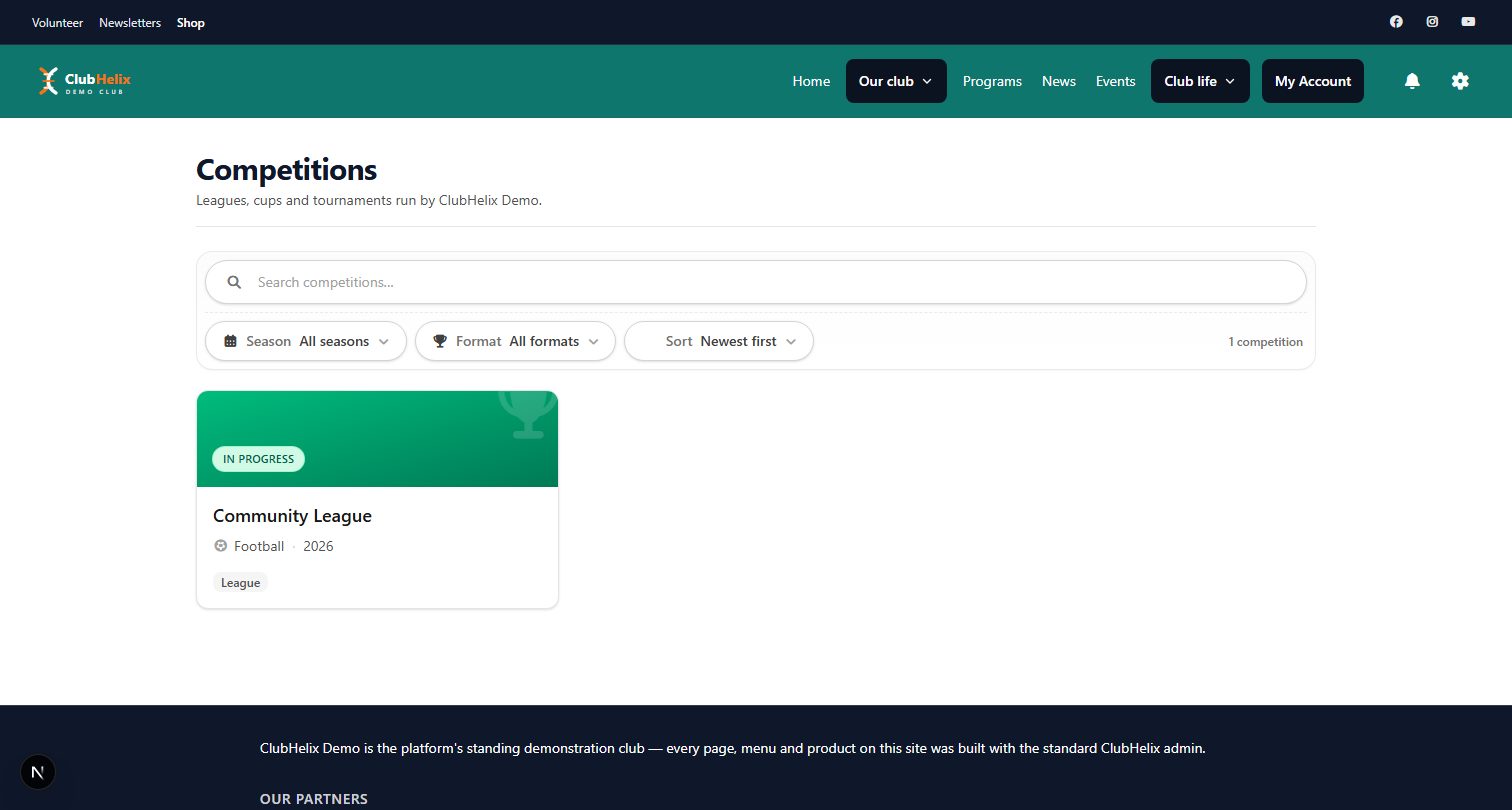
The other half of this section is the fixture list itself. Whether you are entered in an external league or running your own in-house ladder, results need to live somewhere public and permanent — a screenshot posted in a channel is not a season record, and next year's committee cannot use it to prove anything to a funding panel. Published fixtures, results and ladders that compute themselves do that job, and every fixture keeps a match card with lineups and player statistics, which is exactly the evidence a sponsorship or grant conversation needs.
An in-house ladder is also the single best retention tool an esports club has. A six-week internal season across three or four titles, with drafted squads mixing competitive and casual players, converts server lurkers into people who turn up because someone is expecting them. It costs almost nothing, and rosters with captains, positions and team-scoped access mean the captains run their own squads instead of the events officer running eight of them.
Scrims, socials and a room that can take the load
A term's rhythm for a healthy club has four repeating pieces: one casual night in a physical room, one scrim block per competitive roster, one watch party per major tournament, and one weekly message. Everything else is seasonal.
The casual night is the piece that gets skipped and the piece that matters most, because it is where the club becomes a club rather than a contact list. Book the same room, the same night, for the entire term at once — a recurring booking is far easier to get than eight separate ones, and the room bookings guide explains how the campus systems really work.
Booking a room for twenty people carrying gaming laptops is not the same as booking a room for a talk, and four practical things catch committees out:
- Power. Twenty gaming laptops and a couple of monitors will pull more than a teaching room's circuit expects. Ask facilities about circuit capacity, take your own power boards, have them tested and tagged if your campus requires it, and mat or tape every cable that crosses a walkway. This belongs in your event risk assessment, which most associations require before they release a room.
- Network. Campus wireless will not carry a twenty-person LAN, and the network team may block the ports competitive titles use. Ask for wired access or a dedicated segment six weeks ahead, and have a fallback plan of party games and a projector if the answer is no.
- Machines. Computer labs are timetabled, the titles you want are not installed, and you do not have the rights to install them. A bring-your-own-laptop night in a flat-floored room with tables is usually more achievable than negotiating for the lab.
- Storage. If the club owns peripherals, you need somewhere to keep them that is not a committee member's bedroom. Ask at affiliation, when storage is being allocated.
Scrim blocks are training, and treating them that way changes the culture. Schedule the whole term's sessions at once, ask players to mark themselves in, maybe or out in advance, and record who actually turned up. Selection arguments end when a captain can see attendance instead of arguing about it, and a squad view that flags anyone not seen for four weeks gives you a nudge list before renewals rather than a surprise at the AGM.
Open events, ratings and anyone under 18
Open nights, high-school outreach and campus open days are excellent recruitment and the one place an esports club can walk into a genuine compliance problem, because the titles you play carry age classifications and your visitors may be minors.
Games carry ESRB ratings and provincial classification can apply on top, and a Mature-rated title running on a screen at an event that high-school students are invited to is a problem you do not want to explain afterwards. Check the rating of every title on your event's line-up, choose Everyone or Teen titles for anything aimed at prospective students, and keep Mature titles to a separate room or a separate night. Streaming a Mature-rated title to a public audience during an open house is the same problem with a bigger audience.
Working with minors also triggers checks. Executive members involved in outreach, junior coaching or any activity where under-18s are in your care will generally need a vulnerable sector check through the police service where they live, plus your students' union's safeguarding policy — often including supervision ratios and a named responsible adult. Checks can take several weeks and sometimes require an in-person appointment, so start a full term ahead rather than a fortnight. Tell your clubs office what you are planning before you advertise it. This is general information rather than legal advice — confirm with your students' union or a professional.
Money: what an esports club actually spends
Esports clubs are cheap to start and surprisingly easy to overspend, because the two biggest line items — jerseys and hardware — both feel like investments and both can strand a year's budget in a cupboard.
| Line item | Realistic range | The thing to know |
|---|---|---|
| League entry fees | $0–$250 per roster per season | Some circuits are free, some are not; check before you enter four teams |
| Jerseys | $45–$70 each, minimum order 10–15 | Personalised jerseys cannot be resold. Pre-sell and take payment up front |
| Weekly casual night (room, boards, snacks) | $0–$40 a night | The cheapest thing you do and the one that keeps the club alive |
| LAN or flagship event | $400–$1,500 | Venue, tables, cabling, insurance; ticket it so it cannot lose money |
| Club peripherals kit (mice, keyboards, headsets) | $600–$1,200 one-off | Tag it, inventory it, store it somewhere official or it evaporates by March |
| Streaming set-up (capture card, overlays, a spare laptop) | $150–$400 one-off | Borrow before you buy; a broadcast nobody watches is a costly hobby |
| Travel to finals | $300–$1,200 | The cost that ambushes clubs in week ten. Budget it in the first submission |
| Reserve left for the next committee | $300–$600 | Write it in as a line item or it becomes pizza in week eight |
Income comes from membership fees (most student clubs land between $8 and $15 for a year), LAN and social ticket sales, sponsorship and grants. The maths that matters: 900 server members converting at 5% to a $10 membership is $450, which does not fund a season. Converting at 20% is $1,800, which does. That difference is entirely about whether joining is a link that takes twenty seconds and takes payment on the spot, or a bank transfer with a reference number that someone has to chase.
The jersey trap deserves its own warning. Personalised kit has a minimum order, a lead time of four to eight weeks, and no resale value once a name is printed on the back. Run it as a pre-order: open a sale window, collect sizes and names with payment attached, close the window, then place the order for exactly what sold. Clubs that order thirty on the assumption thirty will want one end up with eleven unsold jerseys and no budget for the LAN.
External money mostly comes from students' union club funding and grant applications, usually per term, decided against a submitted budget and paid by reimbursement against receipts — which means you need a float to spend first and be repaid weeks later. Faculty associations hold their own funds, and departments sometimes support esports events tied to computing or design programs. Build the reimbursement lag into your planning: an executive member should never be personally out of pocket for $900 of jerseys for a month.
Sponsorship needs a check before you sign anything. Union sponsorship policies commonly ban gambling and betting sponsors and restrict alcohol, cannabis and energy drink promotion to students, which matters because those are precisely the categories that approach esports clubs first. Skin-betting and wagering sites are a hard no on nearly every campus, and accepting one can cost you ratification. Hardware retailers, internet providers, local venues and graduate recruiters are the sponsors that actually renew. General information only, not tax advice — our sponsorship guide covers building an offer worth paying for.
Keep the whole thing in one simple budget the committee can see. The student society budget template is built for a term-by-term cash view rather than an accountant's format, and the funding and grants guide covers what selection panels actually reward.
Conduct, moderation and the work nobody volunteered for
Every esports committee eventually discovers that it has taken on a moderation job it never agreed to, usually at eleven at night, usually about something said in voice comms.
Write a code of conduct that explicitly covers in-game chat, voice comms and every online space the club runs, because "it happened in the game" is the defence you will hear and it is not one. Slurs in comms during a league fixture can forfeit a match and pull the club into a disciplinary process with your student association attached. Be equally explicit that the code applies to members representing the club anywhere, including on a stream.
Then build the plumbing that makes the code usable:
- Two moderators minimum, never one, with a stated rotation so the same person is not on duty every night.
- A reporting route that is not a private message to the president. People will not report a friend of the committee through a channel the committee's friends can see.
- A log of actions taken. Not a punishment record for its own sake, but a record that shows a pattern and protects the moderator who acted.
- A transcript you can actually retrieve. If a complaint reaches your association, "the messages were in a server owned by someone who graduated" is not an answer.
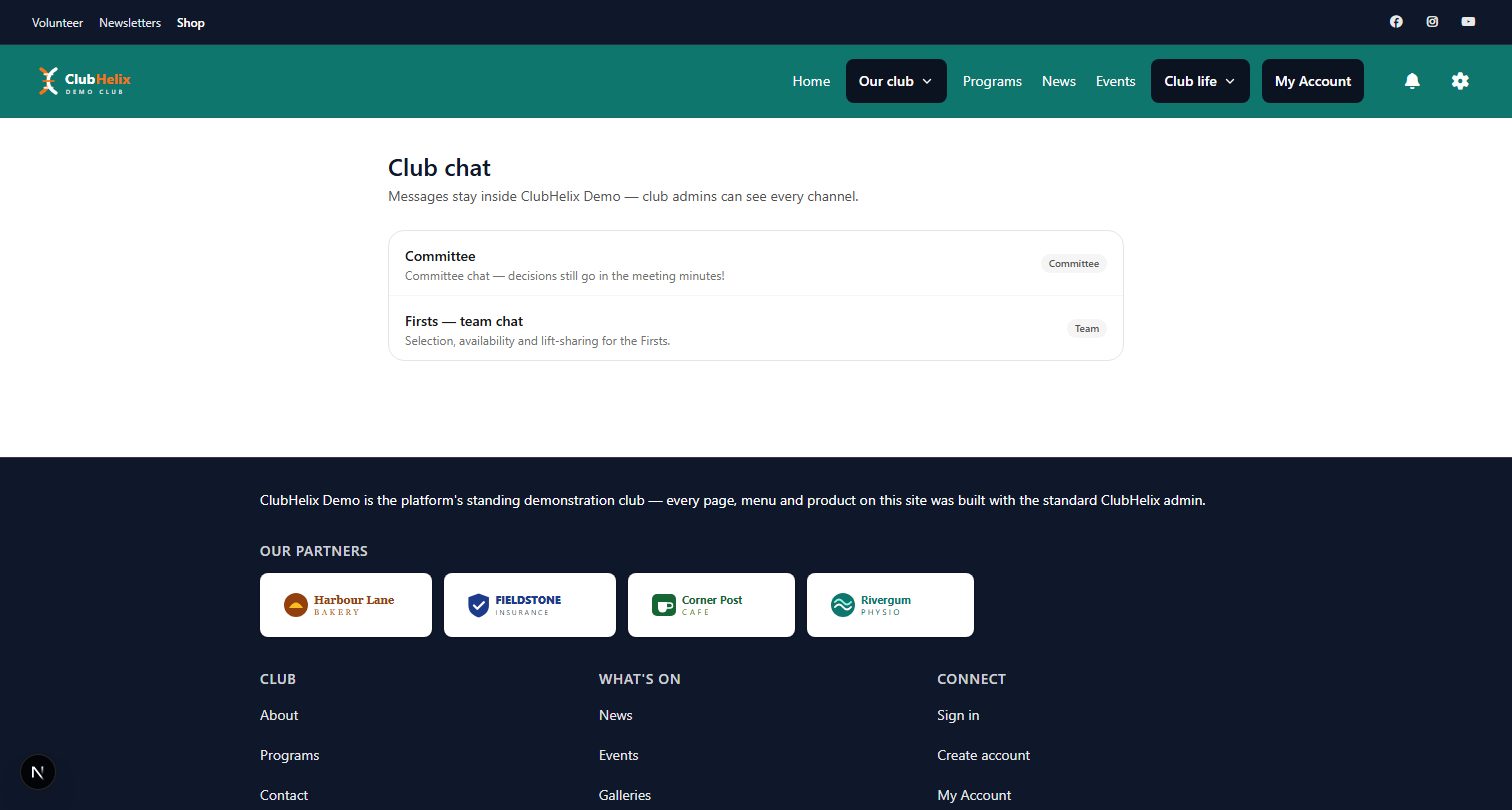
This is the strongest argument for running the club's official channels somewhere the club owns rather than on a personal account. Club-controlled channels with no private member-to-member messages, moderators who can see every channel, message reports that queue for review, and an exportable transcript turn a moderation incident into a process instead of a screenshot argument. Keep the social server for banter if you like — but the announcements, the team channels and anything that might need reviewing later belong somewhere the club controls.
The other reason to take this seriously is who your club is missing. Esports clubs are consistently less diverse than the campuses they sit on, and the reason members give when you ask them is almost never the game — it is the comms. A stated conduct standard that is visibly enforced, a separate practice night for players who want one, and a welfare contact who is not also the team captain change who stays. The welfare and inclusion guide is worth an hour of committee time, and the social event ideas list has plenty of nights that are not competitive at all.
A twelve-week season plan you can hand over
Print this, adjust the week numbers to your term, and give each row an owner's name rather than a role.
| When | What happens |
|---|---|
| 6–2 weeks out | Affiliation renewal, budget submitted, league registration windows diarised, recurring room booked, fair stall booked |
| Fair week | Sign-ups captured digitally with handles and titles attached; membership payable on the spot |
| Week 1 | Welcome message within 48 hours; first casual night in the room you already booked |
| Week 2 | Trials and rank verification; rosters submitted before the lock; subs registered |
| Week 3 | First external fixtures; in-house ladder opens; sponsor pack sent |
| Week 4 | First watch party; check that every roster has a registered substitute |
| Weeks 5–8 | Fixtures and scrims run; mid-season member survey; grant acquittal prepared while receipts are fresh |
| Week 9 | LAN or flagship event; jersey pre-order window closes |
| Weeks 10–11 | Finals; results and match cards recorded; annual report drafted from real numbers |
| Week 12 | AGM and elections, awards night, handover meeting booked within two weeks |
The handover is where esports clubs lose more than most societies, because your assets are unusual and every one of them is attached to a person. Work through this list in the room, with the incoming committee logging in to each item themselves:
- Server ownership transferred — genuinely transferred, not "the new president has been made an admin". An owner who graduates and stops replying can end your club.
- The league portal login and the club's registered team entries, including which email address they are attached to.
- The club's game accounts, if it holds any, and the streaming channel with its overlays and brand assets.
- Roster records and eligibility documents for the season just finished, so a challenged result can still be answered.
- The equipment inventory and where the peripherals kit physically is, plus the storage key.
- Sponsor obligations: who paid what, what you promised, what was actually delivered.
- The fixture and results history, in something more permanent than a channel.
- Access, not passwords — per-person accounts created for the new committee and the old ones removed on the day.
The full version is in our handover checklist, and the university sports club guide covers squad turnover in more depth if you field competitive teams.
Frequently asked questions
How many members does a university esports club actually need?
Far fewer than your server count and far more than your competitive rosters. A club with 40 to 60 people who attend something in a six-week window can run a weekly casual night, fill an in-house ladder, staff a committee and meet most affiliation minimums comfortably. The number to track is attendance in the last six weeks, not sign-ups: 900 in a server and eleven at the casual night is a club with one bad term left in it, while 120 members and 45 regulars is genuinely healthy.
Our best player is not enrolled any more — can they still play?
Almost certainly not, and playing them anyway is the most common way student teams lose a season. Nearly every collegiate league requires current enrolment, often with a minimum study load, and eligibility is usually checked when a result is challenged rather than when the roster is submitted — so you can play half a season before it catches up with you. Give them a role that does not need eligibility: coach, analyst, caster or committee member. That keeps the person and keeps the results.
Do we need our own gaming PCs, or is bring-your-own enough?
Bring-your-own is enough for the first two years of almost every club, and buying machines early is how committees strand their whole budget. What you actually need is a room with power and tables, a set of club peripherals for people who arrive without them, and a network that works. If a permanent gaming space is genuinely on the table, it comes from the university rather than your grant — put a proposal to the department that benefits, with your attendance numbers attached.
Can we run a paid-entry tournament with a cash prize pool?
Usually yes if the outcome is decided by skill, but the answer changes the moment chance is involved and the money almost never stays in the club's hands. The safest pattern is entry fees paid online through the club's own system, prizes awarded as vouchers rather than cash, and a signed receipt list for every prize handed out. Check the rules below and with your student association's finance staff before you advertise a prize pool, because unwinding one afterwards is miserable.
Contests decided by skill are treated differently from games of chance, and a pure draw is regulated provincially with its own rules. Because club money usually sits with the students' union and is paid by reimbursement, expect it to require vouchers rather than cash and a signed receipt list for every prize. If you want to run a draw alongside the tournament, our club raffle guide covers the permissions.
How do we stop the club being just the top team?
Give the casual layer a named owner on the committee, a fixed weekly slot and a share of the budget that is written down before the season starts. The clubs that drift into being a five-person team with 900 spectators do it by accident — every decision individually made sense, and the casual night was cancelled three times because the roster had a scrim. Protect the weekly night the way you protect a fixture, and run an in-house ladder that mixes competitive and casual players so the two layers actually meet.
What happens to the server when the committee graduates?
Whatever the outgoing owner allows, which is why this is the single most important line in your handover. Transfer ownership properly at the handover meeting rather than adding the new president as an admin, and in the meantime keep the things you cannot afford to lose — the member list, the fixtures, the announcements, the transcripts — somewhere that belongs to the club rather than to a person. Clubs that treat the server as the club's only home rediscover this the year a founder stops answering messages.
Where ClubHelix fits
Nearly everything fragile about an esports club is administrative rather than competitive: the membership that only exists as a server count, the roster in a captain's messages, the results in screenshots, the login attached to someone who graduated. ClubHelix gives the club a site it owns with paid sign-ups, member records that carry handles and enrolment details, team rosters with captains and training availability, published fixtures and self-computing ladders for your in-house season, and club-controlled channels with moderation — so the handover becomes a permissions change rather than an excavation. A students' association can even sit above its affiliated clubs in the same structure.
If you are starting from a directory entry on your association's site, have a look at the ready-made site templates and the university clubs solution page, then check the pricing page — the free tier is for building the site and trying it out, with taking payments online and being found in search on the paid plans.
ClubHelix gives your esports club one home for fixtures, results and ladders, team rosters and training availability and moderated club channels. Start free before your next season registration closes.


