
What this guide answers
- Do we need performing rights for a play-reading or a scratch night?
A closed reading among members, unadvertised and free, is generally treated as a rehearsal-room activity rather than a performance.
- How do we cast fairly when everybody already knows everybody?
Write the criteria down before auditions and share them in the audition pack, so the decision is measured against something other than who the director had coffee with.
- Twenty-nine auditioned and we cast nine. How do we keep the other twenty?
Send them a personal message within twenty-four hours of the cast list, not a week later, and attach a real offer: a named production role, a first meeting date, and the date of the next auditions.
- How much should we charge for tickets?
Start from break-even rather than from what feels friendly. Total fixed costs divided by your ticket price gives the number of seats you must sell, and if that number is above 60% of your total capacity the price or…
- Do we need checks to run a workshop in a school or cast a school-age performer?
Usually yes, and the requirement comes from the check scheme in your jurisdiction rather than from your committee's own judgement.
UK edition. This guide is written for volunteer-run clubs in the UK. Where rules differ — grants, tax, incorporation, safeguarding — follow the UK-specific pointers below or check with your national body.
Your society has eight weeks, a play nobody has actually licensed yet, twenty-nine people booked in for auditions and nine parts to give out, a rehearsal room you can only have on Tuesdays, and a set budget of $400 that has to cover a door, two chairs and something that reads as a wall from row F. The show will almost certainly happen. Whether it breaks even, and whether the twenty people you did not cast are still in the society three months later, is being decided right now by choices that have nothing to do with the acting.
Drama societies are the hardest student groups to run and among the best to belong to. An ordinary society plans events. A drama society runs a small production company — with a licensor, a venue, a design budget, a company of thirty, a box office, a get-out at midnight and a genuine duty of care — staffed entirely by people who have essays due. None of that is impossible. It just does not survive being run out of a group chat and one person's laptop.
This guide walks a season the way drama societies actually experience one: designing the year rather than a single show, securing rights before you announce anything, auditions and the people you do not cast, a rehearsal schedule that respects thirty timetables, what a student production really costs, a box office that breaks even, and what changes when you take the show off campus.
Plan a season, not a play
Committees that pour everything into one production get one glorious month and eleven quiet ones. Members drift, the non-cast disappear, and next year's committee has no one to recruit from. A season is the unit of planning, and a good one has four layers.
| Slot | When | Company size | Typical cost | What it is really for |
|---|---|---|---|---|
| Weekly workshop | Every week of term | 8–25 drop-in | $0 | The anchor — where people meet and stay |
| Reading or scratch | First fortnight of term | 10–20 | $0–$40 | A no-audition entry point for nervous first-years |
| Studio production | Mid first term | 12–20 | $900–$1,300 | Low-risk directing and design experience |
| Mainstage | Second term | 25–45 | $3,500–$6,000 | The flagship, and most of the financial risk |
| New writing night | Late in the year | 15–30 | $150–$400 | Writers, and a showcase with no rights problem |
The studio show matters more than committees expect. It is where a first-time director learns what a call sheet is, on a budget the society can survive losing. Handing someone the mainstage as their first production is how societies lose $3,000 and a friendship in the same fortnight.
The fourteen-week clock
Count backwards from performance week. Every experienced drama committee runs some version of this, and the ones that do not run it discover in week three that the licence has not been granted.
| Weeks out | What has to happen | Owner |
|---|---|---|
| 14 | Shortlist three titles, send rights enquiries, hold the venue provisionally | Producer |
| 12 | Licence confirmed in writing, dates and venue locked, budget approved by the committee | Producer/treasurer |
| 11 | Director, production manager, stage manager and designer appointed | Committee |
| 10 | Audition notice published, audition pack out, slots open for booking | Director |
| 9 | Auditions and callbacks, cast list out, non-cast roles offered within 24 hours | Director |
| 8 | Read-through, full rehearsal calendar published, script copies bought | Stage manager |
| 7–5 | Blocking rehearsals, set build starts, poster and program artwork approved | Production manager |
| 4 | Tickets on sale, publicity push begins, front-of-house roster opens | Marketing |
| 2 | Off-book deadline, first full run, risk assessment signed off | Director |
| 1 | Get-in, tech, dress | Stage manager |
| 0 | Performances, box office, front of house | Producer |
| +1 | Strike, get-out, royalty return, invoices settled, debrief written | Producer/treasurer |
Print it. Put it where the whole committee can see it, not in one person's notes app. The end-to-end event guide covers the generic version of this discipline for the rest of your society's calendar.
Rights come before casting
The most common way a student production collapses is entirely preventable: somebody announced the play, ran auditions and published a cast list, and only then discovered the title was withdrawn, or the royalty quote was more than the whole budget, or the licensor wanted a percentage of gross box office nobody had modelled.
Nothing goes public until the licence is in writing. Not the season announcement, not the audition notice, not a poster mock-up on social media. Amateur rights are granted per production, for named dates, at a named venue, at a stated royalty — and they can be refused. A title is routinely withdrawn while a professional production is running in your territory, which is exactly when a student company most wants to do it.
Finding the right licensor is easier than it looks. The acting edition of a published play names its licensor in the front matter, and the publisher's site will have a performance rights page. Send a short enquiry with your organisation's name, the venue and its seating capacity, your dates, the number of performances, your top ticket price and whether the run is ticketed. A reply usually takes one to three weeks — which is why the enquiry sits at fourteen weeks out on the clock above, with a second and third choice ready to go.
Six clauses catch student companies out, every year:
- The royalty structure. Either a flat fee per performance or a percentage of gross box office, sometimes with a stated minimum. Budget for the higher of the two and treat any surplus as a bonus.
- Script copies. Most licences require a legitimate copy per performer. Photocopying the director's script is a breach, and it is the fastest way to be refused a licence next year.
- No alterations. No cuts, no added material, no changed setting, no recast genders without written approval. Ask — permission is often granted — but ask before rehearsals, not after.
- The credit block. The licence specifies exact wording, and often relative type size, for the poster and the printed program. Every design goes past the producer before it goes to print.
- Recording and streaming. Almost never included. An archival recording for the society's own records usually needs separate written permission, and putting the show online almost always needs a new licence.
- New writing. A play by a student author is the simplest case and still deserves one page in writing: performance rights for these dates, credit wording, and who owns the script afterwards.
Amateur rights for most published plays are handled by the play's publisher or by an agent acting for the author, and the licensor is named in the front matter of the acting edition — start there rather than guessing, because titles move between licensors and last year's contact may already be wrong. Music is a separate question. PRS for Music licenses the public performance of music, and your venue almost certainly holds a blanket licence — but ask the venue or the union's activities team to confirm it covers a ticketed dramatic performance by a society, because a licence written for a union bar does not automatically extend to your season. Music that carries the story, as in a musical, sits outside any blanket licence: those grand rights are licensed with the show and cost considerably more than a straight play. On payment, the practical constraint is that your students' union usually holds society funds centrally, so a royalty is paid by raising a requisition rather than by anyone's card. That process is safe and slow — three weeks is normal — so put the request in as soon as the quote arrives. This is general information; confirm with the licensor and your union's finance team.
Auditions, and the thirty people you do not cast
Publish the audition notice ten to fourteen days ahead, and put everything a nervous person needs in it: the play and its content, the run dates, the honest weekly rehearsal commitment in hours, the dates that are compulsory (tech, dress, every performance), whether experience is needed, what to prepare, whether membership is required, how to get into the room if stairs are a problem, and who to contact privately. A notice that says only "auditions Tuesday 6pm, room TBC" selects for people who already know how your society works — which is to say, the people you already have.
The audition pack does the rest of the work. Two pages is enough: a character breakdown with playing ages and a line about what each part asks for, two or three short sides from the script, and a plain statement of how casting decisions get made and by whom. If the play contains intimacy, violence, nudity, or material that needs a content warning, say so in the pack rather than in the room.
Book slots rather than running a queue. Ten-minute slots with a ten-minute gap each hour absorbs the inevitable overrun; twenty-nine auditionees fits comfortably into two evenings. Booking online means you have names, contact details, access needs and a running order before the day, instead of a clipboard and a corridor full of people who have been waiting forty minutes.
Then the part that decides your society's next three years. Twenty-nine people auditioned. You cast nine. Those twenty are your future committee, your crew, your writers and a good share of your audience — and if the only message they get is a cast list they are not on, most of them never come back.
Send the non-cast message within twenty-four hours of the cast list, personally, with a real offer attached:
- Production roles with names: assistant director, stage manager, deputy stage manager, lighting or sound operator, set construction, costume, props, publicity, photography, front of house, box office.
- A first meeting date, so the offer is a diary entry rather than a kindness.
- The date of the next auditions, which is often only six weeks away.
Do not invent roles you do not need — students can tell. Offer the ones you genuinely have, and staff your production out of the audition pool instead of begging the committee in week six. Keep an attendance record from the first call: across a season it tells you honestly who is involved, which is the same evidence a funding panel asks for and the same list your next committee inherits.
The rehearsal schedule is the real product
The biggest cause of cast attrition in student theatre is not workload. It is being called to a three-hour rehearsal and used for eleven minutes. Do that twice to a supporting actor and you have lost them, and they will tell four friends the society wastes their time.
Break the script into units — a new unit at every entrance and exit — and list which characters appear in each. Schedule by unit and call only the people in it. A 90-minute play needs roughly 60 to 80 rehearsal hours before tech: three calls a week of three hours across seven weeks gets you there, and about half of those calls do not need the whole company.
Publish the entire calendar at the read-through. Every call, every date, every location, in one place that is not a chat history. Changes go out through one channel only — the moment there are two sources of truth, someone will turn up to a cancelled call and someone else will miss a run. Put the off-book deadline on the calendar from day one, two weeks before opening, and treat it as fixed.
Book the room as a recurring slot rather than seven separate requests, and check the exam-period closures before you promise a date; the campus room bookings guide covers how those systems actually behave. Keep a register of who attended each call. Three unexplained absences from a lead in week four is a production problem you can still solve; the same information in week eight is a crisis.
Care of the company in the room
- Agree content warnings at the read-through, and publish them on the event page, the poster and the program. Audiences and cast both deserve to know.
- Choreograph intimacy and violence. Anything physical is set, written down and repeatable — never improvised nightly. If nobody in the society is trained, a two-hour intimacy or stage-combat workshop is one of the best $200 a drama society ever spends, and departments and student associations will often fund it.
- Name a welfare contact outside the director's line. A cast member should never have to raise a problem with the person casting the next show.
- Anyone can call a pause, on any exercise, without explaining why.
- Set a hard finish time for late calls, agree how people get home, and make sure nobody is left locking up alone.
- Plan the landing. The flatness after a show closes is real and hits first-years hardest. Schedule the strike, the party and the debrief so the season ends with something rather than nothing.
Our welfare and inclusion guide goes further, and the risk assessment guide covers the paperwork your venue will want before you rig anything.
What a student production actually costs
Here is a realistic pair of budgets: a studio show in a campus room seating 60, and a mainstage production in a hired theatre, both running four performances.
| Line item | Studio show | Mainstage |
|---|---|---|
| Royalty (4 performances) | $300 | $700 |
| Script copies | $150 | $220 |
| Venue hire | $0 | $1,200 |
| Set, materials and construction | $250 | $900 |
| Costume, hair and makeup | $120 | $400 |
| Props and consumables | $80 | $250 |
| Lighting and sound hire | $0 | $350 |
| Publicity, posters, printed program | $90 | $200 |
| Production photography | $0 | $120 |
| Contingency (10%) | $99 | $434 |
| Total | $1,089 | $4,774 |
Five costs get left off almost every first draft. The royalty settlement when the licence takes a percentage — invoiced after the run, when the money feels like yours. Card processing fees on ticket sales, at roughly 1.7% to 3% plus a few cents. The get-out, including waste removal for a set you cannot store. Technician call-out fees, if the venue insists its own staff operate the rig. And the cast party, which the committee always pays for and never budgets.
Build in the order borrow, build, buy. Ask the drama department, the local community theatre and last year's production before you buy anything; a society that keeps a stock store of flats, rostra, a black tab and a props box saves more each year than any grant it will win. Whatever you cannot store, you cannot reuse — so decide where the set is going before you build it, not at midnight on strike night. The budget template has a term-by-term cash view that suits a committee better than an accountant's format.
Production money realistically comes from three places. Your students' union's society funding bids are the main pot, usually decided in rounds against a submitted budget, and they reward specifics — how many students take part, cost per head, and whether you spent last year's award on what you said you would. Departments will often support a production connected to their discipline, and development or opportunity funds cover one-off projects. The practical constraint is that the union normally holds your money centrally: you raise requisitions rather than spending from an account, which is safe but slow. That matters enormously for a production, because a venue deposit and a royalty both fall due long before a single ticket is sold. Get the payment requests in as soon as you have quotes, and never let a student put a four-figure deposit on a personal card in the hope of reimbursement. VAT is normally the union's concern rather than yours where the union holds the funds, but confirm before pricing a large season. General information only, not tax advice; the funding and grants guide covers what panels reward.
The box office has to break even
Do the break-even maths before you announce the ticket price, not after. Divide total fixed costs by the ticket price, allowing for card fees, and you have the number of tickets you must sell before the society's money is safe. The studio show above needs about 91 tickets at $12. Across four nights of 60 seats — 240 seats in total — that is 38% of the house, which is a plan. The mainstage needs about 217 tickets at $22; in an 800-seat run that is 27%, comfortable, but in a 90-seat theatre over three nights it is 80% of every seat, which is a gamble dressed as a season.
If break-even sits above 60% of your total capacity, change something before you commit: a cheaper venue, an extra performance, a higher top price, or a smaller show. Those are all easier decisions in week fourteen than in week two.
Three things distort the maths every time:
- Comps. A company of thirty with one complimentary ticket each is thirty seats — 12% of a 240-seat run — plus the licensor's, the press seats and the association's. Budget them as tickets sold at $0 rather than pretending they do not exist.
- Concessions. Price in tiers: a student rate, a standard rate and a supporter rate for the people who want to pay more. A flat $25 across the board quietly sells your show to parents only.
- Preview and opening night. Opening is almost always the emptiest performance and the last night sells itself. Discount the preview deliberately, invite reviewers to night two, and never panic-discount in the final 48 hours — do it once and your audience learns to wait.
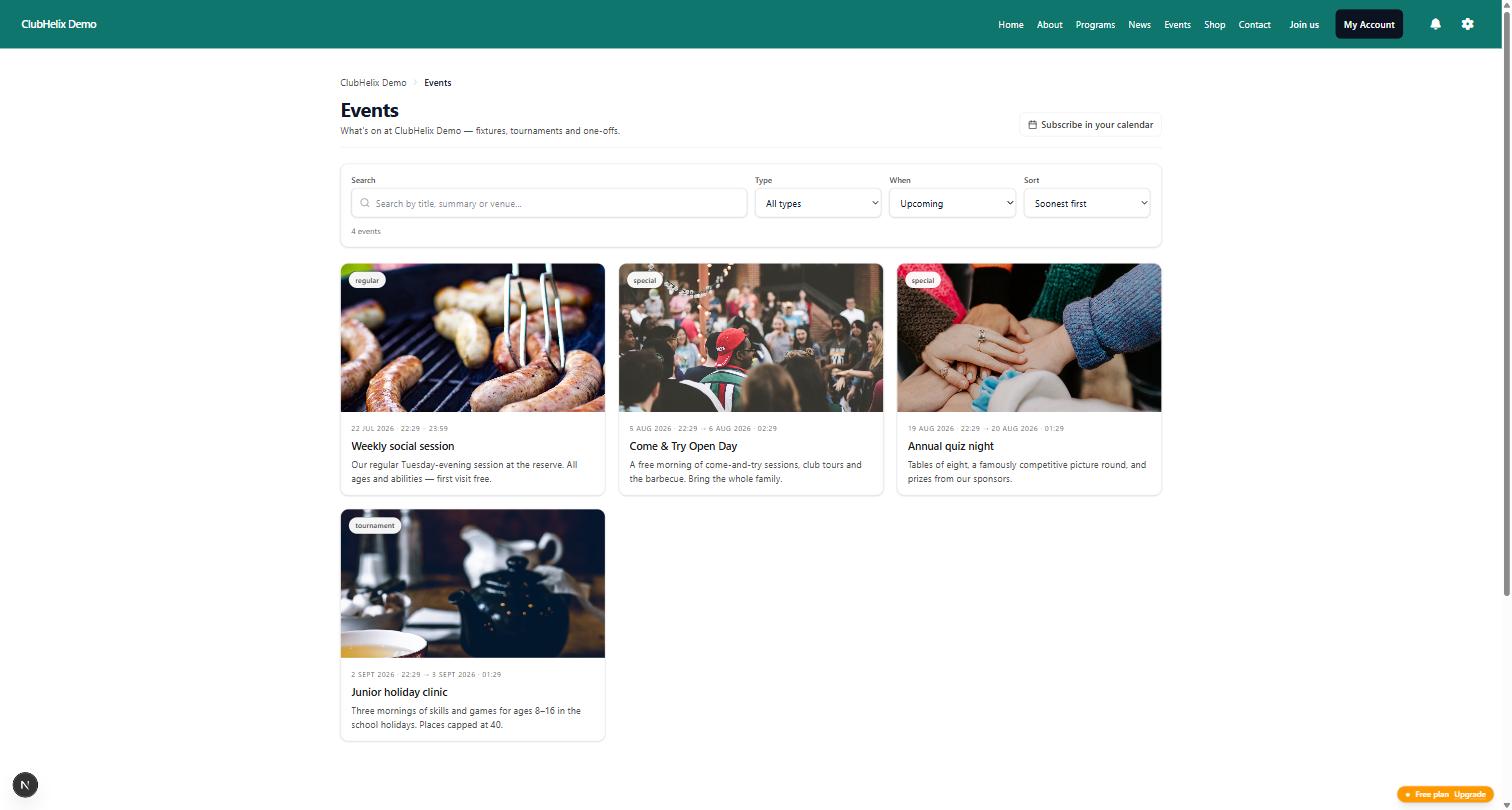
Sell everything from one page that carries the dates, times, prices, running time, interval, content warnings, access information and the buy button together. Every hop — chat message to a form to an external ticketing site to a payment link — loses a share of the people who were going to come. A society site with events and ticketing built in removes the hops, and it gives you a door list you can check people off rather than a printed spreadsheet and a torch.
Publish the exchange policy with the tickets: exchanges to another performance up to 24 hours before, no refunds after that except when you cancel. Offer a relaxed or accessible performance and say so plainly on the page. Then reconcile within a week of closing — tickets sold, comps issued, cash taken at the door, processing fees, royalty settlement — and write the number in the handover file while it is still true. The ticketing guide for a university ball works through pricing against a venue minimum in more depth, and how to promote a club event covers filling the room.
Taking the show beyond campus
A production that works on campus can go further: a fringe season, a student drama festival, a schools tour, a regional competition. Everything gets harder at once. Your licence covers named dates at a named venue, so a second venue needs an extension or a new licence. Transport, accommodation and registration fees are usually payable months before any box office arrives. Your student association will have an off-campus process with a longer lead time than you expect, and cover that stops at the campus boundary unless someone has extended it.
Before you commit, settle one question in writing: who is financially liable if the season loses money? A festival that takes a venue fee up front is a real risk against your society's reserve, and it is not a risk one enthusiastic director should carry on a personal card or sign for alone. Get committee approval minuted, keep the deposit inside the society's own budget, and treat the trip like the trip it is — the trips and tours guide covers consent, emergency contacts and transport properly.
Two circuits matter. The National Student Drama Festival takes submissions of student productions and pairs performances with workshops and structured feedback — for most societies it is the highest-value week of the year and a far better first step than the alternative. The alternative is the Edinburgh Festival Fringe, which is open access and is comfortably the biggest financial risk a student company can take: venue deals, accommodation, marketing spend and a month of living costs, with societies routinely losing four figures. If you go, go with a budget approved and minuted by the committee, a written position from the union on who carries the loss, and a venue contract nobody has signed personally. Inter-university festivals and one-act competitions sit between the two and cost a fraction. Whatever you enter, your students' union will want a risk assessment, travel approval and confirmation that its cover extends off campus, and its lead time is longer than the festival's. This is general information; your union's activities team is the authority.
Frequently asked questions
Do we need performing rights for a play-reading or a scratch night?
A closed reading among members, unadvertised and free, is generally treated as a rehearsal-room activity rather than a performance. The moment you advertise it publicly, open the door to non-members or charge for entry, it is a performance and it needs a licence — even unstaged, with scripts in hand and no set. The safest scratch night is one built entirely from new writing by your own members, where a one-page written permission from each author covers you completely. This is general information; the licensor for the title is the authority.
How do we cast fairly when everybody already knows everybody?
Write the criteria down before auditions and share them in the audition pack, so the decision is measured against something other than who the director had coffee with. Use a panel of at least two people, take written notes against the same criteria for every auditionee, and require anyone with a close personal connection to a candidate to declare it before the room starts. Never make a casting decision in a group chat where the reasoning disappears. The bigger fairness lever is structural: rotate who gets to direct across a season, so the same three people are not casting every show.
Twenty-nine auditioned and we cast nine. How do we keep the other twenty?
Send them a personal message within twenty-four hours of the cast list, not a week later, and attach a real offer: a named production role, a first meeting date, and the date of the next auditions. Staff the show out of that pool rather than asking the committee to do everything, because someone who runs the lighting desk in November auditions again in March. Track who took a role and who did not — the ones who took nothing are the people to invite personally to the next social, and they are usually the ones a society loses without noticing.
How much should we charge for tickets?
Start from break-even rather than from what feels friendly. Total fixed costs divided by your ticket price gives the number of seats you must sell, and if that number is above 60% of your total capacity the price or the plan needs to change. Most student productions land somewhere near the price of two coffees for a concession ticket and half again for a standard one, with a supporter rate for people who want to fund the society. Offer a discounted preview and a members' rate rather than discounting everything in the last week.
Do we need checks to run a workshop in a school or cast a school-age performer?
Usually yes, and the requirement comes from the check scheme in your jurisdiction rather than from your committee's own judgement. This catches drama societies more often than other groups, because schools outreach, youth theatre workshops, open days for prospective students and casting an under-18 in a production all pull you into scope. Start the process before you commit to the date, because these take weeks and sometimes months. This is general information — check with your student association or a professional.
In practice that means a DBS check at the level appropriate to the role, usually arranged through the students' union rather than applied for individually, plus the union's safeguarding policy and training. If a production casts a performer under 18, licensing and chaperone rules can also apply to rehearsals and performances — ask the union's activities team early.
Where ClubHelix fits
Most of what makes a drama society fragile is administrative rather than artistic: the audition list on a clipboard, the rehearsal calendar in a chat that scrolls, the ticket money in three places, the licence email in a graduate's inbox. ClubHelix gives the society one home for its website and season pages, its member register, its audition slots, rehearsal calls and attendance, and its events and box office — all owned by the society rather than by whoever set it up, so next year's producer inherits a login instead of an archaeology project.
If your society sits alongside a music society, a dance group or a whole faculty of clubs, they can all run under the same student association structure with their own sites and their own records. See how it works for university clubs and student societies, browse the ready-made site templates, and check the pricing page — the free tier is for building the site and trying it out, with taking payments online and being found in search on the paid plans. For the year-round view, start with how to run a student society; for the sister art form, how to run a university music society covers scores, rooms and subs; and put the whole lot in the handover file before your producer graduates.
ClubHelix gives your drama society one home for season pages, auditions, calls and attendance and tickets that actually reconcile. Start free before you announce the season.


