
What this guide answers
- How do you start a skateboarding club at a public skatepark?
Start with the riders already there rather than a constitution.
- Should a skate club charge membership when the park is free?
Charge for what costs money — coached blocks, comp entry, jerseys — rather than for access you cannot control.
- What safety rules should a skate club have?
At minimum, a written helmet policy applying to every club session, a first aid kit and named first aider on the deck, a signed consent and medical form for every rider under 18, and an incident report filed the same…
- How do you run a skate comp on a budget?
Use a jam format, sell entries online in advance with capped divisions, ask local shops for product rather than cash for the prize table, and sell a named division to a sponsor.
- How do skate clubs get funding?
Most rely on program fees, comp income, grants and shop sponsorship.
Canada edition. This guide is written for volunteer-run clubs in Canada. Where rules differ — grants, tax, incorporation, safeguarding — follow the Canada-specific pointers below or check with your national body.
Go to your local skatepark at half past four on a weekday and the club is already there. Twenty or thirty riders, three age groups quietly sharing the bowl, an older rider giving a nine-year-old the same advice he was given a decade ago, and a couple of parents in the car park pretending to read their phones. Nobody has signed up for anything. Nobody is in charge. It works.
That is the strange starting position of a skateboarding club. You do not own the venue, you cannot lock it, you cannot stop non-members using it, and the culture is suspicious of committees. A skate club is not built by adding rules to a scene that already works — it is built by adding what a public park cannot do on its own: coached sessions, a comp with a real prize table, insurance, and one credible voice in the room when the land manager is choosing between resurfacing the bowl and sealing a car park.
This guide covers the relationship with whoever owns your park, membership that makes sense when the venue is free, coaching and parent consent, jams that pay for the year, and the online side that stops all of it landing on one person's phone.
Audit the scene before you build a club
Almost every skate club fails the same way — it formalises what the scene already did well and neglects what only a club can do. Spend a session at the park with a notebook before your first meeting.
| The scene already has | Only a club can add | Who owns it |
|---|---|---|
| A venue, open every day | A booked, exclusive slot for coaching or a comp | Committee |
| Informal mentoring | Screened, accredited coaches and a session plan | Coaching coordinator |
| A group chat | A public page a parent or grant assessor can read | Communications |
| Regular faces | A membership list | Registrar |
| Occasional comps | Insurance, permits, first aid, a prize budget | President, treasurer |
| An opinion about the park | A seat at the table when it gets rebuilt | President |
Two answers shape the first year — who the younger riders actually listen to, and what the land manager currently thinks of skateboarding at that site. A club starting from "they see the park as a problem" runs a very different year to one starting from "they want more of it".
Working with the land manager who owns your park
Your park almost certainly belongs to a public body, and that relationship is the club's most valuable asset. It is built on being predictable rather than loud. Find the actual person — not the enquiries inbox, but the officer whose portfolio covers that reserve — and ask for a site meeting at the park, because thirty seconds beside a cracked coping does more than three emails.
That person usually sits in a parks and recreation department, and the site may be governed by a parks board or commission that meets in public. Those meetings have a public comment slot, and turning up to one with six riders and a clear ask is remarkably effective.
Go with a one-page document, not a wish list — who you are, how many riders use the park, what the club will run this year, what you need. Then keep every promise you make, however small.
| What the club wants | What they need from you | What to bring |
|---|---|---|
| Exclusive use for coaching | Certainty the park is rarely closed to the public | A schedule with dates |
| Permission to run a comp | Permit, risk assessment, liability cover | Run sheet, insurance certificate |
| Lights, shade, a beginner area | Evidence of demand and a maintenance case | Head counts, photos, ages |
| Storage for ramps and tools | A responsible signatory and a key register | Named officers, asset list |
| A say in the redevelopment | One representative voice rather than ten emails | Notes from your members |
Affiliation and insurance
Public liability cover is the practical reason most skate crews finally incorporate — you cannot run a coached session or a comp on public land without it.
Most clubs incorporate provincially as a not-for-profit and affiliate to the provincial skateboarding association, which is the usual route to insurance and coach certification. Municipalities often require you to name them as an additional insured on your policy before issuing a park permit — ask early. See how to start a sports club in Canada.
This is general information, not advice — structures, cover and screening rules change, so confirm the current position with your governing body and insurer.
Membership when the venue is free
Here is the awkward maths. A tennis club sells court access. A skate club is asking people to pay for something they can already do for nothing, twenty metres from where they stand. Pitch a flat season fee and you will sign up eleven people, nine of them related to the committee. The fix is to stop selling access and start selling what genuinely costs money — coaching, comp entry, a jersey, and belonging.
| Tier | Price shape | What it buys |
|---|---|---|
| Registered rider | Free | On the list, gets the emails, counts in your head-count |
| Program member | Per term or block | A coached block, cover for those sessions, a progress card |
| Competing member | Annual | Comp entry discount, club jersey, selection eligibility |
| Family | Annual, bundled | Two or more riders across the paid tiers |
| Supporter | Free or nominal | Parents and park regulars — newsletter and a vote |
The free registered-rider tier does more work than it looks. It turns an anonymous crowd into a contactable list, it is what you show a funder who asks how many young people you reach, and it is the pool every paid program sells into. Make it thirty seconds long — name, age bracket, guardian contact if under 18, consent to be emailed.
For scale, community clubs commonly land somewhere near $35–$65 a year for a competing membership and $90–$160 for a coached block of six to eight sessions. Treat those as illustrative starting points and price against local recreation program fees.
Whatever you charge, take it online. A teenager will not fill in a paper form. Online registration with card payment means a coached block sells out from a link in a group chat and your registrar sees a live list, not a pile of screenshots.
Coaching, helmets and the parent-consent conversation
Coaching is where a skate club stops being a scene and starts being an organisation, because the moment you take a nine-year-old's money you have taken on a duty of care.
Coaches
Use accredited coaches and screen everyone who works with young riders. Skateboarding's coaching pathway is younger than most sports, so expect to fund senior riders through their qualification rather than waiting for coaches to appear. It turns the two people the kids already copy into the two who are formally allowed to teach them.
Coaches and volunteers working with minors are generally required to complete a police record check with a vulnerable sector screening, plus your provincial association's safe sport training. Confirm the current requirements with your association before your first session.
Sessions that actually progress riders
Run coached blocks, not one-off lessons. Six to eight weekly sessions at the same time gives riders a cohort, parents a routine, and you something to sell. Cap groups at what one coach can genuinely watch — six to eight beginners, fewer if they are very young. Split each session into a flat-ground drill, then one feature, then free skate with the coach roaming, and keep a progression ladder riders can tick off: push and turn, kerb drop, roll-in, drop-in, ollie, board slide on a low rail. It converts "I'm not any good yet" into "I have three left".
Helmets and protective gear
Have a written policy, publish it, and apply it without argument at club sessions. Check this baseline against your governing body's rules and any conditions in your park permit:
- Helmets compulsory for every rider at every club-run session, coached or social, regardless of age.
- Under-13s also in knee pads and wrist guards at coached sessions.
- Coaches wear helmets too, every session. Nothing else you say about helmets matters as much.
- A set of loan helmets and pads in the sizes you actually see, sanitised between blocks.
- A rider without a helmet is offered a loan one, not turned away.
Write down that this applies to club activity, not the park generally. You are not the helmet police for a public facility, and pretending otherwise will cost you the older riders you need.

The consent pack
Collect this once per rider per season, digitally, before the first session — not on a clipboard while the coach waits.
- Guardian name and two numbers, plus an alternative emergency contact.
- Medical conditions, medications and allergies — what a first aider needs in ninety seconds.
- Photo and video consent, with a genuine option to decline. Skate footage is your best marketing and the thing most likely to upset a family, so keep a list of who declined and brief your filmer.
- Acknowledgement of the risk warning and the helmet and behaviour policies.
- Pick-up arrangements for under-14s — who collects, and whether the rider may leave alone.
Digital waivers and consent forms make this survivable — signed on a phone, stored against the rider's record, re-requested each season, searchable when a coach needs it. Then answer the three questions parents always ask, on your website, before they ask: who is coaching, what are they screened for, and what happens if my kid gets hurt.
Jams and comps that fund the club
Skate comps are unusually good fundraisers because the format is cheap and local businesses would rather give you product than cash — which suits you, because product makes a prize table look enormous at no cost.
Run a jam format rather than heats and finals. An age or ability group skates the same time block together, taking turns, and judges score the best moments rather than a single run. It is faster, better to watch, does not punish a rider for one slam, and is closer to how the park actually operates. A workable one-day club comp:
| Time | What happens | Who |
|---|---|---|
| 07:30 | Set up — barriers, gazebo, PA, signage | Six on the working crew |
| 08:30 | Registration opens, waivers checked | Two on the desk |
| 09:15 | Park closes to the public, riders' briefing | Contest director |
| 09:30 | Under-12 jam, then under-16 | Three judges, one MC |
| 11:30 | Beginner and first-timer jam | Coaches judge, all prized |
| 12:15 | Barbecue and product toss | Canteen crew |
| 13:00 | Open and women's jams, then best trick | Judges and MC |
| 15:00 | Presentations and prize table | President |
| 15:30 | Pack down, park reopens | Everyone still standing |
The details that make or break the day. Sell entry online in advance with a small on-the-day surcharge, so you know your numbers by Thursday. Cap each division and publish the cap. Put a rider liaison on the deck whose only job is calling the next group. Fix a wet-weather call time and announce it the day before. And run the beginner jam when the crowd is biggest — a nervous first-timer getting a full-park cheer is the best membership advertisement you will ever create.
A comp clears money four ways — entries, the barbecue, a raffle, and sponsor cash for a named division. Sell divisions rather than banner space: a named under-12s costs a sponsor very little and gets said aloud forty times. Event ticketing and RSVPs handle entries, caps and the door list; raffles cover the draw without a book of paper tickets.
Schedule your headline comp for the warm months and check the shade situation, because a dark concrete park in midsummer gets hot enough to matter. In the colder parts of the season a wet or frozen park is unrideable, so publish a reserve date at the same time as the main one.
Money for a club with no gate
Skate clubs have no turnstile, no bar and no clubroom, which sounds bleak until you notice how low the cost base is — no ground levy, no umpire fees, no fixtures fund. A small club's year is shaped roughly like this. Treat it as a sketch, not a benchmark.
| Line | Direction | Notes |
|---|---|---|
| Coached program blocks | In | The largest line once two blocks a term run |
| Comp entries, barbecue and raffle | In | Two or three events a year |
| Grants | In | Lumpy — fund projects, never operating costs |
| Sponsorship and shop support | In | Often product not cash, which offsets prize spend |
| Merchandise | In | Deck stickers and tees — a good design sells itself |
| Coach payments | Out | Pay properly or lose them to private lessons |
| Insurance and affiliation | Out | Fixed, annual, unavoidable |
| Loan helmets, pads, first aid | Out | Replace on a schedule, not when something snaps |
| Coach qualification and screening | Out | Budget for two people a year |
Funding usually comes from municipal community grants, provincial sport and recreation funds, and community foundations. Youth-engagement funders respond well to skateboarding because the participation is real and easy to evidence with a head count.
Track every volunteer hour. Dig days, comp shifts, coaching and committee time all count as in-kind contribution in most grant applications, and clubs routinely leave real money on the table by not recording them — tracking volunteer hours for grants explains the method.
Safety when anyone can walk in
Your sessions happen at a facility that stays open to the public. That needs three written positions.
A boundary between club activity and public use. Signage, cones and a briefing saying which part of the park is coached for the next hour. If you have exclusive use, post the notice 48 hours ahead and tell the regulars in person — nothing sours a scene faster than a locked bowl on a Saturday.
A real incident process. Every session needs a current first aid kit, a named first aider on the deck, and an incident report filed the same day. Log near misses too — a loose coping shows up as three near misses before it shows up as a fracture, and a dated log is what convinces a land manager to fix it. Incident reporting keeps the register searchable for when your insurer asks a year later.
A short code of conduct, evenly enforced. No filming anyone who asked not to be. Do not drop in on someone. Beginners get space at coached times. Abuse of any rider or coach ends the session. Get the older riders to own it — peer enforcement is the only kind that works at a skatepark. Sports club risk management covers the wider assessment process permits and insurers expect.
Reaching riders and parents at the same time
You have two audiences with almost no overlap. Riders live in group chats and short video, ignore email, and decide whether to come this afternoon at about 3:50pm. Parents want a calendar, a price, a name and a number, on a page they can read at work. Serve both deliberately — a group chat plus push notifications for what must land now, a monthly email for term dates and the comp calendar, and one public events calendar so a parent can see next term's dates months out rather than the week before.
Push notifications and the installable web app cover the fast channel without asking anyone to install anything from an app store, and email broadcasts handle the parent-facing side from your own club address. Club communication plan is a good starting frame, and how to promote a club event covers the comp build-up.
Giving the scene a home online
The admin load is deceptive. No fixture list and no ladder, but coached blocks to enrol, a consent pack per rider, a comp with capped divisions, an incident log, and a grant acquittal wanting attendance numbers nobody recorded — the pile that ends up living in one volunteer's phone until they burn out. ClubHelix puts it in one place: events and ticketing for comps and come-and-try days, programs and term enrolment for coached blocks, digital waivers for consent, and incident reporting for the register your insurer will eventually ask about.
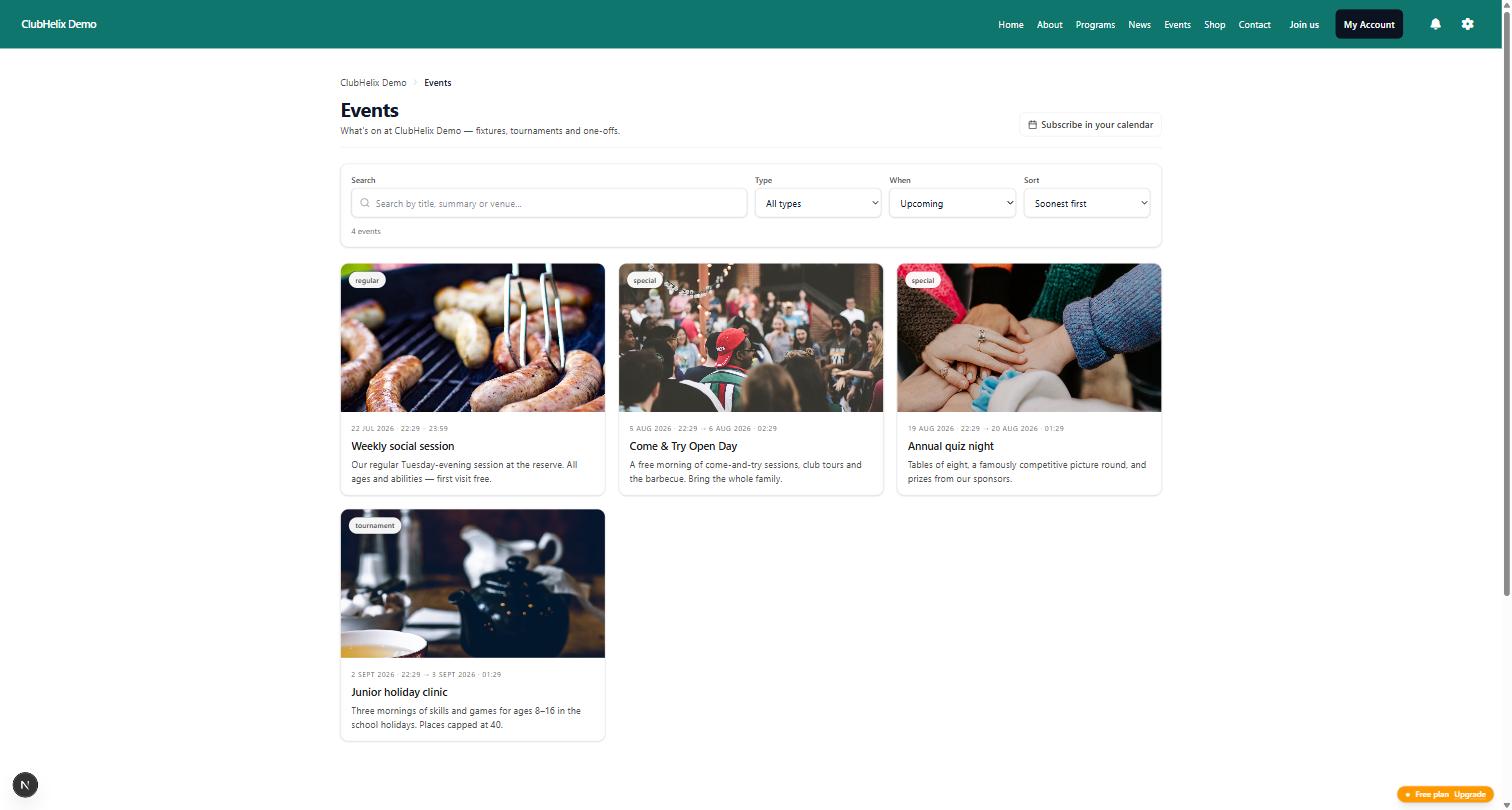
Start on the free tier and add the paid features when a coached block needs to sell out. The pricing is published rather than quoted, and most clubs get a real site — join page, event calendar, coaching info — live in one evening. Create your club site and point the group chat at it.
Frequently asked questions
How do you start a skateboarding club at a public skatepark?
Start with the riders already there rather than a constitution. Talk to the informal leaders, count who uses the park and when, then meet the officer who manages the site. Incorporate and arrange public liability cover before your first coached session or comp, because both require it.
Should a skate club charge membership when the park is free?
Charge for what costs money — coached blocks, comp entry, jerseys — rather than for access you cannot control. A free registered-rider tier that captures contact details and consent, sitting under paid program and competing tiers, works far better than a single season fee.
What safety rules should a skate club have?
At minimum, a written helmet policy applying to every club session, a first aid kit and named first aider on the deck, a signed consent and medical form for every rider under 18, and an incident report filed the same day for injuries and near misses. Check specifics against your governing body and your venue permit.
How do you run a skate comp on a budget?
Use a jam format, sell entries online in advance with capped divisions, ask local shops for product rather than cash for the prize table, and sell a named division to a sponsor. A barbecue and a raffle usually cover what is left.
How do skate clubs get funding?
Most rely on program fees, comp income, grants and shop sponsorship. Grants respond well to skateboarding because it reaches teenagers who avoid traditional clubs — lead with participation numbers, keep attendance records, and log volunteer hours so you can claim them as in-kind contribution.
Keep reading — how to run a come and try day for converting first-timers, and how to run a BMX club if your park sits next to a track.


