
What this guide answers
- Do we have to incorporate to start a sports club in Canada?
No — you can start as an unincorporated association to test demand.
- How much does it cost to start a sports club in Canada?
Provincial incorporation filing fees are generally modest (commonly under a few hundred dollars), but the real startup costs are insurance, facility rental and equipment.
- Do we need to register with the Canada Revenue Agency?
An incorporated nonprofit has basic tax filing obligations, but registered charity status is a separate, optional process most grassroots clubs don't need.
- How many people do we need to start?
Practically, three to five committed committee members and roughly enough interested players for viable sessions in your sport.
Every sports club in Canada — from a six-team hockey league in Manitoba to a summer touch football club in Vancouver — started the same way: a handful of people who wanted somewhere local to play. The good news is that the path from "we should start a club" to a real, running organisation is well trodden. The less good news is that nobody hands you a map, and Canada's federal-plus-provincial structure means the details differ depending on where you live.
This guide walks through the whole journey in order: shaping the idea, forming a committee, becoming a nonprofit sports club in Canada (or deciding not to, yet), getting insured, opening a bank account, finding a venue, and signing up your first members. It applies whether you want to start a sports club in Ontario, Alberta, British Columbia or anywhere else — we'll flag where provincial differences matter.
Start with the idea, not the paperwork
Before you incorporate anything, get clear on four questions:
- Who is the club for? Juniors, adults, masters, families, a mix? A club "for everyone" usually ends up designed for no one — pick a starting audience and grow.
- What will you actually run? Weekly training and pickup games are a very different commitment from entering a sanctioned league with travel, officials and scheduled fixtures.
- Is there genuine demand? Talk to twenty people, not two. If a similar club exists nearby, understand what you'd offer that they don't — a different night, a lower price point, a beginner focus.
- Who is doing the work? You need at least three or four committed people before launch. One enthusiastic founder is a recipe for burnout by the second season.
Write the answers down in a page. That page becomes the seed of your constitution, your funding applications and your first website.
Form your founding committee
Canadian nonprofit rules generally expect a board of directors, and even before you formalise anything you'll want the classic trio: a president/chair to lead and be the public face, a secretary to handle records, minutes and correspondence, and a treasurer to look after the money. Add a registrar once members start arriving. Our guide to club committee roles and responsibilities breaks down each job in detail.
Hold a proper founding meeting, even if it's five people around a kitchen table. Agree the club's name, purpose, and interim office bearers, and minute the decisions — future you will need those minutes when you open a bank account or apply for incorporation.
Becoming a nonprofit sports club in Canada
Here's where Canada's structure matters. You have three broad options, and most community clubs move through them in order:
| Structure | What it is | Typically suits |
|---|---|---|
| Unincorporated association | An informal group with a constitution but no separate legal identity | Brand-new clubs testing demand |
| Provincially incorporated nonprofit | A legal entity under your province or territory's not-for-profit legislation | Most established community clubs |
| Federally incorporated nonprofit | A legal entity under federal not-for-profit law | Clubs operating across provinces |
Unincorporated is fine for a first season of pickup games, but the members personally carry the club's legal and financial risks, and many leagues, insurers, grant programs and facility owners will only deal with an incorporated entity.
Provincial incorporation is the standard route for community clubs. Every province and territory has its own not-for-profit legislation and its own registry — so if you start a sports club in Ontario you'll incorporate under Ontario's regime, while a club in British Columbia or Nova Scotia follows its own province's process. The broad shape is similar everywhere: you file articles or an application with your provincial registry, adopt bylaws (your club constitution does most of this work), appoint directors, and file simple annual returns to stay in good standing.
Federal incorporation exists for organisations that genuinely operate nationally; a single-community club rarely needs it.
Two related decisions to understand, without rushing into either:
- Registered charity or registered amateur athletic association status is a separate, federal tax matter handled through the Canada Revenue Agency, and it comes with real ongoing obligations. Most grassroots clubs operate happily as plain nonprofits without it.
- Sanctioning/affiliation with your sport's provincial sport organisation is usually what unlocks league play, sanctioned competition and often group insurance. Contact them early — their requirements may shape how you set up.
The Government of Canada's website at canada.ca is the right starting point for federal incorporation and tax questions, and it links out to provincial registries for local incorporation.
This is general information, not legal or financial advice — check the current requirements with the official government body for your province and with canada.ca before you file anything.
Insurance, screening and safety
Do not run a single session without liability insurance. Most clubs get cover one of two ways: through affiliation with their provincial sport organisation (often the cheapest and simplest route) or directly through a broker who handles amateur sport. You'll typically want general liability as a minimum, plus directors' and officers' cover once you incorporate.
If your club involves children or youth, build safeguarding in from day one: police record checks with vulnerable sector screening for coaches and volunteers who work with kids, a rule of two (no adult alone with a child), and a simple code of conduct everyone signs. Your provincial sport organisation will usually have screening standards you can adopt wholesale — use them rather than inventing your own.

Money: bank account, fees and a starting budget
Open a dedicated club bank account as soon as you have a name and minutes from your founding meeting — never run club money through a personal account. Most Canadian banks and credit unions offer low-fee community or nonprofit accounts; they'll want your founding documents and two signatories.
Then build a one-page budget. On the cost side: facility rental, insurance, equipment, league or sanctioning fees, officials, and a small contingency. On the income side: membership fees, program fees, fundraising, and eventually sponsorship. Set your membership fee by working backwards from costs — our club budget template walks through the maths. Collecting fees online from the start, with card payment at the moment of registration, saves your treasurer from a season of chasing e-transfers.
Venue, equipment and season shape
Facility access makes or breaks new Canadian clubs, especially indoor sports fighting for winter gym and ice time. Approach your municipality's recreation department early — most allocate community facility time seasonally, and nonprofit community groups often get priority booking windows and better rates than private renters. School gyms, community centres and church halls are the classic starting venues.
Plan around the Canadian season reality: many outdoor sports compress into May–September, while indoor and ice sports own the winter. Decide whether you're a summer club, a winter club, or year-round with an indoor/outdoor split — it affects everything from budgeting to volunteer stamina.
Set up registration and your online presence
You'll feel the admin the moment real people want to join: who's registered, who's paid, who signed the waiver, which kid is in which age group. Spreadsheets survive about one season of that.
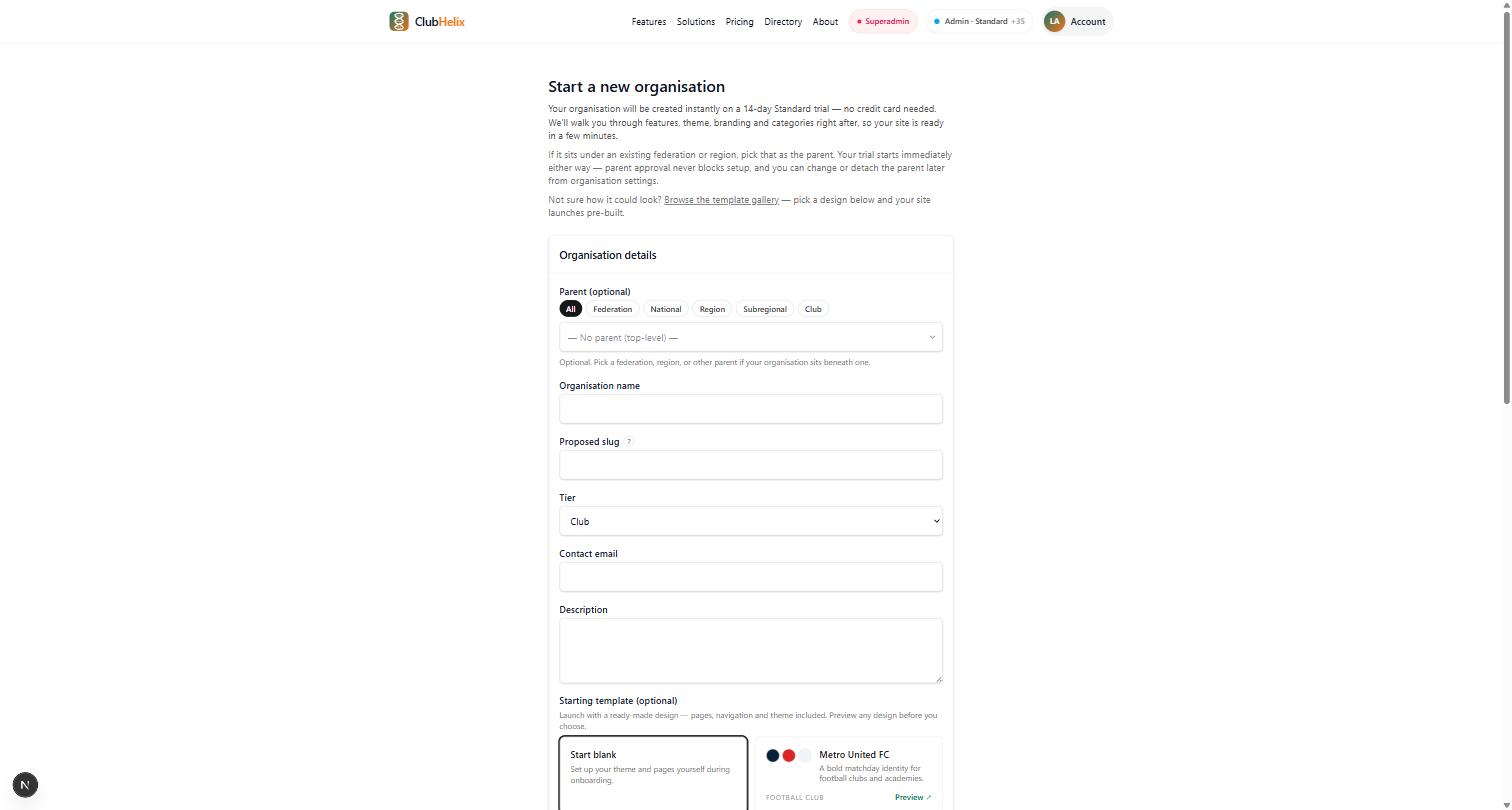
Set up online registration before you launch, so people can join, pay and sign in one sitting — on their phone, at the come-and-try session, while they're excited. Pair it with a simple club website: what you offer, when and where you play, fees, and a big "Join now" button. A page builder made for clubs means a volunteer can build it in an evening without touching code, and email broadcasts let you send one update that actually reaches every member instead of a chain of forwarded texts.
Launch: your first intake
With the structure in place, launch deliberately: pick a start date six to eight weeks out, run one or two free come-and-try sessions, put posters in schools, rec centres and coffee shops, and get a story in local community Facebook groups. Have registration open and working before the first session — the biggest launch mistake is collecting names on paper and hoping people join later. Follow up every attendee within 48 hours while enthusiasm is high.
Then protect your volunteers. Share jobs across the committee, write down how things are done, and recruit your second wave of helpers from your first wave of members.
If you want the boring parts handled, ClubHelix gives a new Canadian club a professional website, online registration and payments, membership management and member email from day one, with a free tier to start on — see pricing or create your club in an evening.
Frequently asked questions
Do we have to incorporate to start a sports club in Canada?
No — you can start as an unincorporated association to test demand. Most clubs incorporate provincially once they're handling real money, signing facility agreements or joining sanctioned leagues, because incorporation creates a separate legal entity and protects individual members.
How much does it cost to start a sports club in Canada?
Provincial incorporation filing fees are generally modest (commonly under a few hundred dollars), but the real startup costs are insurance, facility rental and equipment. Many clubs launch on a few thousand dollars raised through founding memberships and a small grant.
Do we need to register with the Canada Revenue Agency?
An incorporated nonprofit has basic tax filing obligations, but registered charity status is a separate, optional process most grassroots clubs don't need. Check current requirements at canada.ca and get advice before applying for charitable status.
How many people do we need to start?
Practically, three to five committed committee members and roughly enough interested players for viable sessions in your sport. Provincial incorporation typically requires a minimum number of directors, so check your province's rules before filing.

