
What this guide answers
- How is a roller derby league structured compared with a normal sports club?
Most community clubs are run by an elected committee serving a membership that mainly plays.
- What does a league actually need to run a public bout?
A venue with enough floor and safety zone plus load-in and tear-down time, insurance that satisfies the hirer, a full officiating crew of skating and non-skating officials, rostered skaters whose minimum-skills…
- How should a league keep track of minimum skills and clearances?
Keep one dated record per skater showing what was assessed, by whom, against which version of the published standard, and when it lapses — plus a return-to-skate re-assessment after injury or a long absence.
- How do leagues fund themselves?
Membership dues usually cover recurring training venue hire, with bout income covering the bout.
- Can a small league justify its own website?
Yes, and usually sooner than it thinks. The website does the jobs that otherwise consume volunteers — intake enquiries and sign-ups, a public bout calendar, advance ticket sales, merch, sponsor visibility and a…
Ireland edition. This guide is written for volunteer-run clubs in Ireland. Where rules differ — grants, tax, incorporation, safeguarding — follow the Ireland-specific pointers below or check with your national body.
Most community sports clubs are run by a committee elected out of a membership that, on the whole, just wants to turn up and play. A roller derby league is not that. The people who skate are also the people who own the league, write its policies, coach the intake, chase the venue invoice, sell the tickets, work the door and mop the floor afterwards. That double role is the sport's genuine strength — and it is exactly why league admin has the reputation it has.
The failure mode is predictable and it arrives somewhere around your thirtieth active member. Everything still goes to the full league because that is how it has always worked. A three-hour Sunday meeting produces four decisions, two of which get reopened a fortnight later by someone who was away. The three people who actually do the work quietly start doing it without asking, which reads as a power grab to everyone else, and by the end of the season you have lost both those three and the goodwill. Nothing about that is a derby problem. It is a governance problem that derby's ownership model makes unusually easy to walk into.
This guide is for skater-run leagues that want to grow without grinding themselves down. It covers member-owned governance and how to make decisions at speed without losing consent, running minimum skills and assessment so nobody is guessing who is contact-cleared, building an officiating crew you cannot simply borrow, producing a bout that starts on time, and the money side — venue hire, ticketing and the merch stand — that decides whether your season funds the next one.
What member ownership actually commits you to
There is a real difference between a club that is member-served (a committee provides a service, members consume it) and a league that is member-owned (the members are the enterprise). Derby is overwhelmingly the second. Skaters buy their own gear, pay dues that fund the venue, take on unpaid league roles as a condition of membership, and vote on the things that matter. Recruitment pitches lean on that, and rightly so — it is why people stay for a decade.
What it commits you to is less romantic. Member ownership means you owe your members a real vote, real information before that vote, and a written record afterwards. It also means the league carries obligations — a lease or hire agreement, insurance, money held on behalf of members — that a loose collective cannot properly hold. At some point, usually when a venue asks for a certificate of currency or a grant body asks for a bank statement, you need a legal skin.
Leagues here often start as unincorporated clubs and move to a company limited by guarantee registered with the CRO once there is a lease, staff or serious money moving through the account. A written constitution, a proper members' register and audited-or-reviewed accounts are what most funders and venues will ask for, so put them in place before you need them rather than during a grant round.
Governance that scales past your first thirty skaters
The single most useful thing a growing league can do is stop treating every decision as the same kind of decision. Write down which choices need a full membership vote, which sit with the board, and which a working group can just make. Publish it. Once that exists, the three-hour meeting turns into a forty-minute one, because most of what used to be debated was never a membership decision in the first place.
| Decision | Who decides | Who must be consulted first | Recorded where |
|---|---|---|---|
| Constitution change, merger, dissolution | Full membership vote | Board, with notice period | AGM or special meeting minutes |
| Annual budget, dues level, board elections | Full membership vote | Treasurer, board | AGM minutes |
| Venue contract, insurance renewal, bank signatories | Board | Treasurer, training lead | Board minutes |
| Disciplinary outcomes and code-of-conduct matters | Board or a standing panel | Written policy, both parties heard | Confidential register |
| Bout scheduling, ticket price, travel rosters | Events working group | Board sign-off on budget | Working group notes |
| Training plan, intake dates, assessment standards | Training working group | Coaches, officials lead | Training handbook |
| Merch designs, socials, sponsor artwork | Comms working group | Board for anything contractual | Working group notes |
Underneath the board, four or five working groups will carry almost everything: training, officials, events and bouts, membership and money, and comms and merch. Give each a named lead, a budget line and a standing slot to report in. The rule that keeps this honest is that a working group reports what it has done, not what it would like permission to do — if it needs permission for routine work, you have drawn the boundary in the wrong place.
Three habits make the whole structure survive turnover:
- Term limits with staggered ends. Two-year terms with half the board turning over each year means you never lose the entire institutional memory in one AGM. See how to run a club AGM for the mechanics.
- A written conflict-of-interest step. In a league where everyone skates, the person voting on the travel budget is usually also travelling. Declare it, note it in the minutes, and stand aside where the interest is direct.
- Handover packs, not handover conversations. Every league role should have a one-page description and a folder of the actual logins, files and contacts. The committee handover checklist is a good skeleton, and how to write a club constitution covers the document all of this sits under.

Minimum skills, assessment and the road to bout-ready
Derby is one of very few community sports where a brand-new member cannot simply be put on the roster, and where the gate between "learning" and "playing" is a formal, evidence-based assessment. Treat that gate as an administrative system, not a coaching vibe. The league that keeps clean records is the league that never has an argument about whether someone was cleared.
Run intake as cohorts rather than a rolling door. A fixed intake block — commonly eight to twelve weeks, twice a year — lets you teach a curriculum in order, keeps the group bonded, and gives you a predictable moment where a batch of new skaters becomes available to the roster. Rolling intake feels welcoming and quietly destroys your coaches, because every session becomes a mixed-ability session.
Structure clearances in visible stages so everyone knows where they stand:
| Stage | What it means in practice | Typical evidence held |
|---|---|---|
| Intake | Skating fundamentals, falls, stops, no contact | Attendance record, coach notes |
| Contact-cleared | May take part in contact drills at training | Dated assessment, named assessor |
| Scrimmage-cleared | May scrimmage under supervision, rules test passed | Assessment plus rules test result |
| Bout-ready | Eligible for rostering in sanctioned or public games | Full minimum-skills sign-off, current membership, waiver, insurance |
| Return-to-skate | Cleared after injury, surgery or a long absence | Re-assessment against the same standard |
The standards themselves are set by your governing body and by the rule set you play under, not by this article — treat published minimum-skills requirements as the source of truth and check them each season, because they do get revised. What is yours to own is the record: who was assessed, on what date, by whom, against which version of the standard, and when the clearance lapses.
That record does three jobs at once. It answers the roster question before every bout. It is the first thing anyone asks for after an incident. And it is what lets you spot the pattern that costs leagues most — skaters who pass intake and then never appear on a roster. Track the gap between "cleared" and "first rostered". If it is longer than a couple of months, your problem is not recruitment, it is the handover from the intake program into the league proper.
Officials — the crew you cannot borrow
You can find skaters. You cannot borrow a full officiating crew at short notice, and a bout without one does not happen. Officials are the scarcest resource in the sport and the one leagues under-invest in most consistently.
A full crew is bigger than most new leagues expect, and splits into skating officials on the track and non-skating officials at the desk:
| Crew position | Skating or desk | What they own |
|---|---|---|
| Head referee | Skating | Final rulings, crew briefing, game control |
| Jam referees | Skating | Lead jammer, jammer scoring and penalties |
| Pack referees | Skating | Blocker penalties, pack definition |
| Jam timer | Desk | Start and end of every jam, period clock |
| Scorekeepers | Desk | Points recorded from the jam referees |
| Penalty tracker and box crew | Desk | Penalty record, box timing, seating |
| Lineup tracker | Desk | Who was on track for each jam |
| Scoreboard operator | Desk | The public-facing score and clock |
Three things reliably build a crew. First, recruit deliberately from the people already in your orbit — injured skaters who want to stay involved, partners and parents who come to everything anyway, and retired skaters who miss the room. Second, pay the costs of qualification and travel out of league funds and feed your crew on bout day; officials who are out of pocket to volunteer do not come back. Third, roster them like you roster skaters, with named positions confirmed weeks ahead, not a group chat on the Thursday. A shared volunteer roster template helps, and a proper volunteer rostering tool with reminders helps more.
Keep certifications and their expiry dates in the same place as your skater clearances. When a crew member's accreditation, first aid certificate or background check lapses, you want that surfacing on a dashboard, not in a conversation on the day.
Producing a bout
A bout is a live event with a paying public, a fixed start time and a floor you do not own. It rewards a run sheet. Below is a realistic shape for a single-header public bout in a hired hall — adjust the offsets to your venue's access time.
| Time | What happens | Who owns it |
|---|---|---|
| T-4h | Load-in, floor swept, track taped, barriers and seating set | Events lead, working bee |
| T-3h | Desk built, scoreboard tested, PA and music checked, medical set up | Officials lead, tech |
| T-2h30 | Merch stand built, float counted, box office set, signage out | Merch lead, treasurer |
| T-2h | Officials briefing, crew positions confirmed, rules review | Head referee |
| T-1h30 | Team warm-ups, gear check, roster and waivers confirmed | Coaches, registrar |
| T-45m | Doors open, ticket scanning, program handout | Door crew |
| T-15m | Announcer intro, safety and venue briefing to crowd | Announcer |
| T-0 | First whistle | Head referee |
| Half time | Merch push, raffle draw, sponsor thanks, floor check | Comms lead |
| Full time | Announcements, photos, crowd out, tear-down starts | Events lead |
| T+1h30 | Floor cleared, tape lifted, venue walked with the hirer | Events lead |
Two details separate a bout that runs and one that limps. The first is the gear-check and roster confirmation slot at T-1h30 — do it once, formally, against your clearance records, and never let someone be added to the roster after it. The second is the tear-down. Tape removal is the job everyone disappears for, and the job your venue judges you on. Roster it by name in advance and hold the whole roster back for it.
Venue hire, ticketing and the merch stand
The venue conversation
Your floor is your entire product. Before you sign anything, walk the space with a tape measure and ask about the things that end bookings: the usable dimensions once you allow for a safety zone, whether the surface takes and releases your tape, load-in access and whether you can get through the doors with barriers, storage between events, how late you can stay for tear-down, and what the hirer requires in the way of a certificate of currency and a risk assessment. Get a schedule of the venue's own blackout dates for the year in writing, then build your season around it rather than negotiating each month.
Most leagues hire a community sports hall, a school hall or a university sports centre. Hall hire is typically quoted per hour in euro with a premium for evenings, weekends and any out-of-hours access, and a bout day runs to five or six hours once load-in and tear-down are counted. Ask whether a season-long block booking earns a lower rate, and confirm in writing who is responsible for cleaning after a public event.
Ticketing
Sell online, in advance, from your own site. Presale tells you whether to open the second seating bank, gives you a mailing list rather than a pile of cash, and shortens the door queue that otherwise delays your first whistle. Keep the price structure simple — a general admission adult ticket, a concession, free for young children, and a small number of trackside or premium seats if your venue allows them. Offer a season pass once you have three or more home bouts, because the second-bout attendance drop is real and a pass fixes it.
Run a door float anyway, and count it in front of two people at both ends of the night. Comp tickets should be issued as actual tickets, not a name on a list, so your headcount is accurate for venue occupancy and your sponsor knows their guests are covered. If you are weighing an outside platform against selling from your own site, external ticketing site versus built-in ticketing works through the trade-offs, and how to promote a club event covers filling the room.
The merch stand
Merch is where derby leagues either make a useful margin or slowly convert cash into a cupboard of unsold extra-large shirts. Two rules of thumb keep it healthy. Keep the range narrow — one good tee, one hoodie, one low-cost impulse item such as a sticker set or a pair of laces, and the current bout program. And run pre-orders for anything with sizing risk, so the stock you carry to the venue is stock you have already sold. Sell the same range online continuously, not just at bouts, because a third of your buyers are supporters who could not make it. How to sell club merchandise online covers the practical setup.
Set your bout budget as a shape rather than a wish. In most leagues the venue is the largest single line, followed by officials' and production costs, then printing and marketing; ticket revenue should cover venue and production on its own, with merch, bar or canteen and sponsorship providing the margin that funds travel and training subsidies. Write the shape down before the season, then compare each bout against it — the second home bout of a season is where the assumptions usually break.
Insurance, incidents and looking after your people
Insurance for a full-contact sport played at speed on a hired floor is not a box-tick, and the detail differs by market — treat what follows as general information and confirm the specifics with your governing body, your affiliation and a broker who has actually written a policy for a contact sport.
Cover is normally arranged through affiliation to a governing body, with public liability for the league and personal accident for registered participants, and the hall will ask for the certificate before it confirms a booking. Check the limit of indemnity the venue requires, whether officials and volunteers are named, and how the policy treats a taster session where the participant is not yet a member.
Alongside insurance, keep an incident register that is actually usable. In derby the register and the minimum-skills record are two halves of one evidentiary chain — if a claim or a formal complaint ever arrives, the two questions asked are what happened, and whether that skater was cleared to be doing it. So log injuries, near-misses, crowd incidents and code-of-conduct reports on the day, on one form, against the same member record that holds clearances and waivers, and put the register in front of the board every month rather than only after something serious. The incident report form template is a workable starting point.
The last thing worth protecting is your people. Member ownership means the league's workload lands on the same shoulders that take the hits, and the classic derby burnout arc runs about three years — enthusiastic, indispensable, gone. Counter it structurally: cap how many league roles one person can hold, make every role a documented one so it can actually be handed on, deliberately recruit a deputy for each working group lead, and normalise stepping back for a season without stepping out of the league. Club succession planning and how to recruit club volunteers go deeper.
Running the league from one place
Almost everything above is administration wearing a costume — clearances and rules-test results, board minutes and policy versions, officiating rosters, ticket sales, merch stock, incident reports and the mailing list. In most leagues that lives across a group chat, three spreadsheets, someone's personal payment account and a social page nobody can log into. ClubHelix pulls it into one place with roles and permissions that let a working group lead run their own area without handing over the keys to everything, governance and meetings for agendas, minutes and motions that stay findable after handover, events and ticketing for bout presales and season passes, and a club shop for merch that sells between bouts rather than only at them.
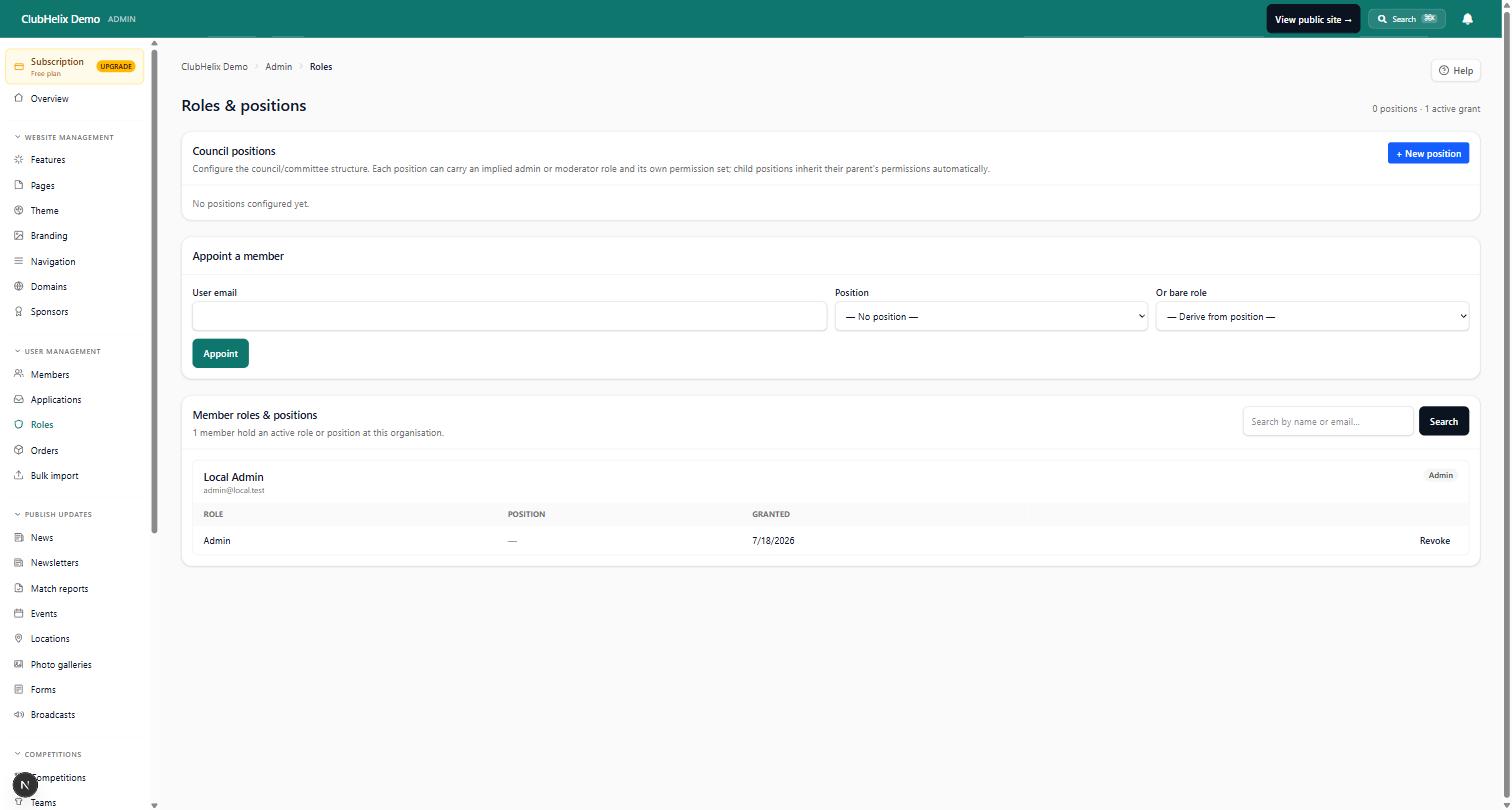
Start on the free tier, which is genuinely enough for a league still finding its feet, and move up only when ticketing and merch outgrow it. Every plan and what it costs is on the pricing page rather than behind a sales conversation. If your league currently runs off one person's laptop, create your club site and you can have memberships, a bout calendar and a merch page live before your next training night.
Frequently asked questions
How is a roller derby league structured compared with a normal sports club?
Most community clubs are run by an elected committee serving a membership that mainly plays. A derby league is member-owned — the skaters are the operators, hold the league roles and vote on the substantive decisions. That means governance has to be explicit: written decision rights, a real constitution, term limits and minuted meetings, or the load quietly concentrates on a few people and the league burns them out.
What does a league actually need to run a public bout?
A venue with enough floor and safety zone plus load-in and tear-down time, insurance that satisfies the hirer, a full officiating crew of skating and non-skating officials, rostered skaters whose minimum-skills clearances are current, medical cover on site, a ticketing and door plan, and a written run sheet with named owners for each block. Missing the officials or the insurance stops the event outright.
How should a league keep track of minimum skills and clearances?
Keep one dated record per skater showing what was assessed, by whom, against which version of the published standard, and when it lapses — plus a return-to-skate re-assessment after injury or a long absence. Group chats and coaches' memories are not records. Your governing body sets the standard itself, so check it each season and store the clearance alongside membership, waiver and any accreditation expiry dates.
How do leagues fund themselves?
Membership dues usually cover recurring training venue hire, with bout income covering the bout. Gate takings should carry the venue and production costs of the event itself, while merch, the bar or canteen, raffles and sponsorship provide the margin that funds travel, officials' qualifications and equipment. Grants tend to fund capital items rather than running costs, and most funders require an incorporated legal structure before they will consider an application.
Can a small league justify its own website?
Yes, and usually sooner than it thinks. The website does the jobs that otherwise consume volunteers — intake enquiries and sign-ups, a public bout calendar, advance ticket sales, merch, sponsor visibility and a searchable home for policies. It also outlives social platforms and individual admins, which matters in a sport where the committee turns over regularly.
Keep reading — how to write a club constitution for the document all of this sits under, and how to recruit club volunteers for filling the roles it creates.


