
What this guide answers
- What is a rally day at a pony club?
A rally is the club's regular instruction day, usually monthly — riders bring their horses, are grouped by ability, and rotate through coached sessions in flatwork, jumping, sporting and horsemanship.
- What is a gear check and why does it matter?
A gear check is the pre-mounting inspection of every horse and rider at a rally or event — helmet standard and fit, footwear, saddlery condition, bit legality and horse soundness.
- Do pony club volunteers need working-with-children checks?
Generally yes for instructors, committee members and regular volunteers, though requirements differ by state and role.
- How many volunteers does a rally day need?
Typically ten or more filled roles — gear checkers, arena setters, canteen shifts, gate and float-parking duty, plus instructors.
Ireland edition. This guide is written for volunteer-run clubs in Ireland. Where rules differ — grants, tax, incorporation, safeguarding — follow the Ireland-specific pointers below or check with your national body.
A pony club is really three clubs in one: a riding school teaching children horsemanship, a sporting club running competitions from mounted games to one-day events, and a small farm — grounds, yards, arenas and fences that need mowing, mending and mucking out. All of it runs on volunteer parents, many of whom arrived knowing nothing about horses and leave a decade later able to run a gear check blindfolded.
That mix is what makes pony club management distinctive. The safety stakes are real (large animals, young riders), the volunteer load is heavy, and the rhythm of the club revolves around one institution: the monthly rally day. Get rallies, safety and volunteers right and everything else — membership, money, even the yards — falls into place around them. Here's how well-run clubs do it.
The shape of the club
Pony clubs are junior-focused equestrian clubs, almost always incorporated associations affiliated with a state pony club body and, through it, the national organisation. Affiliation matters more here than in most sports: it brings the syllabus and efficiency certificate structure your instructors teach to, the rulebooks for each discipline, insurance arrangements, and eligibility for zone and state championships. If you're starting fresh, the general steps are in how to incorporate a club — then talk to your state body early, because grounds and insurance are the two long poles.
The committee carries more operational roles than most clubs because rally days are staffed events:
| Role | What they own |
|---|---|
| President | The club's face; council, state body and landholder relationships |
| Secretary | Minutes, affiliation returns, memberships, correspondence |
| Treasurer | Subs, rally fees, canteen, the fencing-and-arena budget |
| Chief instructor | The instruction program, rally groups, instructor development |
| Rally coordinator | Rally day logistics — groups, gear check roster, timetable |
| Grounds officer | Arenas, yards, fences, water, working bees |
| Canteen coordinator | The food that keeps 60 families on the grounds all day |
If those last four jobs rotate among the same five parents, read how to recruit club volunteers — pony clubs live and die on spreading that load.
Rally days — the heartbeat of the club
The rally is where pony club happens: typically one Sunday a month, riders arrive with their horses, are split into ability groups, and rotate through instruction sessions — flatwork, sporting, jumping, horsemanship theory — with a lunch break that doubles as the club's social life.
A rally day that runs smoothly is a logistics achievement, and the good clubs make it look easy by planning it the same way every time:
- RSVPs before the day. The rally coordinator needs numbers days ahead to set groups, allocate instructors and order canteen stock. Taking rally bookings through an online event page with RSVPs — with the rally fee paid at booking — ends the Saturday-night phone-around and the no-show guesswork.
- Groups posted early. Riders grouped by ability (and horse experience), posted before the day so families know where to go and instructors know who they've got. Attendance tracking on the day gives you the participation records your state body's returns and your insurers expect.
- A published timetable. Gear check from 8:30, mounted by 9:15, three sessions, lunch, afternoon session, dismissed by 3. Everyone — including the horse float queue at the gate — benefits from knowing the shape of the day.
- The volunteer roster, filled in advance. Gear checkers, arena setters, canteen shifts, gate duty. This is the difference between a rally and chaos — more below.

Gear checks and safety — the non-negotiables
Pony club's safety culture is built around a simple ritual: no rider mounts until their gear is checked. Every rally, trained gear checkers inspect each horse and rider — helmet to the current approved standard and correctly fitted, footwear with a proper heel, saddlery sound (stitching, stirrup leathers, girth points), bit appropriate and legal, and the horse itself sound to work. A signed-off gear check list is both a safety control and the club's evidence of diligence.
Beyond gear check, the safety habits that define a good pony club:
- Qualified, current instructors. Instructors teach to the syllabus and hold the coaching accreditations your state body requires, with first aid current. Track every instructor's tickets and renewals with accreditation expiry tracking so nothing lapses quietly.
- Working-with-children checks. Pony club is a children's sport; instructors, committee and rally volunteers generally need WWCC or the state equivalent. Requirements vary by state — our guide to working with children check requirements for clubs covers the general landscape with links to official sources. Horse and rider safety practices themselves should follow your state pony club body's current policies and syllabus rather than club folklore. This is general information, not legal advice — check the current requirements with the official body linked above.
- Incident and near-miss reporting. Falls happen in equestrian sport. Record every incident — rider, horse, circumstances, response — the same day, and review patterns at committee. A risk management plan that names horse-specific risks (loading, tying up, kicking zones, loose horses) is worth an evening of any committee's time.
- Horse welfare as policy. Water at the yards, shade, rest between sessions, and a clear "no sore or unfit horse works" rule that instructors enforce without argument.
Grounds, yards and the working-farm side
Pony club grounds are infrastructure-heavy: arenas that need harrowing and mowing, cross-country fences to inspect, holding yards and tie-up rails to maintain, water troughs, and the perennial fencing repairs. Treat it like the small farm it is — a grounds officer with a seasonal maintenance calendar, a twice-yearly working bee with jobs listed in advance, and an equipment register so the club knows what it owns and what state it's in.
An arena that only earns on rally days is an expensive one. Plenty of clubs hire theirs out between rallies — to members schooling a young horse, to a visiting instructor running a clinic, to a neighbouring club for a dressage day — and it pays for the harrowing. How to hire out a riding arena covers exclusive hire versus shared sessions, pricing per horse per hour, surface and safety rules, and taking the money at the gate.
Grounds are also the classic grant target: arena surfaces, yard upgrades, water infrastructure and safety fencing are exactly the sort of capital items community facility funding exists for.
The Sports Capital and Equipment Programme is the obvious target and funds exactly this kind of work; your Local Sports Partnership and LEADER rural development funding are the other two worth tracking. Register with the programme well before the round opens — clubs miss out on paperwork timing far more often than on merit.
Volunteers and instructors — the engine room
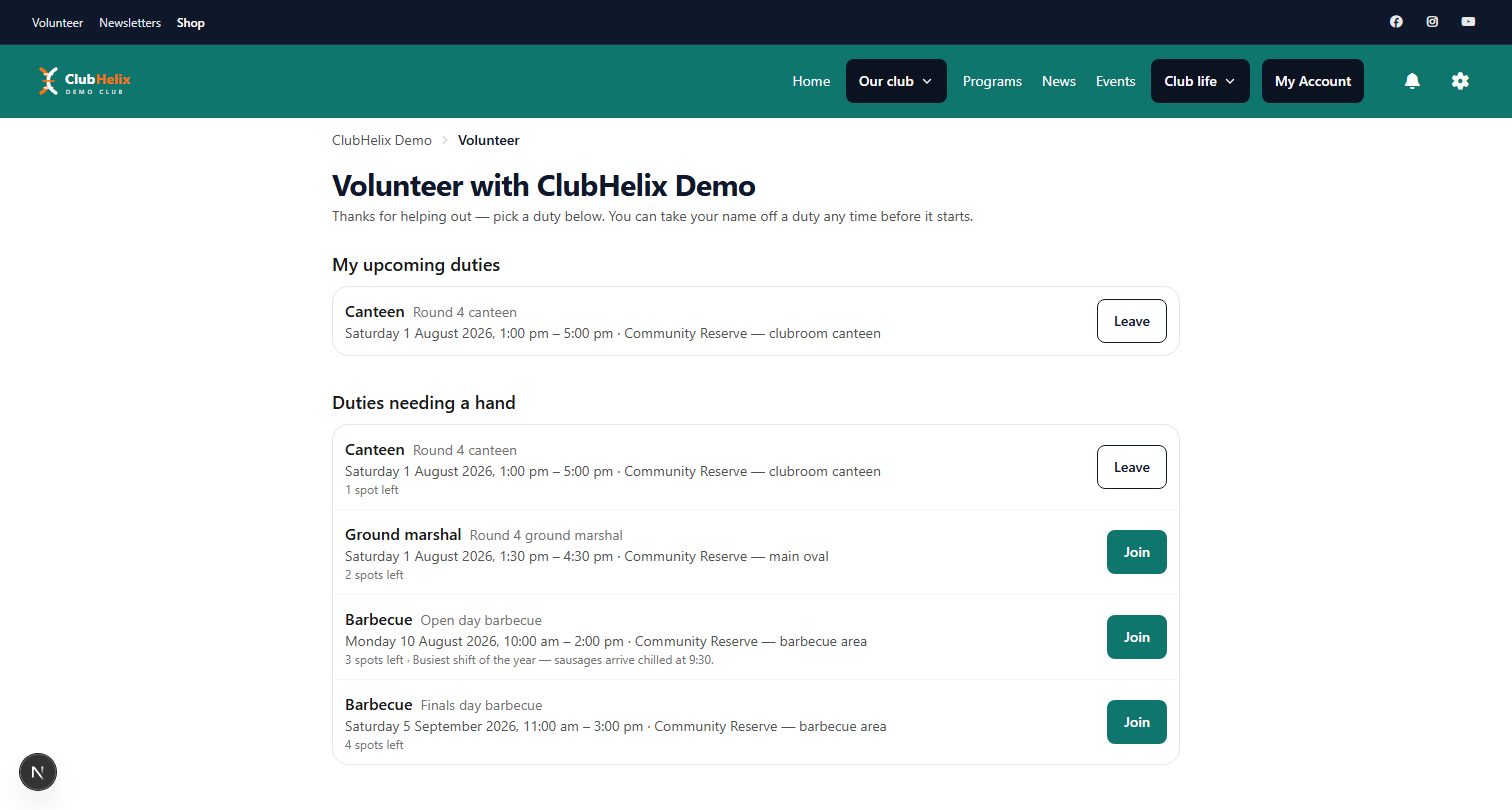
Every rally needs a dozen volunteer jobs filled, and pony club's great advantage is a captive workforce: parents are on the grounds all day anyway. The clubs that harness this well do three things — they define the jobs (a gear-check shift is 45 minutes, not "help out"), they roster in advance rather than begging on the day, and they thank people visibly.
A digital volunteer roster transforms this: publish the rally's duty roster with defined shifts, let parents claim slots from their phone, send automatic reminders, and see the gaps a week out instead of at 8am. Many clubs pair it with a family duty expectation — each family covers a set number of shifts a season — which is far easier to administer when the roster tracks itself.
Instructors deserve their own pipeline: spot the capable older riders and parent riders, fund their coaching accreditations, pair them with experienced instructors, and celebrate them. A club growing its own instructors never has to cancel a rally group for want of a coach — and it's the single best retention tool for teenage members, who stay for the responsibility. That pipeline thinking applies to the whole junior program; see how to increase junior participation.
Membership, money and communication
Pony club membership is family membership in practice: junior riders, riding and non-riding parent categories, and often associate riders. Fees stack — annual subs plus state body capitation, rally fees per attendance, event entries — which is exactly the kind of multi-part money that's miserable on paper and painless online. Online registration handles joining, renewals, rider details and emergency contacts in one pass, and rally fees collected at RSVP time mean the treasurer reconciles a report, not a cash tin.
Income beyond fees follows the classic country-club playbook: the canteen (a pony club canteen on a one-day-event weekend is a serious earner), an annual open gymkhana or ODE that draws entries from neighbouring clubs, a sausage sizzle, sponsorship from the local produce store and float dealer, and grants for capital works.
Communication is where equestrian clubs feel the load most — rally group allocations, gear check reminders, ground condition updates, wet-weather calls by 6:30am. One channel, used consistently, beats five used sporadically: club email broadcasts for the monthly news, and the club website as the single source of truth for the calendar and rally documents. A wet-weather communication plan — who decides, by when, announced where — saves a hundred anxious float-hitching phone calls a season.
Your equestrian club website
New families find pony clubs the same way they find schools: they search, they compare, and they judge from the website. An equestrian club website that answers the newcomer's questions — what happens at a rally, what a starting rider needs, what it costs, whether there's a waiting list, how to visit — converts curiosity into membership. For existing families it's the operational hub: calendar, rally bookings, group lists, news and documents in one place.
ClubHelix's equestrian and pony club management software gives a volunteer committee the whole kit — website, family memberships and online payments, rally events with RSVPs and attendance, volunteer rostering, accreditation tracking and club email — with a free tier to start on (see pricing). For a club whose secretary is also a gear checker, canteen backup and float driver, moving the admin into one system is how rally Sundays stay about the riding.
Frequently asked questions
What is a rally day at a pony club?
A rally is the club's regular instruction day, usually monthly — riders bring their horses, are grouped by ability, and rotate through coached sessions in flatwork, jumping, sporting and horsemanship. It's the core of the pony club program and the club's main social event.
What is a gear check and why does it matter?
A gear check is the pre-mounting inspection of every horse and rider at a rally or event — helmet standard and fit, footwear, saddlery condition, bit legality and horse soundness. No rider mounts until checked; it's pony club's foundational safety control and part of the club's duty-of-care record.
Do pony club volunteers need working-with-children checks?
Generally yes for instructors, committee members and regular volunteers, though requirements differ by state and role. Check your state's screening authority and your state pony club body's current policy rather than relying on another club's practice.
How many volunteers does a rally day need?
Typically ten or more filled roles — gear checkers, arena setters, canteen shifts, gate and float-parking duty, plus instructors. Clubs that publish a defined-shift roster in advance and share duties across all families fill them without drama.

