
What this guide answers
- How do you manage a club with multiple grounds?
Give each site a named venue lead with defined authority, keep one canonical information record per site that every fixture and notice links to, and split rosters, equipment and budget lines by site.
- Should each venue have its own page on the club website?
Yes. One page per venue with the address, map pin, entrance, parking, surface numbering, amenities and contact is the single highest-value thing a multi-site club can publish.
- How do we stop equipment disappearing between sites?
Give every item a home site in your equipment register, keep a simple movement log for anything that travels, duplicate the cheap items rather than shuttling them, and reconcile the count at each site twice a year on…
- How should keys and access codes be handled across several sites?
Keep a key register recording every key or fob, which site and area it opens, who holds it, when it was issued and when it came back.
- Do satellite sites need their own volunteer roster?
They need their own roster view. Build one roster per site per session with a named lead in every slot, never schedule the same person at two sites on one day, and publish about four weeks ahead with a reminder the day…
New Zealand edition. This guide is written for volunteer-run clubs in New Zealand. Where rules differ — grants, tax, incorporation, safeguarding — follow the New Zealand-specific pointers below or check with your national body.
The message lands at twenty to nine on a Saturday morning. The gate at the second ground is locked, nobody on site has a key, and the person who does have one is already umpiring at the main ground clear across town. Half an hour later a different message arrives from a parent who drove to the main ground because that is where the team played last week, and the fixture change went out on a chat thread they were never added to.
Neither of those is a sporting problem. They are both symptoms of the same thing — a club that grew into a second place without ever deciding how it would be run as one. Clubs end up multi-venue for good reasons. You outgrew the home ground. Two clubs merged. A junior program needed an indoor hall for winter. Your landlord could only offer two half-sites rather than one whole one. What nobody warns you about is the coordination tax: every roster, every notice, every set of keys, every piece of gear and every decision now has to specify where, and the moment one of them forgets to, somebody's Saturday is wasted.
This guide is for committees running one club across two or more venues — a second ground, a satellite training site, a hired hall, or the two-of-everything you inherited from a merger. It covers how to name the shape you are actually in, how to push ownership down to each site without losing the club, how to publish venue information nobody can misread, and how to keep equipment, keys and rosters honest across every location.
Name the shape you are actually in
"Multi-venue" covers four quite different situations, and the fixes differ. Work out which one you are before you start changing anything.
| Shape | What it looks like | The failure mode it invites |
|---|---|---|
| Overflow site | A home base plus a second site hired or leased to fit the extra teams | Second-class citizenship — the overflow site gets the oldest gear and the fewest helpers |
| Merged club | Two former clubs, two of everything, one committee on paper | Loyalty by postcode; two rosters, two canteens, two cultures |
| Program venue | A hall, pool, studio or indoor court used by one part of the club only | Invisible members — the program crowd never meets the rest of the club |
| Seasonal or shared | A site you only hold for part of the year, or share with another organisation | Institutional amnesia every time you come back, plus clashes with the co-tenant |
Say it out loud at a committee meeting: "we are a merged club with two sites and we still run two of everything." That sentence is worth an hour of agenda time, because an overflow site needs a volunteer plan, a merged club needs an identity plan, and a shared tenancy needs a written schedule with the other tenant.
Most community clubs hold their grounds under a council lease or a seasonal ground allocation, and a second site is often a school field or a reserve managed by a different council entirely. The two landlords rarely have matching rules on floodlight curfews, line marking, key handling or food sales, so put both agreements in one folder before you plan a season across them.
Venue-level ownership — who runs what, and who decides
The most common multi-venue failure is not logistical, it is structural: the work moved out to the sites but the ownership stayed in the middle. Every gate, every mow, every wet-weather call still routes through two or three central volunteers who cannot physically be in both places, so decisions queue behind them and the second site learns that nothing happens quickly.
The fix is a named person per site with real authority, and a written line showing where that authority stops.
The venue lead
Give each site a venue lead (ground steward, site captain, venue manager — pick one title and use it everywhere). It is a genuinely appealing job for someone who wants to help but does not want to sit on a committee, because it is concrete, local and finite. The role owns:
- Opening and closing on match and training days, or the roster of people who do.
- The key register for that site — who holds what, and getting it back.
- A condition report after each round: line marking, nets, lights, rubbish, toilets, anything broken.
- The site's slice of the equipment register, including what is stored there and what has walked.
- First contact for the landlord's caretaker, groundskeeper or facilities officer.
- Hosting duties — where visiting teams park, which change rooms they use, where the first-aid kit is.
What the role does not own: spending above an agreed limit, changing which teams are based where, altering signage or branding, or deciding club policy. Write that down in the position description so the job stays attractive and the boundary stays friendly. The volunteer position descriptions template is a sensible starting point.
The decision grid
Ambiguity about who decides is what turns a small site problem into a committee argument. Publish a grid like this one and stick it in the back of your handbook.
| Decision | Venue lead | Committee | Rule of thumb |
|---|---|---|---|
| Open or close the site for weather, today | Decides | Informed | The person standing on the surface wins the argument |
| Repairs under the petty-cash limit | Decides | Reported | Report at the next meeting, receipt attached |
| Spend above the limit | Recommends | Approves | One quote below a set figure, two above it |
| Which teams are based at which site | Consulted | Decides | A club-wide call — never a site-by-site negotiation |
| Hiring the site to an outside group | Recommends | Approves | See hiring out your clubrooms |
| Signage, sponsor boards, branding | Consulted | Decides | One club look at every site |
| An incident or injury on site | Reports at once | Owns follow-up | Use the same form everywhere |
Two habits make the grid stick. First, one escalation number, not four — the venue lead calls the same duty officer every time, whatever the site. Second, the venue lead reports at every committee meeting, even when the report is "nothing to raise". A standing agenda item is what stops a site quietly drifting out of the club's attention for a season.
Software should mirror that structure rather than fight it. In ClubHelix, roles and permissions let you give a venue lead admin access to their own site's bookings, notices and roster without handing them the membership database or the club's finances.
Publishing venue information without confusing anyone
The second failure mode is informational. Address details end up in five places — a fixture list, a chat thread, an old newsletter, a sponsor's flyer and someone's memory — and at least two of them are wrong. Multi-venue clubs need one canonical record per site and a discipline of pointing at it rather than retyping it.
One record per site, and everything links to it
Each venue gets a page that carries everything a stranger needs, written for someone who has never been there:
- The full street address and a map pin that drops on the right entrance, not the middle of the park.
- Which gate or entrance to use, and any access code or contact for getting in.
- Parking — where to park, where not to, and what happens on a busy day.
- The surfaces and rooms, numbered consistently, with a note on how the numbering runs.
- Amenities — toilets, change rooms, food and drink, accessible entry and accessible parking, shade, seating.
- What is stored there and what teams need to bring.
- Who to contact on the day, and the wet-weather notice for that site.
- Public transport and, if it is genuinely tricky, a sentence of plain directions.
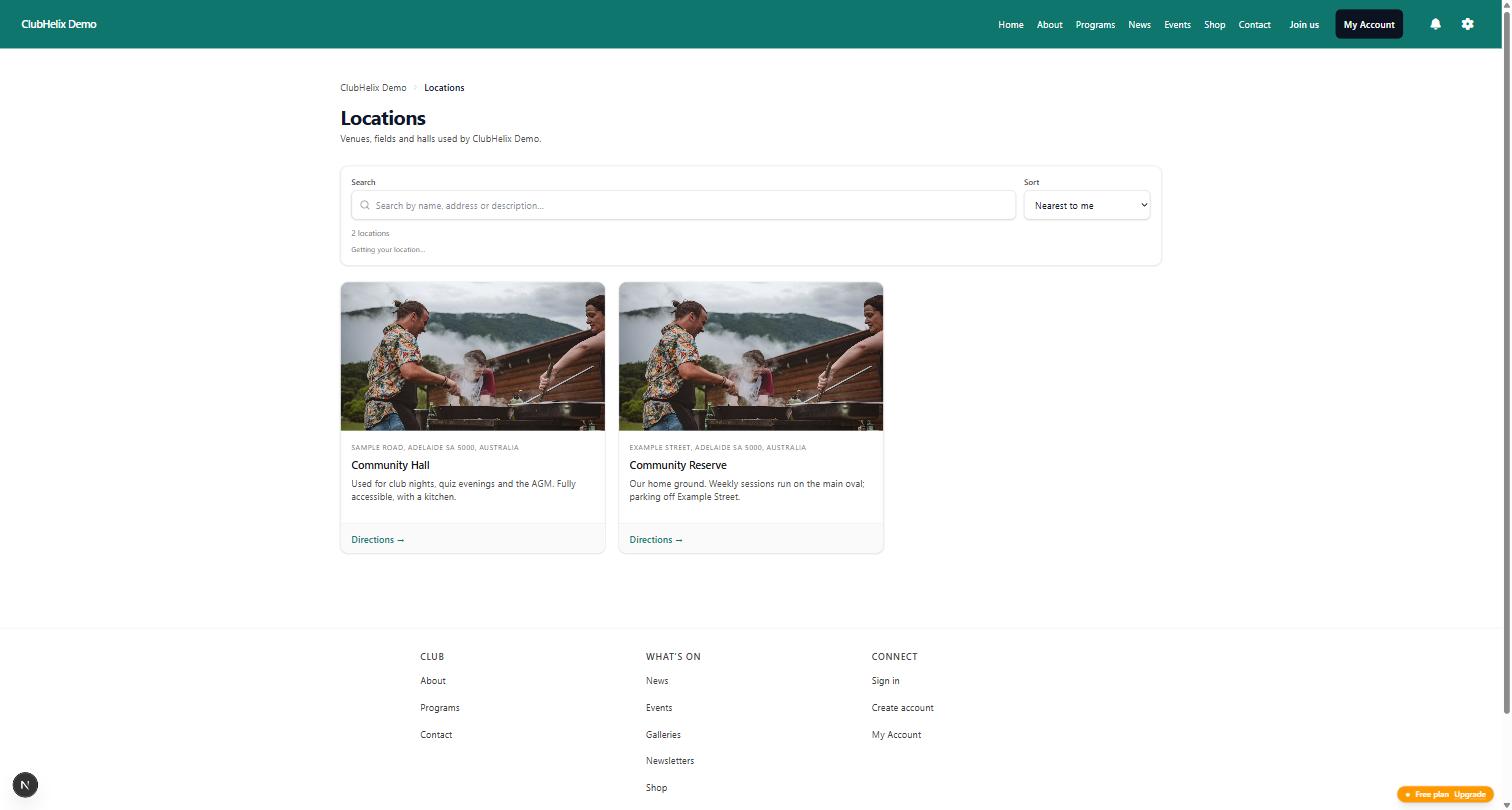
Then hold the line: fixtures, events, training sessions and newsletters link to that record instead of repeating an address. When the gate changes, you edit one page. ClubHelix's locations pages are built for exactly this, with a map and a fixed record every fixture and event can point at.
Naming that survives a group chat
Every site accumulates nicknames — the top ground, the new courts, the school, down the road. Nicknames are how a parent ends up at the wrong address. Pick one official name per site, use it in every fixture, email, roster and sign, and gently retire the rest.
| Site | Official name | Also called locally | Numbering convention |
|---|---|---|---|
| Home base | Memorial Park | "the top ground" | Fields 1-3, numbered from the clubroom side |
| Second site | Riverside Reserve | "the school", "down there" | Fields 4-6, continuing the same sequence |
| Indoor program venue | Northside Community Hall | "the hall" | Courts A and B, marked on the wall |
Two details from that table do more work than they look like they should. Continuing the numbering across sites (fields 1-3 here, 4-6 there) means a fixture that says "Field 5" is unambiguous even if the site name gets cut off. And painting or signing the number on the surface itself ends the weekly argument about which court is which.
The stranger test
Once a season, run this test on each venue record. Hand it to someone who has never been to that site — a new committee member, a parent from another club — and ask whether they could get from home to the right gate, park legally, find the right surface and know who to ask for, without ringing anybody. If they hesitate anywhere, the record is not finished. It is a fifteen-minute exercise that removes a season of phone calls.

Equipment, keys and rosters across sites
The asset register grows a column
Most clubs have some kind of gear list. A multi-venue club needs the same list with one extra column — home site — and one extra rule: every item belongs somewhere, and moving it is a booking rather than a favour.
Record for each item: what it is, quantity, condition, home site, where exactly it is stored at that site, who is responsible, and the date it was last sighted. The club equipment register template covers the base structure; add the site column and a simple movement log (item, from, to, who, date, returned). The movement log is what stops the annual mystery of eight balls at one ground and none at the other.
Three practical rules earn their keep:
- Duplicate the cheap things, share the expensive ones. A second first-aid kit, a second set of cones, a second pump and a second whiteboard cost less than the coordination of moving one set around. Line-marking machines, defibrillator units and scoreboards are worth sharing with a booking system.
- Reconcile at the working bee. Count everything at each site on the same day, twice a year. Our guide on running a working bee has the format.
- Photograph the store room when it is tidy and pin the photo inside the door. It is the cheapest inventory control there is.
Keys, codes and the people who leave
Access is where multi-venue clubs lose the most time and the most goodwill.
| Access method | Suits | Watch for |
|---|---|---|
| Cut keys on a register | Small sites with stable volunteers | Re-keying cost when one goes missing and nobody admits it |
| Coded padlock or keypad | Sites with lots of rotating helpers | The code that has not changed in six years and is in three chats |
| Smart lock or fob | Clubrooms, bars, storerooms | Nobody deactivating a fob when a volunteer steps back |
| Landlord-controlled access | Shared or leased sites | The Saturday nobody answers the caretaker's phone |
Whatever you use, keep a key register with these columns: key or fob ID, site, what it opens, holder, date issued, deposit held, date returned. Set a rule that codes change at the start of each season and whenever a key holder steps down, and add "return keys and confirm codes changed" to your committee handover checklist. The handover is where keys disappear.
Rosters that never strand a site
A multi-venue roster is not one roster with more rows. It is one roster per site per session, with a named site lead in every single slot.
- Every session has an identified lead, even a quiet Wednesday training. If nobody is named, nobody comes.
- Never roster the same volunteer at two sites on the same day. It looks efficient on a spreadsheet and it fails in traffic.
- Build travel time in where sites are far apart, and be honest about what "far apart" means at 8am on a wet Saturday.
- Publish four weeks ahead and send a reminder the day before, per site, so people see only the shift that is theirs.
- Give people a swap mechanism that does not involve the roster coordinator. A swap that needs an intermediary is a swap that becomes a no-show.
The volunteer roster template works fine on paper for one site. Across three, a shared roster with per-site views and automatic reminders — like ClubHelix volunteer rostering — is the difference between a coordinator who lasts a season and one who lasts five.
Give every site its own line in the budget
Multi-venue clubs almost always subsidise one site from another. That is a perfectly reasonable thing to do — and a terrible thing to do by accident. Split these lines by site for one full season and the conversation changes from opinion to arithmetic.
| Line | Why it differs by site |
|---|---|
| Rent, lease or hire fees | Different landlords, different terms, sometimes different seasons |
| Utilities and lighting | Older floodlights can cost multiples of newer ones per hour |
| Maintenance, mowing and cleaning | One site may be maintained by the landlord and one entirely by you |
| Inspections, compliance and insurance | Some landlords require their own certificates and evidence |
| Travel and duplicated equipment | Real money that never appears as a line item until you create one |
| Food, drink and function income | Usually concentrated at one site, which is exactly the point |
The output is one honest sentence at the annual meeting: "the second site runs at a deficit of roughly a fifth of its costs, funded by the main site, because it is where our junior growth is." That is a decision. "We are not sure how the second site goes" is not. Build the split into your club budget template and report it in the treasurer's report each month.
If the second site needs capital work — floodlights, fencing, an accessible path — look at your council's community facilities fund, your regional sports trust, and the gaming trusts that fund exactly this kind of item. Applications for a satellite site are often stronger than for a main ground, because participation growth is easier to evidence when you can show the teams you had to turn away.
One club, not a federation of postcodes
Everything above is logistics. The part that decides whether a multi-venue club survives is whether people at the smaller site feel like members of the club or tenants of it. A few habits do most of the work:
- Rotate committee meetings between sites. It sounds symbolic. It is not — the agenda changes when you can see the thing being discussed through the window.
- One presentation night, one newsletter, one uniform. Split those and you have two clubs sharing a bank account.
- Give the second site something that matters — a finals day, the season launch, the junior carnival. Hosting a real occasion converts a venue into a home.
- Name the site's own history. An honour board, a photo wall, the story of how the club came to be there. If the site arrived through a merger, this is not optional; see how to merge two sports clubs.
- Run at least one cross-site working bee a year so people meet the volunteers they otherwise only see in a roster.
Running every site from one admin
Multi-venue coordination is mostly information moving reliably between people who are standing in different places. A club website with a real record for each location, bookings that know which surface at which site is free on Thursday through facility booking, rosters that send each volunteer only their own shift at their own venue, and per-site notices sent by broadcasts removes most of the phone calls that currently land on three people.
ClubHelix does all of that from one admin, with a free tier to start on and no lock-in if you outgrow it. Have a look at the pricing, or create your club site and set up your venues one afternoon this week — you can add the second site's page before your next round of fixtures goes out.
Frequently asked questions
How do you manage a club with multiple grounds?
Give each site a named venue lead with defined authority, keep one canonical information record per site that every fixture and notice links to, and split rosters, equipment and budget lines by site. The central committee still decides club-wide matters — which teams are based where, branding, spending above a set limit — while day-to-day site decisions are made by the person actually standing there.
Should each venue have its own page on the club website?
Yes. One page per venue with the address, map pin, entrance, parking, surface numbering, amenities and contact is the single highest-value thing a multi-site club can publish. Every fixture, event and training session then links to that page instead of repeating details that go stale, so one edit fixes the information everywhere.
How do we stop equipment disappearing between sites?
Give every item a home site in your equipment register, keep a simple movement log for anything that travels, duplicate the cheap items rather than shuttling them, and reconcile the count at each site twice a year on the same day. Photographing a tidy store room and pinning the photo inside the door is a surprisingly effective control.
How should keys and access codes be handled across several sites?
Keep a key register recording every key or fob, which site and area it opens, who holds it, when it was issued and when it came back. Change access codes at the start of each season and whenever a holder steps down, and put key return into your committee handover checklist — handover is when keys are most often lost.
Do satellite sites need their own volunteer roster?
They need their own roster view. Build one roster per site per session with a named lead in every slot, never schedule the same person at two sites on one day, and publish about four weeks ahead with a reminder the day before. Volunteers should see only the shifts that are theirs, at the venue that is theirs.
Keep reading — how to hire out your clubrooms turns an under-used site into income, and how to organise a working bee covers getting both sites ready before the season starts.

