
What this guide answers
- How do you get permission to build mountain bike trails?
Identify the body that manages the land rather than the one that owns it, then negotiate a written agreement covering scope, approved works, build standard, insurance, signage and reporting.
- How should a mountain bike club grade its rides?
Publish four things for every ride — the hardest trail grade on the route, distance, total climbing and pace — plus a plain line about regroups and whether anyone gets left behind.
- Do mountain bike clubs need insurance for trail building?
Land managers normally require public liability cover before approving works, and it is usually obtained through affiliation to a governing body.
- How do mountain bike clubs raise money for trails?
Most combine a per-member trail levy, donations tied to something concrete like a metre of trail or a day of machine time, business supporters funding a named trail, event surpluses and grants.
- What is the best way to run a club dig day?
Publish specific tasks with time estimates and skill levels rather than a general call for help, induct new volunteers on tools and trail design, split heavy work from entry-level jobs, log the hours per trail, finish…
USA edition. This guide is written for volunteer-run clubs in the United States. Where rules differ — grants, tax, incorporation, safeguarding — follow the USA-specific pointers below or check with your national body.
Nine on a Sunday morning, and eleven people are standing at the top of a fire road holding mattocks. Two of them will spend four hours cutting a drain that nobody will ever notice. One is rebuilding the entry to a corner that has been getting steadily worse since autumn. The rest are moving rock. By three o'clock they will have finished perhaps thirty metres of trail, and several hundred riders — most of whom are not members and will never know their names — will benefit from it for the next decade.
That is the honest shape of a mountain bike club. Other clubs sell games, courts or a season. A mountain bike club sells trail — a network it designs, cuts, maintains and defends, on land it does not own, for a riding public it cannot charge at a gate. The weekly ride is where members meet, but the trail is the product, and the relationship with whoever manages the land is what lets the product exist at all.
This guide is for the committee holding a land-manager agreement, a container of tools and a Sunday ride calendar. It covers formalising trail access and running a dig crew, grading rides and training ride leaders, shuttle days and enduros as both events and income, and how to fund trail work that never stops.
What a mountain bike club actually sells
Get clear on this before you write a membership fee, because it explains why some clubs thrive with two hundred members and others struggle with eight hundred riders on their trails.
| The product | What it means in practice | Who it is for |
|---|---|---|
| Trail access | A legitimate, insured, signed network | Everyone who rides there |
| Trail stewardship | Building and improving that network | The dig crew |
| Organised rides | Graded rides where a newcomer is not dropped | New and social members |
| Skills and juniors | Coaching, junior, women's and beginner sessions | The next decade |
| Events | Shuttle days, enduros, club champs | The community, plus income |
| Advocacy | The credible voice when land use or closures are decided | The club's existence |
Most of that is delivered to people who are not members. That tension sits underneath almost every difficult conversation a mountain bike committee has, and the answer is never to charge at the trailhead — it is to make membership the obvious way to support something people already love, and to make the club visibly the reason the trails exist.
Land-manager agreements and the trail crew
Everything downstream depends on one document and one relationship.
Find out who actually manages the land
Not who owns it — who manages it. Those are frequently different bodies with different processes, and approaching the wrong one costs you a season.
Trails typically sit on national forest, Bureau of Land Management, state park or county park land, and each agency has its own volunteer agreement, environmental review and adopt-a-trail framework. Federal land in particular requires the review process to be completed before ground disturbance, which takes time — start the paperwork a year ahead of the build you want.
The agreement, clause by clause
Whether it is called a memorandum of understanding, a licence or a partnership, settle these points in writing. Vagueness here is what turns a change of staff at the land manager into a closed network.
| Clause | What to nail down |
|---|---|
| Scope | Which trails and which area, on a map |
| Approved works | What the crew may do without asking, and what needs sign-off |
| Build standard | The design and construction standard, referenced by name |
| Insurance | Who insures volunteers doing physical work |
| Tools and storage | Where equipment lives, who may operate machinery, what tickets are needed |
| Closures | Who can close a trail, how quickly, and how it is communicated |
| Signage | Who provides trail head signs, grade markers, emergency location markers |
| Reporting | What the club reports and how often — hours, incidents, counts, works |
| Term and review | How long it runs and what triggers a review, so it cannot lapse quietly |
| Termination | Notice periods, and what happens to club-built infrastructure |
The reporting clause is the one clubs undervalue. A land manager who receives a tidy quarterly summary of volunteer hours, works completed, incidents and trail counter numbers can justify your access internally, defend it in a budget meeting, and put your project into their capital plan. It is the cheapest advocacy you will ever do.
Running a dig crew that lasts
Trail building burns people out faster than any other club activity — the work is hard, the results are invisible to most riders, and the same eight people do it. Structure it deliberately.
- Trail crew leaders, plural. Split the network by trail or area; each leader gets a standing crew and a maintenance schedule.
- Publish a task list, not a call for help. "Drain clearing on the blue descent, two hours, hand tools, suits first-timers" gets far more hands than "dig day Sunday".
- Run inductions. Tool safety, trail design and why water is the enemy — it turns willing bodies into useful ones and satisfies most land managers.
- Separate jobs by effort. Rock work and machine days need experienced volunteers; drain clearing and trail counts do not, and they are the on-ramp for new members.
- Keep a maintenance register per trail — date, works, hours, who attended. It feeds your land-manager report and every grant application.
- Finish on time and feed people.
Volunteer rostering fits here — people claim a specific job on a specific day, and you get a record of hours without anyone keeping a tally in a notebook. How to organise a working bee covers the format, and tracking volunteer hours for grants explains why those hours are worth real money.
Land agencies generally require a signed volunteer service agreement, which can bring some volunteer protection, but clubs still carry their own liability policy. Check specifically that it covers trail construction, powered tool use and led rides, and confirm how your state's recreational use statute applies to the landowner.
This is general information, not advice. Insurance, land tenure and consultation obligations vary and change — confirm the current position with your governing body, your insurer and the land manager before you commit.
Ride grading, ride leaders and rider safety
A led ride is where most new members decide whether the club is for them, usually within twenty minutes. The most common failure is a grading system that means nothing, so a rider expecting a social ride finds themselves off the back on a fire road climb. Grade rides on four axes and publish all four, every time.
| Axis | What to publish |
|---|---|
| Trail difficulty | The hardest grade on the route, on the green to double-black scale |
| Distance | Kilometres, honestly |
| Climbing | Total ascent, which predicts suffering better than distance |
| Pace | Social, steady or fast — defined in plain words on your website |
Add the one-line description that does the real work — "two hours, one solid climb, all descents blue with a black option, we regroup at every junction, nobody gets left" tells a nervous rider more than any grade. Cap groups at eight to ten riders per leader and run two rather than one group of twenty that splits anyway.

The ride leader
Ride leading is a real role with real responsibility and deserves training rather than volunteering. Recognised ride leader courses exist through most governing bodies and are worth funding for four or five members. A leader should carry a first aid kit and current training, know the route, and have the emergency plan on their phone.
Run the same pre-ride briefing every time. Ninety seconds, and it prevents most of what goes wrong.
- Who leads, who sweeps, and the rule that nobody rides in front of one or behind the other.
- The route, the regroup points and the bail-out options.
- The honest grade, and a no-judgement invitation to swap to the easier group now rather than in an hour.
- A bike check, and that everyone has water, a tube, a multi-tool and a phone.
- Where reception drops out, and what happens if the group separates.
- The emergency procedure — who calls, which access points an ambulance can use, and how to describe your location from the marker signs.
- Active closures, wet-weather restrictions or works in progress.
Incidents
Mountain biking produces genuine injuries in places vehicles cannot reach. Three things need to exist before the first led ride of the season.
An emergency access plan per trail area, agreed with the land manager, listing vehicle access points, gate keys or codes and the location markers riders can quote. Put it in every leader's pack.
An incident report filed the same day for injuries, near misses and trail damage. A logged pattern of near misses at one feature justifies a reroute to the land manager, and a documented history is what your insurer wants years later. Incident reporting keeps the register searchable instead of scattered across messages.
A trail closure procedure — someone who can close, tape and sign a trail and get it onto the website within an hour, and a club that knows who that someone is. Sports club risk management covers the wider assessment land managers and insurers expect.
Shuttle days, enduros and the trail fund
Events are where a mountain bike club converts goodwill into money for dirt.
Shuttle days
A vehicle, a trailer and a driver turn a two-hour climb into six descents, and riders will pay properly for that. The essentials — a vehicle and trailer rated for the load, a driver holding whatever licence class carrying paying passengers requires where you are, proper bike restraints, a published run timetable, a marshal top and bottom, and a hard cap on numbers sold.
An illustrative day: one vehicle carrying ten riders, seven runs, seventy shuttle places sold. Deduct fuel, driver costs, permit and insurance loading, and a good day contributes a meaningful lump to the trail fund. Sell places online in advance with a waitlist — no-shows are what kill shuttle economics.
Most clubs price a shuttle day around $35–$70 for members and add a surcharge for non-members. Set it against your real vehicle, fuel and permit costs rather than what feels reasonable.
Enduros
A club enduro is the biggest event most mountain bike clubs run — three to five timed stages, untimed transitions, hundreds of riders, a whole day of marshalling. What makes it survivable: a permit and agreed course, stage marshals plus a sweep on every stage, a defined start interval, a course signed, taped and walked the day before, first aid positioned to reach every stage, and a results process you have tested.
Budget it honestly. Timing, medical cover, portable toilets, signage and permits cost real money before a rider arrives, and clubs regularly find the event broke even only because a hundred volunteer hours were free. Model it with the club budget template, and read how to organise a sports carnival for the event-day machinery.
The trail fund
Name it, ring-fence it, and report on it. A trail fund that is visibly separate from general revenue changes how people give, because riders will support dirt far more readily than they will support "the club".
- A per-member trail levy, small and included in the membership fee, described plainly on the join page.
- Donations with suggested amounts tied to something concrete — a metre of trail, a load of rock, a day of machine time.
- Business supporters who fund a named trail or feature for a season.
- Event surpluses transferred to the fund by resolution, so it is not quietly absorbed.
- Grant funding for the big items, which is where a well-kept register of volunteer hours becomes your co-contribution.
Trail projects are funded through the Recreational Trails Program administered by states, county open-space bonds, community foundations and cycling advocacy grant programs. Land agencies also hold their own project money, so ask your agency contact what is in their program before applying elsewhere.
Membership and who actually pays for the trails
The free-rider problem is structural, and the clubs that handle it best are cheerful about it rather than resentful.
| Category | Suits | Typically includes |
|---|---|---|
| Full riding member | Regular riders | Insurance cover on club rides, event discounts, voting rights |
| Family | Households with juniors | Bundled full membership, junior program access |
| Junior | Under-18 riders | Coaching, junior rides, discounted event entry |
| Dig crew / volunteer | People who build more than they ride | Full rights, fee waived or heavily discounted against logged hours |
| Supporter | Riders who want to fund trails, not join rides | Trail fund contribution, newsletter, no ride entitlement |
| Life member | Long-service volunteers | The club's highest honour, awarded sparingly |
The dig-crew category earns its place. Discounting membership against logged volunteer hours turns "we should really pay for that" into a visible exchange, and makes the hours register something people want to be in. The supporter tier catches the local riders who will never come to a Sunday ride but want the trails to survive.
Sell membership on the trails, not on the club. A join page saying "your fee pays for tools, insurance and 40 hours of machine time this year, and here is what we built last year" converts better than one describing your committee. Online registration with card payment and automatic renewals means the registrar checks a dashboard rather than a bank statement, and how to retain club members covers renewals.
Sharing the trails without a fight
Multi-use conflict is the fastest way to lose access, and it is almost always solved by the club being conspicuously the reasonable party.
- Other users. Publish an etiquette code, put it on trail head signs, and enforce it socially. Yield, slow down, say hello. One rider blasting past a family undoes a season of good work.
- Rogue trails. Unsanctioned building is the biggest threat to your agreement, and ignoring it is not a strategy. Take a clear public position, offer a legitimate route for people who want to build, and be honest with the land manager when something appears.
- Environment and heritage. Ground disturbance carries obligations around habitat, waterways and cultural heritage. Assume works need assessment and ask before you dig, however long the trail has been ridden.
- Wet-weather closures. Riding saturated trails causes damage that takes months of volunteer hours to repair. Publish a plain policy, make the call quickly, communicate it everywhere at once.
Trail status, the ride calendar and the group chat problem
Most clubs run on a group chat that has become unusable — six hundred members, ride offers buried under photos, no way for a newcomer to find out what happens on Sunday. Keep the chat for banter and move the operational information somewhere findable.
- A ride calendar with grade, distance, climbing, pace, leader and meeting point on every entry, published a month ahead. Event RSVPs and attendance give you group caps and a leader's list of who is coming.
- A trail status page — open, closed, works in progress — updated by the crew leaders and linked from everywhere.
- Fast alerts for closures and cancellations by push notification, because those calls get made two hours before a ride.
- A monthly email with what was built, what is planned and a link to join, so supporters see the return on their money.
Club communication plan has a template for the rhythm, and how to write a club newsletter covers the monthly update that keeps supporters connected to the dirt they are paying for.
One place for the trails, the rides and the roster
The admin here is unusual — no fixtures, no ladder, but a dig roster with logged hours, a graded ride calendar with caps and leaders, event entries and waitlists, an incident register, a trail fund with donors to thank, and a quarterly report your land manager expects. That is a lot to hold in a spreadsheet and a chat thread. ClubHelix puts it in one place, with volunteer rostering for dig days and event marshals, events with RSVPs and caps for rides, shuttle days and enduros, donations for the trail fund, and incident reporting for the register you hope you never need. Mountain biking sits under our cycling club management software page, which shows how rides, rosters and memberships fit together.
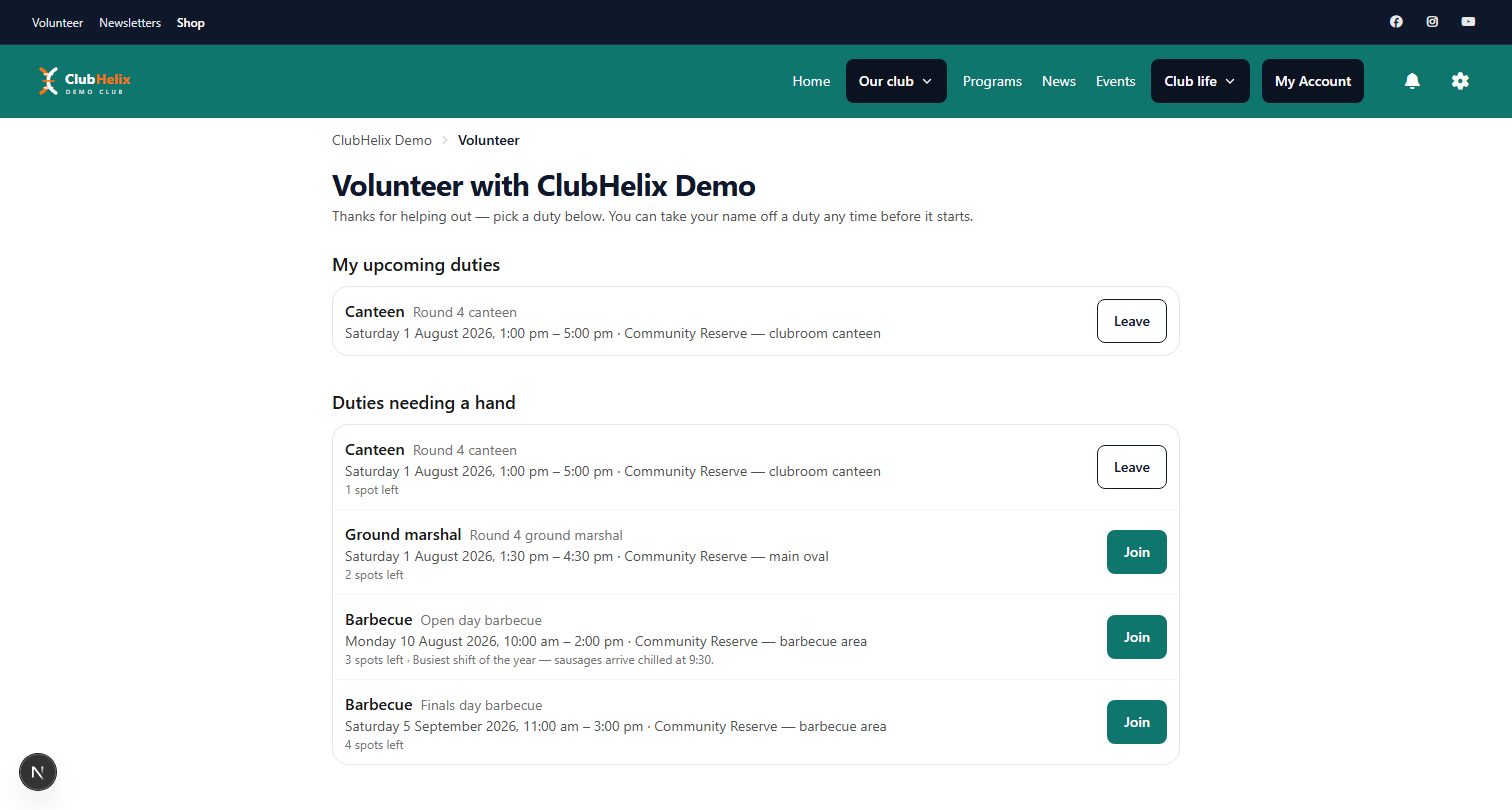
There is a free tier to start on and the pricing is published rather than quoted. Most clubs get a real site live — join page, ride calendar, trail status, dig roster — in an evening. Create your club site and give the trail crew leaders somewhere to put the hours.
Frequently asked questions
How do you get permission to build mountain bike trails?
Identify the body that manages the land rather than the one that owns it, then negotiate a written agreement covering scope, approved works, build standard, insurance, signage and reporting. Expect an assessment process for new trail and ground disturbance, and expect it to take months.
How should a mountain bike club grade its rides?
Publish four things for every ride — the hardest trail grade on the route, distance, total climbing and pace — plus a plain line about regroups and whether anyone gets left behind. Cap groups at eight to ten riders per leader and run a second group rather than one large one.
Do mountain bike clubs need insurance for trail building?
Land managers normally require public liability cover before approving works, and it is usually obtained through affiliation to a governing body. Check specifically that the policy extends to volunteers doing physical construction and using powered tools, not just to riding, and confirm the position with your insurer.
How do mountain bike clubs raise money for trails?
Most combine a per-member trail levy, donations tied to something concrete like a metre of trail or a day of machine time, business supporters funding a named trail, event surpluses and grants. Logged volunteer hours count as in-kind contribution in most applications, which is why the maintenance register matters.
What is the best way to run a club dig day?
Publish specific tasks with time estimates and skill levels rather than a general call for help, induct new volunteers on tools and trail design, split heavy work from entry-level jobs, log the hours per trail, finish when you said, and feed everyone.
Keep reading — how to organise a working bee for the format that keeps dig days full, and how to run a cycling club if your club also rides on the road.


