
What this guide answers
- What does a karting club need to run a race meeting?
A permitted or sanctioned event under your governing body, a licensed circuit, a clerk of the course with authority to start and stop racing, a race secretary handling entries and results, scrutineers and calibrated…
- How many races can a club fit into one day?
Work it out rather than guessing. Take the lap time, multiply by race distance, then add roughly the same again for assembly, roll-out, starts and clearing the circuit.
- How do minimum weights and ballast work in karting?
Each class carries a published minimum weight for driver and kart combined, and lighter drivers add ballast to reach it.
- How quickly should race results be published?
Provisional results should go up as soon as each session is checked, with the posting time printed so the protest window is unambiguous.
- Do you need a licence to race at a club day?
Almost always, yes — competition licences are issued by the governing body, graded by age and experience, and checked at sign-on.
UK edition. This guide is written for volunteer-run clubs in the UK. Where rules differ — grants, tax, incorporation, safeguarding — follow the UK-specific pointers below or check with your national body.
Nine o'clock on a Sunday and the round has ninety-six entries across five classes. Every one of those karts has to be scrutineered, weighed, gridded, raced three times, weighed again, put through a final and then presented with a trophy — and the flyer says presentations are at four. None of that is individually difficult. All of it at once, with volunteers, is a logistics problem.
That is what makes a karting club different from most community clubs. A weekly sport gets thirty chances a season to be a bit disorganised and recover. A karting club gets eight or ten race days a year, and each one is a production line that either runs to the minute or backs up into a queue at the weighbridge that never clears. Volunteers are rarely the scarcest thing a kart club has. Minutes are. Families judge you on whether the last final ran in daylight.
This guide is for the committee that actually runs the rounds — the race secretary, the clerk of the course, the chief scrutineer and whoever ended up with the timing laptop. It covers the arithmetic behind the timetable, the officials a meeting cannot run without, class structures and minimum weights, scrutineering and parc fermé, entries and transponders, results and protests, and the money underneath all of it.
The arithmetic of a race day
Before you write a timetable, work out what a race actually costs you in minutes. Most clubs discover their program was never possible.
Take an illustrative club round. A heat is eight laps and the circuit laps in about forty-five seconds, so the karts are on track for six minutes. Add the assembly call, the roll-out lap, a rolling start that needs two attempts more often than anyone admits, and clearing the circuit afterwards, and a race slot is closer to twelve minutes gate to gate. Two heats plus a pre-final and a final is four races per class. Five classes is twenty races, and twenty races at twelve minutes is four hours of pure racing — before practice, the briefing, lunch, and the two red flags you will get.
That is the whole planning problem in one sum. If the day does not fit, you have four levers and only four — fewer classes, fewer races per class, shorter races, or a faster changeover. Most clubs reach for shorter races when the real win is changeover discipline.
| Time | What is happening | Who owns it |
|---|---|---|
| 06:45 | Circuit inspection, barriers, flag points, marshal posts | Clerk of the course |
| 07:00 | Gates and sign-on open, transponder desk opens | Race secretary |
| 07:15 | Scrutineering opens, scales checked and zeroed | Chief scrutineer |
| 08:15 | Sign-on and scrutineering close, grids drawn | Race secretary |
| 08:30 | Compulsory driver and parent briefing | Clerk of the course |
| 08:45 | Practice, two sessions per class | Assembly and flag crew |
| 10:00 | Heat one, rotating through the classes | Grid, timing, flag crew |
| 12:15 | Track break, circuit sweep, officials eat | All |
| 12:45 | Heat two, then pre-finals | Grid, timing, flag crew |
| 14:45 | Finals, senior classes last | Grid, timing, flag crew |
| 16:00 | Presentations, provisional results posted | Race secretary, steward |
| 16:45 | Protest window closes, results declared final | Steward |
Three habits protect that timetable. Publish it a week out. Give the clerk of the course authority to cut a practice session or drop a heat, and do not second-guess them afterwards. And never let the assembly area run out of the next grid — the kart missing when its class is called costs the day sixty seconds, twenty times over.
The officials a meeting cannot run without
Racing without the right accredited people is not an option, and most kart clubs sit one retirement away from not being able to open the gate. Know exactly who holds what, and when it expires.
| Role | What they actually do on the day | Rough headcount |
|---|---|---|
| Clerk of the course | Runs the meeting, starts and stops racing, final call on the program | 1 plus deputy |
| Race secretary | Entries, sign-on, licence checks, grids, results, paperwork | 1 plus 2 helpers |
| Chief scrutineer | Sets the technical standard, signs karts off, runs post-race checks | 1 |
| Scrutineers | The queue itself — every kart, every meeting | 2 to 4 |
| Weighbridge crew | Weighs karts on and off, records every reading | 2 |
| Assembly (dummy grid) marshal | Holds the next grid in order and gets it out on time | 1 to 2 |
| Flag and observer marshals | Track safety, incident calls, retrieving stopped karts | 1 per post |
| Timekeeper or timing operator | Runs the decoder, publishes sectors, heats and finals | 1 plus backup |
| Steward | Hears protests, applies penalties, declares results | 1 to 3 |
| First aid or medical cover | Whatever your governing body and venue approval require | Per requirement |
Two things fix the succession problem, and neither is a plea in the newsletter. Fund a fixed number of new accreditations every year as a budget line, and pair every new official with an experienced one for a full season before they work solo. Publishing what each role really involves helps too, because most people decline imagining a bigger job than it is. Volunteer position descriptions is a good format, and volunteer rostering lets people claim a named post for a named round.

Classes, weights and the weighbridge
Class structure is set by your governing body, not the committee, and it is what newcomers find most confusing. Publish it in plain language — age range, engine, tyre and the minimum weight of driver plus kart — so a parent standing in a shed looking at a second-hand kart can work out whether their child can race it.
The minimum weight rule keeps the racing honest and is where most disputes start. A light driver in a light kart has a real advantage, so classes carry a combined minimum and lighter drivers add ballast to reach it. Three rules make that work:
- Ballast is bolted, not carried. Securely fixed to the seat or chassis with the fasteners your rules specify, never taped, wedged or pocketed. A lead block leaving a kart in an incident is the worst thing that can happen at your circuit.
- Weigh on the way out as well as the way in. Post-race weighing catches the ballast that fell off, the fuel drained and the weight vest left at the assembly area. Some clubs weigh every kart every race, smaller clubs weigh the top finishers plus a random selection. Publish which you do.
- Calibrate the scales and log it. Check them to whatever standard your governing body requires, file the certificate with the meeting paperwork, and zero them in front of a witness each morning. A protest against a weight reading is unanswerable if you cannot show the scales were right.
An illustrative class table for a club round — use your own governing body's actual figures, never numbers copied from another club.
| Class | Age band | Engine and tyre | Combined minimum weight | Grid limit |
|---|---|---|---|---|
| Cadet | Youngest | Restricted, control | Published by class rules | 20 |
| Junior | Mid teens | Control engine | Published by class rules | 24 |
| Senior | Adult | Control engine | Published by class rules | 28 |
| Masters | Veteran | Control engine | Higher than senior | 24 |
| Social or hire | Any | Club karts | Club rule | 20 |
Grid limits are a safety decision, not a capacity one. If entries exceed the limit, split the class into two divisions with a repechage rather than squeezing an extra row onto a circuit never designed for it.
Scrutineering and parc fermé
Scrutineering has two jobs — safety and fairness — and clubs that treat it as a formality end up arbitrating an argument they cannot win. Run it as a queue with a published checklist so drivers arrive prepared, and a kart that fails is a fix rather than a confrontation.
A community club pre-race check typically covers brakes and pedal feel, steering with no play and split-pinned fasteners, bodywork within the mounting rules, chain and sprocket guards fitted, a throttle that returns on its own, a working cut-out within the driver's reach, seat and stays secure, fuel line and tank condition, tyres of the correct compound, legible number plates in the class colour, and the driver's helmet, suit, gloves, boots and neck protection to the standard your governing body applies.
Parc fermé is the other half. After a final, finishing karts go straight to an enclosed area under an official's control and nobody touches them until they are released. Post-race checks usually cover weight, a fuel sample where the rules allow it, engine seals, tyres against the marking issued at scrutineering, and any restricted component for the class. Write down what was checked on every kart, not just the ones that failed — the record is what protects the club later, and incident reporting with an audit log behind it holds that trail better than a clipboard in a drawer.
Entries, transponders and the timing loop
Entries are the single biggest time saving available to a kart club, because everything downstream — grids, timing, results, presentation engraving — depends on a clean entry list. Take them online, and close them the Wednesday before.
A good entry form captures the driver, their licence number and expiry, the class, the kart number, the engine number where your rules require it, the transponder number if the driver owns one, the guardian for a minor, and emergency contacts. It should refuse to submit without a signed acknowledgement of the circuit's conditions — digital waivers signed on a phone at home beat paper forms at the gate, and they are findable in seconds three years later. Charge a published late entry fee that genuinely covers the disruption.
Transponders are the operational headache nobody warns you about. Whether drivers own them or hire them, you need a register — number, holder, deposit taken, returned or not — and someone whose job it is at the end of the day. Two rules save a lot of grief: no kart onto the assembly area without a transponder check, and keep two spare units charged, because a flat transponder in a final is a result you cannot declare.
On timing, run the decoder off a machine that does nothing else, keep a printed backup of every session, and write down a manual lap-scoring fallback. A club that can hand-score a heat is a club that finishes its day.
Results, protests and penalties
Results are the product. A round where the racing was good but the results took four days to appear is remembered as a badly run round.
The workflow is simple and worth being strict about. Post provisional results as soon as each session is checked, on the board and on your website at the same moment. Start the protest window from the printed posting time. Hear protests inside the window with the steward, the parties and the paperwork. Then declare the results final and publish the round's championship points before the trophies go out.
Protests need three published things or they turn personal — a written form, a fee refunded if the protest is upheld, and a time limit measured in minutes. Penalties should come from a published table rather than a discussion. Typical categories are jump starts, contact and driving standards, technical non-compliance, underweight, and paddock conduct, each with a defined consequence such as a grid drop, a time penalty or exclusion.
Driving standards in junior classes are a culture problem, not a rules problem. The clubs that handle it well brief drivers and parents together, review incidents with the young driver and the parent in the same room, and hold adults to the written standard as firmly as children — a code of conduct signed at entry gives the steward something to point at.
Across a season, the championship is what keeps people entering when they are not winning. Publish the points after every round, keep the dropped-round rule clear, and put the ladder somewhere public rather than in a spreadsheet emailed to people who already know. Competition, fixture and ladder tools do this on your own site, and how to make a fixture draw helps if you are programming heats and rotations by hand.
Practice, track hire and where the money comes from
Race days are the identity of a kart club. Practice days and track hire are usually what pays for them.
The income lines are predictable — race entries, practice day fees, membership, transponder and kart hire, corporate or come-and-try hire, canteen takings, and sponsorship of a class or a corner. Against them sit circuit maintenance, barriers and kerbing, timing hardware, insurance and affiliation, officials' training, medical cover, amenities and the machinery that keeps the surface right.
Two things reliably improve the picture. Sell practice sessions online with payment up front rather than taking cash at a gate, which turns idle midweek circuit time into income with no volunteer standing there. And treat the canteen as a real business line — how to run a club canteen covers margins and food handling. Budget with the club budget template, and put resurfacing and timing hardware into a sinking fund rather than a crisis.
The outdoor season is short and the winter is genuinely wet, so most clubs concentrate rounds between spring and early autumn and accept that some will be run in the rain. That makes a published wet-weather policy essential rather than optional — wet tyre rules, whether the meeting runs, and what happens to entry fees if it is abandoned part-way. Indoor and winter series fill the gap and are worth partnering on rather than competing with.
Capital projects — resurfacing, barrier upgrades, floodlighting, shade and accessible amenities — are usually funded through local authority community grants, National Lottery community funding and landfill communities schemes. Applications that lead with youth participation, accessibility and community use tend to travel further than applications about racing.
Membership, licences and the cadet pathway
People routinely confuse three separate things — club membership, a competition licence issued by your governing body, and entry to a specific race day. Explain all three on your website in plain language, because that confusion quietly costs you drivers who gave up halfway through working it out.
| Category | Suits | Typically includes |
|---|---|---|
| Competing member | Licensed drivers | Member entry rate, championship eligibility, voting |
| Junior competing | Cadet and junior drivers | Member rate, coaching sessions, class eligibility |
| Family | Households with more than one driver | Bundled competing memberships |
| Associate or volunteer | Officials, mechanics, parents | Voting rights, paddock access, no entry entitlement |
| Come and try | First-timers on a club kart | One session under supervision, no membership needed |
The pathway matters more here than in most sports because the entry cost is real. A come-and-try program on club-owned karts is the best recruitment tool a kart club has, and it only converts if you follow up — email every participant within a week with what the next step costs, when the next session runs, and who to ask about a second-hand kart. How to run a come and try day covers the format, and how to increase junior participation the leaks between program and membership.
Clubs run under the motor sport governing body's authority, which issues competition licences by age and grade, publishes the technical and sporting regulations in an annual yearbook, trains and accredits officials, and licenses circuits to a defined grade. Your circuit licence grade determines which classes and events you may run, so read it before you publish a calendar.
This is general information rather than advice. Licensing, insurance and venue approval differ by jurisdiction and change over time — confirm your club's position with your governing body, your insurer and, where the stakes justify it, a professional adviser.
Publishing the round without a spare volunteer
Everything above ends up as information somebody has to publish — the supplementary regulations, the timetable, the entry list, the grids, the provisional results, the championship points, the officials roster and the come-and-try dates. In most kart clubs that lands on one person with a laptop at ten at night. It should not. ClubHelix gives your club a website where entries run as ticketed events with payment taken up front, digital waivers are signed before anyone arrives, competitions and ladders hold your rounds and championship points, and volunteer rostering fills the flag posts and the weighbridge for each date.
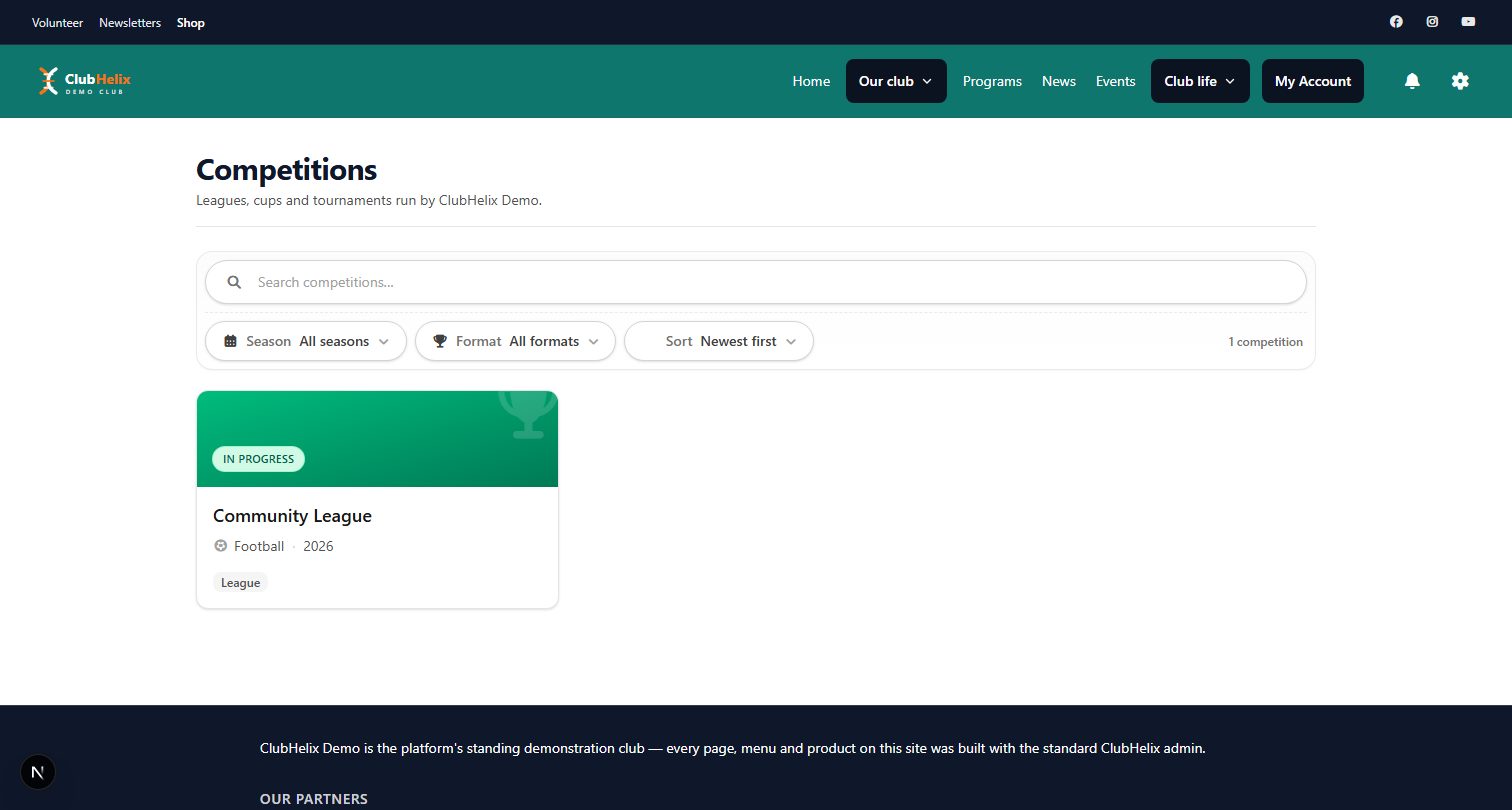
A committee can have the calendar, the entry form and the results page live before the next round. Start on the free tier while you see whether it suits the club, and check the pricing for what a paid plan costs — it is on the page, not behind a quote. Start your club site and give your race secretary their Sunday nights back.
Frequently asked questions
What does a karting club need to run a race meeting?
A permitted or sanctioned event under your governing body, a licensed circuit, a clerk of the course with authority to start and stop racing, a race secretary handling entries and results, scrutineers and calibrated scales, flag and assembly marshals, a timing system with a manual fallback, a steward to hear protests, and the medical cover your governing body and venue approval require.
How many races can a club fit into one day?
Work it out rather than guessing. Take the lap time, multiply by race distance, then add roughly the same again for assembly, roll-out, starts and clearing the circuit. A twelve-minute slot per race is a realistic planning figure for a short circuit. Multiply by races per class and classes entered, then add practice, the briefing, a track break and presentations before you publish a start time.
How do minimum weights and ballast work in karting?
Each class carries a published minimum weight for driver and kart combined, and lighter drivers add ballast to reach it. Ballast must be securely bolted to the seat or chassis using the fasteners your rules specify, never loose or taped. Weigh karts after racing as well as before, and keep the scales calibrated with the certificate filed alongside the meeting paperwork.
How quickly should race results be published?
Provisional results should go up as soon as each session is checked, with the posting time printed so the protest window is unambiguous. Final results and championship points should be published before people leave the venue wherever possible. A round that takes days to produce results feels badly run even when the racing was excellent.
Do you need a licence to race at a club day?
Almost always, yes — competition licences are issued by the governing body, graded by age and experience, and checked at sign-on. Many bodies also offer a day, trial or introductory licence so a newcomer can try a race day before committing. Check what your body allows and never improvise a local arrangement.
Keep reading — how to run a motocross club if you share officials or a precinct, and sports club risk management for the assessment framework underneath your race-day procedures.


