
What this guide answers
- How much should a futsal team pay to enter a season?
Work it out from your own costs rather than by copying another competition.
- How do you stop teams dropping out mid-season?
Take the full fee up front or in two instalments, hold a refundable bond for the season, and publish a forfeit policy with real fees before entries open.
- What is the best way to fill empty timeslots?
Open re-entry to last season's teams before general entry, offer a free trial game to new teams in an otherwise dead slot, discount second teams for existing captains, and keep a free agent list you can build a team…
- How do you turn social players into club members?
Ask at the moments they are most attached: the final whistle of the season, finals night, and when a junior ages out of the youth grades.
- Does a futsal competition need its own website?
Yes, because your product is perishable. An empty court on Tuesday cannot be sold again, and captains searching for a competition and a night need to find current grades, prices and available spaces immediately.
Canada edition. This guide is written for volunteer-run clubs in Canada. Where rules differ — grants, tax, incorporation, safeguarding — follow the Canada-specific pointers below or check with your national body.
The invoice from the stadium arrives at the end of the month for every hour you booked, not for every hour you filled. Twelve teams played on Tuesday and eight played on Wednesday, and both nights cost exactly the same. That single fact shapes everything about running a futsal club — the fee you charge, the deposit you take, how hard you chase a team that has stopped showing up, and whether the club finishes the season with a surplus or a quiet conversation about the treasurer's credit card.
Futsal clubs are unusual in community sport because they are closer to a small venue business than to a traditional membership club. Most of your participants are not members in any meaningful sense: they are a team of mates who entered a season, will disband when someone moves, and may or may not re-enter. Turnover is high by design. The club that thrives is not the one with the most passionate committee, it is the one that keeps every timeslot full and keeps money coming in on schedule.
This guide is for whoever holds the booking. It covers how to cost a timeslot properly and find the break-even team count, how to fill the grid, how to run a social league that does not haemorrhage teams mid-season, how to handle deposits and forfeits without becoming a debt collector, and how to convert a proportion of those social players into something that looks like an actual club.
The timeslot is your unit of production
Stop thinking about your competition as a season and start thinking about it as a grid. Every court, on every night, in every hour you hold, is a cell. Each cell has a fixed cost and a finite number of games it can produce. Your job is to fill cells.
| Night | Hours held | Games possible | Games sold | Utilisation |
|---|---|---|---|---|
| Monday | 3 | 6 | 6 | Full |
| Tuesday | 3 | 6 | 6 | Full |
| Wednesday | 3 | 6 | 4 | Two dead slots |
| Thursday | 2 | 4 | 2 | Half |
| Saturday | 4 | 8 | 3 | Junior comp only |
Draw that grid for your own season and the strategy usually becomes obvious in about ten minutes. Dead cells at the end of a night can be released back to the venue or filled with a junior grade. Dead cells in the middle cannot — they are pure loss, and the fix is scheduling rather than recruitment: never leave a gap between games on the same court, and always schedule the divisions most likely to lose teams at the ends of the night, so a withdrawal shortens the booking instead of punching a hole in it.
The second habit is to hold your booking in one calendar that the whole committee can see, with every game, every junior session and every venue closure on it. A facility and court booking view that shows exactly which hours are committed and which are free is not an administrative nicety here — it is the operational picture of the business.
Futsal sits within the wider soccer structure, with sanctioning running through your provincial association, alongside a substantial independent indoor scene. Sanctioning affects insurance, player registration and progression to national competition. Clubs typically incorporate provincially as a not-for-profit corporation, which municipal facilities generally require before granting a permit.
Costing a slot and finding your break-even team count
Most struggling futsal competitions have never actually costed a night. They set a team fee by looking at what the competition across town charges, then wonder why a good season produces no surplus.
Cost a single night properly, from the bottom up.
| Cost line | Behaviour | Notes |
|---|---|---|
| Court hire | Fixed for the hours you booked | Your dominant cost, and it does not flex with attendance |
| Referees | Variable per game | The second-largest line in most competitions |
| Desk and scoring | Fixed per night | One person, whether you run four games or eight |
| Consumables | Small, steady | Balls, bibs, tape, first aid restocking |
| Payment processing | Percentage of takings | Real money at scale — budget for it, do not pretend it is free |
| Bad debt | Variable, and entirely within your control | Unpaid entries and disappearing teams |
| Administration | Fixed | Insurance, affiliation, software, phone |
Now the arithmetic. Add up the total cost of one night, then divide by the number of teams playing that night. That is the fee each team must pay just to break even before the club earns anything at all — and it moves dramatically with how full the night is.
| Teams playing that night | Share of the night's total cost each team must cover |
|---|---|
| 12 | One twelfth |
| 10 | One tenth — 20 per cent more than at twelve |
| 8 | One eighth — 50 per cent more than at twelve |
| 6 | One sixth — double the twelve-team rate |
That table is the whole business. Because court hire is fixed, losing four teams from a twelve-team night does not cut your costs by a third — it doubles what every remaining team has to carry. It is also why a competition running at eight teams per night cannot solve its problem by cutting the referee fee. The lever that matters is the number of teams.
Three practical rules follow:
- Set fees from your own booking sheet, not from the competition down the road, whose court hire and grid may be nothing like yours.
- Build a contingency into the fee — usually a modest margin above break-even at your realistic team count, not your optimistic one. Price for the season you have had before, not the one you are hoping for.
- Decide your minimum viable night in advance. If a night falls below a set number of teams, you merge it into another night or hand the hours back. Deciding that in week two is a decision; deciding it in week nine is a loss.
Gym time is generally quoted per hour in dollars, with school board and municipal facilities usually cheaper than commercial indoor centres. Permits are typically allocated seasonally and require insurance up front, and demand for winter indoor hours is intense — apply early, and have a second venue quoted in case your permit comes back short.

Filling the grid
Recruitment in futsal is not like recruitment in a season-long club sport. You are selling a short, low-commitment product to groups of adults who decide together, so your marketing needs to reach a team captain and give them something easy to forward.
Where the teams come from, in rough order of reliability:
- Re-entries. The cheapest team you will ever sign is the one you already had. Open re-entry two weeks before general entry, hold their timeslot, and say so.
- Workplaces. One enthusiastic organiser inside a large employer can produce a team every season for years. Give them a shareable entry link and a discount code for a second team.
- Outdoor clubs in their off-season. Whole squads from the outdoor code looking to keep sharp are the highest-quality teams you can recruit, and they arrive pre-formed.
- Universities and school leavers. Cheap grades, late timeslots, and an audience that renews itself every year.
- Women's and mixed grades. Frequently the fastest-growing part of a competition, and often the grade a venue is most willing to discount for.
- Individual free agents. Keep a list. Two free agents plus a short team is a saved entry, and a whole team can sometimes be assembled from the list alone.
- Juniors. Weekend and early-evening hours that adults will not take, with a completely different recruitment channel through schools and outdoor clubs.
Two offers do the heavy lifting. A no-obligation trial game for a new team — one week, no fee, filling an otherwise dead slot — converts remarkably well because the barrier is a single evening rather than a season. And a second-team discount aimed at existing captains costs you little, since the marginal cost of a team in an already-booked hour is close to zero. Run both through published discount codes so nobody is negotiating privately at the desk.
A social league that does not leak teams
The failure mode of every social competition is the slow bleed: a team stops turning up in week six, a division goes to five, the fixture becomes lopsided, and the paying teams start losing interest too. Nearly all of it is preventable with rules written before the season instead of arguments during it.
The entry agreement
Every team captain accepts a short set of terms at entry — not a legal document, one screen of plain language:
- The season length, the grade, and the night and approximate timeslot.
- The full season fee, when it is due, and what happens if it is not paid.
- The deposit or bond, what it covers, and how it is returned.
- The forfeit policy, including notice periods and fees.
- Player eligibility — minimum registered players, borrowing rules, and the finals qualification rule.
- The code of conduct, including how the club protects referees.
Deposits and forfeits
Take the money up front. A season fee paid in full at entry, or in two instalments with the first at entry, removes almost every mid-season money problem. On top of that, a refundable bond held for the season and returned at the end, less any forfeit fees, changes team behaviour immediately, because the money is already gone and the only way to get it back is to keep turning up.
| Situation | Suggested handling |
|---|---|
| Notice given more than 48 hours ahead | Game rescheduled or opponent given a bye credit, no fee |
| Notice given under 48 hours | Forfeit fee from the bond — the referee and court are already committed |
| No show, no notice | Higher forfeit fee, plus a warning |
| Second no show | Team removed, bond forfeited, remaining fixtures voided |
| Team withdraws before round three | Refund of unplayed rounds less an administration fee |
| Team withdraws after round three | No refund — the grid has been built around them |
Publish those numbers before entries open and apply them without exception. Selective enforcement is worse than no policy at all, because the teams who follow the rules are the ones who end up subsidising the ones who do not. Our guide on refunds for club registrations covers how to write a refund policy that people accept.
Fixtures and results
Publish the full season fixture before round one so captains can plan their availability, and stick to it. Where a grade has an odd number of teams, add a bye and rotate it fairly rather than leaving a court empty — how to make a fixture draw covers the round-robin structure and bye rotation. Update the ladder the same night. In a competition where teams are deciding week to week whether they can be bothered, a live ladder and a published golden-boot count are genuinely part of the product.
Game night operations
Futsal nights run tight — games on short clocks, back-to-back, with the next teams already waiting. A run sheet makes the difference between a smooth night and one where everything drifts fifteen minutes late by nine o'clock.
| Time | Task |
|---|---|
| T-30 | Desk set up, scoresheets and tablets ready, balls pumped, first aid out |
| T-20 | Referees arrive, appointments confirmed, any grade changes noted |
| T-15 | Team check-in opens, unregistered players signed up on the spot |
| T-0 | First game starts on time — the whole night depends on this |
| Break | Rolling changeover, scores entered as each game finishes |
| End | Ladder published, incidents recorded, forfeits logged, court swept |
Three details that quietly matter. Have a written process for signing up a player who turns up unregistered, because it happens every week and the alternative is an ineligible player and a protest. Record incidents the same night in a consistent format, not in a text message. And protect your referees actively — a published behaviour standard, a desk that backs the official, and a willingness to remove a team is what keeps referees agreeing to work your competition, which in a market with several competitions competing for the same officials is a real advantage.
Season shape follows winter. Indoor competition is at its strongest when outdoor play stops, and it competes with everything else that wants gym time in exactly the same months. Book those hours early, and treat the shoulder seasons as your recruitment windows — a shorter, cheaper spring competition is a good way to hold teams together until the main indoor season returns.
Turning social players into a club
A competition that only sells timeslots is a business with no floor under it: when a cheaper venue opens nearby, the teams move. The clubs that last build something people belong to as well as something they pay for.
| Tier | Who it is | What they get |
|---|---|---|
| Team entry only | A social team for one season | Fixtures, referees, ladder, finals |
| Individual member | A regular player | Free agent list, discounted entry, club events |
| Squad member | Selected representative or development squad | Coaching, training block, competition beyond your own league |
| Junior member | Under-age player | Coached program, age-grade competition, pathway |
| Life of the club | Referees, desk crew, committee | Recognition, and a say in how the place runs |
The conversion moments are specific and easy to miss:
- The end of a season. A team that just finished is at peak attachment. Ask then — not in the pre-season email six weeks later.
- Finals night. Have a stall, a squad trial flyer and a person whose only job is talking to good players about the representative program.
- The free agent list. Individuals with no team are the people most likely to want something more from the club.
- Junior graduation. Under-age players ageing out need somewhere to go, and if you do not have a senior grade for them they will find a different competition that does.
The off-season squad is the piece most social competitions never build, and it is what makes a club a club: a selected group that trains, plays outside your own competition, wears the club name, and gives your best social players something to aspire to. It needs a coach, a training slot in a cheap hour and a small levy — and it repays you with identity, volunteers and a reason for people to stay when a rival opens down the road.
Above recreational competition sit sanctioned regional and national structures, alongside college and youth club pathways. Entry usually involves sanctioning, registered players, certified coaches and facility standards, so confirm the requirements with your state or provincial association well before you advertise a pathway to your members.
Money discipline and the online side
The habit that separates a solvent competition from a stressful one is boring: collect money before people play, online, with a record. Cash at the desk creates reconciliation work, disputes and a treasurer holding an envelope; bank transfers create a chase list. Online registration and payment at the point of entry, with the bond taken at the same time, means the season starts fully funded and the desk never handles money.
Two more habits worth building in from the start. Publish a single price list, including the bond, the forfeit fees and any discounts, so nobody negotiates at the desk. And reconcile weekly rather than at season end — a missing entry fee found in week two is a phone call, while the same one found in week fourteen is a bad debt. If you are moving off cash for the first time, how to collect club membership fees online walks through the change.
The website does one more job that matters more here than in most sports: it fills empty slots. People search for a competition, a night and a suburb, and the club with a page showing which grades have space, when they play and what it costs picks up the team that would otherwise have gone elsewhere. Keep a permanent "spaces available" section, list the grades with openings, and put a join button next to each one.
Running the grid from one place
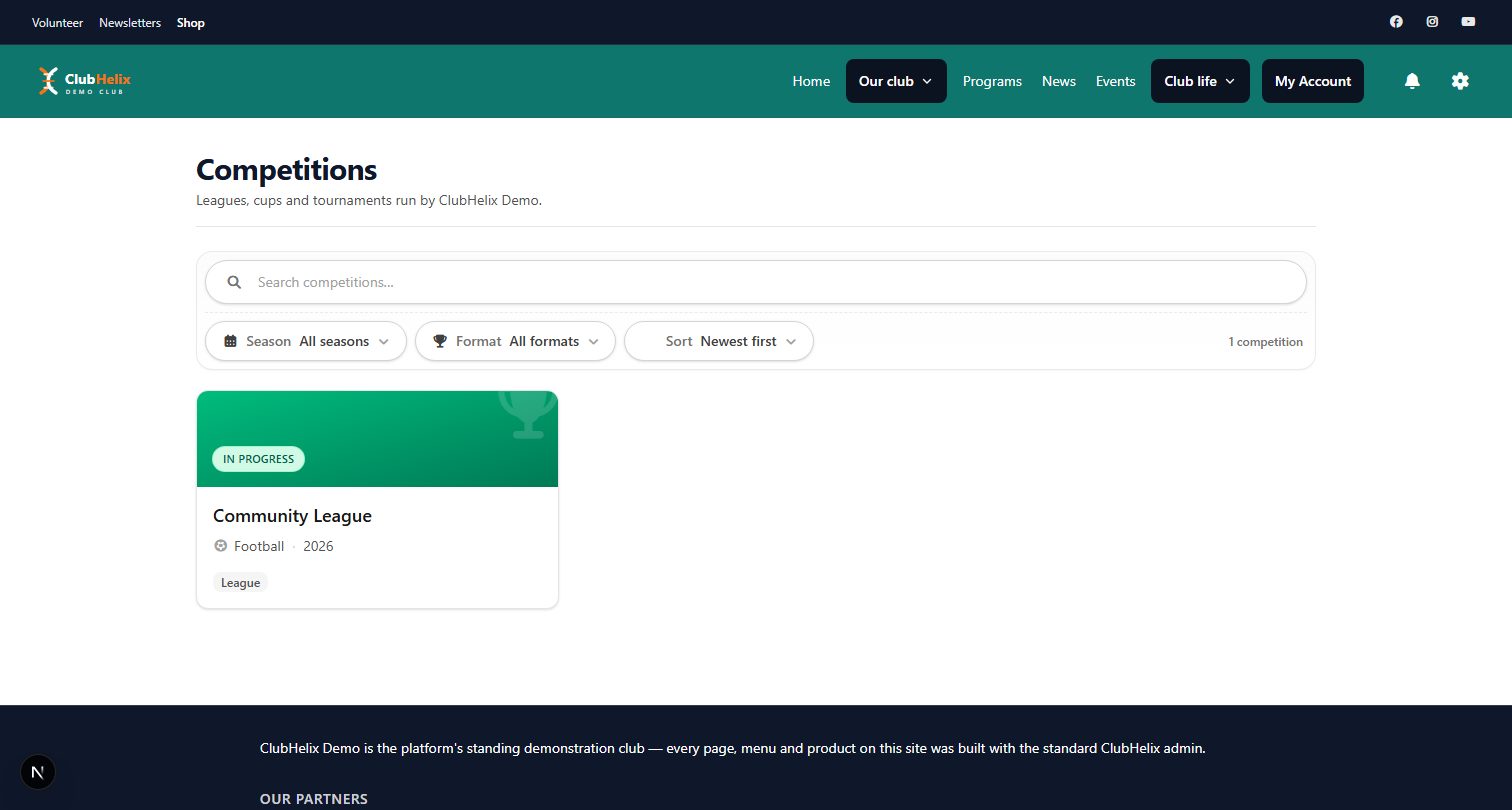
The admin of a futsal club is relentless and repetitive: entries and re-entries, bonds and instalments, fixtures across several nights, results and ladders published the same evening, referee appointments, forfeit records, and the booking calendar underneath all of it. ClubHelix runs that on a club website you control — competitions with fixtures, ladders and finals for every grade, court and facility booking so your grid is visible to the whole committee, online entry with payments for teams and bonds, and discount codes for second teams and early re-entries.
Begin on the free tier and step up as the grid grows. Every tier sits on one pricing page, which means you can drop it into the same night-cost model you built earlier in this guide and know exactly what it does to your break-even before you commit. Create your club site and next season's entry form, bond and forfeit terms can be live within the week. Clubs that also run an outdoor season will recognise the same tools on the soccer club management software page.
Frequently asked questions
How much should a futsal team pay to enter a season?
Work it out from your own costs rather than by copying another competition. Total the night's court hire, referees, desk, consumables, payment fees and administration, divide by the number of teams playing that night, and add a margin. The number moves sharply with how full the night is — at six teams, each team carries double what it would at twelve.
How do you stop teams dropping out mid-season?
Take the full fee up front or in two instalments, hold a refundable bond for the season, and publish a forfeit policy with real fees before entries open. Then apply it consistently. Teams behave differently when the money is already paid and the only way to get the bond back is to keep fulfilling fixtures.
What is the best way to fill empty timeslots?
Open re-entry to last season's teams before general entry, offer a free trial game to new teams in an otherwise dead slot, discount second teams for existing captains, and keep a free agent list you can build a team from. Also fix your scheduling — gaps at the end of a night can be released, gaps in the middle cannot.
How do you turn social players into club members?
Ask at the moments they are most attached: the final whistle of the season, finals night, and when a junior ages out of the youth grades. Give them somewhere to go — an individual membership, a training squad, a representative team — and make joining a single online step rather than a conversation with a committee member.
Does a futsal competition need its own website?
Yes, because your product is perishable. An empty court on Tuesday cannot be sold again, and captains searching for a competition and a night need to find current grades, prices and available spaces immediately. A site that publishes fixtures and ladders the same evening also keeps existing teams engaged through the middle of a season.
Keep reading: how to run a soccer club for the outdoor season that feeds your competition, and how to run a club registration day for the week entries open.

