
What this guide answers
- How many people do you need to run a dragon boat club?
A standard boat races with 20 paddlers, a sweep and a drummer, so a viable club roster is usually 30 or more to cover absences — though a small-boat (10-paddler) crew can get a new club on the water sooner.
- What does a sweep do in dragon boating?
The sweep steers the boat from the rear with a long sweep oar and is responsible for the safety of the boat and crew on the water.
- When is the dragon boat season?
Regatta season generally runs through the warmer months, building to championship events for qualifying crews.
- How do clubs manage boat loading for regattas?
The clubs that do it well publish a duty roster for every travelling regatta — trailer loading crew, tie-down, driver, rigging and wash-down — so the work is named and shared rather than falling on the same few members.
Dragon boating has a maths problem that shapes everything about how you run the club: the boat doesn't move without a crew. A tennis club can function with two people; a standard dragon boat needs twenty paddlers, a sweep on the steering oar and a drummer before it leaves the pontoon. Every training session is a small logistics exercise, and every regatta is a large one — which is why dragon boat club management is really the art of getting the right twenty-two people to the right place, in the right seats, at the right time.
This guide covers the whole operation: how clubs and crews are organised, the on-water leadership roles of sweep and drummer, crew management and seating, the regatta season, boat loading rosters and equipment care, membership and fees, and the dragon boat club website that keeps a big roster coordinated.
How dragon boat clubs are organised
Most clubs affiliate with their national or regional dragon boat association, which runs the regatta calendar, accredits sweeps and officials, and provides member insurance. Within a club, the roster usually breaks into crews and divisions:
- Boat classes — the standard boat (20 paddlers) and the small boat (10 paddlers), each plus sweep and drummer.
- Divisions — typically premier/open, mixed (with minimum numbers of each gender in the boat), women's, masters age divisions (40+, 50+, 60+), and juniors where the club has a pathway.
- Community and survivor crews — dragon boating has a proud tradition of breast cancer survivor crews and corporate/social crews, and many clubs host one alongside their competitive program.
A mid-sized club might field one competitive mixed crew, a women's crew and a social crew from a single roster of forty or fifty paddlers — with plenty of members paddling in more than one. That overlapping structure is exactly why crew lists need a proper home rather than a spreadsheet with seven tabs.
Committee and on-water leadership
Off the water you need the standard committee — see club committee roles and responsibilities — plus a racing secretary who owns regatta entries. On the water, three roles carry the club:
| Role | What they do |
|---|---|
| Sweep | Steers from the rear with the sweep oar; legally and practically responsible for the boat and everyone in it. Accredited through the association. |
| Drummer | Sits in the bow keeping time to the stroke pair; the crew's tempo and its voice during a race. |
| Coach | Sets the training program, technique standards and crew selection approach. |
Sweeps are your scarcest resource. A club with three boats' worth of paddlers but two accredited sweeps can only ever put two boats on the water. Track who is accredited and at what level, fund accreditation courses for promising members every season, and never let the pipeline run dry. An accreditation tracker that flags expiring qualifications is genuinely useful here, because a lapsed sweep accreditation grounds a whole crew.
Crews, seating and team management
A dragon boat crew is not just twenty names — it's a seating plan. Heavier paddlers amidships in the engine room, your most rhythmic pair on stroke, matched timing side to side, and the trim of the boat balanced front to back. Coaches iterate seating constantly, and race day adds another layer: reserves, last-minute dropouts, and paddlers doubling across crews at the same regatta.
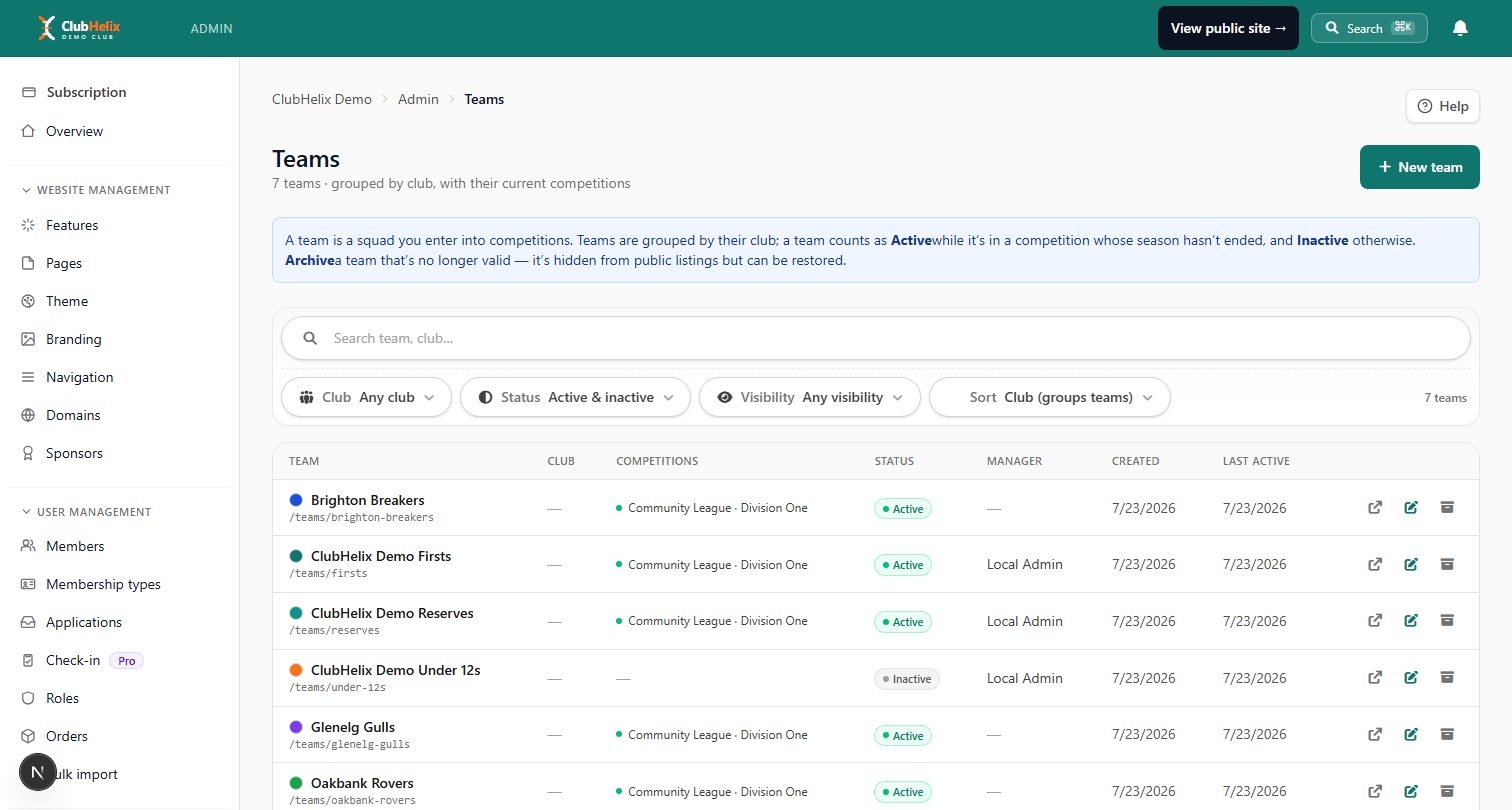
Treat each crew as a team in your club's team management system: a named crew list, its sweep, drummer and coach, and session schedules attached to each crew. Pair it with RSVPs and attendance on every training session, because in this sport attendance isn't a nicety — the coach needs to know by Thursday night whether Saturday has a full boat, a small boat, or a technique session for twelve. Attendance history also gives selection conversations an objective backbone when two paddlers want one seat.
The regatta season
The state association's regatta calendar defines your season — typically a series of regattas through the warmer months, building to state championships, with national championships beyond for qualifying crews.
Racing is short and sharp: 200m and 500m sprints in heats and finals, sometimes a 2km turning race for endurance crews.
For the racing secretary, each regatta is a project: crew entries by division and boat class before the deadline, paddler eligibility (age divisions, gender minimums for mixed crews), marshalling times, and the day-of logistics of tents, food and reserves. Publish every regatta on the club events calendar with entry deadlines and RSVP cut-offs well ahead — the fastest way to miss a final is discovering on Friday that you have eighteen paddlers, no drummer and one sweep double-booked.
Between regattas, many clubs enter community festivals and corporate paddle days. They're excellent fundraisers and recruitment tools — a come-and-try day on a dragon boat sells itself, because almost nobody has done it before and almost everybody grins the whole way.
Boat loading rosters and equipment care
The unglamorous truth of dragon boating: the boats are big, heavy and shared, and moving them is a whole-club job. Every travelling regatta needs the boat (or boats) loaded onto the trailer, tied down, towed, unloaded, rigged, and then the whole thing in reverse — plus paddles, PFDs, the drum and the sweep oars accounted for. At home, boats need washing down, covers on, and pontoon or storage areas left tidy for the next crew.
Clubs that leave this to "whoever's around" burn out the same six people every season. The fix is the same as every volunteer problem: name the jobs and roster them. A volunteer duty roster with explicit slots — trailer crew, rigging, wash-down, trailer driver — published alongside each regatta means the load is shared and visible. Our guide on how to recruit club volunteers covers the culture side; the roster covers the accountability side. Add a simple equipment register (hulls, paddles, PFDs by number, drum, trailer service dates) so pre-season maintenance is a checklist, not an archaeology dig — the pre-season checklist for sports clubs pairs well with it.

Membership, fees and safety
Dragon boat fees usually stack simply: the association component (insurance and racing eligibility) plus a club fee covering boat maintenance, storage and coaching. Some clubs add regatta levies per event. Collect it all through online registration at the start of the season — with emergency contacts and any medical notes the sweep should know about — and let renewals run on automatic reminders.
On safety: sweeps' accreditation, PFD policy, a swim-competency expectation for paddlers, cold-water and weather call protocols, and a log of any capsizes or injuries. Follow your association's water safety guidance, and record incidents when they happen so the committee can see patterns.
Your dragon boat club website
With forty paddlers, three crews, a regatta calendar and a trailer to move, a dragon boat club runs on coordination — and that's the case for giving it a real home. A dragon boat club website puts registration and payments, crew lists, the training and regatta calendar with RSVPs, duty rosters and club news in one place every member can reach from their phone. ClubHelix is built for exactly this shape of club — see the dragon boat club management software page for the setup, and pricing for plans, including a free tier to start with. When you're ready, sign up and put the regatta calendar online first; the rest follows.
Frequently asked questions
How many people do you need to run a dragon boat club?
A standard boat races with 20 paddlers, a sweep and a drummer, so a viable club roster is usually 30 or more to cover absences — though a small-boat (10-paddler) crew can get a new club on the water sooner. Reliable attendance tracking matters as much as raw numbers.
What does a sweep do in dragon boating?
The sweep steers the boat from the rear with a long sweep oar and is responsible for the safety of the boat and crew on the water. Sweeps are accredited through their association, and a shortage of accredited sweeps is the most common cap on how many boats a club can field.
When is the dragon boat season?
Regatta season generally runs through the warmer months, building to championship events for qualifying crews. Many clubs paddle year-round, using the off-season for technique, fitness and community events.
How do clubs manage boat loading for regattas?
The clubs that do it well publish a duty roster for every travelling regatta — trailer loading crew, tie-down, driver, rigging and wash-down — so the work is named and shared rather than falling on the same few members. An online roster with reminders makes it stick.


