
What this guide answers
- What qualifications do dog club instructors need?
That depends entirely on your governing body, which usually runs or recognises an instructor scheme with defined levels.
- How do dog clubs check vaccination records?
The workable approach is to ask for the vet-issued certificate as part of enrolment, record the expiry date against the dog, and remind the handler before it lapses.
- How many handlers should be in a dog training class?
Six to ten per instructor is the usual band for general obedience, fewer for puppy, behaviour and agility classes where each dog needs individual attention.
- Should a dog club run fixed intakes or let people join any week?
Fixed intakes suit most volunteer-run clubs. They make instructor demand predictable, let a cohort progress together, and turn a vague "come down sometime" into a specific start date that people actually diarise.
- Does a dog training club need its own website?
Yes, because almost every question a prospective member has is answerable in writing — when the next beginner course starts, what it costs, what vaccination record you need, and where the ground is.
South Africa edition. This guide is written for volunteer-run clubs in South Africa. Where rules differ — grants, tax, incorporation, safeguarding — follow the South Africa-specific pointers below or check with your national body.
Six o'clock on a Tuesday and the club grounds have turned into a grid of loose circles — six classes, six instructors, forty-odd handlers walking anticlockwise while somebody's collie cross decides the whole thing is a game. At the gate a new family is waiting with a puppy, a lead still in its packaging, and no vaccination record. Whoever is on the desk has about fifteen seconds to decide what happens next — and here that decision is partly a legal one, because the rabies certificate is not optional.
A dog training club is not really a club of dogs. It is a club of handlers, and the dog is the reason they turned up. That single shift explains almost everything that makes these clubs different to run. Your member is an adult learning a skill, not a player being selected. Your product is a course with a start and an end, not a season. Your scarcest resource is qualified instructors, not ground or gear. And your front gate carries a health check that no football club has ever had to think about.
This guide is for the committee of a community dog club — obedience, agility, rally, scent work, or all of them on the same ground — whether you run ten-week intakes on hired council land or a year-round program from clubrooms you own. It covers how to structure classes and intakes, how the vaccination record works as an enrolment step rather than a gate-side argument, how to grow instructors out of your own membership, how to put on a trial or agility day that pays for itself, and how to get the whole thing off somebody's kitchen table.
What kind of dog club you are actually running
Most committees discover halfway through a planning meeting that the four people in the room have four different clubs in their heads. Settle it early, because each discipline asks something different of your ground, your gear and your instructor roster.
| Discipline | What a class looks like | What it asks of the club |
|---|---|---|
| Community obedience | 6-10 handlers per instructor, 45-60 minutes, weekly | Flat fenced ground, cones and mats, a voice that carries |
| Puppy foundation | Small groups, short bursts, heavy on handler theory | Clean enclosed space, the strictest health gate, a quiet corner |
| Rally | A numbered course of stations walked in order | Station signs, a printed course map, room to lay out 15-20 signs |
| Agility | 4-8 dogs per instructor, equipment-heavy | Secure equipment store, safe surface, a setup and pack-down crew |
| Scent work and tracking | Very small groups, long sessions, lots of waiting | Varied surfaces, articles, a tolerant landowner |
| Behaviour and reactive classes | Tiny groups, visual screens, staggered arrival times | Barriers, separate parking, your most experienced instructor |
The honest test is whether you can staff each stream every week for a full term. A club that offers agility once a fortnight when the equipment gets out is not running agility — it is running a rumour. Pick two or three streams you can genuinely sustain, publish them as courses with dates, and add the fourth when you have the instructor to carry it.
Affiliation is the other early decision. Affiliating to a regional or national body is what gives your instructors a recognised pathway, your trials a sanctioned status, and your committee an insurance arrangement that actually contemplates dogs biting people. It also brings rules you will be held to, so read them before you promise anything at an AGM.
Clubs here usually affiliate through a provincial structure to the national kennel federation, which sanctions trials and licences judges. Community clubs commonly register as non-profit organisations through the Department of Social Development, and that registration is often exactly what a municipality wants to see before it will lease you ground or renew a lease you already have.
Class intakes, levels and the vaccination gate
Two enrolment models exist and the choice shapes your whole year.
| Fixed intakes | Rolling enrolment | |
|---|---|---|
| How it works | Everyone starts in week one of a term | New handlers join any week into a foundation group |
| Instructor load | Predictable — you know in March what April needs | Unpredictable — someone triages every new arrival |
| Class quality | Cohort moves together; instructors can build on it | Every week is week one for somebody |
| Waiting list | Real, visible, and a genuine recruiting asset | Invisible — people simply drift away |
| Best for | Clubs with a stable instructor roster | Clubs with a large beginner demand and spare instructors |
Fixed intakes win for most volunteer clubs, because they turn an open-ended obligation into four predictable planning moments a year. They also let you say "the next beginner course starts on the 14th" instead of "just come down and see", which converts far better and stops the desk from becoming a triage station.
Set levels by what a handler can do, not by how many weeks they have attended. Progression on attendance is how you end up with an improver class where half the dogs cannot be let off lead.
| Level | Typical length | What the handler leaves with | Progression gate |
|---|---|---|---|
| Puppy foundation | 4-6 weeks | Name response, sit, settle, handling, socialisation habits | Age — most clubs move pups on around six months |
| Beginner | 8-10 weeks | Loose-lead walking, sit and drop, recall on lead, a 30-second stay | Instructor sign-off |
| Improver | 8-10 weeks | Off-lead recall in an enclosed area, distance work, distraction | Instructor sign-off |
| Advanced and trial prep | Rolling term | A full routine, ring craft, and the handler's own nerves managed | The entry standard of the class you compete in |
| Specialist streams | Rolling term | Agility foundation, rally, scent work | Improver plus a fitness and age check |
Write the sign-off criteria down and give every instructor the same one-page copy. It removes the awkward conversation entirely: the handler is not being judged, the criteria are simply not met yet, and here is what to practise before the next intake.
The vaccination record is your front gate
Nearly every dog club makes proof of vaccination a condition of entry, and it is the single most common reason a new member gets turned away on night one. Treat it as an enrolment step, not a gate-side argument.
In practice that means four things. State the requirement on the enrolment form in the same words your governing body uses. Ask for the certificate as part of enrolment rather than asking people to remember paper on the night. Record the vet, the date and the expiry against the dog rather than the handler, because handlers often bring a second dog later. And put a reminder in the calendar four weeks before expiry, so renewals happen quietly instead of at the desk.
What the club is checking is that a vet has certified the dog. The club is not forming a veterinary opinion, and instructors should never be the ones adjudicating an unfamiliar certificate — publish the club's rule, apply it at enrolment, and point handlers to their own vet for anything beyond it.
A current rabies vaccination certificate is required by law in most jurisdictions here, so it usually forms the backbone of the record you collect, alongside the core vaccinations the vet recommends and whatever your governing body asks for around kennel cough. Check what your local authority requires and mirror it exactly in your club rule — a club standard that sits looser than the law is not something you want to discover after an incident.
Two related policies belong in the same document, because both will come up in your first year. Decide whether bitches in season may attend and under what conditions, and decide how a dog with a known bite history is assessed before it joins a group class. Neither policy needs to be long. Both need to exist before the night you need them.

A training night that starts on time
The difference between a club people recommend and a club people quietly leave is usually whether classes start when they were advertised to start. Build a run sheet and roster to it.
| Time | What happens | Who |
|---|---|---|
| 17:30 | Gates open, equipment out, rings marked, water buckets filled | Grounds pair on roster |
| 17:45 | Desk opens — check-ins, new enrolments, outstanding records chased | Desk volunteer |
| 18:00 | Instructor huddle — who is short, who is covering, weather call | Chief instructor |
| 18:15 | Class block one — puppy and beginner | Instructors plus helpers |
| 19:00 | Break — canteen open, notices read out once, not three times | Canteen roster |
| 19:15 | Class block two — improver and specialist streams | Instructors plus helpers |
| 20:00 | Pack down, incident notes written while people still remember | Everyone |
| 20:15 | Gates locked, next week's roster confirmed and sent | Duty committee member |
The weather call at 18:00 is not optional, and it is the one operational rule that differs most by where you are.
Heat is the hard limit here. Publish a cancellation standard before summer rather than debating it at 17:55 — a forecast temperature, a surface test with the back of your hand, and an automatic switch to a shorter shaded session. Long summer evenings are a gift for a dog club, but a synthetic or bitumen surface holds heat well after the air has cooled, and dogs will keep working long past the point where they should have stopped.
Building instructors — the club's real bottleneck
Every dog club is capped by the same number, and it is not how much ground you have. It is how many people can hold a class.
Do the arithmetic honestly. If your standard is a maximum of eight handlers per instructor and you enrol 96 handlers across a term, that is twelve classes. Run two class blocks a night across two nights and you need six instructors on the ground each night, plus at least two more who can cover illness, holidays and the week somebody's own dog is unwell. Nine or ten trained people, in other words, to serve fewer than a hundred handlers. That is the real constraint, and it takes eighteen months to build — so start recruiting into the pathway a full year before you need the capacity.
| Stage | What they do | Typical time | What the club gives them |
|---|---|---|---|
| Class helper | Sets up, minds the gate, demonstrates, spots trouble early | One term | A named instructor to shadow and a two-minute debrief |
| Assistant instructor | Runs a segment of a class under supervision | 2-3 terms | Written lesson plans and real feedback |
| Class instructor | Owns a class for a full term | Ongoing | Course fees paid, accreditation pathway, their own class |
| Senior instructor | Sets curriculum, assesses handlers, mentors the pathway | Ongoing | A committee voice and a say in intake sizes |
Three things make this pathway actually work. Pay the course fees — a volunteer giving you two nights a week should not also be funding their own accreditation. Give feedback the same night, in two minutes, standing up, because written feedback a week later is never read. And name a successor for every senior role, so the club is never one person's shoulder injury away from cancelling a stream. Our guide on how to recruit club volunteers has the wider playbook, and the same slice-it-small logic applies here.
The other recruiting channel is your own graduates. Handlers who finish improver and enjoyed it are the single best source of helpers you will ever have. Ask them directly, in person, on the last night of the course, with a specific job and a specific term attached. A general call for volunteers in a newsletter produces almost nothing by comparison.
Trials, agility days and ribbon days
A competition day is the biggest single thing a dog club does, and it exists on a ladder. At the bottom is an in-club ribbon day for members only, judged by your own senior instructors, run for fun and photographs. In the middle is an open fun day where visiting clubs may enter but nothing counts towards a title. At the top is a sanctioned trial, run under your governing body's rules with licensed judges and results that go into the record.
Do not start at the top. A club that has run two ribbon days knows where its bottlenecks are — parking, the results table, the queue for the toilet block — and can survive its first sanctioned trial. A club that starts with a sanctioned trial finds out about all three at once, in front of visitors.
| Role on the day | How many | What they actually do |
|---|---|---|
| Trial secretary | 1 | Owns entries, the running order, the catalogue and the paperwork afterwards |
| Judge liaison | 1 | Travel, accommodation, lunch, water, shade and a chair that is actually theirs |
| Ring steward | 1-2 per ring | Calls competitors, keeps the ring moving, manages scratchings |
| Timekeeper, scribe | 1-2 per ring | Records scores and walks the sheet to the results table |
| Results table | 2 | Calculates places, prints certificates, hands out ribbons |
| Grounds crew | 4-6 | Rings set at first light, equipment moved between classes, full pack-down |
| Canteen | 3-4 | The part of the day that actually makes money |
| Welfare and first aid | 1 | People and dogs — shade, water, and a quiet crated area away from rings |
Three timings matter more than anything else on the list. Judges are booked twelve to eighteen months ahead for anything sanctioned, and a good judge fills your entry list on their name alone. Ribbons and trophies have long lead times and get more expensive when rushed. And entries should close far enough out that the trial secretary can build the catalogue calmly — closing entries the night before is how you get a running order that collapses by mid-morning.
Take entries online with payment attached. A trial entry taken by email and paid by bank transfer creates a reconciliation job for your treasurer and a spreadsheet for your secretary, and both of those jobs are entirely avoidable. Running the day as a ticketed event — an entry type per class, each with its own price, capacity and sales window — does the whole thing, and gives the trial secretary a live entry list rather than an inbox.
Build the same eight budget lines in your own currency before you set an entry fee — ground and amenities hire, judge travel and hospitality, ribbons and certificates, printing and signage, first aid cover, sanctioning fees, equipment hire, and a contingency. Then price entries so every one of those lines is covered before the first dog runs, and treat the canteen as upside rather than as the thing holding the budget together. Cap entries at what your ring count can genuinely process in the daylight you have.
Money, fees and the intake calendar
Dog club income has an unusual shape. It arrives in four or five lumps a year, each tied to an intake, rather than trickling in like a season subscription. That makes the intake calendar and the budget the same document.
| Fee model | How it works | Watch out for |
|---|---|---|
| Annual membership only | One fee, train as often as you like | Popular classes fill with long-term members and beginners cannot get in |
| Membership plus per-course fee | Modest membership, then a fee per ten-week course | The clearest model — and the easiest to budget from |
| Pay per night | Casual rate at the gate | Cash handling, no commitment, and instructors never know numbers |
| Household or second-dog rate | Discounted second handler or second dog | Set it deliberately or people will simply share one enrolment |
Most well-run clubs land on membership plus per-course fees, because it matches income to the cost of delivering that course and gives you a clean number to compare against your instructor and ground costs. Publish a short refund rule at the same time — what happens if the dog is unwell in week three, or the handler injures themselves in week five. Most clubs offer a credit into the next intake rather than a cash refund, which is fair to both sides and easy to administer.
Price in your own currency by working from the bottom up rather than by copying the club down the road. Add up ground hire, insurance, equipment renewal and instructor accreditation costs for a term, divide by the number of handlers you can actually take, and that is your floor. Then check what private trainers nearby charge for a comparable course. A club rate should sit clearly below the commercial one — you are volunteer-run — but not so far below that people treat a booked place as disposable and stop turning up in week four. How much should club membership cost works through the logic.
Two habits pay for themselves. Run a small equipment sinking fund, because agility gear, ring fencing and matting all wear out on a predictable schedule and nobody wants that conversation as a surprise. And publish the intake calendar a full year ahead, so members plan around it and your instructor roster has somewhere to point.
Safety, incidents and the conversation nobody wants
Dogs are animals and something will happen. The clubs that handle it well are simply the ones that decided in advance what "handling it well" looks like.
Keep an incident register and write entries the same night, while the people involved still remember the order things happened in. Record what happened, who was there, what was done, and what changed as a result. That last field is the one that turns a register into a safety system rather than a filing cabinet. A structured incident report that goes to the safety officer automatically beats a note in someone's phone, because the follow-up is visible and nothing quietly disappears.
Have a written process for a dog that cannot safely be in a group class — assessment by a senior instructor, a private or small-group alternative, and a clear route back. Frame it as a pathway rather than an exclusion and most handlers accept it readily. Have a separate written process for what happens after a bite, including who contacts whom and by when. Insurance and reporting obligations differ by where you are and by what your affiliation requires, so confirm both with your insurer and your governing body rather than assuming your public liability policy covers everything a dog club does.
Finally, remember that a good proportion of your intake is a family with children, and that the club is often their first serious experience of dog behaviour. Publish plain-language ground rules — leads on outside the ring, ask before you pat, no food at nose height, keep two dog-lengths between dogs — and read them out on night one of every intake, every time.
Getting the admin off the kitchen table
The recurring admin at a dog club is remarkably specific — intakes opening and closing, places filling, vaccination records expiring, instructors rostered against classes, entries for a trial, and the same eleven questions answered by email every time an intake opens. ClubHelix handles that shape directly: programs and term enrolment for intakes with places, waitlists and dates; online registration with your own questions and card payment, so the treasurer stops chasing transfers; custom forms so the vaccination and health declarations are collected at enrolment instead of argued about at the gate; and digital waivers signed once and stored against the handler.
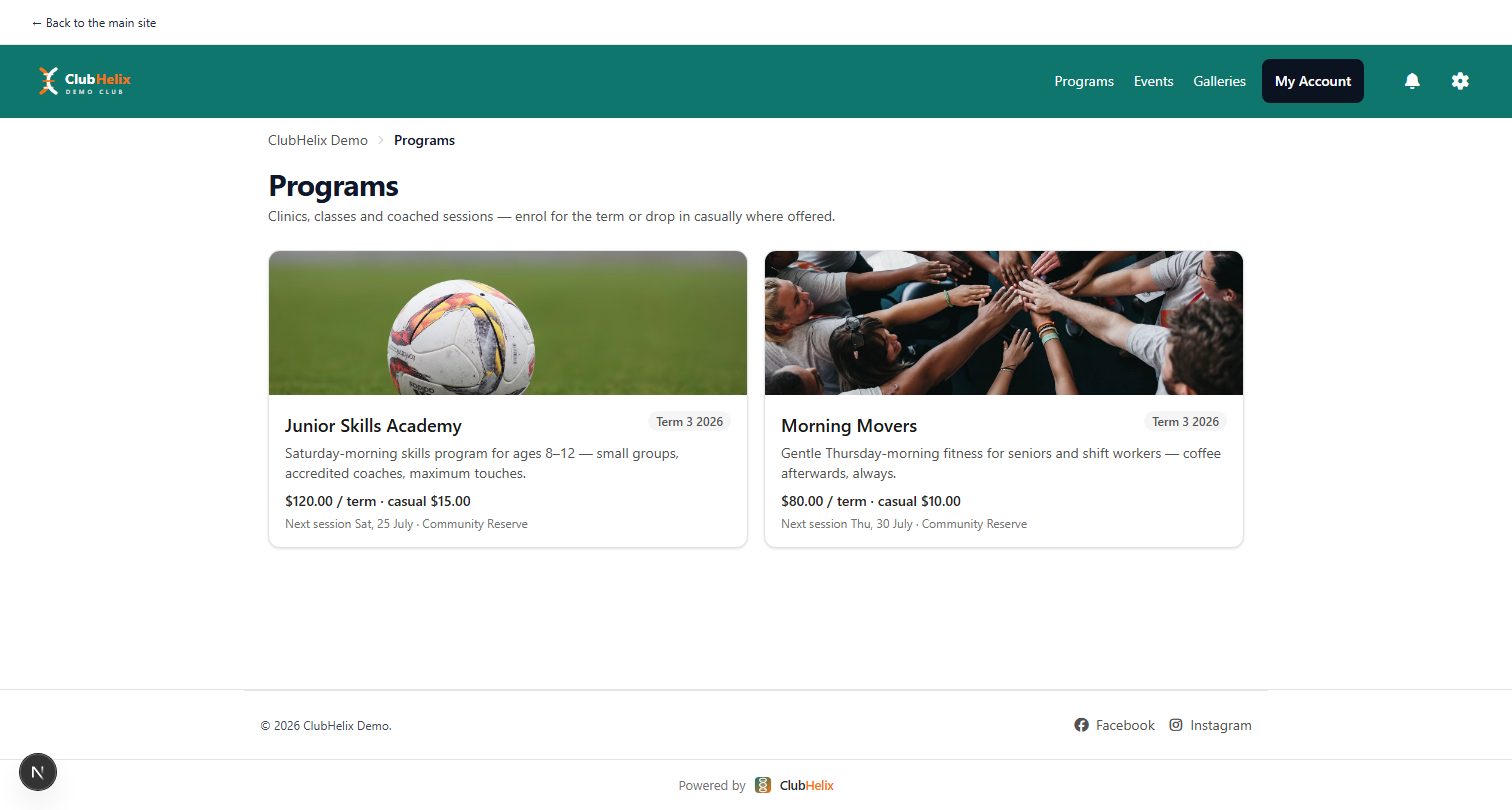
You can start on the free tier, put your intake calendar and enrolment forms up in an afternoon, and let the first course of the year run itself. The pricing is published, there is nothing to negotiate, and you can create your club site and have the next beginner intake taking enrolments before your next committee meeting. If you would rather see the shape of it first, a come and try day is the easiest way to test whether online enrolment actually reduces the queue at your desk.
Frequently asked questions
What qualifications do dog club instructors need?
That depends entirely on your governing body, which usually runs or recognises an instructor scheme with defined levels. Most community clubs grow instructors internally through a helper and assistant pathway, then fund the formal accreditation once someone has shown they will stay. Check the requirements with the body you affiliate to before you promise anyone a title.
How do dog clubs check vaccination records?
The workable approach is to ask for the vet-issued certificate as part of enrolment, record the expiry date against the dog, and remind the handler before it lapses. That way the check happens once, in writing, rather than becoming an argument at the gate. Publish the exact requirement on the enrolment form using the same wording your governing body uses.
How many handlers should be in a dog training class?
Six to ten per instructor is the usual band for general obedience, fewer for puppy, behaviour and agility classes where each dog needs individual attention. The real limit is how much feedback one instructor can give in an hour — if handlers are standing around waiting for a turn, the class is too big regardless of the number.
Should a dog club run fixed intakes or let people join any week?
Fixed intakes suit most volunteer-run clubs. They make instructor demand predictable, let a cohort progress together, and turn a vague "come down sometime" into a specific start date that people actually diarise. Rolling enrolment only works well when you have spare instructor capacity to triage new arrivals every single week.
Does a dog training club need its own website?
Yes, because almost every question a prospective member has is answerable in writing — when the next beginner course starts, what it costs, what vaccination record you need, and where the ground is. A club site that also takes enrolments and payments removes the two jobs that burn out volunteer committees, which are answering the same email and chasing bank transfers.
Keep reading — how to run a club registration day for the intake-day mechanics, and how to recruit club volunteers for building the instructor pathway.


