
What this guide answers
- How do you build a curling league draw?
Decide the leagues and nights first, then how many draws each night your sheets support, then the format — round robin, two halves with re-seeding, or a season with playoffs and a consolation event.
- How should a club run its spares list?
Keep a live register with positions, availability, standing and contact details that members can update themselves, and set clear rules on how many spares a team may use, whether a spare can skip, and what a spare must…
- What equipment does a beginner curler need?
Almost nothing. Clubs supply stones, brooms, sliders, grippers and stabilisers, and a beginner only needs clean flat-soled shoes that have not been worn outside, plus clothing they can lunge in.
- How do curling clubs make money?
Membership and league fees fund the club's base, but for clubs with their own facility the surplus usually comes from the social side — the bar, meals, bonspiels, outside ice rentals and sponsorship.
- How do you turn learn-to-curl participants into league members?
Give them a defined next step before they leave the building — a beginners' league, a free-agent night where teams are formed on the spot, or a spares pathway with a promise of first refusal on a permanent spot.
UK edition. This guide is written for volunteer-run clubs in the UK. Where rules differ — grants, tax, incorporation, safeguarding — follow the UK-specific pointers below or check with your national body.
Thursday, twenty past nine. The late draw is on its fourth end, eight sheets are running, and upstairs the winners of the early draw are buying the losers a drink because that is the rule and always has been. Between the last stone and closing time, the club will take more money over the counter than a full night of league fees raised. That is not a quirk. It is the business model, and any committee that forgets it will spend three years wondering why the ice bill keeps outrunning the income.
Curling clubs are a genuinely unusual species — half competition body, half licensed social club, with a technical ice-making operation attached that most members never think about. The sport itself is orderly and forgiving: a fixed draw, the same time every week, teams that stay together for years, and a culture that makes newcomers feel welcome faster than almost any other sport. But the administration behind it is real. Somebody builds the draw. Somebody finds a fourth when a skip is away. Somebody works out whether the bonspiel made money or lost it politely.
This guide is for the volunteers doing that work — the draw master, the spares coordinator, the bar manager, the treasurer and whoever inherited the club email address. It covers building league draws and allocating sheets, running a spares list that actually answers, converting learn-to-curl nights into full teams, and treating your bonspiels and bar as the funding engine they genuinely are.
Which kind of curling club are you?
The single biggest fork in the road is whether the club controls its own ice. It changes your costs, your calendar, your culture and your fundraising.
| Dedicated ice facility | Arena club | |
|---|---|---|
| Ice | Your own sheets, your own plant, your own icemaker | Hired hours on a rink shared with other sports |
| Season length | Set by your plant and your budget | Set by the rink's calendar, often shorter |
| Ice quality | Yours to control — pebble, scrape, temperature | Whatever the shared surface allows |
| Equipment | Stored on site, always available | Stones and mats moved in and out for every draw |
| Social income | A licensed bar and clubroom above your own ice | Often a pub down the road, which earns you nothing |
| Big risks | Plant failure and capital replacement | Losing your hours to another user group |
| Big advantage | You own the whole experience | Far lower fixed costs and no plant to replace |
Neither is better. They are different businesses. A dedicated facility has more income levers and a permanent capital problem; an arena club has almost no capital risk and almost no social income, which means its fundraising has to be more deliberate. Know which one you are before you copy another club's fee structure.
Curling here is concentrated in Scotland and organised through dedicated ice rinks, with clubs affiliating to the national governing body and many operating as unincorporated members' clubs or CIOs. Community Amateur Sports Club status is worth investigating for rates relief and Gift Aid. Many clubs do not own their rink but rent ice from a commercial or trust-run facility while running their own membership, leagues and social calendar — which means your ice negotiation and your bar are separate businesses.
The draw — leagues, sheets and the spares list
Building a draw people can plan their lives around
The draw is your product. Curlers commit to a night for a whole season, and the quality of your scheduling is judged on three things: it was published early, it was fair, and it did not change.
Decisions to make before you build it:
- Leagues by night and type. Open, women's, men's, mixed, doubles, juniors, and a daytime league that is often your most loyal group. Two healthy leagues beat four thin ones.
- Draws per night. With eight sheets and sixteen teams you run two draws, early and late. With four sheets and twelve teams you run three draws or a bye rotation.
- Format. A straight round robin, two halves with re-seeding at the midpoint, or a season with playoffs and a consolation event. Re-seeding keeps games competitive and stops weaker teams being beaten weekly.
- Points. Two for a win and one for a tie is standard; decide the tiebreakers up front — head-to-head, then ends won, then stones counted — and publish them before anyone needs them.
- Length. Eight ends or six, and a bell or clock rule so the late draw actually starts on time.
| Design decision | The lazy option | The one members prefer |
|---|---|---|
| Publishing the draw | Week by week | The whole half, published before the first stone |
| Early and late draws | Teams keep the same slot all season | Alternating, so everyone shares the late nights |
| Sheet allocation | Same sheet most weeks | Rotating, because sheets genuinely curl differently |
| Byes | Announced on the night | Scheduled and visible from week one |
| Playoff eligibility | Decided when a dispute arises | Written into the league rules before the season |
Sheet allocation, and why it matters more than it sounds
Any curler will tell you sheet one and sheet eight are different animals — edges, draw path, how the ice takes pebble near the boards. If the same team draws the same sheet every week, they gain a real advantage and everyone knows it. Rotate sheets deliberately across the draw, publish the rotation with the schedule, and let the ice crew know which sheets are being used when so their scraping and pebbling schedule matches your draw.
Publish the whole thing where members can see it on a phone at work on a Tuesday. A competition and fixtures page on your own site with the draw, standings and results beats a spreadsheet emailed weekly and a printout taped to the notice board — and it means a curler who missed a week can see the ladder without asking anyone. If you are building a draw from scratch, how to make a fixture draw walks through the mechanics.
The spares list that actually answers
Every curling club has a spares list. Most of them are a document from four seasons ago with three disconnected phone numbers on it. A working spares system has four parts:
- A live register. Name, preferred positions, nights available, rough playing standard, contact method, and whether they are a club member. Let members update their own entry rather than emailing the coordinator.
- A protocol. Who contacts spares — the skip, or a spares coordinator? Most clubs settle on the skip contacting the list directly, with the coordinator stepping in for the hard nights. Say which, in writing.
- Rules with teeth. How many spares a team may use, whether a spare may skip, whether a spare pays anything, and — the one that always causes trouble — the playoff eligibility rule. A common approach is that a spare must have played a stated minimum number of games for that team to be eligible in playoffs. Write it before you need it.
- A fast channel. The spare hunt happens between five and seven in the evening, and email is useless in that window. A group message to the available spares for that night is the tool that works — SMS messaging to a filtered list gets you an answer in ten minutes rather than three unanswered calls.
Treat your spares as members-in-waiting, not as a utility. Someone who spares four times in a season and enjoys it is the easiest full team recruit you will ever get, so make sure someone speaks to them upstairs afterwards.

Ice sports share a structural quirk that outdoor sports do not — the season is defined by a plant and a calendar rather than by the weather, which means every hour is planned, paid for and, if unused, wasted.
Learn-to-curl intakes and equipment
The two-hour session that recruits
Curling converts newcomers better than almost any sport, because a complete beginner can play a real end within an hour. The format that works is consistent across clubs:
| Time | What happens |
|---|---|
| 0-10 minutes | Welcome, sign-in, waiver, borrow a slider and gripper, safety on the ice |
| 10-30 | Delivery basics with a stabiliser, then sweeping, then how a game works |
| 30-40 | Split into teams of four with an experienced club member on each |
| 40-95 | Play four ends, with the club member skipping and explaining as they go |
| 95-120 | Upstairs, drink in hand, and someone explains what happens next |
That last row is the whole exercise. The on-ice session sells the sport; the twenty minutes afterwards sells the club. Have a person — not a flyer — whose job is to sit with the newcomers, learn their names, and tell them exactly which night beginners play and how to sign up.
What the club supplies
Curling has a wonderfully low equipment barrier, and clubs should lean on it hard in their marketing:
- The club provides stones, brooms, sliders, grippers and stabilisers for beginners.
- Participants bring clean, flat-soled shoes that have never been worn outside, stretchy trousers they can lunge in, and layers.
- Nobody needs to buy anything to try the sport, and most curlers only buy their own shoes and broom after a full season.
Keep a labelled club gear bin with a size range of grippers, a handful of stabilisers, and spare broom heads. Register the contents, check them at the start of the season, and budget a small annual replacement figure — worn broom heads and cracked grippers are the cheapest thing standing between a beginner and a good first night.
Getting a beginner onto a team
This is where clubs lose people. A newcomer finishes the intro night keen, and then discovers that leagues are made of teams that formed in 2019 and have no vacancy. Solve it structurally with one or more of these:
- A beginners' league on one or two sheets for six or eight weeks, playing shorter games at an early draw time.
- A free-agent night. Everyone without a team turns up, plays a mixed game, and teams are formed on the spot with a club member acting as broker. It works, and it is far less intimidating than it sounds.
- A stated spares pathway — spare for a season, then be first in line when a team needs a permanent player.
- A buddy rule in one league, where each team carries one newer curler and the club acknowledges it publicly.
Track who came to an intro night, who came back, and who joined. Even a simple list tells you whether your intake nights are recruiting or entertaining. For the wider approach to bringing people in, how to recruit club volunteers covers the same principle applied to the jobs that keep the club running.
Bonspiels and the social side that pays for the ice
The bonspiel is a fundraiser with a sport attached
A bonspiel is the closest thing a curling club has to a controllable income event. Teams enter, play a guaranteed number of games over a day or a weekend, eat and drink on site, and go home happy. Everything about that sentence is a revenue line.
Model it before you set the entry fee. Take entry fee E per team and T teams:
- Income = (E × T) + bar takings + meal sales + raffle + any event sponsorship.
- Costs = ice hours and icemaker time + catering + prizes and trophies + printing and consumables + any officials or hired help.
- Margin = what is left, which should be a number you decided on beforehand, not a surprise.
The instructive part is where the margin actually comes from. Entry fees usually cover ice, prizes and catering with very little left. The bar, the meals and the raffle are the fundraiser. Which means the two decisions that most affect the result are how long people stay after their last game, and whether the bar is properly staffed when they do. Schedule the final draw so that everyone is off the ice at a sociable hour, put the presentation somewhere people have to walk past the bar, and roster your best volunteers to the counter, not to the door.
| Bonspiel element | Decide this early |
|---|---|
| Format | Three-game guarantee, triple knockout, or A/B/C events — say it on the entry form |
| Field size | Set by sheets × draws available, minus a buffer draw for overruns |
| Entry fee | Priced from your cost model, not from what you charged in 2019 |
| Catering | In-house or hired, and whether a meal is included in the entry |
| Prizes | Cash, merchandise or vouchers — sponsored prizes protect your margin |
| Draw publication | Published before the day, with sheet allocation and start times |
| Volunteer roster | Named jobs and shifts, confirmed the week before |
| Payments | Entries paid online in advance, so late withdrawals do not become bad debts |
Take entries and payment online through your own events and ticketing rather than a form and a bank transfer, and publish the draw where teams can find it on their phones. It removes the two most common bonspiel headaches — chasing money on the morning, and printing the draw four times because a team dropped out.
A bonspiel run sheet
| When | What happens |
|---|---|
| Eight weeks out | Date confirmed with the ice crew, format decided, entries open online |
| Four weeks out | Sponsors confirmed, prizes ordered, catering numbers estimated |
| Two weeks out | Entries close, draw built and published, volunteer roster confirmed |
| Week of | Final numbers to catering, bar stock ordered, floats and card readers checked |
| Day, first draw | Registration desk, welcome, safety and ice notes, on time |
| Between draws | Ice maintenance window respected, food service, raffle sales |
| Final draw | Presentation planned for a time when people are still in the building |
| Following week | Reconcile, thank sponsors and volunteers in writing, note what to change |
The bar, the licence and the roster
The social side is not a side. In many clubs it is the difference between a surplus and a deficit, and it deserves as much structure as the draw.
Roster the bar properly — named volunteers on named shifts, not a plea at the end of the night — and rotate the job so it does not always fall to the same three people. Write the closing procedure on a laminated card behind the bar rather than relying on memory: cash reconciled, card reader settled, stock noted, taps and fridges dealt with, doors and lights.
Licensing and responsible-service obligations are regulated and differ by jurisdiction — treat what follows as general information and confirm the current requirements with your regulator or a suitably qualified adviser. If your club runs a canteen alongside the bar, how to run a club canteen covers the food side and its volunteer roster.
Clubs here commonly operate under a club premises certificate, with different rules again if you supply alcohol to non-members at an open bonspiel. Personal licence requirements, permitted hours and the local licensing authority's conditions all vary, so check your certificate's terms and confirm anything unusual with the licensing authority in advance. Sponsors and guests at an open event are exactly the scenario where a club certificate's limits catch committees out.
Ice, the plant and the person who makes it
If your club has its own ice, the icemaker is the most important person in the building and the most likely to be taken for granted. Ice work runs on a rhythm — scrape, pebble, nip — before every draw, plus laying and taking out the ice each season and constant attention to humidity and temperature. Whether the role is paid or voluntary, three things protect the club:
- Document the process. Settings, schedule, plant quirks, supplier contacts. When it lives only in one person's head, one illness becomes a cancelled season.
- Train an understudy. Two people who can prepare a draw's ice is the minimum resilient number.
- Fund the plant. Compressors, chillers and dehumidifiers do not last forever. Divide the expected replacement cost by the years of life remaining and set that aside annually — the least popular line in the budget, and the one that saves clubs.
Arena clubs have the opposite problem: you do not control the ice at all. Set expectations honestly with new members, arrive early enough to set up, agree stone storage in writing, and invest in the rink's operations staff — they decide, in practice, how good your Thursday is.
Membership, fees and the shape of the money
| Category | Who it suits | Usually includes |
|---|---|---|
| Full curling member | League curlers | League entry, club events, voting rights, bar access |
| Second league add-on | Curlers playing two or more nights | A reduced rate for the additional league |
| New curler / first season | Graduates of learn-to-curl | Discounted first year, gear loan, beginners' league |
| Junior and student | School and tertiary age | Reduced rate, junior program, supervised sessions |
| Daytime or senior | Retired and shift-working members | Daytime leagues, often the club's most loyal group |
| Social or non-curling | Partners, past players, supporters | Clubroom and events, no league entry |
Most clubs charge a membership fee plus a per-league fee, which keeps the arithmetic honest: membership funds the club, league fees fund the ice those curlers use. Publish the split so a member playing two nights understands why they pay more than someone playing one.
The income mix is where curling differs from most sports. Membership and league fees rarely cover a dedicated facility on their own. The bar, the meals, the bonspiels, ice rentals to corporate groups and outside bookings, and sponsorship together carry the rest. That is why the social calendar is a financial strategy rather than a nice extra — and why an empty clubroom after the late draw should worry a treasurer more than a slightly small league. Build the year out with the club budget template, and if you are reviewing fees, how much should club membership cost works through the trade-offs.
The committee roles a curling club genuinely needs are specific: a draw master, a spares coordinator, an ice convener, a bar manager, a bonspiel chair and a membership officer, alongside the usual president, secretary and treasurer. Write a short position description for each, hand them over properly at the end of each season, and never let the draw and the spares list live in the same overworked person's inbox.
Running the draw, the spares and the spiel from one place
Most curling club admin is scheduling and communication: publishing a draw, updating a ladder, finding a fourth by six o'clock, taking bonspiel entries without chasing money. ClubHelix does those directly — competitions for league draws, results and standings on your own site, SMS messaging for the spare hunt that has to be answered tonight, events and ticketing for bonspiel entries paid in advance, and facility booking so your sheet allocation and outside ice rentals sit on one calendar.
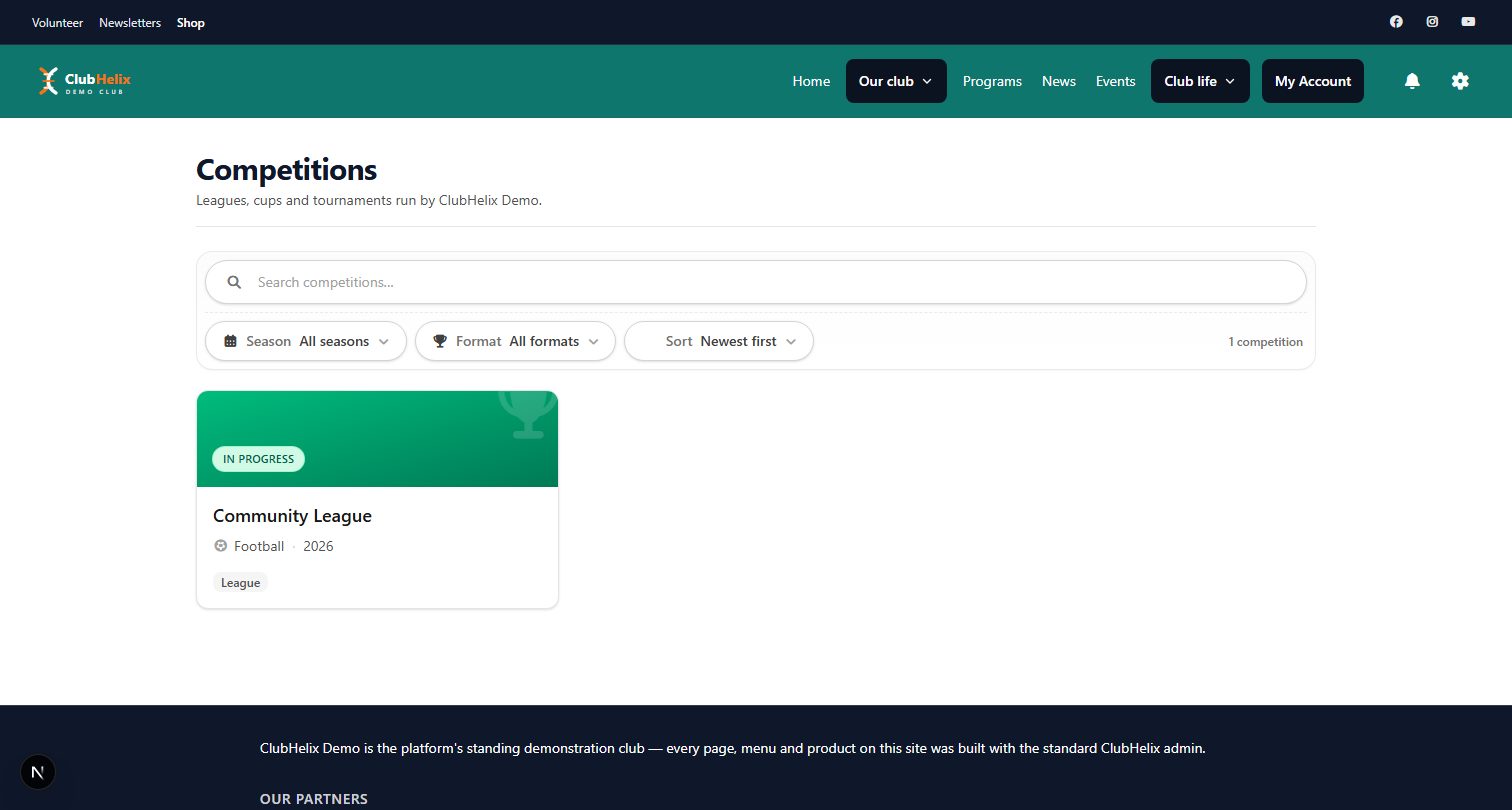
There is a free tier, so a club can put one league's draw online and see whether the phone stops ringing before committing to anything. The pricing is published rather than quoted, and a committee that sets aside one evening usually finishes it with a club website, a member list and the season's draw live. Create your club site before the ice goes in, and let the first draw of the season be the thing that proves it.
Frequently asked questions
How do you build a curling league draw?
Decide the leagues and nights first, then how many draws each night your sheets support, then the format — round robin, two halves with re-seeding, or a season with playoffs and a consolation event. Rotate early and late draw times so no team is stuck with the late slot, rotate sheet allocation because sheets play differently, and publish the whole half before the first stone rather than week by week.
How should a club run its spares list?
Keep a live register with positions, availability, standing and contact details that members can update themselves, and set clear rules on how many spares a team may use, whether a spare can skip, and what a spare must do to be playoff eligible. Use a fast channel like a group text for the same-day hunt, because that decision happens in the two hours before the draw.
What equipment does a beginner curler need?
Almost nothing. Clubs supply stones, brooms, sliders, grippers and stabilisers, and a beginner only needs clean flat-soled shoes that have not been worn outside, plus clothing they can lunge in. Most curlers buy their own shoes and broom only after a full season, which makes curling one of the cheapest sports to try and worth saying so loudly in your recruitment material.
How do curling clubs make money?
Membership and league fees fund the club's base, but for clubs with their own facility the surplus usually comes from the social side — the bar, meals, bonspiels, outside ice rentals and sponsorship. That is why scheduling draws so people stay afterwards, and rostering the bar properly, are financial decisions rather than social ones.
How do you turn learn-to-curl participants into league members?
Give them a defined next step before they leave the building — a beginners' league, a free-agent night where teams are formed on the spot, or a spares pathway with a promise of first refusal on a permanent spot. The conversion happens in the twenty minutes upstairs after the ice session, so make sure a named person is there to have that conversation rather than handing out a flyer.
Keep reading — how to run a lawn bowls club covers the same club-with-a-bar economics on grass, and how to run an ice hockey club digs into ice contracts and cost per hour.


