
What this guide answers
- How much should an ice hockey club charge per player?
Work backwards from the ice contract. Total your booked hours, apply the rate, and divide it out — either flat across all players, by hours consumed per squad, or with a blended club levy plus squad levies.
- How do clubs get more ice time from a rink?
By being the tenant a rink wants to keep. Pay on time, get on and off the ice promptly, take the hours the venue struggles to fill, and negotiate the whole season in one conversation rather than week by week.
- What does a club need to run on game day?
On-ice officials appointed under your league's process, plus a club-supplied off-ice crew — scorekeeper, timekeeper and two penalty box attendants at minimum — along with team managers holding the rosters, a first-aid…
- How can a club reduce the cost barrier for junior players?
Build a club-owned gear pool and say plainly on your join page that a beginner's first season includes a loan kit.
- What should a club do with ice it cannot fill?
Release it back early if the contract allows a credit, or sublet it — stick-and-puck sessions, adult drop-ins, goalie clinics and corporate hires all fill an hour you have already paid for.
Every club has a constraint that shapes everything else. For an ice hockey club it is not volunteers, or coaches, or even parents — it is a line item you do not control: the hourly rate for a sheet of ice, and how many of those hours the rink is willing to sell you at times when human beings are awake. Build the club around that number and the rest of the operation falls into place. Ignore it and you will spend three seasons wondering why the books never balance.
That constraint makes hockey administration unusual. Most community sports clubs have a facility that is more or less free at the margin — one more training session on the oval costs nothing. In hockey, every extra session has a price tag attached before a single player laces up, and the club's job is to convert bought hours into the maximum amount of useful development, competition and enjoyment. Everything from your fee structure to your junior pathway to whether you can afford a goalie clinic is downstream of the ice contract.
This guide is for the committee running a community ice hockey club — the volunteers negotiating the ice block, chasing registrations, sorting the gear cupboard and finding a timekeeper twenty minutes before the puck drops. It covers negotiating and splitting ice time, building a gear pool that removes the junior cost barrier, and the game-day crew, scoresheet and league-reporting workflow that keeps you in good standing with your league.
Your real landlord is the rink
Almost no community hockey club owns ice. You are a tenant in a building with several other tenants — public skating, figure skating, learn-to-skate, curling in some venues, and often a rival club — and the rink's incentive is to fill every hour at the highest rate it can get. That relationship is worth managing deliberately, because it is the single most valuable commercial relationship your club has.
Three habits separate clubs that get good ice from clubs that get leftovers:
- Be the easy tenant. Pay on time, leave changerooms clean, get off the ice at the buzzer, and never let a coach argue with rink staff about a resurface. Rinks reward low-friction tenants with the slots they release first.
- Ask for the whole season in one conversation. Piecemeal weekly bookings are the most expensive way to buy ice and the least likely to secure prime times. Come with a season plan.
- Know what the rink is short of. Many venues struggle to fill mid-morning and late-night ice. If your senior team can train at 10pm and your veterans' group can skate at 7am, you have something to trade for the after-school hours your juniors need.
The season here typically runs through the cooler months, roughly autumn to early spring, on a small number of commercial rinks that are also running public sessions, figure skating, learn-to-skate and birthday parties. Clubs generally affiliate through their state association to the national body and incorporate as incorporated associations. Because rinks are commercial rather than council-run, ice is bought at a market rate rather than allocated — which means your negotiation, not your committee's patience, decides what you pay.
Ice time — what you are buying and how to split it
Buying the block
Negotiate the block, not the hours. Bring a one-page season plan showing how many hours you want, which weeks, which times, and which slots you are flexible on. Then work through this checklist before you sign anything:
| Term to nail down | Why it bites later |
|---|---|
| Rate by time band | Prime evening ice and 6am ice are different products — get both rates in writing |
| Resurface time | Is your hour 60 minutes of skating, or 50 minutes plus a flood? Confirm which |
| Cancellation and credit | What happens if the plant fails, the rink closes, or a public event takes your slot |
| Changeroom access window | How early you get in and how fast you must be out — this drives your whole game-day sheet |
| Referee and timekeeper room | Officials need a space; if the rink cannot provide one, find out before your first home game |
| Off-ice space | Dryland, meetings, gear storage — often cheap to add while you are already negotiating |
| Payment schedule | Monthly instalments smooth cash flow far better than a lump sum in the first week |
| Right of first refusal | Whether your slots roll over to next season, and by what date you must confirm |
Get the season's hours into a single shared calendar as soon as it is signed, and publish it where coaches and parents can see it. Half the ice a club wastes is wasted because a team did not know it had a slot. A facility booking calendar on the club site handles this properly — one calendar, visible to everyone, with squad sessions, games and any hours you sublet all in the same view.
Three ways clubs split the bill
Once you own the hours, someone has to decide who pays for them. There are three defensible models and one indefensible one.
| Model | How it works | Best for | Watch out for |
|---|---|---|---|
| Flat fee per player | Total ice cost divided across all registered players | Small clubs with one or two similar squads | Light users heavily subsidise heavy users |
| Consumed hours | Each team pays for the hours it uses, divided among its own players | Clubs with squads on very different schedules | Development and beginner groups can end up priced out |
| Blended | A club levy covers shared ice, teams pay for their own sessions on top | Most clubs, most seasons | Needs to be explained clearly or it feels like a hidden fee |
| Whoever complains loudest | Fees adjusted per squad after arguments | Nobody | Everything |
The worked allocation
Because ice rates differ enormously between venues, do this exercise in hours first and apply your rate at the end. Take an example club with five squads, buying eight hours a week for a twenty-four week season — 192 hours in total, with 114 registered players.
| Squad | Hours in the season | Share of total ice | Players | Hours consumed per player |
|---|---|---|---|---|
| Junior development | 32 | 16.7% | 30 | 1.07 |
| Under-12s | 40 | 20.8% | 22 | 1.82 |
| Under-16s | 44 | 22.9% | 18 | 2.44 |
| Senior A | 40 | 20.8% | 20 | 2.00 |
| Senior B / social | 36 | 18.8% | 24 | 1.50 |
| Total | 192 | 100% | 114 | 1.68 average |
The lesson jumps out of the last column. An under-16 player in this example consumes more than twice the ice a development player does. If everyone pays the same flat fee, the beginners are subsidising the representative squad by a wide margin — which is exactly backwards, because the beginners are the ones whose families are still deciding whether hockey is affordable at all.
Most clubs land on the blended model: a base membership that covers affiliation, insurance, shared sessions, goalie clinics and tryout ice, plus a squad levy that reflects consumed hours. Publish the split. A parent who can see that their fee is 44 hours of ice divided by 18 players plus a club levy will argue with you far less than one who receives a number with no explanation.

Every winter sport shares the same underlying economics — the surface is rented by the hour, the season is bounded by the venue's calendar rather than the weather outside, and the clubs that thrive are the ones that treat unused booked time as the expensive mistake it is.
As an illustration only — if your rink quotes $320 an hour for prime evening ice and $190 for a 6am slot, the 192-hour season above costs somewhere between roughly $36,000 and $61,000 depending purely on when you skate. That gap is bigger than most clubs' entire fundraising effort, which is why the shoulder-time conversation with the rink matters more than another raffle. Confirm whether GST is included in the quoted rate and whether resurface time comes out of your hour.
Gear pools and the junior cost barrier
Hockey asks a family to buy more equipment before the first game than almost any other sport. That barrier costs you players who would have loved it, and it costs you them at exactly the age when they would have stayed for a decade. A club gear pool is the highest-leverage thing a hockey committee can build.
What a beginner actually needs
| Item | Can it be pooled? | Notes |
|---|---|---|
| Helmet with full facial cage | Yes, with care | Must meet the standard your league requires — confirm before accepting donations |
| Mouthguard | No | Personal item, cheap, never shared |
| Neck guard | Preferably not | Check whether your league mandates one |
| Shoulder pads | Yes | Sizing is forgiving, wear is slow |
| Elbow pads | Yes | Straps perish before the padding does |
| Gloves | Yes | The item that smells first — wash and dry properly |
| Pants | Yes | Very forgiving on size |
| Shin guards | Yes | Sizing matters more than people expect |
| Skates | Yes, with a sharpening budget | The item that most decides whether a beginner enjoys their first month |
| Stick | Yes | Cut to height; keep a range of lengths |
| Club socks and jersey | Club-issued | Return at season end or forfeit a bond |
| Goalie kit | Almost always club-owned | Far too expensive for a family to buy speculatively |
Running a gear library that does not rot
A gear cupboard becomes a gear dump within two seasons unless somebody owns it. Give the role a name, a register and a bond system.
- Register every item with an ID, type, size, condition, when it arrived and who donated it. Anything unregistered is effectively lost the moment it leaves the building.
- Loan against a bond, refunded on return in reasonable condition. The bond is not revenue; it is a reason to bring things back.
- Set a return date that lands a week before your presentation night, so the gear officer is not chasing bags in the off-season.
- Insist on airing and drying. Gear stored wet is gear thrown out. A drying rack and a rule beats a replacement budget.
- Run a swap night at the start of each season — families bring outgrown kit, take what fits, and the leftovers top up the pool.
- Fund it deliberately. A small levy on every registration, one sponsor who funds "the kit bank" by name, or the proceeds of a single fundraiser will keep it stocked.
The offer that converts best is simple and stated plainly on your join page: a new junior's first season includes a full loan kit at no extra cost. It removes the single biggest objection at the point where the parent is deciding. Track the loans against member records rather than in a notebook, so you know who has what without opening the cupboard.
Most gear here is imported, so freight and limited local stock push prices up and lead times out. That makes the second-hand market and club swap nights genuinely important rather than a nice extra. As an illustration only, a complete new junior kit can easily run past $700 before skates are sharpened, while a well-run swap night can fit the same child for a fraction of that. Ask your state association whether any participation funding vouchers apply to registration or equipment.
Game day — officials, scoresheets and league reporting
The crew you need in the building
A hockey game needs more volunteers off the ice than most committees expect, and the club that runs an organised bench earns a reputation with officials and visiting teams very quickly.
| Position | What they do | How many |
|---|---|---|
| On-ice officials | Referee and linespersons, usually appointed rather than supplied by the club | Per league rules |
| Scorekeeper | Owns the scoresheet — goals, assists, penalties, times | One |
| Timekeeper | Game clock, penalty clocks, horn | One |
| Penalty box attendants | Doors, penalty timing communication with the timekeeper | Two |
| Announcer or music | Goals, penalties, sponsor reads | One, optional |
| Team managers | Player rosters, jersey numbers, signatures | One per team |
| First aid or trainer | On-site response, incident record | One |
| Canteen and gate | Where the club actually makes money on a home game | Two to four |
Publish the roster a fortnight ahead and send a reminder the day before. Off-ice officials are the roles where "someone will do it" fails most often, and the game literally cannot start without a timekeeper. A volunteer roster with named slots and confirmations beats a plea in a group chat every time.
The scoresheet workflow
The scoresheet is the club's legal record of the game, and mishandling it is how clubs lose points, get fined or find out about a suspension three weeks late.
- Before the game. Both teams submit rosters with jersey numbers, captains marked, and any affiliated or borrowed players correctly flagged. Getting this wrong is the most common cause of a forfeited result.
- Sign-off before puck drop. Coaches or managers sign; the officials check the sheet.
- During the game. Goals with time and assists, penalties with time, type and duration, goaltender changes, timeouts.
- At the buzzer. Officials review and sign. Any game misconduct or match penalty is noted with a short factual description — not an opinion.
- After the game. The result and sheet go to the league inside the stated window, copies are retained by the club, and anything requiring disciplinary follow-up is flagged to the league immediately rather than waiting for a weekly report.
- Within the week. Suspensions are tracked against the player, and the team manager confirms who is unavailable for the next fixture before selection is published.
Keep your own copy of every sheet. Leagues make errors, standings get corrected, and the club that has the paperwork wins the discussion. Where your league lets you publish your own fixtures and results, do it — competition tools with fixtures, results and ladders on your own site mean parents check your page instead of messaging the manager, and match officials keeps the appointments, contacts and payments in one place instead of on the secretary's phone.
The game-day run sheet
| Relative to puck drop | What happens |
|---|---|
| 90 minutes before | Building access, changerooms allocated, canteen opens, gear check |
| 60 minutes | Team sheets completed, jersey numbers verified, officials met and shown to their room |
| 45 minutes | Resurface, then on-ice warm-up |
| 15 minutes | Scoresheet to officials, timekeeper and box crew briefed, clocks tested |
| Puck drop | Gate and canteen at peak — make sure they are staffed |
| Intermissions | Resurface windows, raffle or promotion, canteen rush |
| Final buzzer | Scoresheet signed, copies distributed, injuries recorded |
| 30 minutes after | Result submitted, incident reports filed, changerooms cleared for the next booking |
That last row matters more than it looks. Your booking ends when the next tenant's begins, and a club that consistently runs over is a club that gets worse ice next season.
Officials here are generally appointed through the state association or an officials' association rather than supplied by the home club, and clubs are expected to provide the off-ice crew. Results and game sheets go to the league inside a stated window, and suspensions are administered by the association rather than by clubs. If your club can develop even two or three of its own registered on-ice officials, do it — official shortages are one of the more common reasons a fixture gets moved.
Rostering people around the hours you bought
Two hockey-specific realities eat committee time. The first is the goalie problem: a club with one goalie per team has no goalies at all, because one injury cancels a game. Recruit goalies deliberately, subsidise their registration if you can justify it, own the goalie kit so a curious eleven-year-old can try the position without a family investing a fortune, and keep a shared list of available goalies across squads.
The second is attendance. Ice you have paid for and nobody skates on is the most expensive thing your club does. Ask for RSVPs on every session, not just games — five minutes of tapping on a phone tells a coach whether Tuesday is a skills session or a scrimmage, and tells the committee which slots are consistently under-used and should be released or sublet. Attendance and RSVPs against the schedule turns that into a number you can act on. And when a session moves because the rink lost its plant, the notification has to reach people who are already in the car — team management with push and SMS is what stops eleven families driving to a dark rink.
Money beyond the ice bill
Ice will dominate your budget, but the other lines decide whether you break even.
- Registration and squad levies — the bulk of income, and the number families judge you on. Publish what it covers.
- Canteen and bar at home games — genuinely material in a venue where families are inside for two hours in the cold.
- Rink board and jersey sponsorship — a hockey rink has ready-made advertising surfaces and a captive audience. See how to get sponsors for a sports club.
- Tournaments — a well-run home tournament can fund a season's development ice, but only if you cost the ice and officials properly before you set the entry fee.
- Subletting spare ice — a stick-and-puck session, an adult drop-in or a corporate hire fills an hour you have already paid for.
Set the fee before the season, not during it. Build the budget from your ice contract outwards using the club budget template, and if you are choosing membership structures, how much should club membership cost works through the trade-offs.
Putting the schedule, the sheet and the money in one place
Hockey admin is really three problems: who is on the ice, who is paying for it, and what got reported to the league. ClubHelix handles all three from one club site — facility and ice booking so your whole season calendar is visible instead of living in a coach's inbox, competitions for fixtures, results and standings on your own pages, match officials for appointments and payments, and online registration with squad levies so the treasurer stops reconciling bank transfers by hand. The ice hockey club management software page shows how the ice, the money and the league reporting sit together.
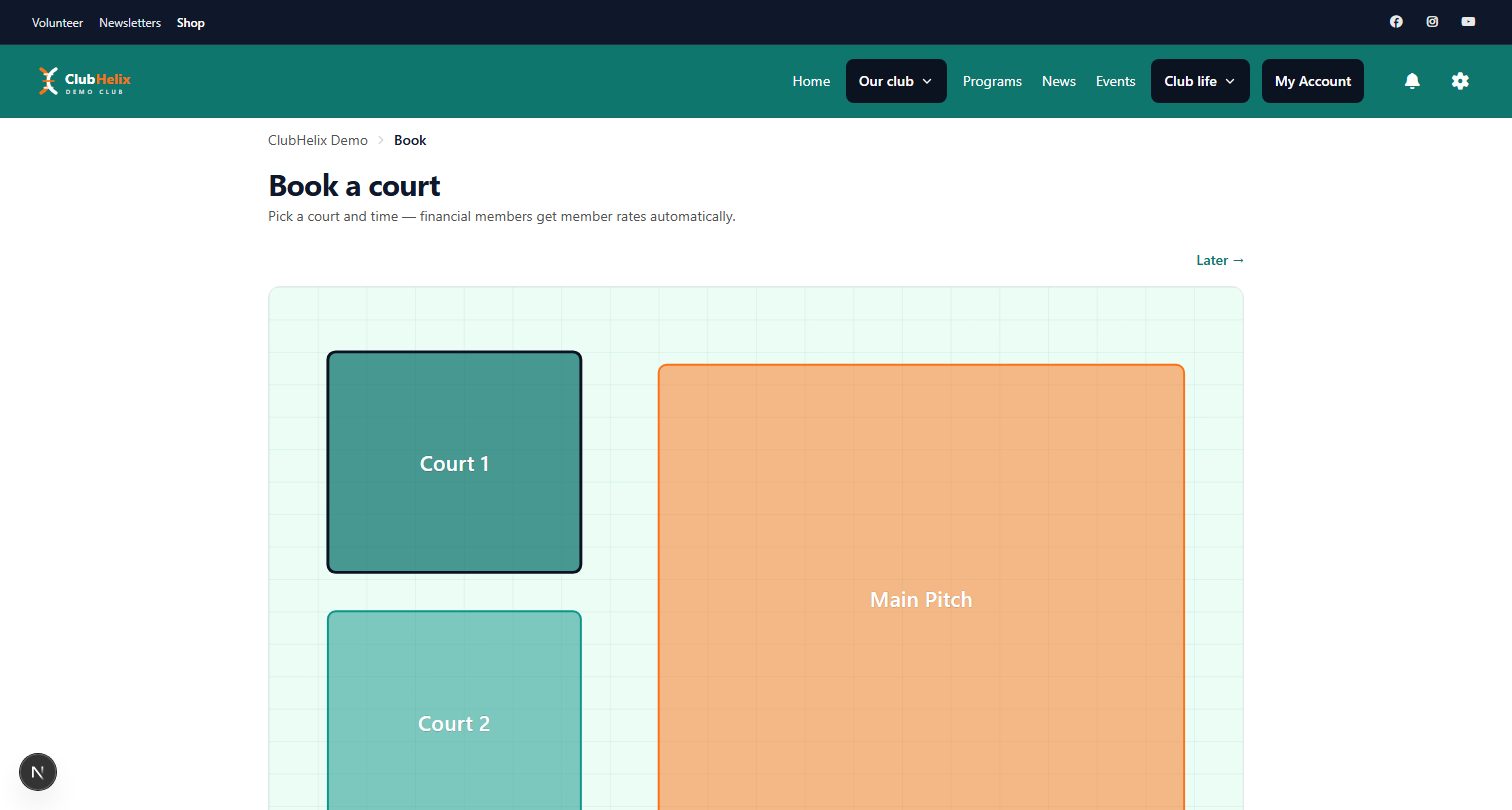
Start free, move one thing across — most clubs start with the season calendar because it is the piece everyone complains about — and add the rest when you are ready. The pricing is published rather than quoted, and a committee can have the site, the schedule and the registration form live in an evening. Create your club site before the ice contract is signed, so the season calendar goes up the day you have it.
Frequently asked questions
How much should an ice hockey club charge per player?
Work backwards from the ice contract. Total your booked hours, apply the rate, and divide it out — either flat across all players, by hours consumed per squad, or with a blended club levy plus squad levies. The blended model suits most clubs because it stops beginners subsidising the squads that skate three times a week. Whatever you choose, publish the arithmetic alongside the fee.
How do clubs get more ice time from a rink?
By being the tenant a rink wants to keep. Pay on time, get on and off the ice promptly, take the hours the venue struggles to fill, and negotiate the whole season in one conversation rather than week by week. Ask about right of first refusal for next season and confirm it in writing before your renewal date.
What does a club need to run on game day?
On-ice officials appointed under your league's process, plus a club-supplied off-ice crew — scorekeeper, timekeeper and two penalty box attendants at minimum — along with team managers holding the rosters, a first-aid presence, and someone on the gate and canteen. Roster those positions two weeks out and confirm the day before, because a game cannot start without a timekeeper.
How can a club reduce the cost barrier for junior players?
Build a club-owned gear pool and say plainly on your join page that a beginner's first season includes a loan kit. Register every item, loan against a refundable bond, run a swap night each season, and always own the goalie equipment. It is the single most effective thing a hockey club can do to widen its intake.
What should a club do with ice it cannot fill?
Release it back early if the contract allows a credit, or sublet it — stick-and-puck sessions, adult drop-ins, goalie clinics and corporate hires all fill an hour you have already paid for. The worst outcome is an empty sheet you have been invoiced for, so track attendance on every session and act on the slots that are consistently thin.
Keep reading — how to run a figure skating club covers the same ice economics from the other side of the rink calendar, and how to make a fixture draw helps when your league leaves the scheduling to you.


