
What this guide answers
- How do you run a craft group session that keeps people coming back?
Give the session a predictable shape — setup, open crafting, a break with short notices, a focus block, then show and tell — and run a beginner table every week rather than a beginners' term twice a year.
- How should a craft group price handmade goods for a market stall?
Cost the direct materials including thread, packaging and labels, multiply by a factor of roughly two to three to cover time and unsold stock, round to a clean price point, then sanity-check against comparable handmade…
- Who owns the money when members make items for the group to sell?
Decide before anyone starts making. The three workable models are group stock (group materials, all proceeds to the group), consignment (members supply their own work and the group keeps an agreed percentage), and a…
- How do you stop charity projects burning out your best makers?
Run them as projects with a target, a deadline and a delivery date rather than an open-ended obligation, get the recipient's written specification before cutting anything, kit up the work so beginners can contribute…
- What does a craft group need on its website?
When and where you meet, what a first visit costs, whether beginners are welcome said explicitly, photos of real work by real members, an online join form, and a calendar of markets, workshops and taught terms.
Canada edition. This guide is written for volunteer-run clubs in Canada. Where rules differ — grants, tax, incorporation, safeguarding — follow the Canada-specific pointers below or check with your national body.
A craft group's entire economy fits on one page, and that page is brutal. There is a hall to pay for, once a week, whether nine people come or twenty-nine. There is tea, coffee and biscuits. There is a table and a power point per person, and a shared cutting mat everyone is polite about. Against that there is a subscription that has not gone up in six years because nobody wants to be the one to raise it, and a market stall in the last quarter of the year that either covers the gap or does not.
What makes the good groups good is not the crafting. It is that somebody worked out how many people need to be in the room for the session to break even, decided what happens to the stall money, and wrote down who the charity blankets actually go to. That work is unglamorous and it takes about three evenings a year.
This guide is for whoever ended up running a quilting, knitting, stitching, card-making or general craft group — usually a person who joined to sew and now holds the hall key. It covers how to shape a session that people keep coming to, how to manage materials and shared equipment without a storeroom that nobody can move in, how to run charity projects that do not quietly grind your best makers down, and how to run a market stall that returns more than it costs.
The session is the product
Members do not renew because of your constitution. They renew because Wednesday morning is the best three hours of their week. Design those three hours deliberately.
| Time | What is happening | Who owns it |
|---|---|---|
| First 20 minutes | Doors, urn on, tables out, name badges, welcome for anyone new | Setup pair on the roster |
| Next 90 minutes | Open crafting — own projects, plus the beginner table running alongside | Session host circulates |
| Middle break | Tea, notices kept under five minutes, birthdays and news | Host |
| Following 40 minutes | Focus block — a demonstration, a technique, or heads-down on the charity project | Whoever is teaching |
| Last 20 minutes | Show and tell, pack down, next week's plan on the board | Everyone |
Three details do more work than the rest of the timetable combined:
- A beginner table, every single session. Not a beginners' term that runs twice a year. A table where a new person can sit down with a spare set of tools and a small starter project, next to someone who has agreed to be there. New members who arrive to a table with their name on it come back; new members who spend two hours watching experts have a lovely time and never return.
- Notices under five minutes, and never at the start. Start with making. Announcements at the break, then back to the tables.
- A show and tell that includes unfinished work. Groups that only celebrate finished objects quietly teach their slower and newer makers to hide.
Roster the setup and pack down
The two jobs that burn out craft groups are urn duty and furniture. Put both on a published roster in pairs so no one person is unlocking, boiling, stacking and locking every week. A roster people can see on their phone — and swap themselves when something comes up — removes most of the last-minute phone calls. Write short descriptions for the jobs the way you would any other volunteer position so a new member can volunteer without having to guess what they are agreeing to.
Materials, the donated stash and shared equipment
Every established craft group eventually has a storage problem, and it is nearly always caused by generosity. Someone's mother's fabric collection arrives in nine garbage bags. A closing shop donates its ribbon stock. None of it is refusable in the moment, and none of it is sorted.
Have a written donation policy before you need one
One paragraph on the website and a copy in the storeroom:
- What you accept — clean, moth-free, in usable condition, and in categories your members actually work in.
- What you do not accept — anything damp, unlabelled chemicals, ancient batting, or equipment you have no room to store.
- Who decides. Name the role, not a person: the materials coordinator accepts or declines, and is allowed to say no kindly.
- What happens to surplus. A standing arrangement to pass overflow to a school, a scout group or another craft group means saying yes costs you nothing.
Run a stash the way a shop runs stock
Clear tubs, labelled by category rather than by donor. A one-in-one-out rule for the shelf that is always full. A twice-yearly sort where anything untouched for two years goes into the fundraising bundle table at the market. And the rule that matters most: club materials are for club projects. If members can take fabric home for personal use, decide that explicitly and price it, rather than letting it become a resentment nobody names.
The equipment register
Sewing machines, overlockers, die-cutting machines, an iron, a good pair of shears that must not go near paper. Keep a register with the purchase date, serial number, condition and last service — our equipment register template is a straightforward starting point — and add three rules:
- Machines get serviced on a schedule, not when they break in the middle of a workshop. Budget it annually as a line item.
- Anything with heat gets a supervised zone. Irons, heat presses, hot glue and soldering for jewellery work all live in one corner with a mat, a timer and a rule that the last person to leave the table turns it off.
- Borrowing goes in a book. Item, member, date out, date back. Groups that skip this lose a machine roughly every three years and never quite know when.
Charity makes without grinding people down
Charity projects are the reason many craft groups exist, and they are also the most common cause of quiet burnout. The failure pattern is always the same: an open-ended commitment, no specification, no end date, and a small number of members doing most of it.
Get the specification in writing from the recipient
Before a single item is cut, ask the receiving organisation for their written requirements — size, materials, whether items must be new, laundering and packaging expectations, and any restriction on what they can accept. Hospitals, neonatal units, aged care homes, refuges and animal shelters all have real constraints, and a beautiful delivery that does not meet them is heartbreaking for everyone. Ask three questions every time:
- What exactly do you need, in what quantity, and by when?
- What can you not accept, and why?
- Who is our single contact, and how do you want the delivery made?
Cap the commitment
Run charity work as projects with a beginning and an end, not as a standing obligation. A project has a target number, a deadline, a nominated coordinator and a delivery date. When it is delivered, it stops. The group then chooses the next one, which is also when a member can opt out without letting anyone down.
| Element | Get this wrong | Get this right |
|---|---|---|
| Scope | "We make blankets for the hospital" | "Forty cot quilts, delivered by the end of the term" |
| Materials | Members fund it invisibly from their own stash | A budget line, plus a donated-materials call before the start |
| Skill level | Only the experienced makers can contribute | Blocks cut and kitted so a first-timer can sew one |
| Recognition | A thank-you email to the coordinator | Named in the newsletter, photographed at delivery, tallied at the AGM |
Ask the recipient early what they are permitted to accept, because the constraint is rarely about quality. Health services, refuges and animal shelters all work under policies that a well-meaning group can spend six months quietly breaching.
Hospitals in Canada generally route donations through a volunteer resources department, and many publish material and laundering requirements for items going to neonatal, oncology or palliative care. Long-term care homes, shelters, newcomer settlement services and animal rescues are the other common recipients. Ask for the written requirements before starting, and agree a single contact and a delivery date rather than dropping items at a reception desk.
The recognition loop is what sustains it
Makers keep giving when they can see where it went. Build the loop deliberately: photograph the finished batch before it leaves, get the recipient's permission for any photo that involves their people or premises, publish a short piece with the total count and the names of everyone who contributed, and read the tally out at the annual meeting. Put the delivery photos on your website as well as in a private chat — that page becomes the thing you show a potential funder or a new member, and it is far more persuasive than any recruitment poster. Volunteer appreciation has more ideas that cost nothing.
The market stall
The stall is where a craft group turns hours into a bank balance. It is also where a group can accidentally spend a whole year of goodwill for very little money, so treat it as an operation.

Decide who owns the stock
This is the question that causes real friction, and it must be answered before anyone makes anything for sale.
| Model | How it works | Suits |
|---|---|---|
| Group stock | Members make from group materials on group time; all proceeds go to the group | Charity-focused groups with a strong shared fund |
| Consignment | Members supply their own work, the group keeps an agreed percentage | Groups with several serious makers |
| Split stall | One table of group-made goods, one of consigned member work, clearly signed and separately reconciled | Most established groups |
| Commission-free showcase | Members sell their own work, pay a flat table fee to the group | Larger craft fairs where members are effectively traders |
Write the chosen model into your rules, put the percentage in numbers, and print a simple consignment sheet — maker, item, price, quantity in, quantity sold, amount due — that gets signed at both ends of the day.
Price handmade goods properly
The most common mistake is pricing at what the maker would pay, which is always too low, and the second is pricing on materials alone, which ignores the twelve hours in the item. Use a simple, consistent method for everything on the group table:
- Add up the direct materials for the item, including thread, wadding, buttons, packaging and the label.
- Multiply by a materials factor — most groups use somewhere between two and three — to cover time, wear on machines and the items that never sell.
- Round to a clean price point that makes change easy at a busy stall.
- Cross-check against what similar handmade work sells for locally. If yours is far cheaper, you are training your market to undervalue every maker in the room, including the ones who sell for a living.
Worked example: a lined zip pouch using a fat quarter, wadding scraps, a zip and a printed label. Materials add to roughly one unit of cost; a factor of two and a half gives the shelf price; round it up to the nearest clean note. Do that consistently and your stall makes a predictable margin instead of a mysterious one.
Keep a small range with depth rather than a huge range with one of each. Six product lines in three colourways sells better than forty singletons, it is far easier to price, and it lets you tell a new maker exactly what to make next.
Run the day like a shop
- A float, counted by two people, recorded before you open. Take card as well as cash — a card reader typically pays for itself at a single market, because the average handmade purchase is well above the amount people carry in coins.
- Two people on the table at all times. One sells, one wraps and restocks. A single person cannot do both and will lose sales at exactly the busiest moment.
- A stocktake sheet. Items out, items back, sold count per line. Without it you cannot answer the only question that matters afterwards, which is what to make more of.
- A sign-up sheet and a QR code to your website on the corner of the table. The stall is your best recruitment channel of the year, and most groups waste it.
- Reconcile within 48 hours while everyone remembers. Takings, less float, less table fee, less consignment payouts, equals what the day was actually worth.
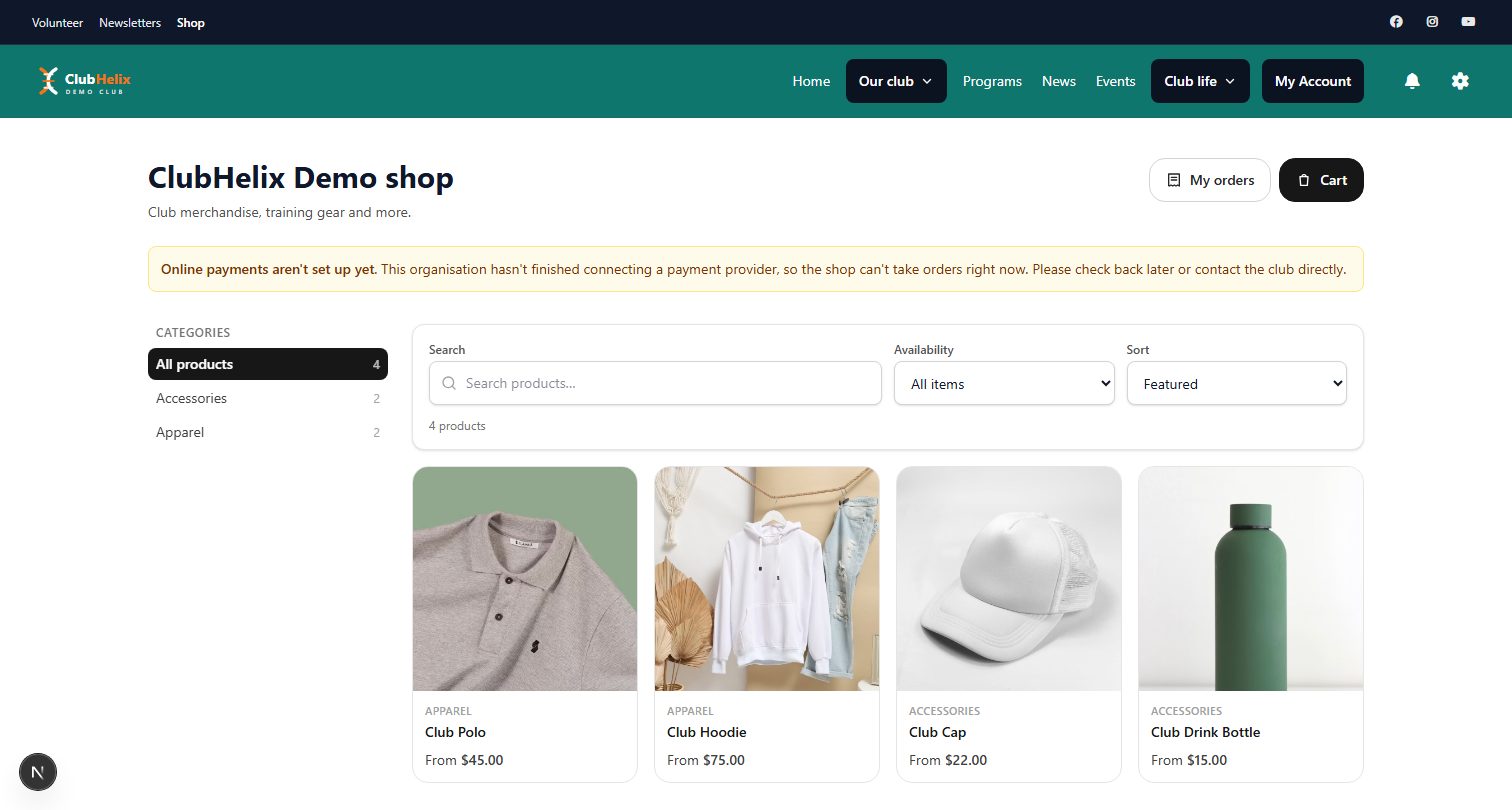
Selling online between markets is worth setting up once. A simple club shop on your own website lets people order the pouch they saw on the stall, handles the tax settings, and means your makers are not running personal payment links through a chat group — see how to sell club merchandise online for the practicalities.
When selling stops being a raffle table
Once a group sells regularly, three questions arrive: whether the income is taxable, whether the group needs to register for anything, and whether the goods themselves are subject to safety rules — which they very often are for anything intended for a child. Treat everything below as general information and confirm the current position with the relevant authority or an adviser before you rely on it.
In Canada, the questions to raise with your adviser are your group's tax position given its structure, whether the small supplier threshold for sales tax registration is in reach, and how provincial sales tax applies where you trade. Toy and children's product safety is federally regulated with real requirements around materials, small parts and labelling — check the current rules before selling handmade items intended for children.
Your stall calendar is built around craft fairs, farmers markets and the holiday bazaar season, with the last quarter of the year doing most of the work. Apply early, since juried fairs often close applications months ahead, and check what the organiser requires — proof of liability coverage and a sales tax permit are both common conditions of getting a table.
Making the hall hire work
Do this arithmetic once a year and the group stops feeling precarious.
Take your total annual fixed costs — hall hire multiplied by the number of sessions, insurance, equipment servicing, a modest consumables budget — and divide by the number of sessions. That is your cost per session. Divide again by your average attendance and you have the true cost per person per week. Compare it to what you charge. Most groups discover the gap is small enough to close with a modest rise, or with three good market stalls, and enormous relief follows.
Then choose a fee model that matches how people actually attend:
- Annual subscription plus a small door fee. The sub covers fixed costs, the door fee covers tea and consumables, and irregular attenders stop feeling they are subsidising the regulars.
- Pay per session only. Simple and welcoming, but leaves you exposed in quiet weeks and makes budgeting guesswork.
- Term or seasonal blocks. Best where the group runs taught programs, since it gives you committed numbers before you order materials.
Whichever you pick, take the money online. Collecting subs in cash at a craft table is how treasurers end up with a shoebox and a headache — online joining and renewals with a card payment and an automatic reminder puts an end to the annual chase, and the guide to how much membership should cost helps you set the number.
Space in Canada is often the cheapest part of the budget if you look in the right places. Library meeting rooms, seniors centres, legion halls, church basements and municipal community centres frequently offer a low or nominal not-for-profit rate. Ask what the room includes — tables, kitchen access and on-site storage change the real cost far more than the hourly rate does.
Access, safety and the people in the room
General information only — your venue, insurer and local requirements set the rules that apply to your group.
- Public liability cover is usually a condition of hiring a hall and holding a stall. Check whether your policy covers members using group machines and selling goods to the public.
- Hot tools and cutting equipment need a designated zone, a mat, and a rule about rotary cutters being closed the instant they leave a hand. Rotary cutter injuries are the most common serious injury in a fabric group by a wide margin.
- Accessibility. Table height, chair type, lighting, a hearing loop if the venue has one, and a path to the toilet that is not blocked by a fabric tub. Ask members what they need rather than guessing — and note that good lighting is the single most requested change in almost every craft room.
- Scent, allergies and dust. Fibre dust, spray adhesives and strong fragrance all affect people with respiratory conditions. A no-aerosol-indoors rule and a well-ventilated room solve most of it.
- Wellbeing. Many members join a craft group as much for the company as the craft. Keep a short list of local support services on the noticeboard, brief your hosts on who to quietly check in with, and never let the group's warmth become an expectation that people share more than they want to.
Keeping in touch between sessions
The weekly session is the group. Everything else is reminders. Keep it light and predictable: one short email a fortnight or a month with the next few dates, the current project, what to bring and any change of venue, plus a message on the day a session is cancelled. A group newsletter with three photographs and four lines outperforms a long one nobody finishes.
Put the essentials where a stranger can find them without asking: when and where you meet, what a first visit costs, whether they need to bring anything, and whether beginners are genuinely welcome. That last one needs saying explicitly on the page — most people who never walk through your door decided they were not good enough before they left home.
One place for the subs, the stall and the roster
The admin of a craft group is small but relentless — the subs, the roster, the market stock, the charity tally, the reminder that the hall is closed next week. ClubHelix handles that in one place: online joining and renewals, an events calendar for markets, workshops and taught terms, an email broadcast tool that sends the fortnightly note from your own address, and a club shop so members and customers can order between markets.
If you are the person currently holding the hall key, the biscuit tin and the mailing list, this is the part worth trying. The free tier costs nothing to test on a real membership list, the pricing is published rather than quoted, and nothing needs installing — you can set your group up between sessions and have the join form and the next market listed before Wednesday. Craft, hobby and interest groups can see how the pieces fit on our hobby and interest groups page.
Frequently asked questions
How do you run a craft group session that keeps people coming back?
Give the session a predictable shape — setup, open crafting, a break with short notices, a focus block, then show and tell — and run a beginner table every week rather than a beginners' term twice a year. Keep announcements under five minutes and never at the start, celebrate unfinished work as well as finished, and roster setup and pack down in pairs so the same person is not always unlocking and stacking.
How should a craft group price handmade goods for a market stall?
Cost the direct materials including thread, packaging and labels, multiply by a factor of roughly two to three to cover time and unsold stock, round to a clean price point, then sanity-check against comparable handmade work sold locally. Pricing on materials alone ignores the hours in the item and undercuts every maker in your area, including those who sell for a living.
Who owns the money when members make items for the group to sell?
Decide before anyone starts making. The three workable models are group stock (group materials, all proceeds to the group), consignment (members supply their own work and the group keeps an agreed percentage), and a split stall running both side by side with separate reconciliation. Write the model and the percentage into your rules and use a signed consignment sheet at every market.
How do you stop charity projects burning out your best makers?
Run them as projects with a target, a deadline and a delivery date rather than an open-ended obligation, get the recipient's written specification before cutting anything, kit up the work so beginners can contribute, and close the loop by photographing the delivery and naming every contributor. When a project ends, the group chooses the next one — which is also the moment a member can step back gracefully.
What does a craft group need on its website?
When and where you meet, what a first visit costs, whether beginners are welcome said explicitly, photos of real work by real members, an online join form, and a calendar of markets, workshops and taught terms. Add a shop page if you sell between markets, and a page for charity project totals — it is the page that convinces both new members and potential funders.
If the stall is quietly becoming your main event, club fundraising ideas covers the rest of the calendar.


