
What this guide answers
- How much should a club charge for a golf day team?
Work backwards from the course quote. Get a written per-player price covering green fee, cart and catering, multiply by four, and set the team price so it comfortably covers that with a genuine margin — most clubs land…
- How many players do you need for a golf day?
An eighteen-hole shotgun start with four-player teams tops out around seventy-two players, and most club days run well anywhere from ten to eighteen teams.
- What is the best format for a charity golf day?
A four-person scramble, where the team plays the best ball from each shot.
- How much should a hole sponsorship cost?
Price it so a small local business can say yes without approval from anyone else, and sell as many as you have holes.
- How do you get sponsors for a golf day?
Start with the employers of the people already playing — that is the warmest list you will ever have.
South Africa edition. This guide is written for volunteer-run clubs in South Africa. Where rules differ — grants, tax, incorporation, safeguarding — follow the South Africa-specific pointers below or check with your national body.
The thing nobody tells you about a club golf day is that only a fraction of the field really plays golf. There will be a handful of low markers who take it seriously, a solid middle who play a few times a year, and then a long tail of people who have been handed a set of clubs by their employer, have not swung one since the last golf day, and are mainly here for the cart, the beers and the chance to spend six hours with a client. Design the day for the people who can play and you will have a slow, joyless round and no repeat business. Design it for the tail and everyone has a good time, including the good players.
That reframe matters because a golf day is not really a sporting event. It is a sales event wearing a polo shirt. You are selling four-person teams to businesses, signage to businesses, and a room full of decision-makers to whoever wants their attention for ninety seconds after the round. The golf is the packaging.
This guide covers how to build one that makes money and gets booked again — the field maths that determines whether the day is viable at all, team pricing and hole sponsorship, the sponsor pack you hand a business, the format and timings that keep a mixed-ability field moving, the on-course competitions that quietly add a second revenue line, and the follow-up that turns a corporate team into a season sponsor. If your club already owns a course, running a golf club covers the wider operation; this is about the one day.
Start with the field, because the field is the whole business
Every other decision follows from one number: how many players the course will accept. A golf day has a hard ceiling that a dinner does not — you cannot squeeze in an extra table.
An eighteen-hole shotgun start with four-player teams gives you a natural maximum of seventy-two players, and most clubs run comfortably at that. Some courses will take five-player teams on a few holes to lift the field into the eighties. That ceiling sets your maximum revenue before you have spoken to a single sponsor, which is why hole sponsorship and on-course competitions matter so much — they are the only lines that scale beyond the tee sheet.
The break-even model is simple enough to keep on one page. Per player you have a course cost — green fee, cart, and usually a catering component — and per day you have fixed costs that do not change whether you fill the field or not.
| Line | Behaviour | Notes |
|---|---|---|
| Green fee and cart | Per player | Negotiate hard on a quiet weekday, ask for a group rate |
| Catering — bacon rolls, on-course, meal | Per player | Often bundled by the course, sometimes cheaper unbundled |
| Prizes | Mostly fixed | Aim to have every prize donated rather than bought |
| Signage, printing, scorecards | Fixed | Reusable tee signs pay for themselves in two years |
| Contingency | Fixed | Weather, a no-show team, a broken cart |
Now the arithmetic that decides the day. The numbers below are illustrative and unit-free — put your own course quote in and the shape holds.
| Field | Team price | Player income | Course cost at 90 per player | Sponsorship | Net |
|---|---|---|---|---|---|
| 18 teams (72) | 600 | 10,800 | 6,480 | 4,000 | 8,320 |
| 14 teams (56) | 600 | 8,400 | 5,040 | 4,000 | 7,360 |
| 10 teams (40) | 600 | 6,000 | 3,600 | 4,000 | 6,400 |
| 18 teams (72) | 480 | 8,640 | 6,480 | 1,500 | 3,660 |
Two conclusions fall straight out. First, the day is remarkably resilient to a half-empty field, because most of your player cost is variable — this is the opposite of a catered dinner, where an empty seat costs you money. Second, sponsorship is where the profit actually is. A full field at a thin team price with weak sponsorship earns less than a half field with a proper sponsor program. Sell the signage before you sell the golf.
Pick your date around the shoulder months. High summer is punishing for a six-hour round and the course will want its best rates then; deep winter gives you soft fairways and short daylight. Late in the warm season or early in the cooler one gives you comfortable conditions and a course that is pleased to fill a quiet weekday. Book eight to ten months out, because the good weekday slots at the popular courses go early.
Team pricing and what a team actually buys
Price per team, not per player. Businesses buy a team of four the way they buy a table of ten — it is one line on one approval, and the person signing it does not want to do arithmetic.
Build a short ladder rather than a single price:
| Entry | Includes | Sold to |
|---|---|---|
| Team of four | Golf, cart, on-course catering, meal, gift bag, scorecards | Businesses and groups of mates |
| Team plus tee sign | The above, plus a sponsored hole with signage and a mention at presentation | Small businesses wanting some visibility |
| Member team | A discounted rate for four club members, capped at a set number of teams | Filling the field late |
| Individual entry | One player placed into an incomplete team | Keen individuals, and it tidies the draw |
The member rate deserves a note. Keep it capped and keep it quiet — a handful of member teams fill the last gaps and add atmosphere, but a field made mostly of members is a social day that raises very little. The businesses are the fundraiser.
As a rough guide, a team price in the range of R4,000 to R9,000 is normal for a community club day, once the course is charging you somewhere between R500 and R1,200 a head for golf, cart and catering. Get the quote in writing with catering itemised, and settle the halfway-house arrangement early, since on-course food and drink is often billed separately from the package.

Hole sponsorship and the sponsor pack
Hole sponsorship is the highest-margin thing you will sell all year, because the cost of delivering it is a printed sign and a sentence at the microphone. Structure it in tiers so a business can find its own level without you having to negotiate each one from scratch.
| Tier | Typically includes | How many to sell |
|---|---|---|
| Day sponsor | Naming rights, logo on every sign and scorecard, a team, speaking slot at presentation, banner at check-in | One only |
| Cart sponsor | Logo on every cart, mention at the briefing, signage at the cart shed | One |
| Meal sponsor | Branding in the room, a table card, thanks before the meal | One |
| Hole sponsor | A tee sign on one hole, logo in the program, a line at presentation | Up to the number of holes |
| Competition sponsor | Naming a nearest-the-pin, longest drive or putting competition and presenting its prize | Three to five |
| Gift bag sponsor | An item and a flyer in every bag | Two or three |
| In-kind supporter | Prizes, refreshments, a service — acknowledged in the program | As many as you can find |
Sell the exclusive tiers first and in person. Hole sponsorship can be sold by email and by your members' own networks, and it should be — every player in the field works somewhere, and the easiest hole sponsor to sign is the employer of someone already playing.
The sponsor pack, item by item
One page, one price list, no waffle. A business decides in about ninety seconds, so put the useful things first:
- The date, the course and the format, in the first two lines.
- Who is in the room. Not "our valued community" — the actual composition. Local trades, professional services, the club's own membership, families. That is what the sponsor is buying.
- The tier table, with prices, exactly as above.
- What the money does. One specific sentence, not a general appeal. "This day funds the junior program's coaching for the season" is worth more than three paragraphs about community spirit.
- The artwork deadline and specifications — the single most common cause of a sign that says the wrong thing.
- A named contact with a phone number, and a link to a page where they can pay without any further correspondence.
- Last year's result and last year's sponsors, if you have run one before. Social proof does the closing for you.
Our guide on how to get sponsors for a sports club has proposal and letter templates you can adapt for the pack itself.
One practical point to settle with your treasurer. In South Africa, sponsorship is generally a business expense for the sponsor rather than a donation, so a section 18A receipt is not appropriate where the sponsor receives advertising value in return, and VAT treatment depends on your registration. This is general information — put the question to your accountant and check the SARS guidance for public benefit organisations before invoicing.
Format, timings and keeping a mixed field moving
Use a four-person scramble — every player tees off, the team picks the best ball, and everyone plays their next shot from there. It exists precisely for fields like yours. The beginner never holds anyone up because their poor shot is simply not used, the good player gets to be the hero on most holes, and the round finishes in something close to the time you planned.
Add a light handicap adjustment if your governing body's format allows it, and put one rule on the scorecard that saves the whole day: a maximum score per hole. Nothing drains a field like a team on their eleventh shot on a par three while three groups wait behind them.
Run a shotgun start. All teams tee off simultaneously from different holes, so everyone starts and finishes together — which means one briefing, one presentation, and no team hanging around for three hours. It is the only sensible format for a fundraiser.
A workable run sheet for an eighteen-hole day:
| Time | What happens |
|---|---|
| 07:00 | Volunteers arrive, tee signs out, competition holes set up and marked |
| 07:30 | Registration opens — team packs, scorecards, cart allocation, competition sales |
| 08:15 | Bacon rolls and coffee, sponsors circulate, photographs of each team at the clubhouse |
| 08:40 | Briefing — format, local rules, competition holes, safety, finish time |
| 09:00 | Shotgun start |
| 11:30 | On-course refreshment cart reaches the midpoint of the field |
| 14:00 | Field finishes, scorecards in within fifteen minutes, bar opens |
| 14:30 | Meal served while scoring is finalised |
| 15:15 | Presentation — thank sponsors first, then prizes, then the ask |
| 15:45 | Auction or raffle draw if you are running one, then close |
The presentation order in that sheet is deliberate. Sponsors are thanked while the room is full and attentive, not at the end when a third of the field has left for the car park.
The on-course competitions that raise the extra
Team entry covers the course. These lines are the profit, and they work because each one is a small, cheerful, entirely voluntary ask made when someone is already in a good mood.
| Competition | How it works | Why it earns |
|---|---|---|
| Mulligans | Sold at registration, a set number per team, each buys one shot again | Bought without thinking, and every team wants them |
| Nearest the pin | Marked par three, measure and mark the closest ball | Sponsorable, and free to run |
| Longest drive | Marked hole, separate markers for different categories | Sponsorable, and it produces a photograph |
| Beat the pro | A player or club champion sits on one hole, teams pay to beat their shot | Steady all day, and a talking point in the room |
| Buy a drive | Teams pay to have the pro or champion hit one tee shot for them | Sells hardest on the toughest hole on the course |
| Putting competition | On the practice green before or after the round | Runs itself with one volunteer and a clipboard |
| On-course raffle | Tickets sold at registration, drawn at the presentation | Captures anyone who did not buy anything else |
| Hole in one prize | A significant prize on a nominated par three | Free promotion — but read the next paragraph |
The hole-in-one prize is the one to be careful about. A big advertised prize is normally underwritten by a specialist insurance policy, and those policies carry strict conditions — a minimum distance, independent witnesses on the hole, a maximum field size, sometimes a requirement that the shot is filmed. Read the policy before you advertise anything, and never promise a prize you would have to fund yourself if it landed. Treat this as general information and get the terms confirmed in writing by the insurer.
Bundle the small items. Selling mulligans, a raffle book and the putting competition as one package at registration converts far better than three separate asks, because the volunteer at the desk makes one offer and takes one payment.
Turning a corporate team into a season sponsor
This is the part clubs almost universally leave on the table. A business that bought a team has just spent a day with your club, met your committee, met your juniors, and had a good time. They are warmer than they will ever be again, and the window closes fast.
Within forty-eight hours, send the team photograph and their score with a genuine thank-you from a named person. No ask attached. Just the photograph, which will end up on their office wall or their social feed, either of which is worth more to you than anything you could say.
Within ten days, ask for twenty minutes. Not for money — for a conversation about what they got out of the day and what they are trying to achieve locally. Go with a one-page menu of what the club can offer across a season: the assets you audited when you built your sponsorship program, priced honestly.
| Asset | What the sponsor gets | Suits |
|---|---|---|
| Ground or fence signage | Season-long visibility to everyone who attends | Trades, local retail, hospitality |
| Playing kit or training top | Their name on the field every week | Businesses wanting broad brand exposure |
| Team or squad sponsor | A named relationship with a group and its families | Anyone selling to households |
| Junior program partner | Association with participation and development | Health, education, professional services |
| Website and newsletter | A logo and a link where members actually look | Anyone whose customers are your members |
| Event naming rights | The day, the presentation night, the season launch | Businesses wanting a single big moment |
Within a month, either you have a proposal on their desk or you have a clear no with a reason, which is nearly as valuable because it tells you what to change. Then keep them warm regardless — the golf day invitation next year goes out to everyone who played, whether they became a sponsor or not. Our guide on keeping club sponsors happy covers the delivery that makes the second year easier than the first.
Taking the clipboard out of it
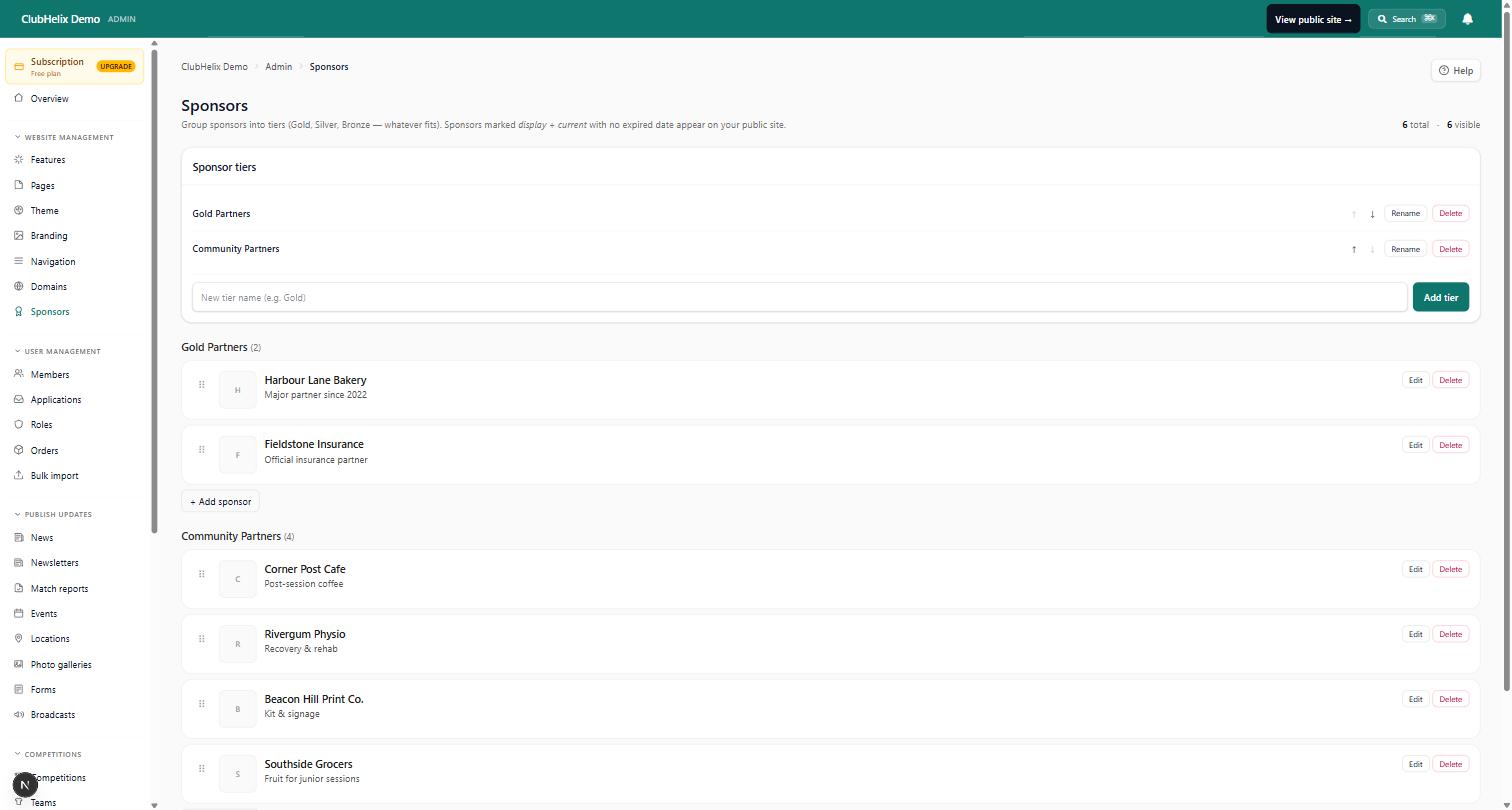
The administration of a golf day is deceptively heavy — team entries with four names each, dietary requirements, cart allocations, sponsor artwork, sponsor invoices, prize donations, mulligan sales, and a spreadsheet that three people are editing at once. ClubHelix keeps the whole thing on your own club site: events and ticketing for team entries with player names and dietary notes captured at purchase, forms for artwork and prize donation submissions, sponsor and billing records so every sponsor, their tier, their invoice and their renewal date live in one place instead of in the outgoing treasurer's inbox, and email broadcasts from your own domain for the reminders and the thank-you.
Build the entry page and the sponsor landing page this week and see how it feels before you commit to anything — the free tier takes real bookings, and what each plan costs sits on the pricing page rather than behind a quote form. You can create your club site between now and the next committee meeting, which is roughly how long it takes to talk one business into a hole sign. If golf is your club's whole business rather than one fundraising day, the golf solutions page shows the wider setup.
Frequently asked questions
How much should a club charge for a golf day team?
Work backwards from the course quote. Get a written per-player price covering green fee, cart and catering, multiply by four, and set the team price so it comfortably covers that with a genuine margin — most clubs land at roughly double the delivered cost. Price per team rather than per player, because a business approves one line rather than four.
How many players do you need for a golf day?
An eighteen-hole shotgun start with four-player teams tops out around seventy-two players, and most club days run well anywhere from ten to eighteen teams. A half-full field still makes money because most of your cost is per player, which is why a golf day is far more forgiving than a catered dinner.
What is the best format for a charity golf day?
A four-person scramble, where the team plays the best ball from each shot. It hides weak players, speeds up the round and keeps everyone in the game to the last hole. Add a maximum score per hole on the scorecard and run a shotgun start so the whole field begins and finishes together.
How much should a hole sponsorship cost?
Price it so a small local business can say yes without approval from anyone else, and sell as many as you have holes. It is the highest-margin item on the day because the delivery cost is a printed sign and a mention at the presentation. Reserve the naming, cart and meal sponsorships as single exclusive tiers at several times the hole price.
How do you get sponsors for a golf day?
Start with the employers of the people already playing — that is the warmest list you will ever have. Then work outward through businesses that already support the club, businesses whose customers are your members, and businesses that have sponsored other local days. Send a one-page pack with the tiers and prices on it, and follow up by phone.
How do we turn golf day sponsors into ongoing supporters?
Send the team photograph within two days with no ask attached, then request twenty minutes within ten days to talk about what they want locally. Take a one-page menu of season-long assets with honest prices. The conversation converts far better in the fortnight after the day than at any other point in the year.
Keep reading — how to get sponsors for a sports club has the proposal templates, and running a club auction night covers the evening fundraiser that pairs well with a golf day presentation.


