
What this guide answers
- How far ahead should a club book rally sites?
Aim to have venues confirmed in writing nine to twelve months ahead, and the whole calendar published to members twelve months ahead.
- What deposit should a camping club take for a rally?
Enough to cover the club's exposure if a few members drop out, and small enough that booking is not a decision.
- How do you handle catering numbers and dietary requirements?
Ask at booking, per meal and per person, rather than assuming every attendee eats every catered meal.
- How do you keep older members connected between rallies?
Run something small and regular between rallies, keep a welfare register with a named committee member responsible for phone calls, and send a photo-heavy write-up after every rally so the members who could not travel…
- Does a caravan club need its own website?
Yes, and for a specific reason — the rally calendar needs one authoritative public version.
Most clubs sell a season. A touring club sells a calendar — a run of weekends away, booked so far ahead that your committee is arguing about a long weekend eighteen months from now while half the membership is still on the road home from the last one. The rally is the product. The newsletter, the committee, the badge on the back of the van: all of it exists to get thirty rigs onto the right patch of grass on the right Friday afternoon, with the right number of chairs around the fire drum.
That calendar is shaped by distance more than anything else. A rally three hours out is a weekend; a rally eight hours out is a week, and it needs a fuel-and-overnight plan for members towing at 90 km/h. Add school holidays, Easter, and the total fire ban days that can close a campfire — and sometimes a whole site — at 24 hours' notice, and you are planning around a calendar that is half tradition and half weather. Most Australian clubs run a mix of caravan parks, showgrounds and council reserves, because the showground with power and a hall is the one venue that reliably fits an entire club at once.
This guide is for the committee of a caravan, camping or motorhome club: the people who book the sites, chase the deposits, count the roast dinners and ring the member who has gone quiet. It covers building a rally calendar a year out, handling site bookings and deposits without the treasurer losing sleep, getting attendance and dietary numbers right, the rally roster and run sheet, and the harder problem of keeping an older, geographically scattered membership connected in the eleven weekends a month when nobody is anywhere.
What members are actually buying
It is worth being blunt about this at committee, because it drives every decision that follows. Almost nobody joins a touring club for cheaper sites. They join for three things: company on the road, competence they can borrow, and a reason to go. The club that keeps its members is the one that delivers all three consistently, and the club that loses them is usually still delivering the first while quietly failing at the third.
Company is easy to underestimate. For a lot of members — recently retired, recently widowed, recently sold the family home — the rally calendar is their social infrastructure. Competence is the reason a new member with a six-week-old caravan pays your subs: someone will help them reverse onto a sloping site without an audience forming, and someone will know why the fridge only works on gas. And the reason to go is the calendar itself. A club with eight well-run rallies a year has a healthy membership almost by default.
| What members joined for | What it means for the committee |
|---|---|
| Company on the road | Rallies need social structure — a happy hour, a shared meal, a welcome for newcomers |
| Borrowed competence | Pair new members with an experienced rig; run a maintenance or towing session |
| A reason to go | Publish the calendar early and completely; never leave a quarter empty |
| Belonging when not travelling | Something between rallies — a coffee morning, a newsletter, a phone call |
| A safety net | Someone notices when a member misses two rallies in a row |
Building the rally calendar twelve months out
The single biggest lift in club quality comes from moving your calendar from "we'll sort out the next few trips at the next meeting" to a published twelve-month program. It lets members book leave, plan travel and budget. It lets the treasurer forecast. And it stops the recurring failure mode of touring clubs, which is a rally that quietly dies because nobody owned it.
Give every rally a named rally marshal at the point the calendar is set — not later. The marshal is not a caterer or a booking clerk; they are the person accountable for that weekend existing. They scout or vouch for the site, they hold the run sheet, they meet the first arrivals, and they write four paragraphs afterwards for the newsletter. Two marshals per rally works even better, because it trains the next one.
| When | What happens |
|---|---|
| 12 months out | Calendar agreed and published; each rally has a marshal and a target venue |
| 9 months out | Venue confirmed in writing; deposit paid; site count and layout agreed |
| 3 months out | Rally listing published — costs, what is included, arrival window, what to bring |
| 8 weeks out | Bookings open; deposit collected at booking |
| 3 weeks out | Bookings close; final numbers to the venue and the caterer; roster published |
| 1 week out | Confirmation to attendees — directions, gate code, arrival times, weather note |
| Rally weekend | Marshal runs the run sheet; attendance recorded on arrival |
| 2 weeks after | Wash-up note, photos, and the venue rebooked if it worked |
Scout with a checklist rather than a feeling. The things that decide whether a site works for a club are unglamorous: turning circle at the gate, ground firmness after rain, how many sites can be held together in one block, distance to the amenities from the far end of the block, whether there is a hall or covered area for the social night, generator and campfire rules, dog policy, quiet hours, and the phone number of a human who answers. Write the answers down. A scouting sheet in your club's files is worth more than the memory of the member who scouted it and has since moved interstate.
Site bookings, deposits and other people's money
There are four ways clubs handle bookings, and choosing the wrong one for your size is where most of the administrative pain comes from.
| Booking model | How it works | Best for |
|---|---|---|
| Club block booking | Club books and pays for N sites, members pay the club | Group sites, showgrounds, whole-field hire |
| Bulk hold, member pays site | Club holds a block, each member pays the venue on arrival | Larger parks with a booking system |
| Self-book with a club code | Members book direct quoting the club name or code | Chains and parks used to group codes |
| Free or low-cost camping | No venue payment; club collects a small rally fee | Reserves, farm stays, informal sites |
Block booking gives you the best rally — everyone together, one arrival process, one bill — and it hands your club the most risk, because the club has committed to sites it may not fill. That risk is managed with deposits, not optimism.
Set a deposit policy once, publish it in every rally listing, and apply it without exception, because exceptions are what turn a treasurer's role into a grievance-handling role. A workable shape: a non-refundable booking deposit per rig at the time of booking, the balance due at the booking close date, full refund of the balance if you cancel before the close date, and after that a refund only if your site is taken by someone else off the waiting list. Medical and family emergencies are handled by the committee case by case, and that discretion is stated openly rather than granted quietly.
As an illustrative example, a club block-booking 25 powered sites at $45 a night for a three-night long weekend has committed roughly $3,375. A $30 non-refundable deposit per rig covers around $750 of that — enough to absorb a handful of late drop-outs without dipping into general funds. Publish the per-rig cost inclusive of GST if the venue charges it, so nobody is surprised at the gate.
Collect deposits the same way you collect subs, and keep them out of anyone's personal account. Card payment at the moment of booking removes the entire chase-the-transfer cycle, and it timestamps who booked first — which is what you need when the block is oversubscribed and a waiting list forms. If you are still reconciling bank transfers against a spreadsheet of surnames, read how to collect club membership fees online; the same argument applies to rally deposits, only more so, because rally money moves in and out all year.

Numbers, catering and dietary lists
Catering is where good clubs come unstuck, because the number you need is not the number of members attending. It is the number of people eating a specific meal, which is a different figure for Saturday's shared dinner than for Sunday's breakfast, and both are different again once you count visitors, grandchildren and the day-trippers who drive out for the social night.
Collect it once, at booking, with the questions written so the answer is a number rather than a sentence:
- Rig type and length, plus whether you need power
- Number of adults and number of children in the rig
- Arrival day and departure day (not "the weekend")
- Which catered meals you are in for, by name and by count
- Dietary requirements and allergies, free text, per person
- Emergency contact and any medical information you want the marshal to hold
- Dog, and whether it is fine around other dogs
- Whether you are happy to be rostered on
That last question quietly solves half your roster problem. The dietary field solves the other half of your catering problem — but only if it flows to the person cooking. The failure pattern is a booking form owned by the secretary, a dietary list living in her inbox, and a caterer who finds out about two coeliacs and a nut allergy on Saturday morning. Whoever is cooking should be able to see the current list themselves, at any time, without asking.
| Data you collect | Who needs it | When they need it |
|---|---|---|
| Site count and rig sizes | Venue | At the booking close date |
| Meal counts | Caterer or cook team | One week out |
| Dietary and allergy notes | Cook team | One week out and on the day |
| Arrival times | Rally marshal | The day before |
| Emergency contacts | Rally marshal | On the day, on a phone |
| Attendance actual | Secretary and treasurer | On arrival, on the day |
Record actual attendance at the gate, not from the booking list. It takes one person with a phone ten minutes, and it is the number that settles the venue invoice, informs next year's block size, and tells you which members have quietly stopped coming.
The rally roster and the run sheet
A rally with a roster feels organised. A rally without one is four people doing everything while thirty enjoy it, and those four resign in a two-year cycle. Slice the jobs small enough that a first-time member can take one:
- Rally marshal — owns the weekend and the run sheet
- Site marshal — meets arrivals, guides rigs onto sites, keeps the block tidy
- Tail-end marshal — travels last on convoy legs and does not leave anyone behind
- Morning tea — twice, and it is the easiest first job for a nervous new member
- Happy hour — sets up the circle, makes sure nobody sits alone
- Cook team — three or four people, never one
- Raffle — draws a crowd and funds the next rally's ice
- First aid — a named person with current training and a stocked kit
- Kids' activity — only for family rallies, and it earns you families
Then publish a run sheet. It is unglamorous and it is the difference between a marshal enjoying the weekend and a marshal spending it apologising.
| Time | What | Who |
|---|---|---|
| Fri 1pm–5pm | Arrivals and site marshalling | Site marshal |
| Fri 5.30pm | Welcome circle and briefing | Rally marshal |
| Sat 8am | Morning tea and day plan | Morning tea roster |
| Sat 10am | Group activity or free day | Activity coordinator |
| Sat 5pm | Happy hour | Happy hour roster |
| Sat 6.30pm | Shared meal and raffle | Cook team, raffle |
| Sun 9am | Club meeting or breakfast | Secretary |
| Sun/Mon | Departures and site sweep | All, marshal last out |
The briefing at the welcome circle should take four minutes and cover exactly five things: where the amenities and the nearest hospital are, quiet hours, fire and generator rules for this site, the weekend's plan, and the names of anyone new. That last one is the one clubs skip and the one that decides whether a new member renews.
Keeping members connected between rallies
Here is the structural problem with touring clubs that other community clubs do not have: your members are, by definition, elsewhere. They are scattered across a wide geography, they are often on the road, and a meaningful proportion of them are in the age band where a bad six months can quietly end their travelling. A club that only exists on rally weekends loses those people without ever noticing.
Three habits fix most of it. First, run something small between rallies — a monthly coffee morning in each area of the club, a weeknight video call for planning the next big trip, a mid-winter lunch. It does not need a program; it needs a fixed date so it becomes habit. Second, keep a welfare register: a short, private list of members who are unwell, recently bereaved or off the road, with a named committee member responsible for a phone call. Third, write the newsletter. A photo-heavy rally write-up sent within a fortnight is the single most effective retention tool a touring club has, because it reaches the members who did not go and reminds them what they missed.
Communication needs to be genuinely multi-channel, and this is one club type where "just put it on the club chat" is not good enough. Publish everything on the club website so there is one authoritative version, email the newsletter and the rally listings, send urgent changes by text — a closed road, a flooded site, a cancelled rally — and keep a small print run for the handful of members who do not use email at all. Somebody phones those members. Put their names on the same welfare register so it is nobody's private favour.
Coverage shapes this more than committees expect. Once a rally heads inland or up the coast in Australia, whole days pass with no mobile signal, and a member who has not answered an email for a week may simply be out of range. Larger clubs running remote trips often ask each rig to carry a satellite messenger or UHF radio and set an agreed channel and a nightly check-in time. Write the comms plan into the rally listing, along with the last town with reliable coverage.
Safety, welfare and the awkward conversations
This section is general information, not advice — insurance, incorporation and duty-of-care obligations differ by jurisdiction, and your national body or an adviser is the right source for what applies to your club.
The practical baseline most touring clubs settle on looks like this. Confirm what your public liability cover actually covers before the season, including whether it extends to a rally on private land and to convoy travel. Do a short written risk assessment per venue and keep it on file — hazards, who is affected, what you have done about it. Have a named first-aider and a stocked kit at every rally. Agree a fire policy that survives a change in conditions, including who decides that tonight's fire is not happening. And decide in advance how alcohol works at club events, because "it has never been a problem" is not a policy.
Most Australian clubs of this kind are incorporated associations registered under state or territory legislation, which is what gives the committee limited liability and lets the club hold a bank account and insurance in its own name. Fire is the seasonal risk that reshapes rallies here — total fire bans and catastrophic-rating days can close campfires, cooking and sometimes the site itself, so build a documented decision point into every summer rally and communicate the outcome by text, not email.
Handle members' medical and emergency information carefully. Collect only what the marshal genuinely needs, tell members why you are collecting it, keep it somewhere access-controlled rather than in a shared spreadsheet, and delete it when the rally is over. A club member's health information is the most sensitive data most committees will ever hold.
Fees, budgets and where the money goes
Touring club finances are simple in structure and easy to get wrong in practice, because rally money flows through the club account in large lumps that are not the club's money. Keep rally funds visible as a separate line so nobody mistakes a full account for a healthy club.
| Income | Expenditure |
|---|---|
| Annual subscriptions | Affiliation and insurance |
| Rally fees and deposits | Site and venue payments |
| Raffle and social nights | Catering and rally consumables |
| Badges, shirts and stickers | Newsletter, website and postage |
| Sponsorship from suppliers | Equipment — gazebo, urn, PA, first aid |
Subs should cover the club's fixed costs — insurance, affiliation, website, newsletter — so that every rally can stand on its own fee. That way a poorly attended rally costs you a little goodwill rather than a hole in the budget. Build a small equipment reserve too: the club gazebo, urn, PA and fire drum all die eventually, and replacing them out of a single year's raffle takings is miserable. The club budget template is a reasonable starting shape, and if you are formalising a young club, how to start a social club covers the setup steps that come before any of this.
Running the rally calendar from one place
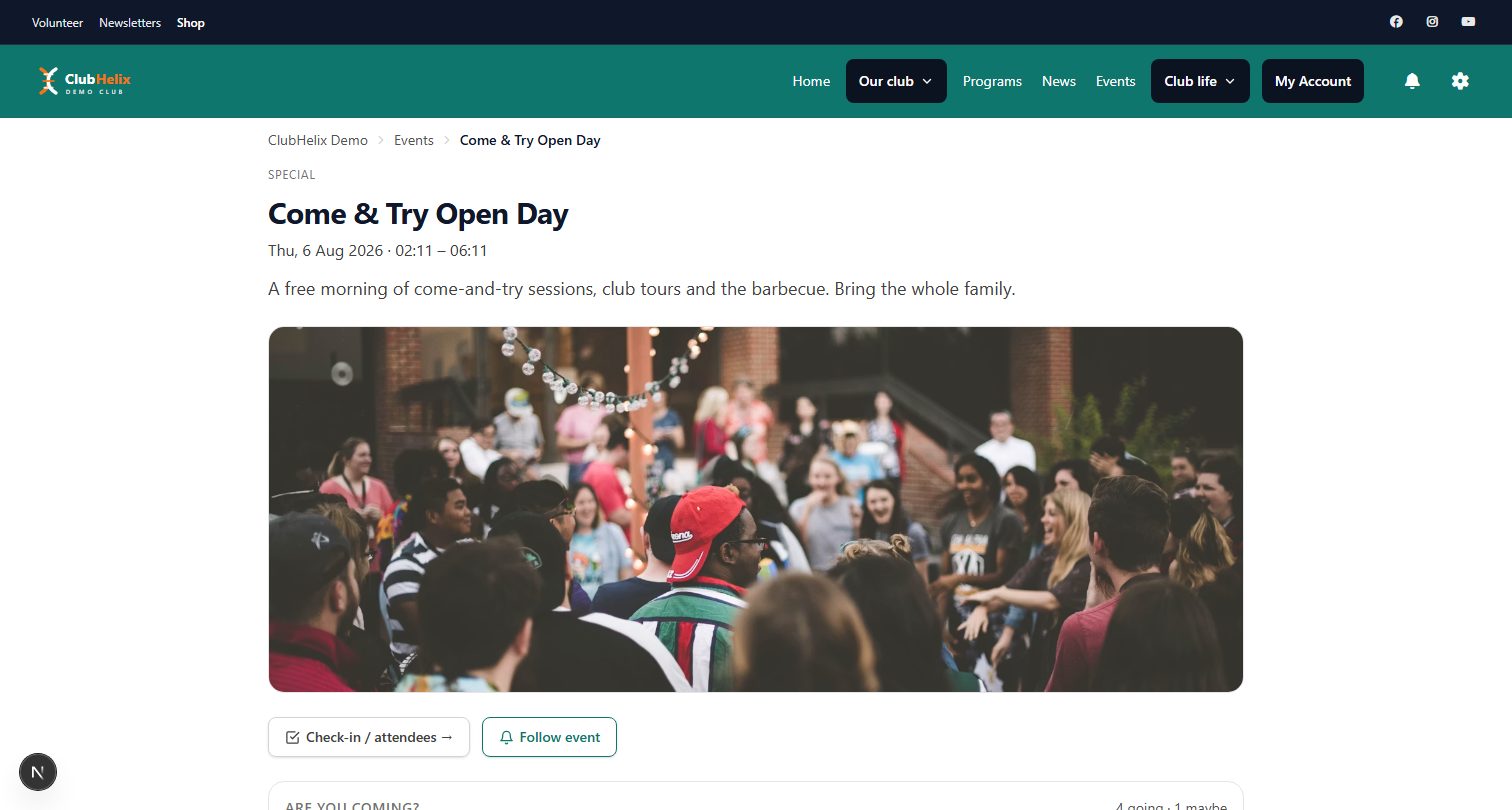
Almost every job in this guide is the same job wearing different clothes: publish something, collect responses, count them, and tell people what changed. ClubHelix does that end to end — the rally calendar and each rally listing live on your club's own website with events and bookings, members book and pay their deposit online, and RSVPs and attendance give the marshal live numbers, meal counts and the dietary list on a phone at the gate. Newsletters and urgent changes go out from your own address with email broadcasts, and new members join and renew themselves through online registration instead of a form posted to the secretary.
It is one system rather than half a dozen tools stitched together, there is a free tier that suits a small touring club perfectly well, and the pricing is published rather than quoted. If your rally calendar currently lives in a spreadsheet, a chat thread and one committee member's memory, you can create your club site and have next season's program published before the next rally.
Frequently asked questions
How far ahead should a club book rally sites?
Aim to have venues confirmed in writing nine to twelve months ahead, and the whole calendar published to members twelve months ahead. Popular group sites and long weekends are booked out well before that, and members need the lead time to arrange leave and travel. Anything less than six months means you are choosing from what is left rather than what suits your club.
What deposit should a camping club take for a rally?
Enough to cover the club's exposure if a few members drop out, and small enough that booking is not a decision. A non-refundable per-rig deposit taken at the moment of booking, with the balance due at the booking close date, is the standard shape. Publish the refund rules in every rally listing and apply them consistently — most disputes come from exceptions granted quietly rather than from the policy itself.
How do you handle catering numbers and dietary requirements?
Ask at booking, per meal and per person, rather than assuming every attendee eats every catered meal. Collect dietary requirements and allergies as free text against each person, and make sure the cook team can see the current list themselves rather than waiting for it to be forwarded. Close bookings three weeks out so you can give the caterer a firm number, and record actual attendance at the gate.
How do you keep older members connected between rallies?
Run something small and regular between rallies, keep a welfare register with a named committee member responsible for phone calls, and send a photo-heavy write-up after every rally so the members who could not travel still feel part of it. Use several channels — website, email, text for urgent changes, and a printed copy for the few who do not use email — and never let the club's real conversation live somewhere a member cannot reach.
Does a caravan club need its own website?
Yes, and for a specific reason — the rally calendar needs one authoritative public version. Prospective members want to see where you go and what it costs before they enquire, and existing members need a listing they can reach without scrolling back through months of chat messages. A club site with online bookings and payments also removes most of the deposit chasing that eats a treasurer's year.
Keep reading — how to promote a club event for filling a rally that is looking thin, and how to recruit club volunteers for building the roster that runs it.

