
What this guide answers
- How should a kayak club allocate boat storage?
With a written policy applied identically to everyone — one space per member, current membership required, no sub-letting or private transfers, a use-it-or-lose-it review after twelve months of no movement, and a…
- What should a club charge for rack space?
Work out the shed's annual cost — insurance, lease or rates, power, maintenance and the sinking fund — divide by the number of spaces, and treat that as the floor.
- Who should be allowed to paddle alone from the club?
Most clubs tie solo paddling to a recorded skills sign-off and a stated set of conditions — sheltered home water in daylight for newly inducted members, and progressively more sign-off for open water, moving water…
- Do paddlers need a licence or permit?
It depends entirely on the water and the authority that manages it — some inland waterways require a licence or permit, some require registration for certain craft, and marine and protected areas have their own rules.
- How do paddling clubs recruit new members?
Through a ladder rather than a single event — a short come-and-try session, a four-week beginner course, then skills clinics and a graded trip program to keep people progressing.
USA edition. This guide is written for volunteer-run clubs in the United States. Where rules differ — grants, tax, incorporation, safeguarding — follow the USA-specific pointers below or check with your national body.
Walk into most paddling clubs and the first thing you see is the answer to the club's hardest question, stacked four high along both walls. Sixty-two rack spaces. Seventy-four members. A waiting list written in a notebook that only the shed captain can interpret, and at least three boats that have not moved since a knee reconstruction two winters ago.
Rack space is unusual among club assets. It is genuinely scarce, it is the most reliable income line the treasurer has — paid annually, by people who may barely paddle, before anybody has done anything — and it is the thing members will fall out over. A committee that runs its racks on memory and goodwill will eventually have an ugly meeting about whose boat is on the low rack near the door. A committee that runs them on a written policy and a register almost never does.
This guide is for the committee of a canoe, kayak, ocean ski or stand-up paddleboard club — flat water, surf ski, whitewater or a mix. It covers storage policy and rack fees, skills grading and who is allowed on the water alone, the relationship with whoever controls the water and the ramp you launch from, running learn-to-paddle courses that convert into members, and the money shape that holds it all up. If your club shares a shed or a ramp with a rowing club, much of how to run a rowing club will be familiar reading too.
Racks — scarce, valuable, and worth a written policy
Start with an inventory. Not a headcount of boats, an inventory of spaces, each with an identity of its own, because they are not interchangeable — a bottom rack near the roller door is worth more to a member than a top rack at the dark end of the shed, and pretending otherwise is how resentment builds.
| Register field | Why you need it |
|---|---|
| Space ID | Bay, column and height, painted on the frame and matched in the register |
| Class | Indoor low, indoor high, outdoor covered, outdoor open, ski cradle, SUP slot |
| Maximum length and weight | A six-metre ski does not go where a three-metre creek boat goes |
| Allocated to | Member name and membership number, never just a surname |
| Boat description | Make, colour and any identifying mark, so an unlabelled boat has an owner |
| Allocated from | The date the allocation started — the basis for annual renewal |
| Fee band and status | What they pay and whether it is paid |
| Last seen moving | Filled in at the annual audit. The single most useful column in the register |
An allocation policy that survives a waiting list
Write it down, put it on the club website, and apply it identically to the committee and to the newest member.
- One space per member. A second space only when the waiting list is empty, and it is surrendered first when the list reopens.
- Membership first. A rack is available only to a current financial member; lapse and the allocation lapses with it, with a stated grace period.
- No sub-letting or private transfer. Spaces come back to the club and go to the top of the list. This one rule prevents almost every dispute.
- Use it or lose it. A boat that has not moved in twelve months is reviewed. Not confiscated — reviewed, with a conversation and a written notice period.
- Waiting list by application date, published as a numbered list with names removed if members prefer, with the position visible so nobody has to ask.
- A stated exception process, decided by the committee and minuted, for injury, deployment, pregnancy, or a member the club has good reason to accommodate.
- A labelling rule. Every boat carries a club tag with the member's name and the allocation year. Untagged boats are photographed and given sixty days' notice.
The audit that pays for itself
Run one shed audit a year, on a fixed date, ideally the weekend before renewals go out. Two people, a printed register, a phone camera and two hours. Tick off every space, photograph every unidentifiable boat, note the dust, and check the fee status against the list.
An illustrative example of what a first audit might turn up in a sixty-space shed: four boats belonging to people who left the club, two boats whose owners will happily move outside, three unlabelled boats nobody claims, and one space that has been quietly free for a year because a member moved a boat home and never told anybody. That is ten spaces — roughly a sixth of your capacity and a sixth of your rack income — recovered by two people with a clipboard.
Pricing the racks
Rack fees should be a separate line from membership, invoiced on one date for everyone rather than on each member's anniversary. One renewal date means one reminder run, one reconciliation and one follow-up list, instead of a chase that never ends. Price by class — indoor low commands more than outdoor open — and consider a modest premium for a second boat where capacity allows.
The useful way to sanity-check the fee is to work out what the space costs the club. Take the shed's annual costs — insurance, lease or rates, power, maintenance, the sinking fund for the roof — divide by the number of spaces, and you have the floor. Anything above that funds club boats and coaching. Most clubs discover their rack fee has not moved in six years while their insurance has doubled.
Rack fees in the United States commonly run from $150 to $500 a year, and considerably more where a club holds racks at a municipal marina or a waterfront park with limited space. Membership is often a separate $50 to $200. Some clubs sublease rack space from a parks department and simply pass the cost through. Municipal recreation grants, community foundations and paddling advocacy organisations all fund launch improvements and adaptive equipment.

Skills, sign-off and who is allowed on the water alone
The awkward truth of a paddling club is that a keen beginner can buy a boat, pay a rack fee and be on open water alone within a week of joining. Your policy decides whether that is possible. Most clubs land on a graded system that ties conditions to a recorded sign-off, and publishes it so nobody has to be told individually.
| Water and conditions | Minimum sign-off | Mandatory kit |
|---|---|---|
| Flat, sheltered, within the club's home reach, daylight | Club induction plus a wet exit and re-entry demonstration | Lifejacket or buoyancy aid worn, whistle, sign-on |
| Sheltered water beyond the home reach | Level 1 skills sign-off, or accompanied by a signed-off member | As above plus a phone in a waterproof case and a tow line |
| Open water, wind over a stated limit, or a crossing | Level 2 sign-off, deep-water re-entry demonstrated in conditions | As above plus paddle leash, spare paddle in the group, and a plan |
| Moving water and rapids | Whitewater sign-off at the club's stated grade | Helmet, throw bag, buoyancy aid rated for moving water, group of three |
| Surf, bar crossings and ocean ski | Ocean sign-off with a rescue demonstrated in swell | Leash, phone or beacon, and a nominated shore contact |
| Night paddling | Existing sign-off plus a night induction | Lights front and rear, reflective tape, group only |
Four practices make the system real rather than decorative.
A compulsory induction for every new member. Ninety minutes: shed rules, rack rules, the sign-on system, where the first aid kit and throw bags live, a wet exit, a re-entry, and the club's rules about who paddles alone. Run it monthly whether two people or ten have joined.
A recorded assessment, held centrally. Who signed off, on what date, at what level, and who assessed them. If the record only exists in a coach's head, it does not exist. Keep it with the membership record so a shed captain can check it on their phone.
A sign-on and sign-off system that is actually used. A whiteboard works. So does a phone-based version, which has the advantage of a timestamp and the ability to see who is out from home. Whatever you use, the rule is the same: name, boat, intended route, expected return, and a mandatory sign-off on return. Then somebody has to check the board at closing time, which is a rostered job, not an assumption.
A trip leader tier. Club paddles need someone who has agreed to lead, knows the group's limits, briefs the route and hazards before launching, sets a turnaround time, and counts heads at every change of direction. Give leaders a written one-page role description, a first aid expectation and the committee's explicit backing to cancel — the leader who knows the committee will support a cancellation is the one who makes the right call in a rising wind.
Cold water dominates the risk picture for a large part of the year, and ice at the launch closes many clubs' sheds outright for a season. Set a written cold-water policy — a wetsuit or drysuit requirement below a stated water temperature, no solo paddling outside the warm months, and a re-entry practice run in genuinely cold conditions. Clubs that also run indoor pool sessions through the closed season keep their beginners engaged and their skills current.
The waterway, the ramp and everyone else who uses them
Your club almost certainly controls none of the things it depends on. The water, the ramp, the land under the shed, the car park and the access road are typically owned or managed by different bodies, and knowing exactly who controls each is the difference between a two-week approval and a six-month one.
| Asset | Typically controlled by | What you need from them |
|---|---|---|
| The water itself | A waterway or maritime authority | Rules of navigation, event approvals, safety obligations |
| The ramp or pontoon | Local government or a port authority | Access rights, shared-use conditions, maintenance duties |
| The land and shed | Local government or a private landholder | Your lease, and who is liable for what |
| The car park | Local government | Parking on event days, trailer access |
| Environmental zones | A parks or environment agency | Sanctuary zones, seasonal closures, wildlife protections |
Three habits keep those relationships healthy. Introduce yourself before you need something — a short annual email to the ranger, harbourmaster or council officer describing what the club does, how many members it has and what your busy times are, costs nothing and turns a stranger into a contact. Put your event dates in early, because approvals for a race or a come-and-try day take longer than committees expect and the same officer is fielding requests from every other water user. Report problems rather than fixing them yourself — a damaged pontoon, a broken bollard, a silted ramp. Clubs that report get maintenance; clubs that quietly repair things get liability.
Sharing a ramp
Where a single ramp serves paddlers, rowers, anglers, sailing dinghies and trailer boats, the fix is a published timetable rather than a set of grievances.
- Agree written windows with the other users and put them on both clubs' websites, not just on a sign nobody reads.
- Keep paddlers off the ramp when a trailer is reversing, and give trailers absolute priority — it takes fifteen seconds and eliminates the main source of conflict.
- Set a rule that boats are carried clear of the ramp before kit is sorted. Ramp-blocking is the complaint that reaches the council.
- Nominate one committee member as the contact for the other users, so complaints arrive as a message to a person rather than as a report to the land manager.
- For events, publish closures well ahead, post a marshal at the ramp, and leave the area cleaner than you found it.
Environmental obligations
Wash-down between waterways to avoid moving weed, pests and pathogens is now the standard expectation almost everywhere, and it is one of the easiest things for a club to be visibly good at. Build a wash-down point if you can fund one, keep a brush and a hose by the shed, put the rule in your induction, and mention it on the website. Add the local specifics your members need — nesting seasons, sanctuary zones, no-go areas near wildlife, and any seasonal closures — to a single page on your site and link it from every trip listing.
Requirements in the United States vary by state and by the agency that manages the water. Several states require registration of non-motorised craft above a certain length, most require a wearable flotation device of an approved type for each person aboard, and federal navigable waters carry their own rules on top. Launch permits are common at state parks and reservoirs. For events, expect to deal with the state boating agency and possibly the coast guard for coastal water.
Learn to paddle — the pipeline that fills the racks
Courses are how a paddling club grows, and they are the one part of the operation that behaves like a business. Design them as a ladder rather than a one-off.
| Stage | Format | Outcome for the paddler | Outcome for the club |
|---|---|---|---|
| Come and try | 90 minutes, club boats, flat water | They discover it is easier than it looks | Contact details and a first impression |
| Beginner course | Four sessions over four weeks | Basic strokes, wet exit, re-entry, confidence | The main conversion point |
| Skills clinics | Half day, one topic — bracing, rolling, tow | Progression toward the next sign-off | Retention of the six-month member |
| Trip program | Regular graded club paddles | Belonging, and somewhere to use the skills | Volunteers, and future trip leaders |
| Coaching qualification | Sponsored course for a keen member | A pathway and a credential | The instructor capacity for next season |
An illustrative funnel for a small club: run four beginner courses a year with eight places each, and you touch thirty-two people. If half join as members, that is sixteen new members — and sixteen new people eventually looking for rack space, which is why the course program and the rack policy are the same conversation.
Two operational notes. Set instructor-to-participant ratios in writing and stick to them, matched to the qualification your instructors hold and the conditions. And take payment at booking rather than on the day, with a clear refund window — courses that are free to abandon get abandoned, and a course with three no-shows out of eight is a wasted Saturday for two volunteers. Programs and term enrolment is designed for exactly this shape of thing.
Boats, gear and the maintenance rhythm
Club boats are how beginners start and how members try before they buy, and they take a beating. Keep a fleet register alongside the rack register — boat, age, condition, repairs, hire fee, and who used it last. The club equipment register template gives you a starting structure.
Set a plain damage policy: report damage the same day, no penalty for honest damage reported, a repair charge for damage found unreported. That single asymmetry keeps your fleet in known condition. Track service life on safety gear too — buoyancy aids, helmets and throw lines all age, and a shed full of twenty-year-old foam is a problem waiting to be discovered in an incident report.
Run two working bees a year, one before the busy season and one after. Publish a task list beforehand so people arrive knowing what needs doing, and finish with food. Rack rebuilds, pontoon repairs, gear audits and shed cleaning all fit into a morning if fifteen people turn up with a plan.
The money shape of a paddling club
| Income line | Behaviour |
|---|---|
| Membership subs | The base. One renewal date is worth more than a perfect fee structure |
| Rack fees | The steady, predictable line. Invoice annually with the subs |
| Course fees | Seasonal and lumpy, but the highest-margin activity most clubs run |
| Boat and gear hire | Modest, and it should fund fleet replacement rather than general costs |
| Events and regattas | Usually close to break-even; run them for participation, not profit |
| Facility hire | If your clubroom is decent, see how to hire out your clubrooms |
| Grants and sponsors | Capital items — racking, pontoons, safety boats, adaptive equipment |
The cost side is dominated by insurance, the lease or rates on the shed, safety equipment replacement and the long-term sinking fund for the building. Set the sinking fund deliberately: take the replacement cost of the roof, the racking and the pontoon, divide by remaining life, and put that number in the budget every year. Clubs that do this survive a storm; clubs that do not run a raffle in a panic. If you are reviewing fees generally, how much should club membership cost works through the reasoning.
One system for racks, courses and the club calendar
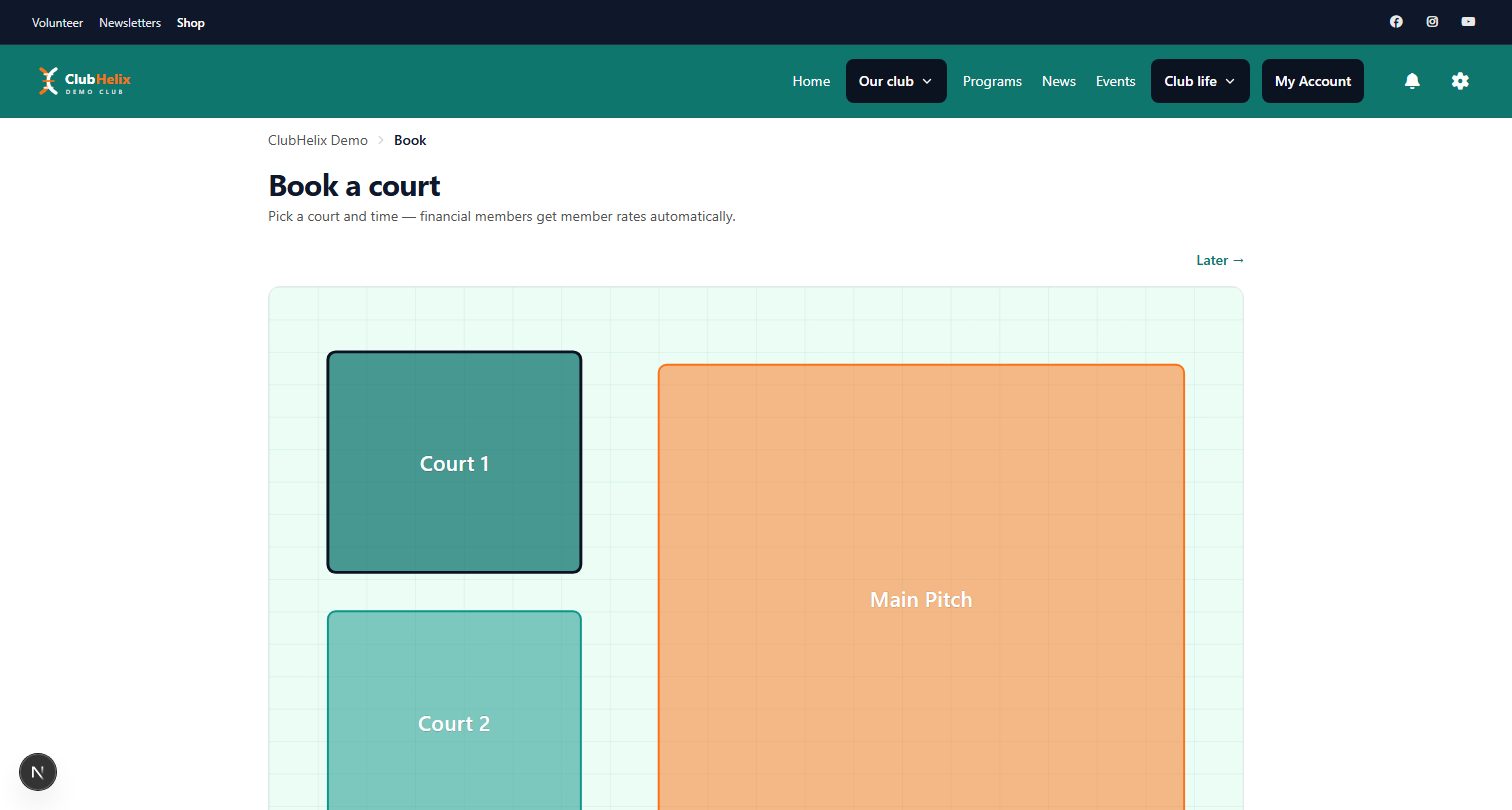
The administration that grinds down a paddling committee is unusually specific — a rack list in a spreadsheet, a waiting list in a notebook, course bookings by email, waivers on paper in the shed, and a whiteboard nobody photographs. ClubHelix gives your club a website that carries all of it: facility and shed booking for the clubroom, the boat shed and pool lanes, online joining and renewals so rack fees and subs go out on one date and reconcile themselves, programs and term enrolment for learn-to-paddle courses with capacity limits and waitlists, and digital waivers signed once at join time instead of scrawled on a clipboard in the rain.
There is a free tier while your club is small, the pricing is published rather than quoted, and a committee member with an evening free can set your club site up before the next shed audit. Your rack register would be a good first thing to move.
Frequently asked questions
How should a kayak club allocate boat storage?
With a written policy applied identically to everyone — one space per member, current membership required, no sub-letting or private transfers, a use-it-or-lose-it review after twelve months of no movement, and a waiting list ordered by application date with positions published. Back it with a register of spaces and an annual audit, because the audit is what recovers the spaces nobody knew were free.
What should a club charge for rack space?
Work out the shed's annual cost — insurance, lease or rates, power, maintenance and the sinking fund — divide by the number of spaces, and treat that as the floor. Price above it by class, since an indoor low rack is worth more than an open outdoor space, and invoice rack fees on the same date as membership so there is one reminder run instead of a year-round chase.
Who should be allowed to paddle alone from the club?
Most clubs tie solo paddling to a recorded skills sign-off and a stated set of conditions — sheltered home water in daylight for newly inducted members, and progressively more sign-off for open water, moving water, surf and night paddling. Publish the table, record every assessment centrally, and require a sign-on and sign-off for every paddle.
Do paddlers need a licence or permit?
It depends entirely on the water and the authority that manages it — some inland waterways require a licence or permit, some require registration for certain craft, and marine and protected areas have their own rules. Check with the waterway authority for your stretch of water and with your governing body, and treat safety-equipment requirements as separate obligations that apply regardless.
How do paddling clubs recruit new members?
Through a ladder rather than a single event — a short come-and-try session, a four-week beginner course, then skills clinics and a graded trip program to keep people progressing. Take payment at booking, run the same courses at predictable times each year so people can plan around them, and make sure a graduate of the beginner course is invited to a specific club paddle rather than told to "come along sometime".
Keep reading — how to run a sailing club covers duty rosters and shared water in more depth, and how to run a dragon boat club tackles the crew-boat version of the same shed problem.


