
What this guide answers
- How much does it cost to start a boxing club?
Beyond venue hire, the main start-up costs are affiliation, insurance, coach accreditation and basic equipment (bags, pads, gloves and wraps for loan stock).
- Do boxing club members need to be registered with a governing body?
Members who compete in sanctioned amateur bouts must generally be registered with the governing body and meet its medical requirements.
- What insurance does a boxing club need?
At minimum, public liability and personal accident cover — usually accessed through governing-body affiliation — plus waivers and medical declarations for every participant.
- How do boxing clubs charge membership fees?
Most run tiered, class-based memberships — casual passes, a fitness tier and a boxer/squad tier — billed fortnightly or monthly rather than one annual fee.
South Africa edition. This guide is written for volunteer-run clubs in South Africa. Where rules differ — grants, tax, incorporation, safeguarding — follow the South Africa-specific pointers below or check with your national body.
A community boxing club is a different beast from most sporting clubs. You're running a venue, not a ground; a timetable of classes, not a Saturday fixture; and a membership that spans everyone from a nervous first-timer hitting pads for fitness through to an amateur boxer preparing for a sanctioned bout. Get the structure right and a boxing club is one of the most rewarding clubs to run — few sports change lives as visibly.
This guide covers how to run a boxing club as a volunteer committee: affiliation and coach accreditation, class-based boxing club membership, insurance and waivers, the training week, fight nights, and the boxing gym website that holds it all together.
Getting set up and affiliated
Affiliation typically gives your club access to sanctioned amateur competition, coach and official accreditation pathways, and the governing body's insurance program — which matters more in boxing than in almost any other sport.
You'll also want a club constitution, a bank account in the club's name, and clarity on whether you're a not-for-profit community club or a privately owned gym, because it changes everything from grants eligibility to how you set fees.
Most community boxing clubs affiliate through their provincial structure to the national federation for amateur boxing, which is what unlocks sanctioned competition, coach accreditation, officials and insurance. Before you affiliate, sort your legal structure: most community clubs register as non-profit organisations through the Department of Social Development so the club — not individual committee members — carries contracts and liability.
One boxing-specific wrinkle that matters a great deal here: professional boxing is regulated by statute through the national boxing regulator, with licensing, medical and promoter requirements that are entirely separate from the amateur code. A community club running an amateur programme must keep the two distinct, in its paperwork and in how it advertises. Check with your provincial structure and the regulator before you plan a tournament.
This is general information, not legal advice — check the current requirements with your provincial structure and the national boxing regulator.
Coaches, accreditation and the committee
Your coaches are the club. In boxing, nobody stays for the equipment — they stay for the person holding the pads. Governing bodies run tiered coach accreditation courses, and sanctioned amateur competition generally requires an accredited coach in the corner. Budget for accreditation and renewals as a club expense rather than expecting volunteer coaches to pay their own way; it's one of the best retention investments you can make.
Because most boxing clubs run junior classes, every coach and regular volunteer working with under-18s needs a valid Working with Children Check. Read our guide to WWCC requirements for clubs and track expiry dates somewhere more reliable than a folder in someone's garage — ClubHelix's accreditation tracking records coach quals and WWCC expiries and warns you before they lapse.
The committee itself can stay lean: a president, secretary and treasurer, plus a head coach who owns the training program. Add a fight-night coordinator when you start hosting events — they're a genuine job on their own.
Boxing club membership and fees
Boxing club membership rarely fits the one-annual-fee model of a footy or netball club. Most clubs run a class-based structure with several entry points, because the person doing boxfit twice a week and the amateur prepping for a bout are consuming very different amounts of coaching.
A typical structure looks like this:
| Membership type | Who it suits | Usually includes |
|---|---|---|
| Casual / trial pass | First-timers | Single class, no commitment |
| Fitness membership | Boxfit and pad-work classes | 2–3 classes per week, no sparring |
| Boxer membership | Competitive squad | All classes, supervised sparring, corner support |
| Junior membership | School-age classes | Age-grouped classes, no head contact until eligible |
| Concession | Students, seniors, health care card | Discounted rate on any tier |
Whatever tiers you choose, collect fees online with a card on file rather than cash at the door — chasing payments face-to-face sours the coach–member relationship fast. ClubHelix's membership and registration handles tiered membership types, renewals and instalments, and term-based class enrolment suits clubs that run junior boxing in school-term blocks. If you're weighing up price points, our guide on how much club membership should cost has a framework.
Insurance, waivers and safety
No area of boxing club management deserves more attention than this one. Boxing is a contact sport with inherent risk, and your club needs three layers of protection working together.
Insurance. Affiliation with your governing body usually brings personal accident and public liability cover for sanctioned activities — confirm exactly what's covered, because "sanctioned activities" may not include open fitness classes or unsanctioned sparring. Our guide does our club need insurance covers the categories in plain language.
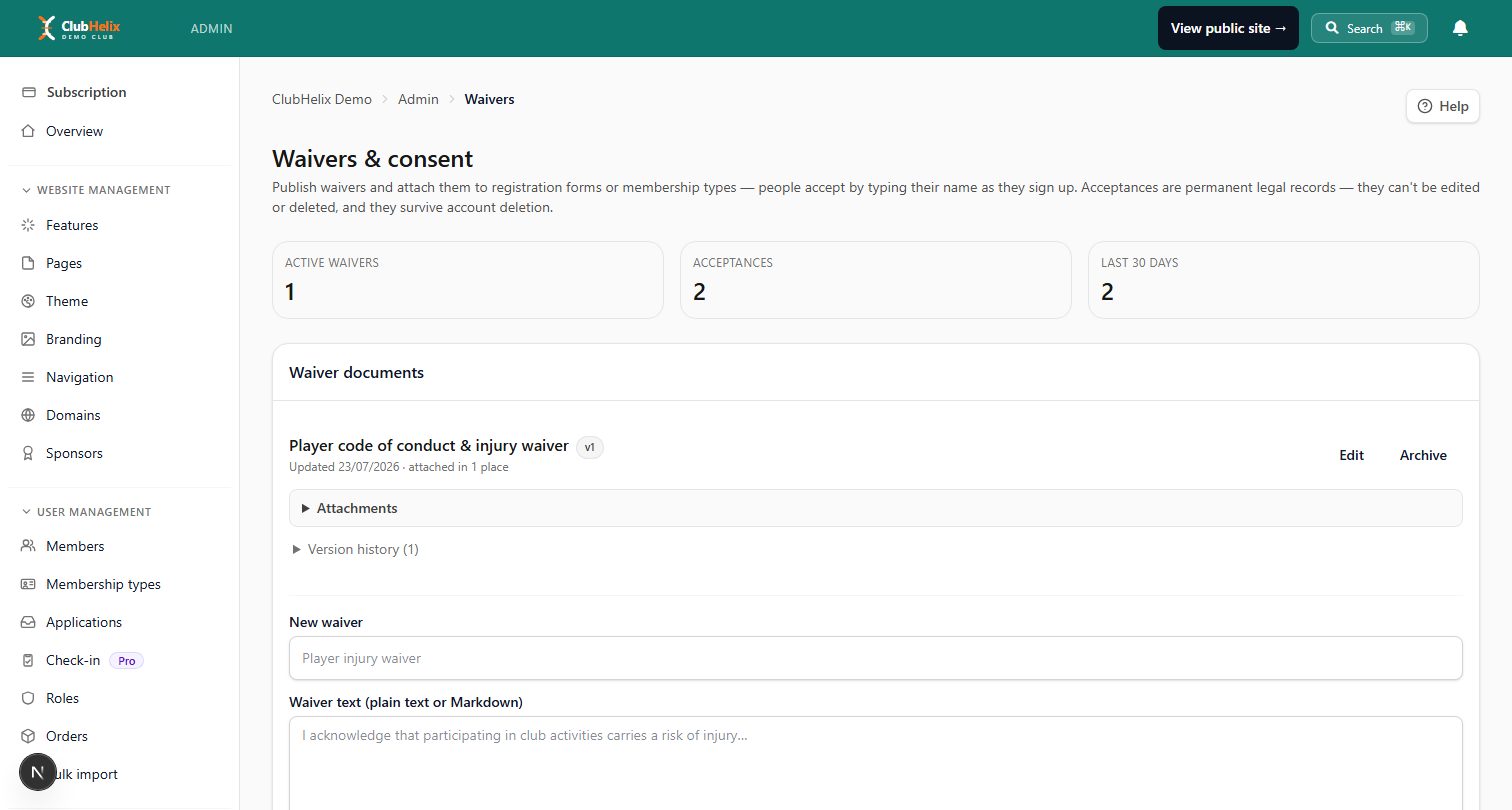
Waivers and medical declarations. Every participant — including casual trial visitors — should sign an acknowledgement of risk and a medical declaration before they touch a glove. Paper waivers get lost exactly when you need them; digital waivers are signed on a phone at registration, stored against the member's record, and re-presented for signature when you update the wording.
Sparring policy. Write down who may spar, under what supervision, with what protective equipment, and how boxers are matched for size and experience. Amateur rules set medical requirements for competition — including medical clearances and mandatory stand-down periods after a knockout — and your club policy should mirror them in training. Log any incident, however minor, the day it happens.
This is general information, not legal or medical advice — check current requirements with your governing body and state combat sports authority.
The training week
A well-run boxing timetable balances three kinds of session. Fitness classes (boxfit, pads, bags) are your funnel and your revenue base — they subsidise everything else. Skills classes teach the sport properly to people who want more than a workout. Squad sessions — technical sparring, conditioning, fight preparation — serve your competitive boxers.

Publish the timetable somewhere members can always find it, and update it in one place when it changes. Cancelling a class via a hand-written note on the door is how clubs lose members; a website timetable plus a push notification to affected members is how clubs keep them. Cap class sizes to match your floor space and coach numbers, and use attendance records to spot the member who's quietly stopped coming — a two-line message from a coach brings back more lapsed members than any promotion.
Fight nights and competition
For your amateur squad, the season is a calendar of sanctioned tournaments and interclub events rather than a weekly fixture. The club's job is logistics: entries lodged on time, medical requirements current, weigh-in details communicated, and an accredited coach in the corner.
Hosting your own fight night or interclub is a milestone — and a serious fundraiser — but treat it as an event production: sanctioning and permits, matched bouts, officials, medical cover, ticketing and a canteen. ClubHelix's events and ticketing lets you sell tickets from your own club website instead of an external ticketing site, with the money landing in the club account. Start with an interclub sparring day before you attempt a full show.
Communication, money and fundraising
Boxing clubs juggle several audiences — fitness members, boxers' families, the competitive squad — and each needs different messages. A weekly rhythm works: timetable and club news to everyone, squad logistics to the squad only. Keep it to one channel members actually check, not four they don't; our club communication plan guide shows a simple structure.
On money: class-based income is steadier than annual-fee income, but watch direct costs. Gloves, wraps, pads and bags wear out fast in a busy gym, so build an equipment replacement line into the budget. Fundraising favourites for boxing clubs include fight-night ticketing, club merchandise (an online club shop beats a box of hoodies in the office), and community grants for youth engagement programs — boxing clubs often have strong stories to tell funders about working with young people.
Your boxing gym website
A boxing club without a decent web presence is invisible to its biggest market: people who've never boxed and are nervous about walking in. Your boxing gym website should answer their questions before they ask — what a first class looks like, what to bring, what it costs, and a friendly photo of the actual gym. Add your timetable, an online joining flow with the waiver built in, and a clear "book a trial class" button.
ClubHelix was built for exactly this. Our boxing club management software gives you a professional website with online registration, class and term enrolment, digital waivers, membership payments, events and member messaging in one place — with a free tier to start (pricing here). Most committees have a site live in an evening.
Frequently asked questions
How much does it cost to start a boxing club?
Beyond venue hire, the main start-up costs are affiliation, insurance, coach accreditation and basic equipment (bags, pads, gloves and wraps for loan stock). Many clubs start in a shared or council venue with second-hand equipment and upgrade as membership grows.
Do boxing club members need to be registered with a governing body?
Members who compete in sanctioned amateur bouts must generally be registered with the governing body and meet its medical requirements. Fitness-only members usually don't need competitive registration, but check what your affiliation insurance requires for each membership type.
What insurance does a boxing club need?
At minimum, public liability and personal accident cover — usually accessed through governing-body affiliation — plus waivers and medical declarations for every participant. Confirm exactly which activities your policy covers, especially open fitness classes and sparring.
How do boxing clubs charge membership fees?
Most run tiered, class-based memberships — casual passes, a fitness tier and a boxer/squad tier — billed fortnightly or monthly rather than one annual fee. Online payment with automatic renewals keeps cash flow steady and saves coaches chasing money at the door.

