
What this guide answers
- How much margin should a club make on merchandise?
Blend toward the mid-forties as a gross margin across the whole shop, but vary it by item class.
- How do I work out what a club hoodie really costs?
Add the blank, the decoration, the share of any setup or digitising charge, freight in, samples, expected wastage, payment processing, packaging and postage, then divide by the number of sellable units.
- Should members pay less than the public for club merchandise?
Usually yes. A member price makes membership visibly worth something and costs you very little, while the public are buying a souvenir and are less price-sensitive.
- How many should we order the first time?
Order against real demand rather than optimism. Run a pre-order window, count the committed orders, add a small buffer in the middle sizes, and check the result against your break-even units at a 70% sell-through…
- What should we do with merchandise that did not sell?
Put it on a schedule rather than a shelf. A modest discount two weeks after the season ends, a table sale at presentation night, odd sizes bundled as a registration add-on in pre-season, then clear the remainder…
Ireland edition. This guide is written for volunteer-run clubs in Ireland. Where rules differ — grants, tax, incorporation, safeguarding — follow the Ireland-specific pointers below or check with your national body.
Somewhere in your clubrooms there is a plastic tub with the lid half on, containing twenty-six size-XS hoodies carrying a crest you stopped using two seasons ago. Everyone knows about the tub. Nobody wants to be the person who writes it off. It sits there as a monument to the two decisions that actually set merchandise prices: how many you ordered, and what you assumed people would pay.
That is the uncomfortable part of pricing club gear. By the time the box arrives, almost every variable is locked. The supplier's invoice, the setup charge, the size split and the run length are already decided, and the only lever left is a retail price that has to carry all of them. Which is why the treasurer's instinct — take the invoice, add a bit, round it up — reliably produces either a shop that makes no money or a tub under the stage.
This guide is about pricing merchandise properly, from the landed cost of a single garment through to what you do with the ones that did not sell. It covers the full cost stack, the difference between markup and margin, how to work out the run size you can actually clear, how to set member and public prices without insulting either group, how to build bundles that raise the order value instead of cutting your margin, and how to run a markdown schedule so leftovers become cash rather than storage. For the logistics of actually selling — pre-orders, pickup and postage — read how to sell club merchandise online alongside this.
Start with landed cost, not the invoice line
The number on the supplier's quote is not what the garment costs you. Landed cost is everything you spend to get one sellable unit into a member's hands, and about a third of it is usually invisible on the quote.
| Cost line | What it covers | Easy to forget? |
|---|---|---|
| Blank garment | The hoodie, polo, cap or tee itself | No |
| Decoration | Embroidery stitch count or print, priced per position and per colour | Sometimes — back prints are extra |
| Setup or digitising | One-off charge to convert your logo to the machine's format | Very |
| Freight in | Supplier to club, including any fuel or remote-area surcharge | Very |
| Duties and import handling | Where the goods cross a border | Very |
| Samples and approvals | The pre-production sample you paid for and cannot sell | Almost always |
| Wastage and misprints | Budget one or two units per hundred | Almost always |
| Payment processing | A percentage of every card sale, plus a fixed fee per transaction | Very |
| Packaging and postage out | Satchels, labels, and the trip to the post office | Very |
| Storage and shrinkage | The tub, the space it occupies, and the ones that walk off | Always |
Add those, divide by the number of sellable units, and you have your true landed cost per unit. Do it in a spreadsheet once and reuse it for every order — the same sheet then feeds your club budget without a second round of arithmetic.
The setup charge is really a run-size decision
Setup and digitising charges are fixed. They do not care whether you order twenty-four hoodies or two hundred and fifty, which means each unit's share of them collapses as the run grows.
| Run size | Share of the setup charge carried by each unit |
|---|---|
| 24 | 4.2% |
| 48 | 2.1% |
| 100 | 1.0% |
| 250 | 0.4% |
Put concretely: if the setup charge equals roughly the cost of six blank garments, spreading it across twenty-four units adds a quarter of a garment's cost to every single one. Across a hundred units it adds six per cent of a garment. That difference is often the entire gap between a shop that funds a junior program and one that just recirculates money.
The obvious conclusion — order more — is the trap the tub under the stage was built by. The right conclusion is narrower: keep your logo file, artwork and supplier stable so you pay setup once and reorder against it, and choose a small number of core items you will restock rather than a wide range you will order once. A club that runs the same hoodie for four years pays setup once and never has to guess at sizes again, because it has three years of sales history to order from.
Markup and margin are not the same number
This trips up more committees than anything else on the page. Markup is measured against your cost. Margin is measured against your price. A supplier saying "we're on a 50% markup" and a treasurer hearing "we make 50%" are describing very different outcomes.
| Markup on cost | Resulting gross margin |
|---|---|
| 30% | 23% |
| 50% | 33% |
| 75% | 43% |
| 100% | 50% |
| 150% | 60% |
Always talk in margin. It is the number that tells you what is left after the goods to pay for everything else, and it is the number the report reads better in.

Set a margin target per item class, not per item
Not everything in the shop is trying to do the same job. Playing kit exists so people can play; a hoodie exists to fund something. Price them differently and say so out loud at committee, because otherwise someone will argue that a training singlet should carry the same margin as a scarf.
| Item class | Examples | Target gross margin | Why |
|---|---|---|---|
| Playing kit and required uniform | Match jersey, playing shorts, club cap for competition | At cost to 20% | Access matters more than profit — a required item priced as a fundraiser is a participation barrier |
| Training and squad wear | Training tops, warm-up jackets | 25–40% | Semi-required, bought by the committed, moderate margin is fair |
| Supporter apparel | Hoodies, polos, tees, caps | 40–55% | This is the fundraiser, and buyers are choosing, not obliged |
| Low-ticket impulse | Stickers, keyrings, socks, scarves, stubby holders | 55–70% | Cheap to produce, price is barely examined, sells at the gate |
| Commemorative and limited | Premiership shirt, centenary polo, milestone tee | 50–65% | Scarcity and emotion carry the price, and there is no reorder risk |
| Resold equipment | Balls, grips, tape, mouthguards | 20–35% | You are competing with actual retailers, so convenience is your only edge |
Blended across the shop, most volunteer-run clubs should be aiming for something in the mid-forties as an overall gross margin. Below the mid-thirties, the shop is a service rather than a fundraiser — which is a legitimate choice, but make it deliberately and stop calling it fundraising in the treasurer's report.
Find the break-even run size before you commit
The break-even calculation answers the only question that matters at order time: how many do we have to sell before this order stops being a loss.
Break-even units = fixed costs ÷ (retail price − variable cost per unit)
Fixed costs are setup, digitising, artwork and any minimum freight. Variable cost per unit is the blank, decoration, per-unit freight, packaging and the payment fee. The gap between retail price and variable cost is your contribution per unit — the amount each sale puts toward the fixed costs, and then toward the club.
Three rules make the answer safer:
- Assume 70% sell-through in the first season, not 100%. If you cannot break even at 70%, either raise the price, cut the run, or do not run it. The remaining 30% is your margin for error and your markdown stock.
- Order the confident number and keep the artwork. A reorder at the same setup costs you nothing extra in fixed costs, so a sold-out first run followed by a reorder beats a half-sold big run every time — even though the unit cost looks worse on the quote.
- Take pre-orders to set the run. Open a pre-order window, count the real commitments, add a modest buffer of the sizes that always move, and order that. This is the single most effective anti-tub measure there is.
Order the size curve, not the sizes you like
Dead sizes are a 100% loss, not a 40% one, which makes the size split a pricing decision. A defensible starting curve for adult supporter apparel, adjusted with your own sales history as soon as you have any:
| Size | Share of an adult run |
|---|---|
| XS | 3% |
| S | 12% |
| M | 22% |
| L | 27% |
| XL | 20% |
| 2XL | 11% |
| 3XL | 5% |
Junior curves are flatter and skew to the middle sizes. If your club runs a required uniform, your uniform policy should nominate the sizes you always hold, so a new family is never told to wait six weeks for a delivery.
Member price, public price and the bundle
There is a good reason to charge members less: it makes membership visibly worth something, and it is a benefit you can advertise on your join page that costs you very little. There is also a good reason to charge the public more: they are buying a souvenir, not equipment, and they are not funding your season any other way.
| Structure | How it works | Best used for |
|---|---|---|
| Member and public price | Two prices on the same item, the member price visible only when signed in | Supporter apparel and event merchandise |
| Member-only item | Squad wear that non-members cannot buy at all | Training kit, playing numbers, anything identity-bearing |
| Pre-order price and walk-up price | Cheaper during the pre-order window, dearer once you are holding stock | Every seasonal apparel run |
| Bundled into the fee | A starter pack included in a first-year or junior membership | Juniors, and any category where kit is a barrier |
| Family or multi-buy | Buy two or more, the additional units drop in price | Junior clubs where siblings need the same item |
| Add-on at checkout | A low-ticket item offered alongside a registration or ticket purchase | Socks, stickers, scarves, drink bottles |
Two habits make bundles profitable rather than merely popular. First, build the bundle out of margin, not price: discount by no more than the margin on the add-on item plus whatever you save on postage and handling by shipping one parcel instead of two. Second, use the bundle to raise average order value, not to move a single item — a hoodie plus a cap plus socks at a modest saving is a better piece of pricing than a hoodie on its own at the same total.
If you bundle merchandise into a membership fee, price it at landed cost inside the fee and say what it includes. Families accept a higher junior fee that visibly contains a shirt and a bag far more readily than they accept the same increase with no explanation. Where the shop and the join form are part of the same system, add-ons at registration are just an extra step in the flow rather than a second transaction to chase — that is how online registration and a club shop earn their keep together.
Display prices VAT-inclusive. Children's clothing and footwear within the relevant size limits is zero-rated for VAT, which means a junior garment and the identical adult garment can carry different tax treatment out of the same delivery. If the club is VAT-registered, build your margin on the VAT-exclusive figure; below the registration threshold you do not charge VAT at all. Revenue publishes the criteria for the zero rate, and confirming them before you price the junior range saves a painful correction later.
What the market will actually bear
Cost tells you the floor. The ceiling is set by what a comparable garment sells for in an ordinary shop, because that is the reference price in your buyer's head — and club merchandise carries a genuine emotional premium above it, but not an unlimited one.
As a rough band for a community club: a decorated cotton-blend hoodie landing at €19 to €28 typically retails at €40 to €50, a polo landing at €13 to €19 retails at €28 to €36, and a cap landing at €6 to €9 retails at €16 to €20. Stickers and keyrings landing under €1.50 sell happily at €4. If your hoodie has to clear €60 to make the margin work, the run size or the supplier is the thing to change.
Markdowns, end-of-season and the tub under the stage
Unsold stock is not an asset waiting patiently. It is a decision you already made, sitting there getting less valuable every month, occupying space and quietly telling everyone that club gear is the sort of thing you can wait to buy cheap. Put a schedule on it before the first item is sold, and follow the schedule even when someone is convinced it will move next season.
| When | Action | Typical discount | Channel |
|---|---|---|---|
| During the season | Full price, no discounting at all | 0% | Shop, gate, events |
| Final home round | Last-chance push, full price | 0% | A message to members, table at the ground |
| Two weeks after season end | First markdown, whole remaining range | 15–20% | Online shop with a time-limited code |
| Presentation night | Table sale, cash and card | 25–30% | In the room, where nostalgia is doing your selling |
| Pre-season of the next year | Second markdown, odd sizes only | 40% | Bundled with registration as an add-on |
| Twelve months on | Clear it out entirely | 50%+ or free | Raffle prizes, sponsor gifts, volunteer thank-yous, junior giveaways |
The last row is not a failure. A leftover hoodie handed to a volunteer, used as a raffle prize, or given to a new junior at their first session generates goodwill worth more than the storage. What it must not do is come back into the tub for another year.
Two habits stop next year's leftovers before they start. Keep a single core range that does not change annually, and treat a logo or uniform change as a project with a stock plan attached — the moment the committee votes to change the crest, every garment in the cupboard becomes clearance stock, so schedule the clearance sale for before the announcement rather than after it. And record markdown losses honestly in the shop's accounts, because a shop that looks profitable only because its unsold stock is carried at cost is a shop nobody is managing.
The one-page merchandise result
At the end of each season, put this in front of the committee. It takes ten minutes to fill in and it settles every argument about whether the shop is worth running.
| Line | Where it comes from |
|---|---|
| Gross merchandise sales | Shop reports, plus gate and event takings |
| Less cost of goods sold | Landed cost of the units actually sold |
| Less markdown and write-off loss | Clearance discounts plus stock written off |
| Less payment processing fees | Your provider's statement |
| Less freight and packaging out | Postage and satchels |
| Net contribution to the club | The number that belongs in the annual report |
| Units ordered / units sold | Sell-through percentage |
| Closing stock at cost | What is still in the cupboard, valued honestly |
Two ratios matter across seasons: sell-through percentage and blended gross margin. If sell-through is climbing while margin holds, your ordering is improving. If margin is climbing while sell-through falls, you have priced past your members. Whether you should be running the shop yourself at all is a separate question worth revisiting — club shop versus a third-party merch store sets out the trade-off.
Pricing it once and letting the shop do the arithmetic
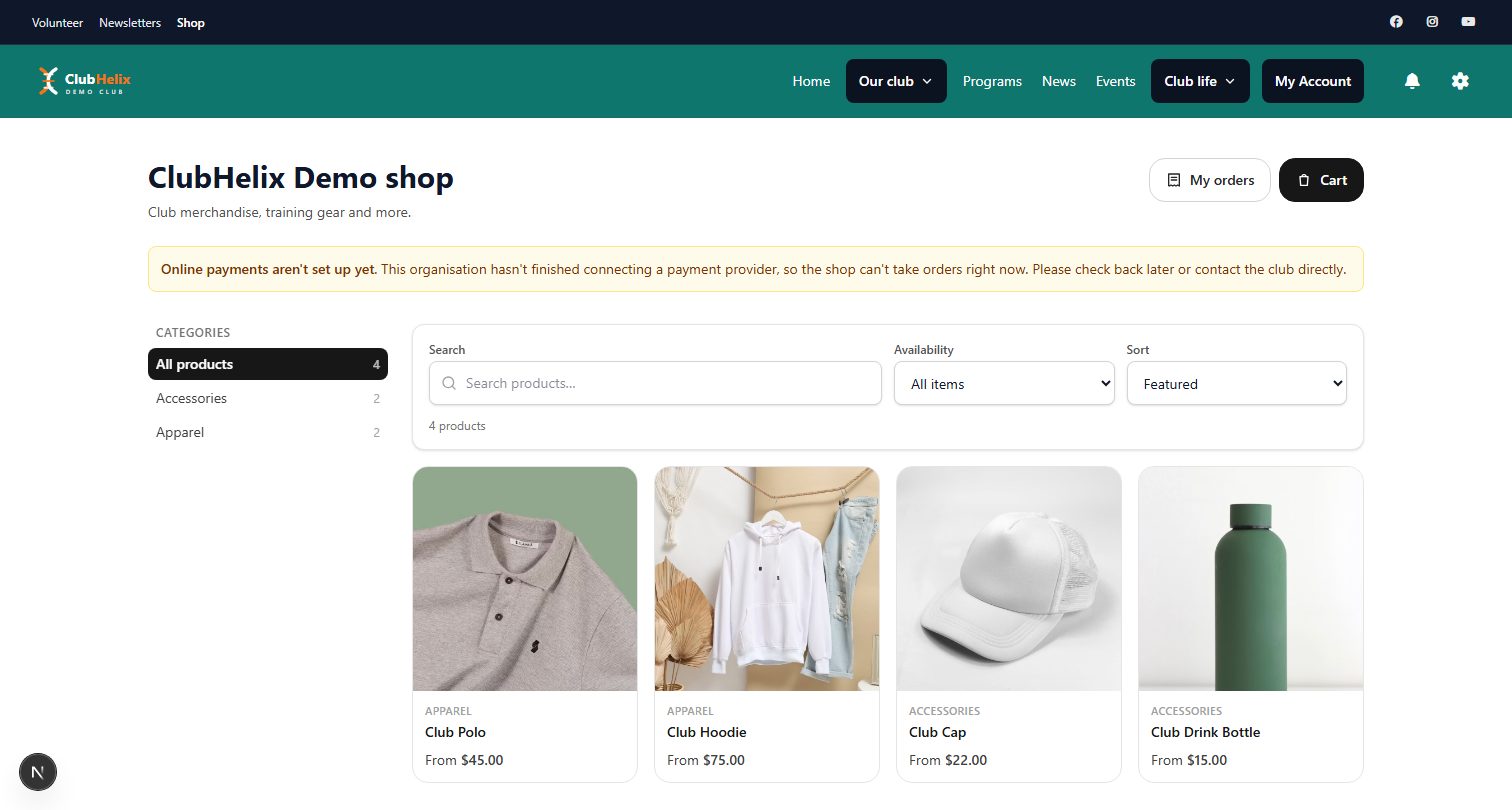
Most of the work above only stays accurate if the prices, stock levels and member discounts live in one place rather than in three spreadsheets and a message thread. A club shop that holds member and public pricing on the same product, applies tax the way your jurisdiction expects, and closes a size off when it sells out removes the two jobs that eat volunteer evenings — answering "do you have it in large" and reconciling who paid for what. Discount codes run your markdown ladder to a schedule instead of a decision, and reports give you the sell-through number without counting the tub.
ClubHelix puts the shop inside your club website, alongside memberships, events and everything else the committee already runs. Begin on the free tier, check the pricing before you commit to anything, and build your club site over a weekend — the first pre-order window is usually the one that pays for the year.
Frequently asked questions
How much margin should a club make on merchandise?
Blend toward the mid-forties as a gross margin across the whole shop, but vary it by item class. Required playing kit should sit close to cost so it never becomes a barrier to playing, supporter apparel like hoodies and polos can carry 40–55%, and low-ticket impulse items such as stickers and socks comfortably carry 55–70%. Remember margin is measured against your price, not your cost.
How do I work out what a club hoodie really costs?
Add the blank, the decoration, the share of any setup or digitising charge, freight in, samples, expected wastage, payment processing, packaging and postage, then divide by the number of sellable units. The setup charge is the one that surprises people, because it is fixed — spread over a run of twenty-four it adds far more per unit than the same charge spread over a hundred.
Should members pay less than the public for club merchandise?
Usually yes. A member price makes membership visibly worth something and costs you very little, while the public are buying a souvenir and are less price-sensitive. Keep identity items such as squad and training wear member-only, and reserve public pricing for supporter apparel and event merchandise.
How many should we order the first time?
Order against real demand rather than optimism. Run a pre-order window, count the committed orders, add a small buffer in the middle sizes, and check the result against your break-even units at a 70% sell-through assumption. Keeping the artwork and supplier stable means a reorder costs you nothing extra in setup, so selling out and reordering always beats over-ordering.
What should we do with merchandise that did not sell?
Put it on a schedule rather than a shelf. A modest discount two weeks after the season ends, a table sale at presentation night, odd sizes bundled as a registration add-on in pre-season, then clear the remainder entirely as raffle prizes, volunteer thank-yous or junior giveaways. Record the markdown loss honestly so next season's order is smaller and better shaped.
Keep reading: how to sell club merchandise online for the logistics of pre-orders and delivery, and club fundraising ideas for the campaigns your shop can support.


