
What this guide answers
- Does affiliation automatically bring us funding?
No. Affiliation makes you eligible to apply; it does not put money in an account.
- How many members do we actually need to affiliate?
It varies by institution, but somewhere between ten and thirty verified, currently enrolled students is the usual range, and it is checked against enrolment records rather than accepted on trust.
- What if a society already exists that does what we want to do?
Duplication is one of the two most common grounds for refusal, and it is usually negotiable.
- Who is personally responsible if something goes wrong?
For an unincorporated society, the committee members who signed the affiliation agreement usually are, which is precisely why the association makes each of you sign individually.
- We missed the affiliation deadline. What can we do this year?
Ask immediately rather than waiting — some associations run a late or rolling window for new groups, and a polite email to the clubs coordinator in the first week is a completely different conversation to one in week…
UK edition. This guide is written for volunteer-run clubs in the UK. Where rules differ — grants, tax, incorporation, safeguarding — follow the UK-specific pointers below or check with your national body.
Your society already exists. There are 240 people in the group chat, five of you meet in the same café every Wednesday, someone has made a logo, and two of you have started saying "the committee" without irony. What you do not have is a room, insurance, a legitimate way to take money, or a table at the start-of-year club fair — and every one of those sits behind the same door.
Affiliation is that door. Depending on where you are it might be called registration, ratification or recognition, but it is the same bargain: you give the students' organisation that affiliates clubs a constitution, a committee list, a minimum number of verified members and a set of signed declarations, and it gives you the infrastructure that makes a society possible instead of a group of friends with a name.
This guide covers what affiliation actually buys, the pack you will be asked to submit, the three things that cause most applications to bounce, and the renewal rhythm that keeps affiliation alive through a committee that changes every twelve months. If you have not formed the society yet, read how to start a university club or society first — affiliation is step four, not step one.
What affiliation actually buys you
Committees under-sell affiliation to their own members, because from the inside it looks like a form. Here is what sits on the other side of the form. Not every student association offers every line, but most offer most of them.
| What you get | Why it matters more than you think |
|---|---|
| Public liability cover under the association's policy | The single most valuable item. No society can realistically buy its own, and no venue on campus will confirm a booking without evidence of cover |
| Room and venue booking at member rates | Often the difference between meeting weekly and meeting twice |
| Eligibility for grants | Unaffiliated groups cannot apply at all. This is a gate, not a preference |
| A stall at the start-of-year club fair | Where most societies get 60–80% of a whole year's new members |
| A listing in the official society directory | Where first-years genuinely look, all year, long after the fair |
| A licence to use the institution's name | "The [Institution] Photography Society" is a name you are permitted to use, not one you own |
| Somewhere legitimate to hold money | Either a club account on the association's ledger or permission to run your own |
| Equipment, storage, printing, AV | Small on paper, and the reason your ball breaks even |
| A recognised route to run events | Approvals for ticketing, alcohol, security and external speakers all assume you are affiliated |
The obligations that come with it are modest but real: an affiliation fee, a minimum membership, compulsory committee training for at least the president and treasurer, an AGM every year, an annual financial statement, and a code of conduct that binds committee members personally rather than binding some abstract entity.
That last point deserves emphasis, because new committees skim it. When you sign the affiliation agreement you are usually signing as an individual. If the society is suspended for a conduct breach, the people who signed are the ones the process is about.
Who you affiliate to, and when the window opens
Almost every campus has more than one body that could plausibly be your parent, and they do not share a queue. Sporting clubs and non-sporting societies are usually handled by different offices, with different deadlines, different insurance and different handbooks. Applying to the wrong one costs three weeks you do not have.
Three questions settle it. Does your society compete in a sport, as opposed to playing one socially? Does it exist to represent a course, faculty or department? And does it involve people who are not enrolled students? The first usually routes you to the sport office. The second often means a faculty conversation as well as an association one. The third turns a five-minute form into an insurance discussion, and it is better to have that discussion before you promise anyone anything.
The body that affiliates societies is your students' union. Most unions split activities in two: a societies side, run by an activities or societies officer with a societies exec or council, and a sport side, often an athletic union with its own affiliation, its own club captains' meetings and its own insurance. A society that plays a sport socially usually still sits on the societies side; a team entering league competition does not.
Ratification is annual. The window for existing societies typically opens near the end of the summer term for the year ahead, so the committee elected in the spring elections is the one that renews. New societies usually apply through a heavier process that includes a pitch to the societies exec or council, a constitution based on the union's model, and a signature list of prospective members checked against enrolment.
The freshers' fair is where the year is won, and stalls go to societies already ratified when the plan is drawn. If you miss it, the refreshers' fair in January is a genuine second chance — smaller, but the students who come are actively looking for something to join. Expect the union to require committee training before it releases budget access, and expect that training to be scheduled once, during welcome week, with no repeat.
Whatever the local shape, do one thing before you write a word: download this year's affiliation handbook and read the checklist page. Requirements change annually, and the version sitting in the society drive is usually two committees old.
The affiliation pack: what you will actually be asked for
Assume the pack takes a focused evening if you have your material ready, and three weeks if you do not. Here is the full list, in the order it is usually requested.
- Society name and a non-duplication statement. You will be asked to confirm no existing group already does what you do. Be specific about the difference in one sentence — "we play tabletop role-playing games; the existing games society runs board games and video games" — because a vague answer gets bounced back for clarification and you lose a fortnight.
- Objects or aims, three to five lines. These end up in your constitution and in the directory listing, so write them for a first-year, not for an assessor.
- A constitution that matches the association's model. Do not submit a bespoke one when a model exists; it will come back marked. Our student society constitution template walks through every clause and what an assessor is checking for.
- Committee list with each person's full name, student number, course, position, term of office, institutional email and a phone number. Most associations require at least president, secretary and treasurer, held by three different people who are all currently enrolled.
- Minutes of the founding or general meeting at which that committee was elected, including who attended and who moved and seconded each appointment.
- A member list meeting the minimum, with student numbers. This is the one that fails most often — see the next section.
- A finance declaration: how you intend to hold money, who the signatories are, and whether you are requesting an association-held account.
- An activity statement describing what you actually do, flagging anything physical, anything involving travel, anything with alcohol, and anything involving people under 18.
- An insurance question set derived from that activity statement. Answer it honestly; an undeclared activity is not covered, which is the whole point of the question.
- A data and privacy declaration about how you will handle member information.
- A signed code of conduct or affiliation agreement, usually one per committee member rather than one per society.
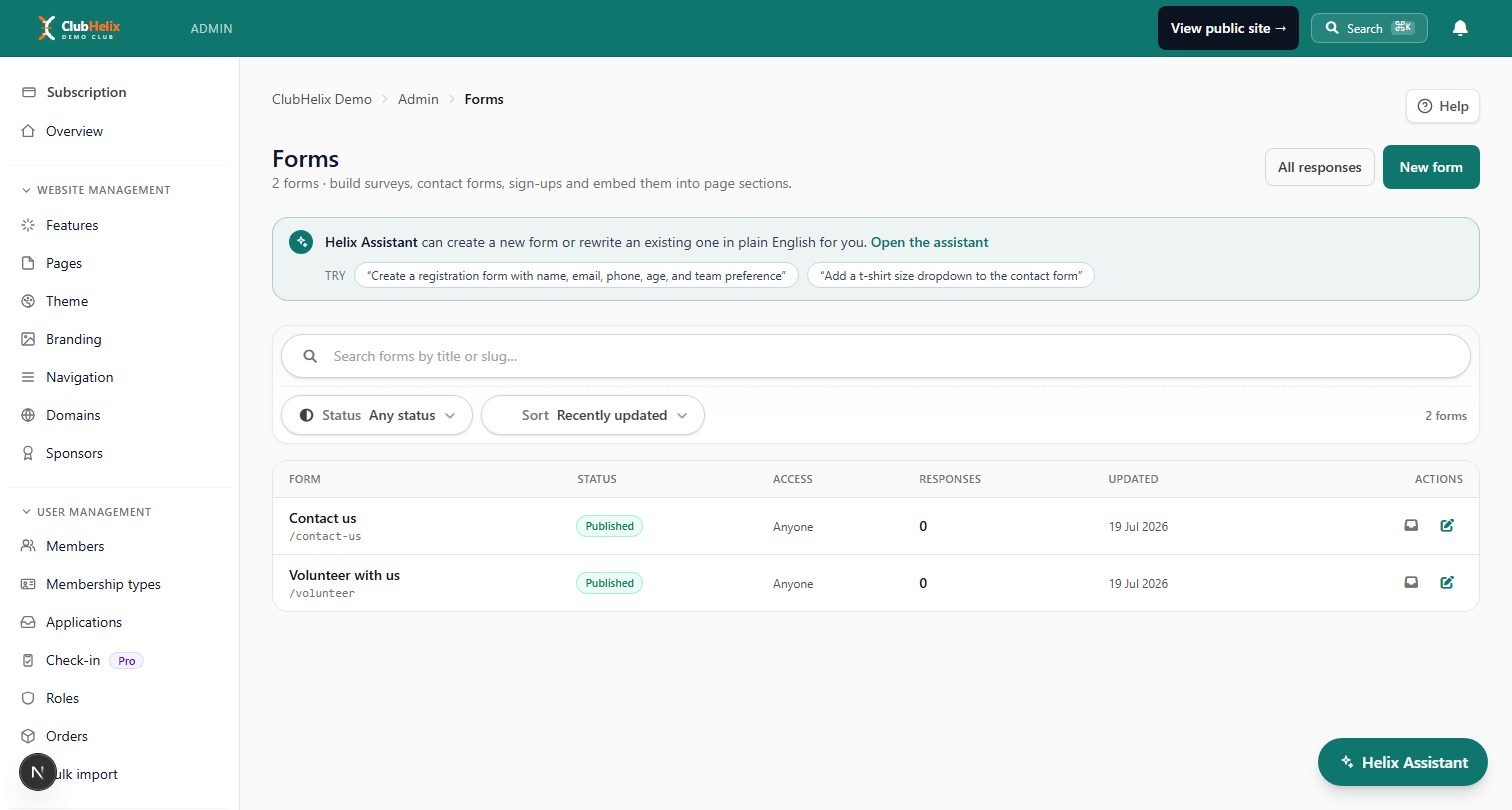
Collecting eleven items from five students across four weeks by group chat is how affiliation applications die. Put the whole pack behind a single structured form with one row per committee member, a file upload for the constitution and the minutes, and a required tick for the code of conduct. Then you can see at a glance who has not filed, and chase one person rather than re-reading 300 messages.
The member list is what most applications fail on
Every association sets a membership floor — commonly somewhere between ten and thirty verified students — and checks it against enrolment records rather than taking your word for it. That check is where applications stall.
The usual cause is the paper sign-up sheet from the club fair. Expect 20–40% of a handwritten list to be unusable: an email address you cannot read, a transposed student number, a name with no contact details at all, and at least one person who wrote "sure why not" in the email column. When the association bounces those rows, you are 40 short of a minimum you thought you had cleared, and the person who could re-collect them has gone home for the break.
The fix is unglamorous and takes one afternoon. Collect sign-ups digitally at the point of contact — a QR code on the table linking to your own sign-up page — and capture exactly six things: full name, student number, institutional email address, course, year of study, and a tick confirming they want to join and understand what you will use their details for. Nothing else. No date of birth, no home address, no dietary requirements until there is an actual dinner.
Then do three things before you submit:
- De-duplicate. The same person will sign at the fair, again at the first event, and once more when a friend forwards the link. A list with 30 rows and 22 humans fails a minimum of 25.
- Check enrolment status. Exchange students finishing mid-year, recent graduates hanging around, and staff members all count differently — or not at all — depending on your association's rules.
- Export the list in the format they asked for. Some want a spreadsheet with named columns, some want a count only, and some want you to grant them read access to your system. Read the instruction before you build the file.
Keeping the register in the society's own member records rather than a personal drive solves the other half of the problem, which is not this year's application but next year's. When the membership officer graduates in June, a list living in a student account graduates with them. Societies that lose their member list generally cannot demonstrate the minimum at renewal, which is how a healthy society ends up dormant with money it cannot reach.
Legal shape, bank accounts and the money question
Almost every affiliated society starts unincorporated: a group of people bound by a constitution, with no legal existence separate from its members. That is normally the intended shape, and it is why the association can insure you and hold your money — you sit inside it rather than beside it.
The arrangement stops fitting when a society begins holding real money or signing real contracts: a ball with a venue minimum, a storage lease, equipment worth insuring, a tour with deposits. At that point the question of legal form becomes a genuine one, and the answer differs by where you are.
Almost every ratified society is an unincorporated members' club, and that is deliberate. The union normally holds your money in an internal account, the treasurer raises requests against it, and the union's insurance and legal identity cover your activity because you are constitutionally part of it. Most unions do not permit societies to hold external bank accounts at all, and opening one is among the fastest routes to suspension.
That arrangement has a consequence worth understanding properly: the union is usually the contracting party for your venue bookings and the controller of your member data. It is why you are asked to route bookings through its staff rather than signing yourself, and why a departing committee cannot simply take the membership list with it.
Societies only outgrow the arrangement when they become genuinely independent — an alumni-facing body, a society employing someone, or one holding significant assets. The usual next step is a charitable incorporated organisation, which gives a separate legal identity and limited liability but brings trustee duties, annual returns and a registration threshold to clear first. VAT only becomes relevant above the registration threshold, which is far beyond a normal society's turnover. This is general information — check with your union's activities staff or a professional before changing anything.
The declarations you sign
The last few pages of an affiliation pack are the ones committees sign without reading, and they are the ones that matter when something goes wrong.
Three declarations sit in most ratification packs. The first is safety: a description of what your society does, flagging physical activity, travel, alcohol and any contact with under-18s. Flagged activity usually triggers a risk assessment before the first event, and unions increasingly want that assessment filed with them rather than kept in a folder somewhere.
The second is safeguarding. A society working with schools, running outreach or coaching juniors will be asked about DBS checks for the members involved. The union normally manages the applications because it is the eligible body, so ask early — turnaround is measured in weeks, and a check is tied to a specific role rather than transferable from a member's part-time job.
The third is data protection. Under UK GDPR and the Data Protection Act 2018 your member list is personal data, and the union is normally the controller with your society processing on its behalf. That is why you are asked to keep the list on approved systems rather than a personal spreadsheet, and why the honest answer to "can we take our list with us" is usually "not without the union's agreement". Collect the minimum, tell members what you will use it for, keep special-category data such as health or dietary needs to the single event that needs it, and delete it afterwards. General information only — check with your union's staff or a professional.
If your society runs anything physical, add digital waivers to the sign-up flow rather than chasing paper on the day. A waiver signed on a phone at 11pm the night before is a record you can produce; a clipboard at the door is a record you will lose.
The renewal calendar that keeps affiliation alive
Affiliation is not a milestone, it is a subscription — and the renewal always lands during the handover, when the people who know how it works are leaving. Build this calendar into the committee's shared diary the day the AGM finishes.
| When | What has to happen | Who owns it |
|---|---|---|
| 8 weeks before the renewal deadline | Download this year's handbook; note every change from last year in one paragraph | Secretary |
| 6 weeks before | Hold the AGM. The committee that renews must be elected before you can name it on a form | President |
| Within 7 days of the AGM | Lodge the committee change and update account signatories | Secretary |
| 4 weeks before | Annual financial statement prepared, plus any grant acquittals still outstanding | Treasurer |
| 3 weeks before | Member list de-duplicated, enrolment-checked and exported in the requested format | Membership officer |
| 2 weeks before | Renewal pack submitted, with a copy saved to the society's own records | President |
| 1 week before | Written confirmation chased. "Submitted" is not "approved" | Secretary |
| Before the club fair | Stall confirmed, insurance certificate downloaded, sign-up QR code printed | Events officer |
| First four weeks of the academic year | New members registered and the count re-submitted if your association asks for it | Membership officer |
| Mid-year | Grant acquittals, event reports, half-year figures | Treasurer |
Two habits do most of the work. First, save the submitted pack somewhere that is not a student email account — every renewal is 80% last year's renewal, and a society that keeps its own copies renews in an hour instead of a weekend. Second, put the deadline in the handover pack as a dated item with the handbook link, not as a line in a conversation.
When affiliation lapses, is refused or is suspended
Three things go wrong, and they have different fixes.
It lapses. Nobody filed by the deadline, usually because the outgoing committee assumed the incoming one knew and the incoming one had not been elected yet. The society goes dormant: bookings cancelled, stall gone, and any money held on the association's ledger frozen where you can see it but not spend it. Recovery normally means applying as a new society, but you can usually reclaim the name, the history and the frozen balance if you can produce the old constitution and the last AGM minutes. This is exactly why the constitution should not live only on a graduate's laptop.
It is refused. The two common grounds are duplication and an incomplete pack. Duplication is negotiable if you can articulate a genuine difference in one clear sentence, or if you are willing to start as a sub-group of the existing society and split later once you have your own members. An incomplete pack is simply resubmitted, but only in the next window, which can cost a whole recruitment cycle.
It is suspended. Suspensions come from conduct, money or safety: an initiation that breached the code, funds through a private account, an event that went ahead without an approved risk assessment. The process is normally a show-cause letter with a deadline, and the single worst response is silence. Reply in writing inside the deadline, take responsibility where it is due, and attach a remediation plan with named people and dates. Committees that engage properly are usually reinstated with conditions; committees that go quiet are usually deregistered.
Frequently asked questions
Does affiliation automatically bring us funding?
No. Affiliation makes you eligible to apply; it does not put money in an account. Grants almost always run in rounds with hard closing dates, and most are paid as reimbursement rather than cash up front, which is why even a small float matters in your first year.
Union funding usually runs as a bid: societies submit a funding request for the year or the term, the societies exec or a finance committee allocates from a fixed pot, and you are told a number that is smaller than you asked for. Bids that quantify — expected attendance, cost per head, what happens without the money — routinely beat bids written as enthusiasm. Many unions also hold a smaller hardship or opportunity fund that is decided quickly and is far less contested.
Charity fundraising sits in a separate structure again, through RAG, which brings its own approvals, its own collection rules and its own paperwork before you can run a sponsored anything.
Grants come with a spend-by date and a receipts requirement, and unspent allocation is usually clawed back at year end rather than rolled over. Track your allocation against actual spend monthly so that in the last few weeks you are choosing what to buy, not discovering you have lost it.
Departments are the source nobody uses. A course-linked society running a careers panel or an academic speaker can often get the room, the catering and a speaker fee from the department itself, decided by one administrator in a fortnight, with none of the bidding round's paperwork.
Whichever pot you are applying to, the numbers you need are the same, and they are all things a society should already know: verified member count, attendance at your last three events, and what you spent per head. Our guide to funding and grants for a student society goes through the application itself.
How many members do we actually need to affiliate?
It varies by institution, but somewhere between ten and thirty verified, currently enrolled students is the usual range, and it is checked against enrolment records rather than accepted on trust. Aim to submit 50% more than the minimum, because de-duplication and enrolment checks reliably remove rows you thought were solid. If you are genuinely short, run one open event before the deadline and collect sign-ups digitally there — a single well-promoted first meeting can close a gap of fifteen.
What if a society already exists that does what we want to do?
Duplication is one of the two most common grounds for refusal, and it is usually negotiable. Write the difference in one sentence a stranger could repeat, and be honest about it — "we are the postgraduate branch", "we play a different game", "we run in the evenings for students who work". If the difference is genuinely thin, the faster route is to start as a sub-group or special-interest arm of the existing society for a year, build your own membership and events under their affiliation, then apply on your own numbers once you can show them.
Who is personally responsible if something goes wrong?
For an unincorporated society, the committee members who signed the affiliation agreement usually are, which is precisely why the association makes each of you sign individually. Insurance held by the student association covers declared activity carried out properly, which is why the activity statement and the risk assessment matter more than they look. Do not sign contracts in your own name when the association can sign them, do not run an activity you did not declare, and treat the code of conduct as the binding document it is. This is general information rather than legal advice — your association's clubs staff will answer specific questions faster than anyone else.
We missed the affiliation deadline. What can we do this year?
Ask immediately rather than waiting — some associations run a late or rolling window for new groups, and a polite email to the clubs coordinator in the first week is a completely different conversation to one in week six. You will probably lose the stall at the club fair and this round's grants, so plan a year that does not depend on either: run open events in borrowed space, build a real member list you can prove, and use the year to arrive at the next affiliation window with everything ready. A society that turns up to renewal with 80 verified members and a clean set of accounts is not a late applicant, it is an obvious approval.
Where ClubHelix fits
Affiliation is mostly an evidence problem: a current member list, a committee list, a financial statement and a set of signed declarations, all produced on a deadline by people who were not here last year. ClubHelix keeps those in the society's own account rather than a graduating student's drive — structured forms for the affiliation pack and committee declarations, a member register that de-duplicates and exports, and waivers attached to the events that need them.
It also handles the shape above you: a student association can run as a parent organisation with each affiliated society sitting underneath it, so the association can see membership numbers and renewal status without asking thirty committees for a spreadsheet. If you are setting your society up from scratch this year, how to run a student society covers the rest of the year, and pricing starts free for small societies.


