
What this guide answers
- What temperature should a sports club cancel at?
There is no single answer a club should set for itself, and inventing one is both less safe and harder to defend.
- Who should make the heat call at a club?
A named heat officer for that day, rostered by round, with a deputy — not "the committee" and not whoever happens to be at the ground.
- What can a club do instead of cancelling in hot weather?
A great deal, if it has prepared. Extra drinks breaks, longer intervals with compulsory shade, ice and wet towels, unlimited interchange, shortened periods, an earlier or later start, an indoor or shaded alternate…
- How do we tell everyone a game is off because of heat?
Use a staged sequence rather than one message — a watch notice a day or two out setting out the contingency, a confirmation the evening before, and a final call on the morning if anything changes.
- Do heat policies apply to training as well as matches?
Yes, and training is where most heat illness at community level actually happens, because sessions are often held in the hottest part of the day with less supervision and no match official present.
USA edition. This guide is written for volunteer-run clubs in the United States. Where rules differ — grants, tax, incorporation, safeguarding — follow the USA-specific pointers below or check with your national body.
The heat call is almost never made by the person you would choose to make it. It is made at ten past nine by a volunteer coach standing on the boundary with a phone in one hand and a water bottle in the other, looking at eleven under-twelves and a forecast that has already been beaten by half past eight. Nobody has told them what number matters, who they are allowed to ring, or whether "we'll play shorter quarters" is a thing the club does. So they make a reasonable guess, and the club finds out what its heat policy is by watching what one person did under pressure.
Heat is the hazard community clubs manage worst, and the reason is structural rather than careless. A washout is binary and it announces itself — you can see the ground. Heat arrives on a forecast three days out, changes hour by hour, keeps escalating after play has started, and affects a thirteen-year-old in a dark jumper differently from a fit adult and differently again from an umpire standing still in the sun for three hours. A policy built on the washout model — one inspection, one decision, one message — does not fit the shape of the problem.
This guide is general information, not medical or legal advice, and it deliberately does not print a temperature at which you should cancel. Those numbers belong to your governing body, your national sporting organisation and the sports-medicine guidance they follow, and a club that invents its own is both less safe and less defensible. What this guide gives you instead is the structure — where each threshold comes from, who owns each decision and by when, the modifications that save a fixture instead of cancelling it, in-play triggers, and how to get the decision to several hundred people in the ten minutes you actually have.
Three ways heat is not rain
Everything that follows comes from these three differences, so it is worth being explicit about them before you draft.
Heat is forecast, so the decision can be staged. You will usually know on Wednesday that Saturday is a problem, which means you can pre-announce a contingency instead of springing a cancellation. "If the forecast holds we move the junior age groups to the 8am slot — confirmed by 5pm Friday" is a message no washout policy can send, and it turns a disruption into a plan.
Heat escalates during play, so the decision is not made once. A fixture that starts inside your safe band can leave it by the third quarter. Rain either stops play or it does not; heat needs in-play triggers, a person watching them, and a defined authority to modify or abandon mid-game.
Heat risk lives in the participant, not the ground. A waterlogged pitch is unsafe for everyone equally. A hot day is far more dangerous for juniors, for players carrying illness or certain medical conditions, for anyone unacclimatised, for players in dark or heavy kit, and for officials who stand still in full sun without the breaks players get. Your policy has to be able to cancel one age group and not another, which means your thresholds need to be written per participant group.
When the risk actually falls
A policy that nobody rehearses is a policy nobody applies, and the rehearsal window depends entirely on where your hot months sit against your competition calendar. Work out which of your age groups is exposed and when, then put the policy review one month ahead of that.
For most clubs the exposure runs from late spring through to early autumn, and the sharpest risk sits in preseason — squads returning after an off-season, training in full kit, unacclimatised, often twice a day. Acclimatisation rules exist for exactly this reason and are frequently mandatory rather than advisory, so check what your league or your state or provincial association requires before the first session rather than after it. Summer tournaments and multi-game days are the other concentration point. Review the policy in early spring.
Where your thresholds come from
Do not start with a number. Start with the documents that already bind you, in this order.
- Your national body's hot weather policy, and whatever your regional association adds to it. Most codes publish one, and affiliation usually makes it binding on your club whether or not anyone has read it. It will define the metric, the bands and what happens in each.
- Your competition's playing conditions. The league or association often modifies the national policy — different break rules, different authority to abandon, a different person who owns the call on match day.
- Recognised sports-medicine guidance for your sport. Where the governing body is silent, this is the reference to name in your policy so the club is following a framework rather than a committee opinion.
- The venue's own rules. A council, school or facility operator can close a ground on its own assessment, and their call outranks yours.
Then build a table the shape of the one below, with the numbers filled in from those sources rather than from here. The bands and the metric are theirs; the ownership, the deadlines and the communication are yours.
| Band | Metric reading (from your governing body's policy) | Junior age groups | Senior age groups | Training | Who decides |
|---|---|---|---|---|---|
| Normal | [ ] | Proceed | Proceed | Proceed | — |
| Caution | [ ] | Extra drinks breaks, shade at the interval | Extra drinks breaks | Proceed, shorten | Coach or team manager |
| High | [ ] | Modified format — shortened periods, rolling subs | Extra breaks, longer interval | Move to evening or indoors | Heat officer of the day |
| Extreme | [ ] | Do not play | Modified or postponed | Cancelled | Heat officer, or association |
| Beyond extreme | [ ] | All activity cancelled, grounds closed | All activity cancelled | Cancelled | Association or venue owner |
Air temperature is the wrong number on its own
Whatever your governing body specifies, understand why it probably is not a plain thermometer reading. The physiological load on a player comes from air temperature plus humidity, radiant heat from the sun and the surface, and air movement — which is why a still, humid morning at a lower temperature can be more dangerous than a hot, dry, breezy afternoon. Most sports heat policies therefore use a heat-stress index rather than air temperature alone, and many require a reading taken at the venue rather than from a regional forecast.
Two practical consequences. First, buy whatever measuring device your policy specifies and put it in the kit that goes to the ground, not in the clubroom cupboard. Second, record the reading. A logged measurement at a stated time is the difference between "we thought it was alright" and a defensible decision, and it belongs on the same incident and event record as everything else that happened that day.
In the United States heat guidance is comparatively mature and often mandatory. Wet bulb globe temperature is widely specified as the measurement, taken on site, with activity modified by region-specific bands — and state high school associations, youth leagues and national governing bodies frequently publish binding requirements covering acclimatisation periods, work-to-rest ratios and equipment removal. The National Weather Service issues heat advisories and warnings. Find the rules that bind your league before writing anything of your own.
The timeline — Wednesday to the last change of ends
This is the part that makes a heat policy usable, and it is the part clubs leave out. Publish it, so members know when they will hear.
| When | Decision | Owner | What goes out |
|---|---|---|---|
| 72 hours out | Watch declared. Contingency options identified | Heat officer | Nothing public yet |
| 48 hours out | Contingency named publicly — earlier start, alternate venue, likely bands | Heat officer | Notice to affected age groups — "if the forecast holds, X" |
| Evening before | Provisional call. Canteen orders, volunteers, officials adjusted | Heat officer with president | Confirm or stand down the contingency |
| 2 hours before | Reading taken at the venue. Band confirmed | Heat officer of the day | Final call to all affected age groups |
| At the ground | Pre-match brief — breaks, shade, water, who is watching | Coaches and officials | Verbal, plus a note on the day sheet |
| During play | Re-read at each interval. Modify or abandon | Match official or heat officer | Immediate, on the ground |
Three points make it real. Name a heat officer, and roster the role by round. It cannot be "the president", who is at an away game. It is a named person for that day with a deputy, exactly as your wet weather plan names a ground officer. Publish the deadline and honour it. "Final call by 7:30am, announced on the website and by push notification" stops the phone ringing at 6:45. Decide early in favour of modification, late in favour of caution. Contingencies announced 48 hours out cost nothing if the forecast breaks; a cancellation announced after families have driven forty minutes costs you trust you will need next time.

Modifications short of cancellation
Cancellation is the blunt instrument, and clubs reach for it because it is the only tool anyone has written down. A tiered ladder of modifications keeps far more sport happening safely, and it is the single most useful section of a club heat policy.
| Level | Modification | Authorised by | Notes |
|---|---|---|---|
| 1 | Extra drinks breaks, water on the boundary, unlimited interchange | Coach | No approval needed, no notice needed |
| 2 | Longer interval, compulsory shade at breaks, ice and wet towels available | Team manager | Requires ice and shade to be on site, so it is a pre-season purchase |
| 3 | Shortened periods or reduced total playing time | Heat officer | Needs the association's agreement if results count |
| 4 | Earlier or later start time, same day | Heat officer | Announce 48 hours out where possible; officials and canteen affected |
| 5 | Alternate venue — indoor court, shaded ground, pool-based session for training | Heat officer | Only works if the alternate is arranged before summer |
| 6 | Kit relaxation — training singlets, no dark jumpers, helmets off between plays where rules allow | Coach, within the rules | Check your code's uniform and equipment rules first |
| 7 | Postpone the fixture | Association | Rarely the club's call alone |
| 8 | Cancel all activity, close the ground | Association or venue | Communicate as a single clear message, not as a maybe |
Most of the ladder depends on things you cannot buy on the morning. Shade at the ground, a working water refill point, ice, wet towels, a spare set of light training tops, and an indoor fallback booked in advance are all pre-season decisions. Put them in your pre-season checklist with a named owner and a cost, or the policy will describe modifications the club is not equipped to make.
Modify the participant group, not the whole day
Because heat load lands unevenly, the highest-value modifications are targeted. Junior age groups usually get the earliest slot of the day, not the middle one. Officials get the same breaks as players, plus shade and water they do not have to ask for — an umpire standing in full sun for three hours is often the most heat-exposed person on the ground and the least likely to complain. Players returning from illness, players who are new to the climate, and anyone whose medical information the club holds a note about get individual attention rather than a general instruction. And spectators need somewhere to sit that is not the open embankment, which is a shade and seating question rather than a playing one.
In-play triggers and abandonment
Write these as unambiguous instructions, because they will be applied by someone who is hot, distracted and being watched.
- Take a new reading at every interval. Not a glance at the sky. The reading, logged, on the day sheet.
- Any suspected heat illness stops that participant immediately — not at the end of the period. Cooling starts straight away, and the club's first-aid response takes over.
- Two or more participants affected in the same session is a session-level trigger, not two individual ones. Something about the conditions is wrong.
- The match official's authority to abandon is absolute and is not negotiated on the ground. Say this in the policy so a coach does not argue it at the time.
- Never restart to "get the result in". A shortened or abandoned fixture is a competition-points question for someone else on Monday, and the club's position should be that it never trades safety for a result.
Anyone who leaves the field with suspected heat illness generates a written record the same day, including what was observed, what was done and whether medical help was called. That record protects the participant and the volunteer who acted, and it is the input your committee reviews at the end of summer when it revises the bands.
The hazards that travel with heat
Heat rarely arrives alone, and a policy that only reads a thermometer will wave through days that are unsafe for a different reason. Add a second trigger for air quality and a third for ultraviolet exposure, using whatever public index your national weather or environment agency publishes, and treat a poor reading on either as its own decision rather than a footnote to the heat call. The same heat officer owns it; the same ladder of modifications applies, with the important difference that moving indoors helps with smoke and sun but not always with heat.
In the United States wildfire smoke has become a routine seasonal hazard well beyond the states where fires burn, and many leagues and state associations now specify air quality index thresholds alongside their heat rules. The national air quality index is the standard reference and is available by location. Treat a poor reading as its own cancellation trigger — participants with asthma are affected at levels well below those that would trouble anyone else, and the sky often looks fine.
Recognising heat illness
This section is general information and is not a substitute for first-aid training or medical advice, and every club should have someone current in first aid at every session. What a policy can usefully do is tell volunteers what to look for and what not to do.
The early signs are behavioural before they are physical — a player who stops talking, drifts out of position, looks clumsy or irritable, or seems confused about the score or the time. Cramping, heavy sweating, headache, nausea and dizziness are the familiar signs and warrant immediate removal from play, shade, and active cooling. The signs that mean call for emergency help without hesitation are confusion or altered behaviour, collapse, seizure, or a player who cannot be roused — do not wait to see whether they improve, and do not let them "run it off". Cooling and emergency help are not alternatives; start cooling while help is on the way.
Two things clubs get wrong. Do not send an affected player home alone or let them drive. And do not treat a quick recovery as clearance — follow your code's return-to-play guidance before that player takes the field again, and take medical advice where the guidance is silent.
Getting the call out in ten minutes
You will not build a new communication system for heat, and you should not — heat calls run on the same ladder as every other urgent club message. The mechanics are covered in full in our wet weather communication plan, and the same escalation applies here: website first as the single source of truth, push notification for speed, email for detail, and SMS reserved for the genuinely time-critical calls.
What is different is the shape of the message, because heat calls are staged rather than binary. Write three templates and keep them ready.
Watch (48 hours out). Heads up for [Saturday] — the forecast is well above our comfortable range. If it holds, [junior age groups move to the 8am slot / training is cancelled]. We will confirm either way by [5pm Friday]. Nothing changes until then.
Confirmation (evening before). Confirmed for [Saturday] — [what is happening], [what is not], [new times]. Bring extra water and a hat. Shade is set up at [location]. Full detail on the club website.
Same-morning modification. [Round] is going ahead with heat modifications — [shortened quarters, extra drinks breaks, rolling interchange]. [Age group] is cancelled. Officials and coaches have been briefed. Check the website before you leave.
The "watch" message is the one clubs never send and the one members value most, because it converts a possible cancellation into a plan they can work around. It costs one notification and it removes fifty phone calls.
Putting the call in one place
Heat decisions fail on distribution far more often than on judgement — the right call made at 7:20 that reaches half the club by 8:05 is not a working policy. ClubHelix puts the whole chain in one admin. Publish the call once and it lands as a push notification through your club's installable app, as a targeted email broadcast to exactly the age groups affected, and as an urgent SMS for the same-morning cancellations that cannot wait — all from the member list you already keep, with no volunteer copying text into five places. Heat illness and near-misses log through incident reporting so the committee reviews real data at the end of summer instead of anecdotes.
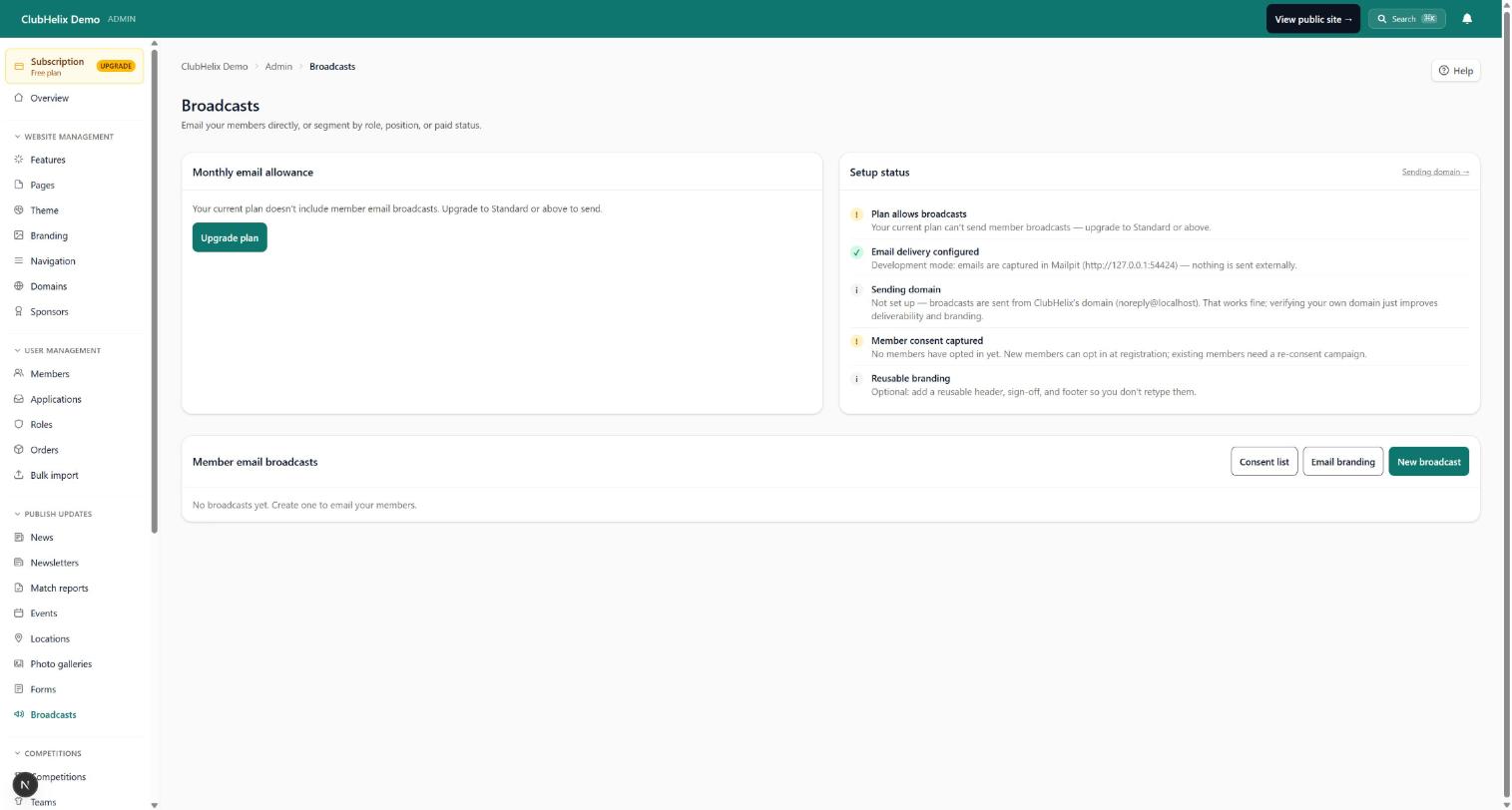
Small clubs can run on the free tier indefinitely, and the pricing is published rather than quoted. If your club is heading into a hot season with a policy that lives in a committee member's memory, this is a good weekend to change that — set your club up and have the templates loaded before the first warm forecast.
Frequently asked questions
What temperature should a sports club cancel at?
There is no single answer a club should set for itself, and inventing one is both less safe and harder to defend. The threshold comes from your national body's hot weather policy, modified by whatever your competition's playing conditions add, and it is usually expressed as a heat-stress index that accounts for humidity and radiant heat rather than as an air temperature. Adopt those bands, name the source in your policy, and use your own document to define who measures, who decides and how everyone finds out.
Who should make the heat call at a club?
A named heat officer for that day, rostered by round, with a deputy — not "the committee" and not whoever happens to be at the ground. On match day the authority to modify or abandon often sits with the match official or the association under the playing conditions, so your policy should say plainly where the club's authority ends. Publish a deadline for the decision and honour it, because a promised time stops the phone calls better than a faster answer does.
What can a club do instead of cancelling in hot weather?
A great deal, if it has prepared. Extra drinks breaks, longer intervals with compulsory shade, ice and wet towels, unlimited interchange, shortened periods, an earlier or later start, an indoor or shaded alternate venue, and relaxed kit rules within your code's requirements. Most of these depend on equipment and bookings arranged before the season, so the modifications section of a heat policy is really a pre-season purchasing list.
How do we tell everyone a game is off because of heat?
Use a staged sequence rather than one message — a watch notice a day or two out setting out the contingency, a confirmation the evening before, and a final call on the morning if anything changes. Push the decision to your website first so every other channel can point at one source, then notify by push and email, and reserve SMS for same-morning changes. Announcing that play is going ahead matters as much as announcing that it is not.
Do heat policies apply to training as well as matches?
Yes, and training is where most heat illness at community level actually happens, because sessions are often held in the hottest part of the day with less supervision and no match official present. Training is also the easiest thing to modify — moving to a later slot, shortening the session, or going indoors requires nobody's approval but the coach's. Write training triggers that are at least as protective as match triggers, and give coaches explicit authority to shorten or cancel without asking.
Keep reading — the wet weather communication plan covers the channel ladder in detail, and sports club risk management puts weather alongside the club's other risks.


