
What this guide answers
- When should a governing body take over a complaint from a club?
Take it on when the club cannot hear it impartially — because its own officers are parties, or the complaint is about the club as an organisation — when the conduct happened at your events or involves someone you…
- Who should sit on a governing body complaints panel?
People with no stake a reasonable member would recognise: nobody related to a party, holding a role at a party's club, nominated to your board by that club, or who has already expressed a view.
- Does a stand-down mean a finding has been made against the person?
No, and your letter needs to say that in plain terms. A precautionary measure exists to manage a risk, it should be the smallest arrangement that does so and carry a review date, and writing down that nothing has yet…
- What belongs in a complaints register?
A reference, the category and severity, who received and who handled the matter, the key dates, any external report made, the outcome, and any appeal — with access limited to administrators.
- How much can we tell an affiliated club about a complaint?
Enough for the club to give effect to any measure and no more: the fact of a sanction or condition, its terms and duration, and who to contact.
UK edition. This guide is written for volunteer-run clubs in the UK. Where rules differ — grants, tax, incorporation, safeguarding — follow the UK-specific pointers below or check with your national body.
A club complaint that stays inside a club is somebody else's problem. The ones that reach an association are the ones that could not be finished: the matter where the club's own committee is a party, the parent who has decided the club will never hear them fairly, the incident at a representative fixture where nobody is certain whose rules apply. By the time it arrives, the complainant has usually told the story four times and trusts the process less each time.
This guide is for the general manager, member-protection officer or board secretary at a region, state, national or federation-level body. It is the companion to our club complaints and disputes process, which sets out the procedure a club runs for its own members — the staged timeframes, the particulars letter, the panel of three, the templates. That article is the club's side and this one is yours, so nothing here repeats it. What changes at your level is not the procedure so much as the questions that come before it: is this matter mine, who is allowed to decide it, and what does the record have to prove when somebody asks about it in two years.
It is general information, not legal advice. Your own constitution, your member-protection or integrity policy, and the rules of the body you are affiliated to all prevail over anything suggested here. A matter touching a child, possible criminal conduct, discrimination, or anyone your organisation pays needs advice from somebody qualified to give it, plus whatever reporting your jurisdiction requires of you.
The three doorways, and why each needs a different first response
Associations tend to build one complaints process and then discover that complaints arrive through three quite different doors. The mistake is answering all three the same way.
| How it arrives | What it usually is | Your first response | The mistake to avoid |
|---|---|---|---|
| Escalated by an affiliated club | A matter the club heard and could not finish, or one its own officers are inside | Ask for the club's file and its decision, then say plainly whether you are reviewing it or starting again | Accidentally re-running the club's process, so the respondent answers everything twice |
| Brought direct by a member of a club | A complainant who does not trust the club, or a complaint about the club's officers | Acknowledge, then settle jurisdiction before you look at the substance | Bouncing it back to the club that is the subject of it |
| Raised by someone outside the game | A neighbour, a venue, a referee's family, a spectator, or an anonymous report | Acknowledge without promising an outcome the person is not entitled to receive | Treating "not a member" as "not our business" |
The escalated matter needs a scope decision in your first letter, because a respondent who has already answered particulars at club level will reasonably refuse to do it again. The direct complaint needs a jurisdiction decision, because the honest answer is often that the club has to hear it first. The outside complaint needs an expectation set: you will look at whether your rules were breached, you will not be reporting back on the detail of a member's disciplinary outcome, and you will say which of those you are doing before they invest hope in the other.
Jurisdiction: the first question, and the most skipped
Almost every complaints failure at association level starts with somebody reading the allegation and forming a view before anybody asked whether the matter belonged to them. Answer this first, in writing, and put the answer in the file.
| The matter | Who deals with it first | What you do |
|---|---|---|
| A concern about the safety or wellbeing of a child | The statutory child-safety body in your jurisdiction | Report first, record the report, preserve everything, then pause your own process until told it can resume |
| An allegation that may be criminal — assault, threats, theft, stalking | The police | Report, or support the complainant to report. Interview nobody first |
| Member conduct at a club, under the club's own rules | The club | Refer it back with a date and ask to be told the outcome |
| Conduct at your events, by your officials, or by a person you accredit | You | Run it under your own policy |
| A complaint about an affiliated club as an organisation | You | No club can hear a complaint about itself |
| A category your affiliation reserves to a higher body | Your national body's integrity framework | Refer it up, tell the complainant you have, keep a copy of what you sent |
| A grievance from somebody your organisation pays | Your employment obligations, with advice | Not a member-protection panel, whatever the person's other roles are |
| A dispute about a result, eligibility or selection | Your competition or appeals rules | Keep it out of the conduct pipe entirely |
Two rows carry a hard rule. A matter involving a child, or an allegation that may be criminal, goes to the statutory body or the police first. It is never "investigated internally first" and then reported if it looks serious. The reason is practical as much as principled: your interviews can contaminate an investigation that has not begun, a respondent tipped off has time to act, and a complainant who has told an untrained volunteer the whole account may be asked to repeat it in circumstances that are far harder for them. Your job at that point is to report, preserve, support and cooperate — and to say so to the complainant so the pause does not read as indifference.
The other rule concerns who is allowed to say no. Whoever picks up the phone records the matter and classifies it, and the jurisdiction call belongs to somebody else entirely. Put that split in your policy, because a single officer with the power to decide something was never a complaint is how associations end up with matters that appear nowhere at all.
The intake record
Almost everything that later goes wrong is traceable to the first contact. A complaint arrives as a phone call, and forty minutes of careful listening produces no record at all beyond what one person remembers. Capture these at first contact, in a form, while the call is happening: who is reporting, and whether they are the affected person; who the complaint is about, and their club and role; what is alleged, with dates, places and anyone present; which club or competition it sits under; whether a child is involved; whether anybody else has been told, including a club, a statutory body or the police; what the person is asking for; and what you told them would happen next.

Two fields earn their place more than the rest. Whether a child is involved determines the whole pathway, so it cannot be a note buried in a narrative. And what you told them would happen next is the promise you will be measured against, which means it is worth writing down before you make it.
Constituting a panel a losing party will accept
At club level, conflicts are a problem of a small membership. At association level they are a problem of a small board — the directors were nominated by regions, several still hold club roles, and in most sports everybody at that table has known everybody else for twenty years. Self-assessment is no use here, because every director sincerely believes they can set a friendship aside for an evening. The workable test is an outside one: reading the panel list, would a member conclude that one of those names had something riding on the answer?
Anyone steps out if they are related to a party, holds a role at a party's club, was nominated to your board by the club involved, took the original complaint, has already expressed a view, or has any commercial or employment connection to a party. That can empty a small board quickly, which is exactly why the pool cannot be the board. Build a standing list of eligible decision-makers before you need one: past officers who no longer hold a club role, officials from a different region, members with hearing experience from outside the sport, and an independent chair — a mediator, a retired practitioner, an experienced administrator from another code. Recruit them in calm weather, brief them once a year, and record their own declarations of interest the way you would for your conflict of interest policy.
Then record the recusals. A single line — "The director nominated by the respondent's region declared the connection and took no part" — costs nothing on the night and closes off the easiest ground of appeal a losing party has.
Natural justice, in plain words
Strip the phrase back and it is three obligations, none of them complicated.
The person complained about sees the allegations — the actual particulars, in writing, numbered, before they are asked to say anything. Not a summary, not the complainant's whole letter, not a phone call that starts with "look, there's been a bit of a thing".
They get time to respond, which means a real period stated as a date, and a support person if they want one. A response deadline that lands inside a finals week is a technical compliance and a practical denial.
And everyone hears the reasons. The outcome letter says what was accepted, what was not, and why, and it names the standard applied. A decision with no reasons is indistinguishable from a decision made on a preference, and it is the one thing an appeal body can never fix.
A fourth obligation is specific to your level: where you are reviewing a club's decision, the club is a party too. It sees the grounds of appeal and it gets to respond, and an association that overturns a club decision without hearing the club will spend the next season being told so.
Timeframes, and what to do when you are going to miss one
Publish timeframes for acknowledgement, notice of particulars, response, decision and appeal, and make them ones your actual staffing can keep. An association that promises fourteen days and averages fifty has not set a standard, it has manufactured a grievance.
You will still miss some. A matter paused for a statutory body, a respondent on leave, a panel that loses its chair to a conflict — these are ordinary. What is not ordinary, and what complainants describe as the worst part of the whole experience, is silence. When a deadline is going to be missed, write before it passes, say why in one honest sentence, give a new date, and keep it. An unexplained delay converts a complaint about a person into a complaint about you, and the second one is much harder to resolve.
Interim measures: a stand-down is not a finding
Where somebody's safety is actually at stake, or where leaving a person in place would let them lean on witnesses or on the material, you can put temporary arrangements around a matter before anything at all has been decided — a stand-down from officiating, a condition on attending fixtures, an instruction to keep away from a particular person.
Three qualities stop a precautionary step operating as a penalty nobody has yet earned. It exists to manage a risk rather than to register disapproval. It is the smallest arrangement that manages that risk, not the tidiest. And it carries a review date rather than running quietly until somebody remembers it. Put the first of those in the letter, in so many words. A line as plain as "this step is precautionary, and nothing has been decided about the allegations" costs you one sentence and buys a great deal: for the person standing down, for the club that has to explain a change to its members, and for you, on the day somebody argues that the stand-down was the association making up its mind early.
Tell the club only as much as it needs to comply. It needs to know that a person is not officiating this weekend. It does not need to know what was alleged.
Outcomes: sanction, direction, education
Associations reach for suspensions because suspensions are the outcome their rules describe most clearly. In practice most matters are better served by one of the other two, and distinguishing them in your policy gives a panel somewhere sensible to land.
| Outcome type | What it is | When it fits | What it is not |
|---|---|---|---|
| Sanction | A penalty imposed after a finding — a reprimand, conditions, suspension, expulsion | A breach is established and proportionality warrants a consequence | Available without a finding, or without a right of appeal |
| Direction | An instruction about future conduct or arrangements, with a review date | The behaviour needs to stop or change more than it needs punishing | A quiet substitute for a finding somebody is entitled to |
| Education | Required training, mentoring, a supervised return, or a facilitated conversation | The conduct was real but came from inexperience or a gap in the club's practice | A soft option, and not something to impose without agreement on what it involves |
| No action | A finding that the allegation was not established, recorded with reasons | The material does not support it on the balance of probabilities | The same thing as saying the complaint was made in bad faith |
Write outcomes somebody can actually comply with. "Complete the member-protection module before returning to the sideline" is enforceable. "Improve your attitude" is not, and it will be back in front of you inside a season. Judge conduct against a standard you have published rather than one you assume everybody shares — your player code of conduct and its spectator counterpart are the documents a panel usually ends up reading aloud.
Appeals, and who may not sit on one
An appeal is a review on stated grounds, not a second hearing of the whole complaint. Name the grounds: a material procedural error, evidence that was not reasonably available before, a finding no reasonable panel could have reached on the material, or a sanction outside the range. Give the appellant a period to lodge and require the grounds in writing, so the appeal body knows what it is deciding.
Who may not sit is the part associations get wrong. Nobody who sat on the original panel. Nobody who advised it. Nobody who took the intake, drafted the particulars, or investigated. Nobody who signed the interim-measures letter. And nobody who has already discussed the matter around the board table, which is a good reason to keep the substance of live complaints out of general board business entirely and refer to them by their register reference instead.
If your own decision is appellable further — to your national body, or to an external dispute service your rules nominate — say so in the outcome letter and give the contact details. Telling a party an external route exists and then leaving them to find it is a discourtesy that comes back as a complaint about the association.
Confidentiality and the club's need to know
Confidentiality is a rule about distribution rather than a promise of silence: material travels to whoever has a job to do in the matter, and stops there. Three limits follow, and the club-side guide spells them out: the parties are never the ones kept in the dark, the complainant does hear an outcome, and none of it outlives a mandatory report. All three read the same at your level. What changes is that your distribution list crosses organisations.
That is the question associations get wrong. An affiliated club does need to know a person is subject to a condition, because the club is the one who has to make the condition real on a Saturday. It does not need the allegations, the statements, or the complainant's name. Settle once, in the policy, exactly what a club receives: the existence of a sanction or measure, its terms, how long it runs, and who to ring with a question. Nothing beyond that — and hold the same line in reverse, so a club referring something up sends its file to a named officer rather than to a committee distribution list.
The register: what actually protects you two years later
The reason to keep a complaints register is not tidiness. It is that in two years somebody will ask a question nobody in the room was present for — an insurer, an auditor, a new board, a journalist, a court. A register answers it in a minute. A folder of recollections does not.
| What you keep | Who can open it | How long |
|---|---|---|
| The register entry — reference, category, severity, who handled it, dates, outcome | Administrators only | Indefinitely. The index is the thing that answers the question in two years |
| The file — complaint, particulars, response, notes, decision, letters | The panel and the officer who holds the portfolio | Your stated retention period, applied consistently |
| Reports made to an external body, and their references | The officer holding the portfolio, plus the board on request | Usually longer than ordinary records. Take advice rather than guessing |
| Interim-measures letters and their review dates | The panel, and the club to the extent it must comply | With the file |
Attach the access to the portfolio and not to the individual holding it. When your member-protection officer hands over, what they can open hands over with them — otherwise somebody who left the association two seasons ago can still read its most sensitive material, the trap our guide to club record keeping and retention describes at club level. Choose the retention period on purpose, state it in the policy, hold to it, and check that what you publish about how you store personal information actually matches what you do.
The pattern review that turns matters into policy
Individual complaints are decided one at a time, which is exactly why nobody notices the pattern. Once a year, read the register as data rather than as a set of stories. Count matters by category, by club, by competition, by role of the respondent, by how long each took and how many were withdrawn. Then ask the questions a single matter never raises: is one age group producing most of the sideline complaints, in which case the problem is a fixture arrangement rather than a set of parents? Are complaints against officials concentrated in the grade where you have the least experienced appointments? Is a club generating nothing at all, which more often means its members do not know how to complain than that nothing happens there?
Report the counts to the board with names removed, minute what you decided to change, and close the loop — a rule change, a coaching requirement, a briefing for club presidents, a reworded form. A register that produces one policy change a year has paid for itself. One that produces none is filing.
Where ClubHelix fits
ClubHelix is a record, not a process. It will not run your panel, schedule a hearing, escalate anything automatically or draft a decision — those are judgement calls with people's reputations attached, and they belong to your officers. What it does is hold the trail so the trail is not four inboxes.
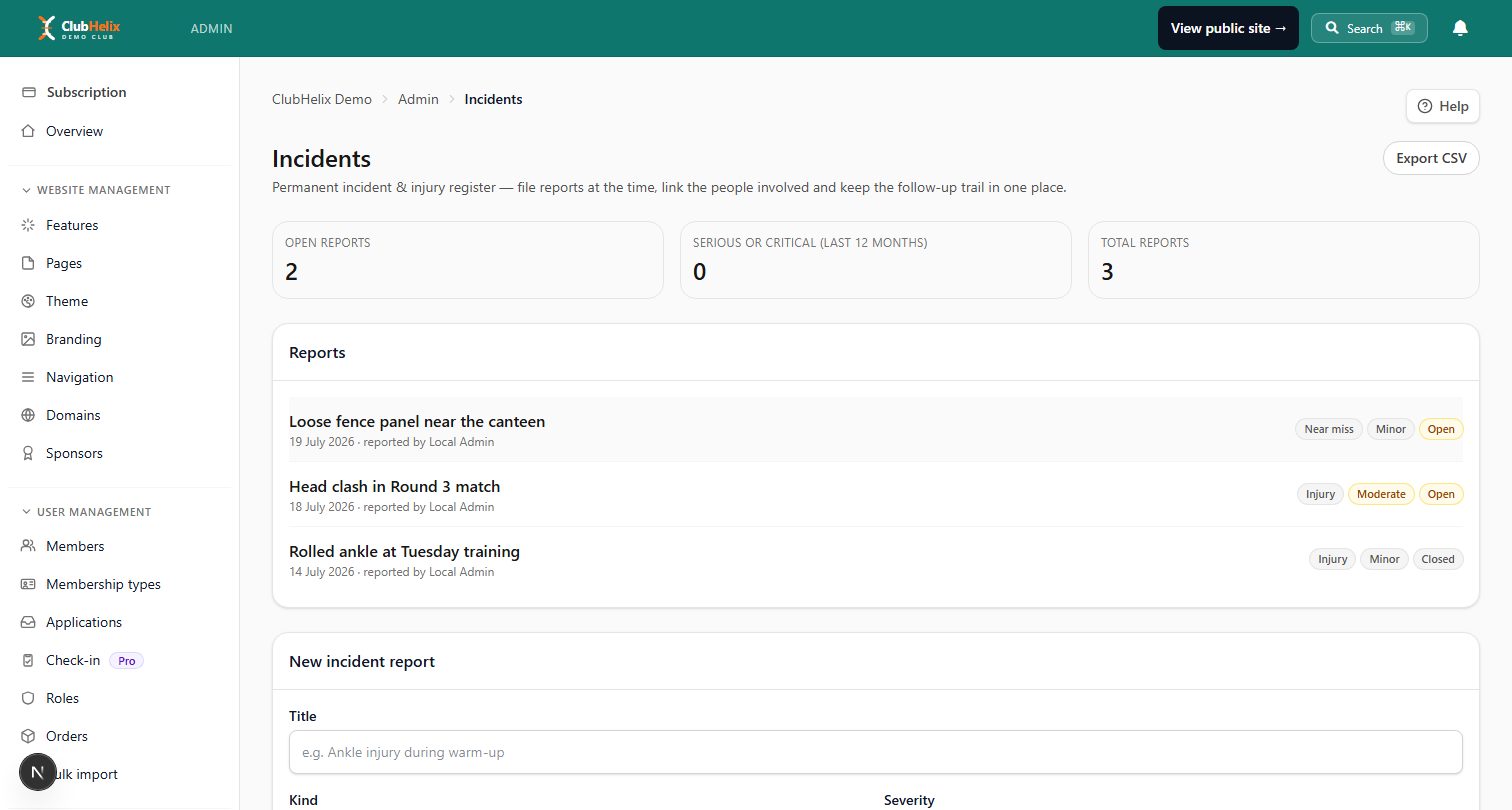
The complaints register is a permanent conduct register: category, severity, who handled the matter and the outcome, open to administrators only, and referable upward to your governing body. It sits deliberately beside incident reporting rather than inside it, because the product draws the same line your policy should — one register records what happened to a body, the other records what somebody alleges about a person, and a member-protection matter filed under injuries is a matter nobody will find. Both are available on the plans that carry them; the register itself is on every plan, including the free tier.
ClubHelix also models the shape you actually work in. Its multi-level hierarchy runs from a federation down through regions and sub-regions to individual clubs, each tier carrying a site and an admin of its own, so your association and every club affiliated to it keeps a register inside the same tree. One thing to be clear about before you write your policy, because it is the opposite of what most people assume: the visibility setting belongs to the body, not to the club. A body sets a descendant-visibility policy for its tree, and at the fullest setting its admins can read complaints and case notes held by the clubs directly beneath it — without a referral, and without anyone granting a role. Narrower settings exist, and a club further down the tree than your immediate children is not covered. Decide deliberately which setting your association should run on, say so in your policy, and tell your clubs — a complaints file that a club believes is private and a body can read is the worst of both, and the fix is disclosure rather than a different setting.
Around that, the audit log records every administrative action in an append-only, exportable trail — which is how you answer "who opened this file, and when" without anybody's word being the only evidence. Governance and meetings keeps agendas, recorded motions and minutes, so a board resolution about a policy change from your pattern review is findable next season rather than remembered differently by four people. Plans are published on the pricing page, and you can set an organisation up and have the register standing by well before the first matter arrives.
Frequently asked questions
When should a governing body take over a complaint from a club?
Take it on when the club cannot hear it impartially — because its own officers are parties, or the complaint is about the club as an organisation — when the conduct happened at your events or involves someone you accredit, or when your rules reserve that category to you. Where the club can properly hear it, refer it back with a date and ask to be told the outcome, and record that you did.
Who should sit on a governing body complaints panel?
People with no stake a reasonable member would recognise: nobody related to a party, holding a role at a party's club, nominated to your board by that club, or who has already expressed a view. Build a standing pool of eligible decision-makers and an independent chair before a live matter forces the question, because a small board can disqualify itself in about four minutes.
Does a stand-down mean a finding has been made against the person?
No, and your letter needs to say that in plain terms. A precautionary measure exists to manage a risk, it should be the smallest arrangement that does so and carry a review date, and writing down that nothing has yet been decided is what stops the stand-down being read afterwards as the decision itself.
What belongs in a complaints register?
A reference, the category and severity, who received and who handled the matter, the key dates, any external report made, the outcome, and any appeal — with access limited to administrators. Keep the register entry indefinitely, because it is the index that answers a question two years later, and keep the underlying file for the retention period your policy states.
How much can we tell an affiliated club about a complaint?
Enough for the club to give effect to any measure and no more: the fact of a sanction or condition, its terms and duration, and who to contact. The allegations, the statements and the complainant's identity stay with the panel and the parties, and deciding that once in your policy is far easier than negotiating it under pressure in every matter.
Keep reading — the club complaints and disputes process is the procedure your affiliated clubs should be running, and the incident report form template is what should reach you with anything that happened on the ground.


