
What this guide answers
- What should a parental consent form for a club include?
Six separate permissions rather than one: participation and the club's terms, medical treatment and first aid, photography and publication asked per use, transport and away trips, communication by channel and topic…
- Who can give consent for a junior member?
A person with parental responsibility for the child. That is usually a parent, including a separated parent who is not the one who filled in the form, and it is usually not a grandparent, a family friend or a paid…
- Can a child refuse to have their photo published if a parent has agreed?
A young person's own view carries more weight as they mature, and for something as reversible as a photograph the sensible club default is to take the more restrictive of the two answers.
- Can a parent withdraw consent partway through the season?
Yes, for everything except the participation agreement and the authorisation to get a hurt child treated, which a club may reasonably require.
- How often should a club renew junior consents?
Once a year, attached to membership renewal rather than sent as its own task, because families expect some administration when the season turns over.
Canada edition. This guide is written for volunteer-run clubs in Canada. Where rules differ — grants, tax, incorporation, safeguarding — follow the Canada-specific pointers below or check with your national body.
A parent emails the club one question on a Tuesday evening: what did I actually agree to when I enrolled my son? It is a fair question, politely asked, and at most junior clubs nobody can answer it. There is a registration form somewhere with a tick box near the bottom marked "I agree to the club's terms and conditions". There is a photograph of the boy on the club's news page from the come-and-try day. There is a group chat he was added to. There is a minibus that took eleven kids to a carnival two towns over. And there is a spreadsheet that went to the governing body in February. All of that came out of one tick.
That is the real problem with junior member consent, and it starts as a design problem rather than a legal one. Consent at a junior club is not one signature. It is six different permissions, collected as one, from an adult whose authority to give them the club has usually never checked, with no record of what the wording said on the day. Fix the design and most of the awkward conversations disappear.
This guide is general information for community clubs, not legal advice. Privacy law and child-safeguarding rules differ considerably between jurisdictions and change often — your national body and your own privacy regulator are the authorities on what binds your club. Treat this as help with asking them the right questions.
The six consents a junior club actually needs
Ask them separately. Six questions take a parent about ninety seconds longer than one tick, and they save a season of guesswork.
| Consent | What it covers | Who can give it | When it lapses |
|---|---|---|---|
| 1. Participation and the terms | Enrolment itself: training, fixtures, the code of behaviour, fees, the risk warning your sport requires | A person with parental responsibility for the child | Runs with the membership — re-agreed at every renewal |
| 2. Medical and first aid | Sideline first aid, calling an ambulance, and authorisation to seek treatment when no guardian can be reached | A person with parental responsibility | Each season, because the underlying detail changes faster than anything else on the form |
| 3. Photography and publication | Images and video, asked per use: clubroom wall, your own website, public social accounts, being named, media and sponsors | A person with parental responsibility, with the young person's view considered | Until withdrawn; re-ask annually because families change their minds |
| 4. Transport and away trips | Travelling with someone other than the family, overnight stays, billeting, who drives and who supervises | A person with parental responsibility | Per trip — a season-long transport consent is not a consent to any particular trip |
| 5. Communication | Who the club may contact, on which channel, and about what: team logistics, club news, fundraising, commercial offers | The guardian for a junior; the young person may hold their own channel later | Until withdrawn — treat a marketing opt-out as taking effect straight away, no conditions |
| 6. Data sharing | Registering the member with a governing body, an insurer, a competition or a facility, and what each receives | A person with parental responsibility | Per recipient and per purpose — a new recipient is a new consent |
Three of those deserve a note, because they are where clubs discover their one tick covered nothing.
Transport is the consent most often assumed. A parent who agreed at enrolment that their child "may travel to away fixtures" has not agreed to a particular Saturday, a particular driver, or a night away. Handle away trips as a short, per-trip permission naming the date, the destination, who is driving, who is supervising and when the child comes home — and keep the completed list with whoever is going.
Communication is the one that quietly breaks the club's own rules. A junior's own phone number is not a channel the club may use because it exists. Decide which messages go to the guardian, which the young person may receive directly as they get older, and keep anything commercial — sponsor offers, merchandise, fundraising pushes — on its own separate permission that can be declined without affecting anything else.
Data sharing needs naming, not hand-waving. "We may share your details with third parties" tells a family nothing and protects the club from nothing. Name the recipients you actually use, say what each one gets and why, and go back for a fresh consent when a new one appears. Your club privacy policy is where the detail lives; the form only needs the plain-English version.
Who can actually consent
Here is the rule clubs get wrong, and it is worth putting on the wall of the registration desk: a person who can collect a child is not automatically a person who can consent for them. Those are two different lists, and most clubs keep only one.
| Who is in front of you | May collect the child? | May give consent? | What the club should do |
|---|---|---|---|
| A parent recorded at enrolment | Yes | Yes | Record both parents where there are two, not just the one who filled in the form |
| A separated parent not named on the form | Usually | Usually — separation by itself rarely removes parental responsibility | Ask at enrolment who holds parental responsibility; where an order limits it, ask for the part that answers your question in writing |
| A grandparent, sibling or family friend at drop-off | Yes, if on the pick-up list | No | Keep a pick-up list that is visibly labelled "may collect" and says nothing about consent |
| A paid carer or support worker | If listed | No, unless the guardian has delegated it in writing | Ask the guardian to put any delegation in writing and note its limits on the record |
| A child in out-of-home care | Per the placement | Often not the carer — it may sit with an agency or an appointed decision-maker | Ask the placing worker, in writing, who signs what, and file the answer before the first session |
| A coach, team manager or committee member | Only if listed | Never | In an emergency they act under consent 2 above, which is exactly why consent 2 is collected in advance |
The separated-parent case is the one that turns into a complaint, and the club's job in it is narrow. You are not adjudicating a family arrangement. You are recording who holds parental responsibility, keeping both guardians reachable so neither learns about a grand final from someone else's post, and declining politely to be the messenger between them. Do not ask a family for a whole court order; ask for the part that answers the question you actually have, and keep only that.

When the young person's own view starts to matter
A junior is not a passenger in this. As a young person matures, their own view carries more weight, and many national bodies name a point at which the young person is asked alongside their guardian rather than about them — check what your sport says, because it will be more specific than anything a general guide can be.
The case that arrives first is almost always a photograph: a teenager who does not want their picture published, and a parent who has already ticked yes. A workable club default, published in advance so nobody negotiates it at half-time, is this. Where the disagreement is about something reversible and optional — a photo, a name in a results table, being in a highlight reel — take the more restrictive answer. Nobody is harmed by one fewer photograph, and a young person who learns that the club listened is a member for another decade. Where the disagreement is about something the club cannot simply decline, such as participation itself or emergency treatment, that is a conversation with the family and possibly your safeguarding officer, not a judgement call for a volunteer at the gate. Our guide to photography and image consent covers the publication side in depth.
Declining one item is not leaving the club
Every consent on the list above can be declined without the member being excluded — except the two that are the membership. Consent 1 is the agreement to join, and consent 2 authorises the club to act and seek help when a child is hurt and no guardian is reachable; a club may legitimately make both a condition of participation, and should say so plainly rather than burying it. Note that consent 2 authorises the club's people to act and to call for help. It is not a substitute for the treatment consent a clinician will seek for themselves.
Everything else is optional and the club's systems should behave accordingly. A child with no photography consent still plays, still gets a jersey, and still appears in the team on the fixture sheet — they are simply not in the gallery. A family who decline a governing-body data share may find the member cannot be registered for a particular competition, which is a real consequence and should be stated as a fact rather than used as pressure. Write the consequence of each decline next to the question. A parent who can see what they are choosing chooses faster.
Withdrawal: days, not the end of the season
A consent is not a contract. It can be withdrawn, and the club's promise is that withdrawal takes effect within days. That promise is only as good as the chain behind it, and the chain is manual at almost every club: one published contact point, an acknowledgement that does not ask why, the stored answer changed the same day, the people who act on it told — the comms volunteer, the team manager, whoever is rostered with a camera — and then a sweep of what is already out there.
Be honest about that last part, internally and with the family. No system reaches into an email already delivered, a newsletter already sent, or a printed program already handed out. Someone has to search the club's own site and accounts, remove or replace what they find, and say by when. A week is a realistic promise for a volunteer club and a kept promise beats an impressive one. Note the date and who actioned it, because the question will come back next season.
Making a consent provable a year later
The parent's Tuesday-evening email is answerable if four facts survive: who consented, what they consented to, when, and which wording they were shown. The fourth is the one everybody loses.
You do not need special software to keep it, but you do need a habit. Put a version label in the question text itself — "Photography consent (v3, updated March 2026)" — so the stored answer carries its own wording reference. Keep a dated copy of every version of the form in the club's files, so "v3" can be produced. Capture the date the answer was given, either from a dated question on the form or from the signature record on a signed acknowledgement. And keep the answers on the member's record rather than in a mailbox, because a mailbox belongs to whoever held the role at the time. If you run registration on ClubHelix, each of the six consents can be its own question on the form rather than one blanket tick, which is most of this problem solved at the point of collection.
An annual re-consent cycle that does not feel like paperwork
Consents go stale quietly. Contacts change, families separate, a young person grows up, a new competition appears. Re-ask once a year and nothing has to be reconstructed.
The trick is to attach it to renewal rather than to send it as its own task. People already expect to do something administrative when the season turns over, and nobody expects a form in the middle of the season. Keep it to the six questions, show last year's answers as the starting point where you can, and open with one line explaining why you ask again — "these answers are a year old and we would rather ask than assume" is enough. Most systems will not do this for you: put "re-ask the six consents" on the renewal checklist with a named owner and a date, or it will not happen.
A checklist for the registrar
- Split your form's single consent tick into the six questions above.
- Write the consequence of declining beside each optional one.
- Ask who holds parental responsibility, and record both guardians where there are two.
- Keep the pick-up list separate from the consent list, and label both.
- Put a version label and a date in each consent question's wording.
- Publish one withdrawal contact point, on the form and on the website.
- Name the people a withdrawal must reach, and check that list is current.
- Put the annual re-ask on the renewal checklist, with an owner.
- Ask your national body what it requires that this list does not cover.
Where the rules for your club come from
Two sources sit above the club wherever you are. Your national body's safeguarding or member protection policy will usually specify what consent it expects for junior participants, and your regional or state association's version adds the local detail — including the safeguarding check your jurisdiction requires of volunteers who supervise children. Those policies are generally built on a published set of child-safe principles with a regulator or commissioner overseeing them, and there is almost always a national information regulator putting out plain-language privacy guidance written for small organisations. Read both before you draft anything, name them in your own policy so families can see the club is following a framework rather than inventing one, and ask your safeguarding officer what your sport adds on top.
Collecting it on your own site
The reason junior consent ends up as one tick is usually that the form was built somewhere that made six questions hard. It does not have to be.
On ClubHelix, registration forms collect your own questions on your branded site, with your own terms, so each of the six consents can be its own question rather than one blanket tick — and a form does the same job for an away trip that needs its own permission. Digital waivers are signed online and held against the member record, which is where a signed acknowledgement belongs rather than in a folder behind the bar. Roles and permissions control who in the club can see a member's details, so the under-12 manager is not reading the whole junior program's answers. Member records carry an optional date of birth used for age-group eligibility. A child can be on the register without an account of their own, with a parent or guardian linked to the record, so an email about their team reaches the adult who consented rather than the child.
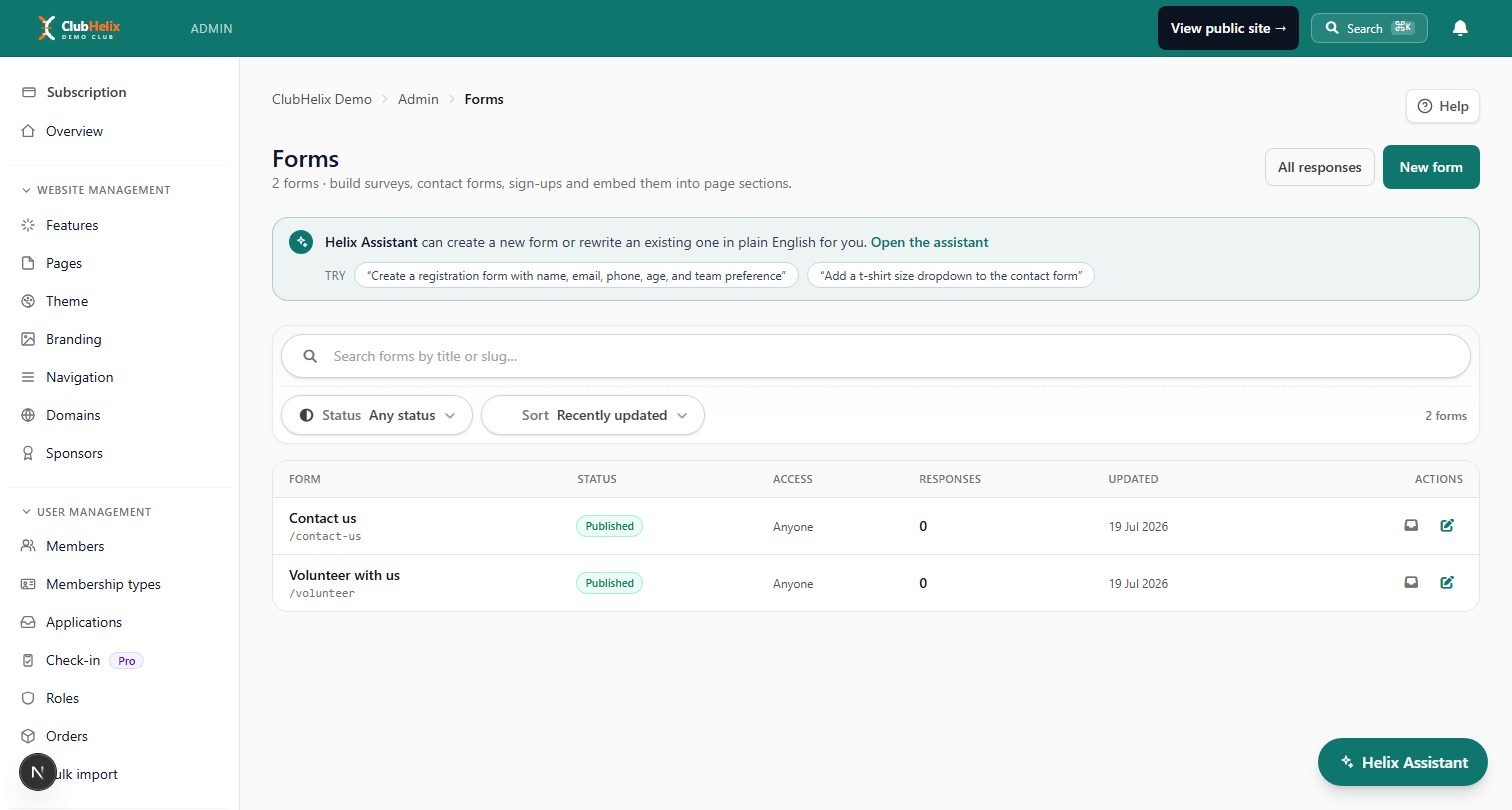
Be clear-eyed about what is still yours to do by hand. Nothing versions your consent wording for you, so the version label goes in the question text. Nothing re-asks the six questions on an anniversary, so the annual cycle is a checklist item with an owner. A withdrawal means someone at the club changes the stored answer; it does not reach back into newsletters already sent or galleries already published, so somebody sweeps. And no club system verifies a volunteer's safeguarding check against a government register — the club sights the document, records the number and the expiry, and re-checks it. Plans are on the pricing page, and the free tier is enough to build the form properly before next enrolment day — start your club site and split that one tick into six. If you are rebuilding the rest of your forms at the same time, how to set up online club forms covers the order to do it in.
Frequently asked questions
What should a parental consent form for a club include?
Six separate permissions rather than one: participation and the club's terms, medical treatment and first aid, photography and publication asked per use, transport and away trips, communication by channel and topic, and any data sharing with a governing body or insurer. Each needs a named person answering, a date, and a version reference for the wording they were shown.
Who can give consent for a junior member?
A person with parental responsibility for the child. That is usually a parent, including a separated parent who is not the one who filled in the form, and it is usually not a grandparent, a family friend or a paid carer — being authorised to collect a child is a different thing from being able to consent for them. Where a child is in out-of-home care, ask the placing worker in writing who signs what.
Can a child refuse to have their photo published if a parent has agreed?
A young person's own view carries more weight as they mature, and for something as reversible as a photograph the sensible club default is to take the more restrictive of the two answers. Publish that default in your policy so a volunteer is not negotiating it on the sideline, and check what your national body says, because some set an explicit point at which the young person is asked alongside their guardian.
Can a parent withdraw consent partway through the season?
Yes, for everything except the participation agreement and the authorisation to get a hurt child treated, which a club may reasonably require. Publish one contact point, acknowledge without asking why, change the stored answer the same day, tell the people who act on it, and give an honest timeframe for removing what is already published.
How often should a club renew junior consents?
Once a year, attached to membership renewal rather than sent as its own task, because families expect some administration when the season turns over. Show last year's answers as the starting point, keep it to the six questions, and treat any new recipient of member data as a fresh consent rather than something the old tick covered.
Keep reading — emergency contact and medical forms for clubs covers what to collect for consent 2 and who should be able to see it, and photography and image consent at clubs covers consent 3 in full.

