
What this guide answers
- Does my club need a website if we already have a social page?
Yes, for jobs the page cannot do — being found by people who do not know your club's name, holding permanent answers about fees and how to join, taking registrations and payments, and giving funders and sponsors…
- Is a club group enough for a small club?
For a very small, free, invitation-only group it can be. As soon as you charge fees, recruit strangers, chase grants or run teams, the group starts costing volunteer hours in retyped answers and missed messages — and…
- Why do so few of our members see our posts?
Because several filters sit between you and them — members who have no account, members who never joined the group, an algorithm deciding what to show, and the simple fact that many people do not open the app that day.
- Should we stop posting once we have a website?
No. The two do different jobs.
- What should we do if we lose access to our club page?
Prevent it rather than fix it — keep at least three current committee members as admins, review that list at each AGM, and never let the page depend on one personal account.
Canada edition. This guide is written for volunteer-run clubs in Canada. Where rules differ — grants, tax, incorporation, safeguarding — follow the Canada-specific pointers below or check with your national body.
Somebody has asked what time the under-12s train. It is the fourth time this month, and the answer is genuinely there — in a post from early March, twenty-one posts up, under a photo of the working bee. The secretary types it out again anyway, because it is faster than explaining where to scroll. Multiply that by every question a club gets in a season and you have a fairly precise measurement of what a group costs you.
None of which means the group is a mistake. It is free, your members are already there, and it does two things brilliantly: it moves fast, and it lets people talk back. A club that abandons social for a website nobody visits has traded a busy room for an empty one.
The trap is treating a group as the club's home. A group is rented ground. You do not own the address, you cannot export the contents, someone else's algorithm decides which of your members see a post, and the questions people ask before they join — what does it cost, where do you train, do you have a girls' team — are asked in a search box your group cannot appear in. This guide covers where prospective members actually search and where they land, why so many of your own members never see what you post, and a practical split between the two so you are not publishing everything twice.
Start with what a group does well
Being fair to the group first makes the rest of this argument easier to accept in a committee meeting.
- Speed. A photo from Saturday's game is up in forty seconds, from the boundary, on a phone.
- Conversation. Members reply, tag each other, argue about the umpire. A website cannot manufacture that.
- Reach into networks you have no access to. A parent shares a post and eleven families who have never heard of you see your name.
- Zero setup. No domain, no design decisions, no cost.
- Warmth. It shows a club as a group of people rather than an institution. That matters more to a wavering newcomer than any brochure copy.
Keep the group. The argument is not group-or-website; it is which jobs go where.
The search problem — what people type, and where they land
Almost everything a club wants from the internet begins in a search box, and the searches that matter most come from people who do not yet know your club's name.
| What someone actually types | What they want | Can a social group win this |
|---|---|---|
| "netball club near me" | A shortlist with locations | No — this is a map and website result |
| "junior soccer registration fees [suburb]" | A number | Rarely, and not reliably |
| "[club name] training times" | This week's schedule | Sometimes, if the post is public and recent |
| "[club name]" | Anything official | Yes — your page usually ranks |
| "how to join a hockey club as an adult beginner" | Reassurance and a next step | No |
| "[club name] committee contact" | An email address | Almost never |
Two things are going on. First, content inside a group — especially a private one — is largely invisible to search engines, and even public posts are short-lived, poorly titled and buried in a feed. A page on your own site titled "Junior membership fees and how to join" is a permanent, findable answer; a post saying the same thing is gone in a fortnight.
Second, the people you most want are the ones who cannot find you by name, because they do not know it yet. They search for the sport and the suburb. Winning those searches is a website job — how to build a sports club website covers the pages that do it — plus a properly filled-out Google Business Profile, which is what puts you on the map with your hours, photos and a link.

Newcomers in Canada also arrive through channels that expect a website link. Municipal recreation guides, provincial association club finders and community centre listings all carry a URL field, and a social link there reads as a club that has not organised itself. Claiming and correcting those listings is cheap, slow-burning recruitment.
The reach problem — the members who never see your posts
Committees consistently overestimate how many people a post reaches, because the people who reply are the same twenty every week and they feel like the club.
Work through the arithmetic with your own numbers. As an illustration only, take a club with 300 members and 500 followers:
- Some members have no account on that platform at all — older members, some parents, anyone who has quit social media.
- Of those who do, a portion never joined the club group, because nobody asked them to.
- Of those in the group, the feed shows your post to some fraction, decided by an algorithm you do not control and cannot appeal.
- Of those shown it, only the ones who open the app that day see it.
- Of those, some scroll past because it looks like the post from Tuesday.
Every step is a filter, and none of them are visible to you. A post that "did well" can still have missed the parent who needed to know their child's game moved to the other ground. That is why time-critical information — cancellations, venue changes, registration deadlines — should never live only in a feed. Put it where you control delivery: an email to the member list, a text for the truly urgent, a notice on your own site that anyone can check without logging in. Our wet-weather communication plan sets out the order.
There is also a fairness dimension. Requiring an account on a commercial platform to find out when training is excludes members who have deliberately left it, and it makes it harder for people who use screen readers or who simply do not use the platform well. A page on your own site is available to everyone, and if you build it properly it is accessible too.
Rented ground — the things you do not own
The group belongs to the platform. Four failure modes clubs hit regularly:
- The admin who left. The only person with admin rights resigns, moves away or falls out with the committee. Every year clubs lose control of their own page this way. Have three admins, all current committee members, and review the list at the AGM.
- The account that got disabled. Pages are created under a personal profile. If that profile is suspended for something unrelated, the club page can go with it.
- The rules that changed. Reach, formats and what you may post are set by the platform and can change without notice. Nothing you built is portable.
- The stuff you cannot export. Five years of club history — photos, results, tributes, the record of a premiership year — sits in a feed you cannot back up in any useful form. Your own site can be exported and archived, and recording your club's history is a genuine reason on its own.
Your website is the opposite of all of that. You own the domain, you can move hosts, you can export the content, and nobody puts a competitor's advertisement beside your registration post.
The division of labour
This is the practical heart of it. Decide once where each type of content lives, write it into your club marketing plan, and stop debating it weekly.
| Content | Lives on your website | Posted to social |
|---|---|---|
| Membership fees and categories | Yes — a permanent page | A link when registration opens |
| How to join | Yes — the join button lives here | Link, repeatedly, in season |
| Fixtures, draws, ladders | Yes — one source, always current | Weekly "who we play" post with the link |
| Match reports and results | Yes — findable next year | Photo plus a line, linking back |
| Events and ticket sales | Yes — the ticket page | Promotion, three or four posts |
| Committee, constitution, policies | Yes | Never, apart from an AGM notice |
| Sponsor logos and pages | Yes — permanent value | Occasional thank-you posts |
| Photos from Saturday | A gallery, curated | Yes — this is what social is for |
| Wet-weather calls | Yes — a notice, plus email or text | Yes — but never only here |
| Congratulations, milestones, banter | Optional | Yes — the whole point |
| Contact details | Yes | In the bio |
The rule of thumb: your website holds the answer, your social posts point at it. Every post that contains information found nowhere else is a future question for your secretary.
A weekly rhythm that uses both
- Monday — results and a short match report on the site; a photo post linking to it.
- Wednesday — this week's fixtures and any venue changes on the site; a "who we play" post.
- Friday — the reminder that matters (canteen roster, ticket deadline) by email or push, not just a post.
- Saturday — photos as they happen, on social, where they belong.
- Whenever it rains — the call on your own site and by direct message, then a post.
That is roughly twenty minutes of work if the site and the sending live in the same system, and about ninety if they do not. How to promote a club event has the campaign version of the same idea.
Moving people from rented ground to ground you own
Followers are not a list. You cannot email them, you cannot segment them, and you lose them all if the platform changes its mind. The whole point of the group is that it feeds something you control.
- Put the join link in the group description, the bio and every second post.
- Run one post a month whose only job is "get on the club email list" — with a form, not a comment thread.
- Use a QR code at the ground, on the canteen wall and on registration flyers; it lands on your site, not a feed.
- Answer repeat questions with a link to the page that answers it, rather than retyping. It trains people where to look and improves that page's standing in search.
- When someone comments "how do we join?", reply publicly with the link and message them privately as well.
The measure of success is not follower count. It is how many people arrive on your join page from social each month, and how many finish. If nobody can tell you that number, start there — and read how to grow club membership for what happens after they land.
Where funders and partners look
The audience that quietly decides whether you should have a website is not your members at all.
Funders in Canada — community foundations, municipal grants, provincial sport funding and local sponsors — expect a real website and will check before committing. Donors also look for evidence of who runs the club and how funds are used, which is a website page rather than a post that scrolled away last spring.
The data question nobody asks
If your group is where members share phone numbers, medical notes or photos of juniors, your club has quietly moved member information onto a platform it does not control and cannot audit.
Privacy law in Canada applies to member information your club collects, and provincial rules add to the federal position. Treat this as general information, check the current requirements with the relevant privacy office and your provincial association, and keep member records in a system the club controls rather than scattered through a social platform.
One home, many front doors
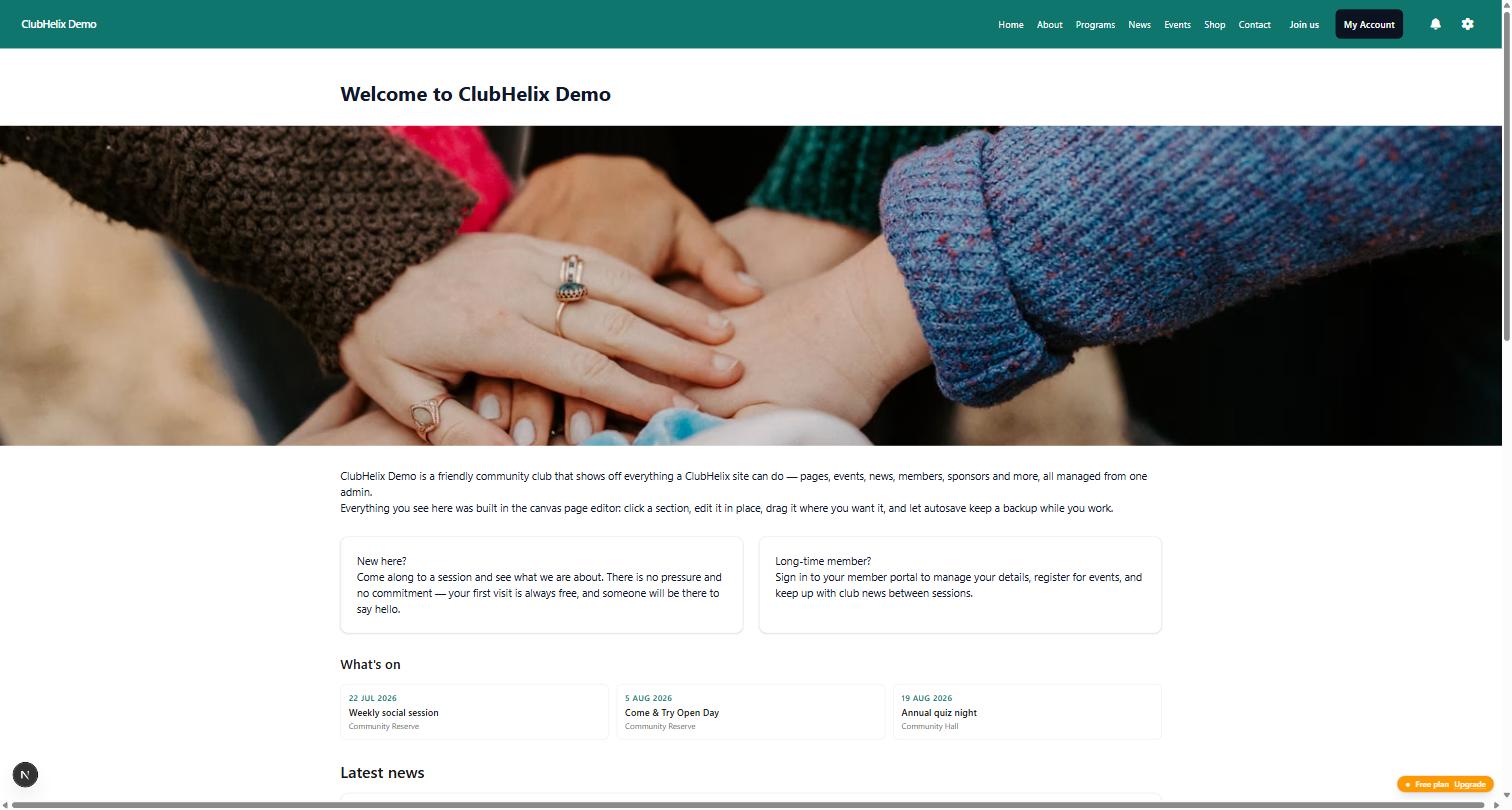
The version of this that actually works is a website that is easy enough to update that the social posts have somewhere to point. In ClubHelix, the canvas page editor lets a committee member change the fees page in a couple of minutes, news posts give match reports a permanent home worth linking to, and events turn a function into a page with a ticket button — the link you paste into a post.
If your club's entire online presence currently lives on borrowed ground, it takes an evening to fix. Start on the free tier, look at the pricing only when you have outgrown it, and point your own custom domain at the result so every future post links to an address the club owns. Set your club site up this week and keep posting exactly as you do now — just with somewhere to send people.
Frequently asked questions
Does my club need a website if we already have a social page?
Yes, for jobs the page cannot do — being found by people who do not know your club's name, holding permanent answers about fees and how to join, taking registrations and payments, and giving funders and sponsors something credible to look at. Keep the page for conversation and photos; add a site for everything that has to stay findable.
Is a club group enough for a small club?
For a very small, free, invitation-only group it can be. As soon as you charge fees, recruit strangers, chase grants or run teams, the group starts costing volunteer hours in retyped answers and missed messages — and it cannot be found by the people you want to recruit.
Why do so few of our members see our posts?
Because several filters sit between you and them — members who have no account, members who never joined the group, an algorithm deciding what to show, and the simple fact that many people do not open the app that day. Never rely on a post alone for anything time-critical.
Should we stop posting once we have a website?
No. The two do different jobs. Post as often as you like, but make each post point at a page that holds the detail, so information stays findable after the post has scrolled away and your secretary stops answering the same question every month.
What should we do if we lose access to our club page?
Prevent it rather than fix it — keep at least three current committee members as admins, review that list at each AGM, and never let the page depend on one personal account. Recovery processes exist but are slow and uncertain, which is exactly why the club's real home should be a site you own.
Keep reading — club social media ideas covers what to post, and club website content ideas covers what belongs on the site those posts point at.


