
What this guide answers
- What should a club website include at minimum?
Five things cover the overwhelming majority of visits: a homepage that says what/where/who in one screen, a join page with real fees and an online registration form, current fixtures or training times, venue addresses…
- How often should we update the club website?
Structure pages (fees, teams, venues, key dates) need a proper refresh once per season, before registration opens.
- Who should write club website content?
Spread it by proximity, not by job title: team managers write match reports, the registrar owns joining content, the treasurer checks the fees page, one comms volunteer handles spotlights and events, and the secretary…
- Do club websites help with attracting new members?
Yes — measurably, because they're where every other channel converts.
"We've got a website — we just never know what to put on it." Every club says this eventually. The structure gets built once (if you haven't done that yet, start with our guide to building a club website), and then the harder question arrives: what actually goes on the pages, and what keeps them worth visiting all season?
This guide is the answer in list form: more than thirty content ideas, organised by page type, with honest notes about which ones earn their upkeep and which ones quietly rot. Steal freely — none of this requires a designer or a copywriter, just a committee that knows what its members and prospects actually want to read.
Once you know what goes on a page, the next question is where it goes on the page. Our companion guide to club website page layout covers which ideas belong in the main column and which work best in a sidebar.
Two principles before the list:
- Content that answers a question beats content that makes an announcement. Every "what time is training?" answered on the site is a message the secretary doesn't answer at 9pm.
- Only publish what someone will maintain. A page that's wrong is worse than a page that doesn't exist. Each idea below notes its upkeep cost — pick the ones your volunteer capacity can honestly sustain.
Homepage content (the 10-second test)
Your homepage has one job: let a stranger work out what, where, who and how-to-join in ten seconds. Ideas that serve that job:
1. A one-sentence "what we are" banner. Sport, suburb, who's welcome. "Junior and senior hockey in Brisbane's north — beginners always welcome." Upkeep: none.
2. Next fixture / next event strip. The single most-checked piece of information in season. On a good platform this updates itself from your fixtures. Upkeep: automatic or weekly.
3. A big, unmissable Join button. During registration season, make it the loudest thing on the page. Upkeep: seasonal.
4. Three real photos of club life. Players mid-game, juniors training, the crew behind the food counter (with consent sorted at registration). Swap them each season so the site never looks frozen in time. Upkeep: seasonal.
5. Sponsor logo strip. Sponsors check that they're visible; prospects read logos as credibility. Upkeep: when sponsors change.
6. Latest news teasers. Two or three most recent posts, pulled automatically from your news section. A dated post from last week signals a living club. Upkeep: automatic.
News & match report ideas (your freshness engine)
A news section is the difference between a brochure and a club. It's also your social media supply line — publish here, share the link there.
7. Match reports. The classic, and still the best. Three paragraphs, a photo, player of the match. Delegate to team managers — one report per team per round is sustainable; one person writing all of them is not.
8. "Registrations are open" posts. Your highest-converting content of the year. Include fees, dates, and the registration link in the first two lines.
9. Volunteer spotlights. One per month: photo, three questions, genuine thanks. Costs twenty minutes, pays in retention — volunteers who feel seen stay.
10. Milestone posts. 100 games, 50 years of the club, first championship since 1998. These get shared beyond your usual audience and make great local-paper material for your club marketing plan.
11. Season previews and wraps. Pre-season: new coaches, key dates, what's changed. Post-season: results, awards, thank-yous. Two posts a year, high value.
12. "New to [your sport]?" explainers. What a beginner needs to know: gear, rules in plain words, what the first session looks like. Evergreen — written once, linked from every registration campaign, quietly recruiting via search all year.
13. Wet-weather and ground-status updates. If your sport gets called off, a single known place for "is training on?" earns more goodwill than anything else you publish. Upkeep: only when it rains — but it must be reliable, so name an owner.
Team & playing pages
14. A page per team. Training night, home ground, coach and manager (role email, not personal mobile), and the fixture. Upkeep: pre-season refresh.
15. Coach and committee bios. Two sentences and a photo per person. Parents choosing a junior club read these more than you'd think. Upkeep: annual.
16. Fixtures, results and league standings. If your platform publishes these automatically from your competition, this is your most-visited in-season content at zero volunteer cost. If someone types them in weekly, they'll stop by round six — automate or skip.
17. "Where we play" venue pages. Every ground with a map that opens in the phone's map app, parking notes, and food and toilet info. Your most-visited page in winter.
Membership & joining content
18. A fees page with actual numbers. Every category, what's included, family discounts, and payment options. Hiding fees behind "contact us" costs you sign-ups every registration season.
19. An FAQ for new families. Ten real questions with plain answers: what to wear, what to bring, how teams are picked, refund policy, how the season works. Harvest the questions your registrar actually gets asked.
20. "Your first session" walkthrough. Where to park, who to look for, what happens in the first hour. Removes the last drop of social friction for nervous newcomers.
21. Uniform and gear guide. What's compulsory, what the club lends, where to buy — linked to your club shop if you sell merchandise online.
22. Financial assistance info. Most states and territories run sports voucher programs that rebate registration fees for kids. A short paragraph explaining that you accept them (and how) removes a real barrier — and most clubs never mention it.
Events content
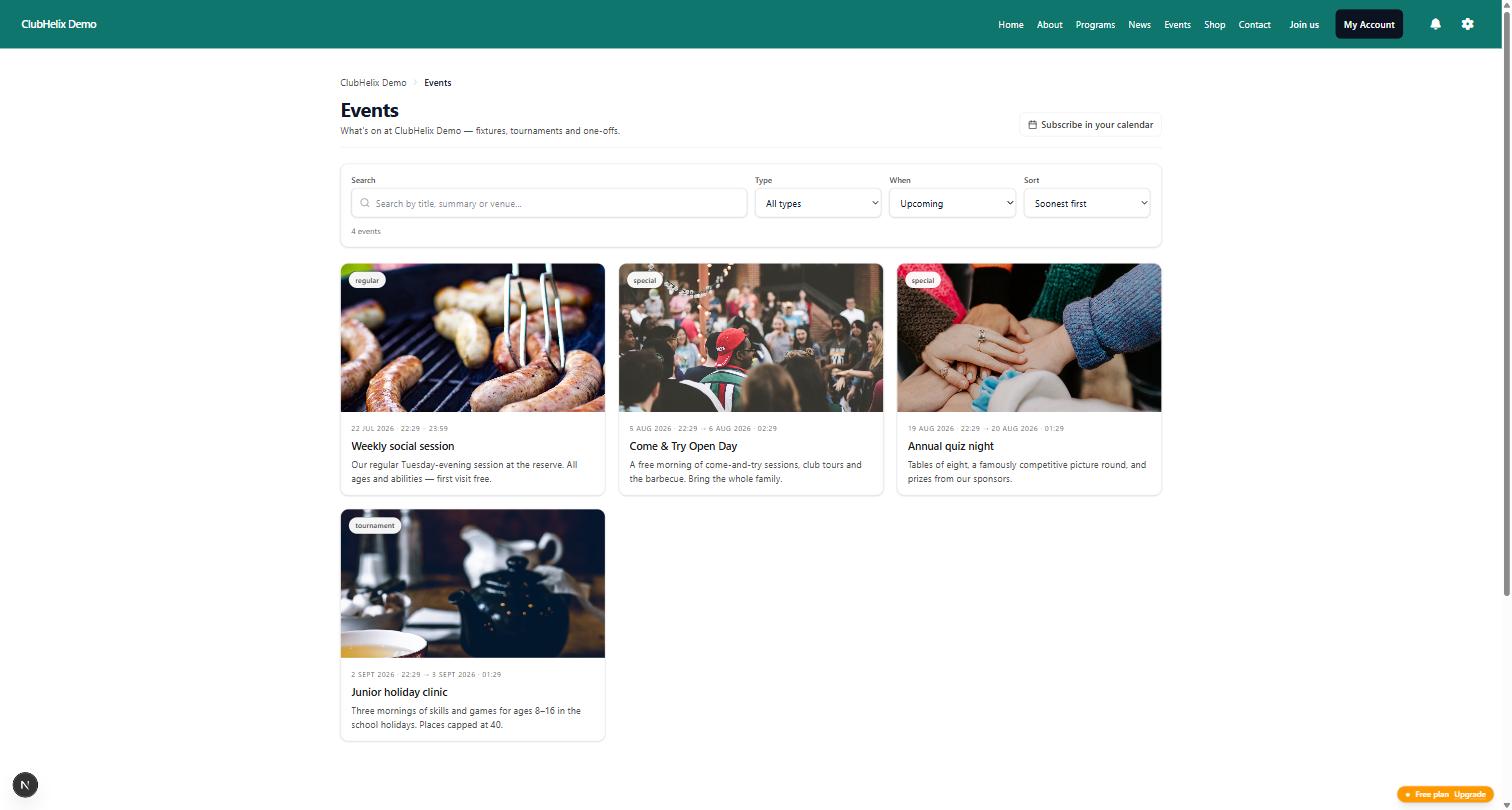
23. Event pages with RSVP or tickets. Presentation night, registration day, gala day, trivia night. A page with date, time, price and a working RSVP beats a PDF poster in every measurable way.
24. An annual key-dates page. Season start, rep trials, photo day, AGM, presentation night — one page parents bookmark at the start of the season and check all year. Upkeep: annual, plus edits.
25. Fundraiser pages. The sausage sizzle roster, the raffle, the working bee — each with a clear "how to help" action.
Sponsor & community content
26. A sponsor page with tiers. Logo, link and a sentence for every sponsor, organised by tier. This page is really for next year's sponsors — it shows them what they'd get.
27. "Sponsor a junior" or equipment wishlist. Concrete asks with a price on them ("cover a set of match balls") convert better than "support the club".
28. Community impact snapshot. Numbers a grant assessor loves: members, volunteer hours, juniors coached, years serving the community. Update annually; reuse in every grant application.
About, history & governance
29. A short club history page. Founding story, honour boards, premiership lists. Written once, loved forever, especially by long-time families. Low upkeep by design.
30. Committee and contacts page. Every role with a role-based email (secretary@…). Institutional addresses survive committee turnover.
31. Policies and documents. Constitution, codes of conduct, child-safety policy, privacy note. Unsexy, but grant applications and school partnerships increasingly check for them.
32. AGM and annual report page. Date, papers, and last year's report. Transparency reads as health.
Member-only content (if your platform supports it)
33. Member noticeboard or chat. Lift shares, kit swaps, volunteer calls — conversation that shouldn't live on a public platform (see our social media guide for why).
34. Documents for members: team contact lists, roster spreadsheets, canteen duty — behind a login, not on the public internet.
Seasonal content calendar (so it actually happens)
Ideas without owners are wishes. Map the list to your season:
| When | Publish | Owner |
|---|---|---|
| Pre-season | Fees page, key dates, season preview, "new to the sport" refresh | Secretary |
| Registration weeks | Registrations-open post, first-session guide, assistance info | Registrar |
| Each round | Match reports, results | Team managers |
| Monthly | Volunteer spotlight, event pages as needed | Comms volunteer |
| Post-season | Season wrap, presentation night gallery, sponsor thank-you | President |
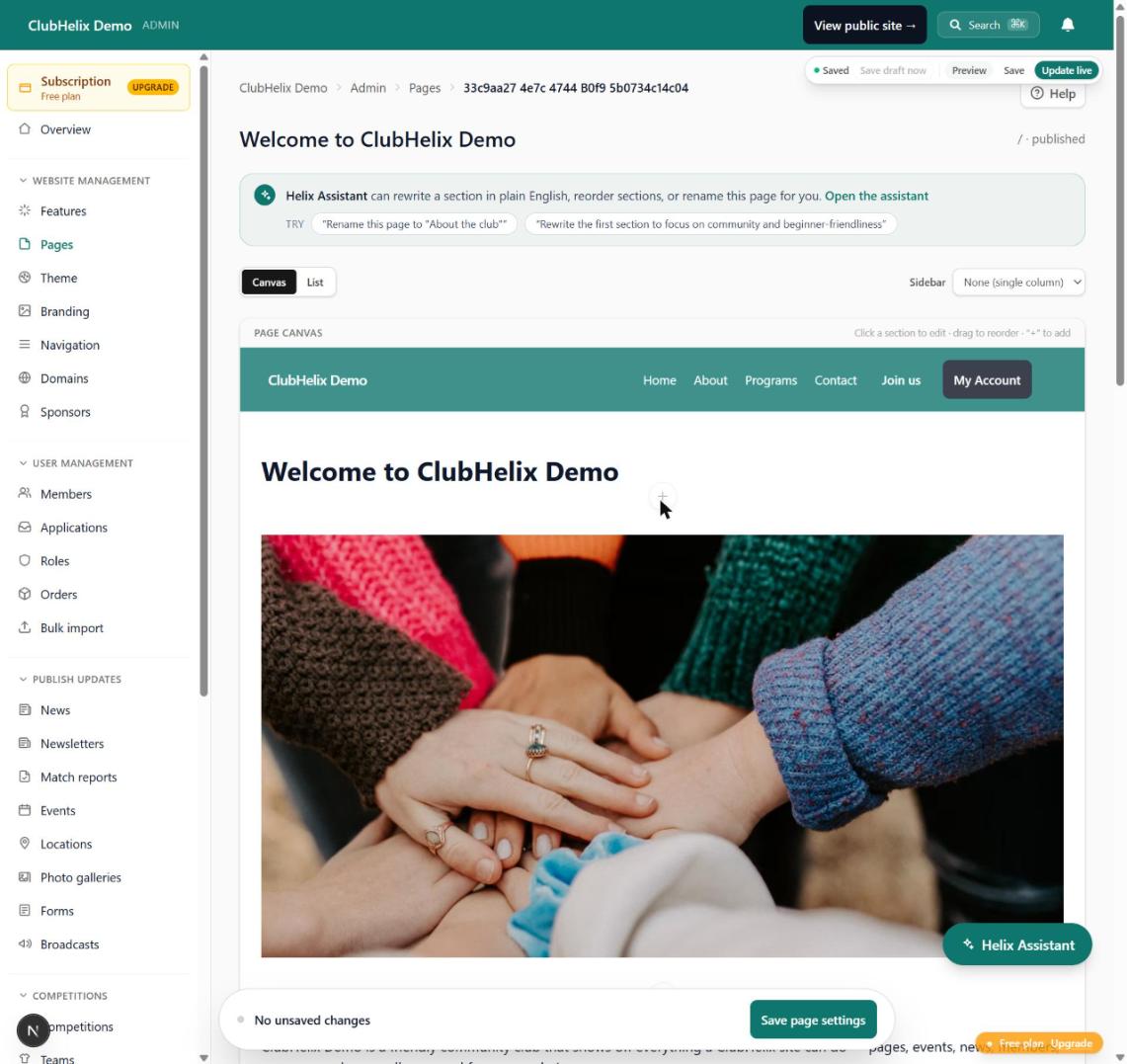
The tooling matters here: if publishing requires the one volunteer who "knows the website", the calendar dies mid-season. A drag-and-drop page editor that any committee member can use — sections for text, photos, fixtures, sponsors — is what makes a content plan survivable across committee changes.
What to leave off
Just as useful as the list above:
- "Coming soon" placeholder pages. They read as neglect. Launch fewer, finished pages.
- Anything with a personal mobile or personal email. Role addresses only — people change, roles don't.
- Content duplicating your governing body. Link to the association's rules and rep pathways instead of maintaining stale copies.
- The uncurated photo dump. Ten great photos beat four hundred unsorted ones; galleries need consent hygiene too.
- A blog nobody committed to. If no owner is named in the calendar above, don't create the section.
Frequently asked questions
What should a club website include at minimum?
Five things cover the overwhelming majority of visits: a homepage that says what/where/who in one screen, a join page with real fees and an online registration form, current fixtures or training times, venue addresses with tappable maps, and a contact page with role-based emails. Everything else in this guide is worthwhile expansion, but if those five are current, your website is already doing its core job better than most club sites.
How often should we update the club website?
Structure pages (fees, teams, venues, key dates) need a proper refresh once per season, before registration opens. The news section should move at least fortnightly in season — match reports delegated to team managers make that nearly free. The honest rule: publish at whatever pace you can sustain all year, because a site that visibly stopped months ago tells visitors the club might have too.
Who should write club website content?
Spread it by proximity, not by job title: team managers write match reports, the registrar owns joining content, the treasurer checks the fees page, one comms volunteer handles spotlights and events, and the secretary keeps governance pages current. The website owner's real job is chasing the calendar, not writing everything. Modern club platforms make this practical by letting multiple people edit safely with their own logins and permissions.
Do club websites help with attracting new members?
Yes — measurably, because they're where every other channel converts. Search brings people who typed "your sport + your area"; social posts and flyers point at your pages; your Google listing links there. A site with visible fees, a real registration form and evergreen "new to the sport" content turns that traffic into sign-ups, and it works while your volunteers sleep. It's the one marketing asset your club fully owns.
Every idea on this list is a section your committee can drag onto a page: ClubHelix's canvas page editor plus built-in club news make the content calendar something any volunteer can run. See how to structure the whole site and start free.


