
What this guide answers
- Is a governing-body club website free?
Often, yes, in the sense that there is no subscription. 8% added per Stripe transaction and enterprise tiers on request.
- Can we have our own domain on a governing-body platform?
It depends entirely on the platform and the arrangement, so ask rather than assume.
- Can we run our own website and still use the platform for bookings?
Yes, and it is the most common sensible outcome. Keep bookings, registrations and anything mandated where it works, and run your public site, news, sponsors and commerce on something you control.
- What actually happens if the platform provider changes?
Your login, your site's address and your configuration typically change on a timetable set by the governing body, and historical data may or may not migrate cleanly.
- Which is better for a tennis club?
If courts and coaching programs are the core of your operation and you are eligible for a governing-body platform, its booking depth is hard to argue with.
Do this before you read any further. Open a browser, type your club's name and your suburb, and look at the first result. If your club runs on a governing-body platform, that result is very likely a page on the governing body's domain — a tidy, functional, entirely competent page that you did not design, cannot restyle beyond the options given, and could not move somewhere else if you wanted to. It is also, in search terms, the strongest page about your club on the internet, and none of its accumulated authority belongs to you.
That is not a scandal. It is a bargain, and for thousands of clubs it is a good one: the governing body funds a platform, the club gets booking, membership and a site for nothing, and a volunteer who would otherwise be wrestling a website builder gets their Sunday back. But it is a bargain with terms, and most committees have never read them.
ClubSpark and Pitchero sit on opposite sides of that bargain. This guide compares them on the three questions that actually differ — who owns the domain, the data and the design; how each handles court and facility booking; and what happens to your club if the governing body changes supplier. Along the way there are two checklists you can run at your next committee meeting.
Worth knowing who is talking. ClubHelix is ours, and it sits squarely on one side of this argument — we sell the model you buy and control, not the model a governing body hands you, so discount us where you should. Against ClubSpark specifically we have less of a quarrel than you might expect; their distribution model is one we openly admire. Everything factual below is what these companies publish, current as at July 2026, and where we are offering an opinion rather than a fact, we label it.
What each one actually is
ClubSpark, built by Sportlabs, is a white-label club platform distributed through governing bodies rather than sold to clubs. Its best-known deployment is with the LTA for tennis in the UK, with cricket heritage through the ECB, and it has run in the United States with the USTA and has history in Australian tennis. The product covers court and venue booking, membership, coaching programs and a club website. On the published arrangement it is free for LTA-registered venues and accredited coaches, with ClubSpark adding 0.8% per Stripe transaction, and enterprise tiers available on request. Its network effect is enormous and easy to overlook — thousands of club sites live on governing-body subdomains and rank for essentially every club name in the sport.
Pitchero is the other model entirely: a Leeds-based grassroots club platform you buy. Club website, branded club app, membership and payments, team pages and player stats, plus governing-body fixture and league feeds with football and rugby union heritage. Pricing is published — a free tier, Standard at £38 a month and Pro at £99 a month, with payment fees from 2.42% + 17p on Standard to 1.67% + 15p on Pro, no payments on the free tier, 30-day trials and annual discounts advertised. It is UK-first but sells in Australian, New Zealand and US currencies, and it sits behind a very large network of hosted club sites.
The distinction that matters is not features. It is who the customer is. On a governing-body platform, the customer is the governing body and the club is a tenant. On a subscription platform, the club is the customer. Everything downstream — how fast things change, whose priorities win, what happens at renewal — follows from that.
Side by side
| Area | ClubSpark | Pitchero |
|---|---|---|
| Model | White-label, distributed through governing bodies | Direct subscription bought by the club |
| Cost to the club | Free for LTA-registered venues and accredited coaches | Free tier; Standard £38/mo; Pro £99/mo |
| Transaction cost | Adds 0.8% per Stripe transaction | From 2.42% + 17p (Standard) to 1.67% + 15p (Pro) |
| Enterprise options | Tiers on request | Annual discounts; 30-day trials |
| Court/venue booking | Yes — booking at national scale is a core strength | Built around website, app, membership and team stats |
| Coaching programs | Yes — coaching and programs are part of the product | Membership and team structures |
| Branded app | No separate club app published — check your governing body's setup | Yes — native branded club apps |
| Fixtures and stats | Not published as a general fixtures and stats product | Governing-body league feeds and team stats depth |
| Website address | Typically a governing-body subdomain | Club-branded site on the platform |
| Home base | London, UK; deployments in the US and history in Australia | Leeds, UK; sells in AU, NZ and US currencies |
Who owns the domain, the data and the design
Three separate questions that committees tend to merge into one vague feeling about control. Separate them and each has a clear answer.
The domain
A website address on a governing body's domain is not your address. Practically, that means three things. Search authority accrues to the host domain rather than to your club, so the page ranks well — often better than a small club could manage alone — but the benefit is not portable. Your printed material, sponsor boards and social profiles end up carrying a URL that belongs to somebody else. And if you ever move, every link ever shared points at a page you no longer control.
The hedge costs about the price of two coffees a year and takes an afternoon: register your club's own domain regardless of what platform you use. Even if it only redirects to the platform page today, you own the address, you can point it somewhere else tomorrow, and every business card printed between now and then stays correct. Our guide on buying a domain for a club covers who should hold the registration — hint, not a departing secretary's personal account — and how to keep it renewing after the person who bought it moves on.
The data
Ask two questions and write the answers into your minutes. First, who is the data controller for your member records — the club, the platform provider, or the governing body? Second, can you export the complete member list, contact details, payment history, booking history and consents yourself, without submitting a request? On a subscription platform the answer to the first is usually straightforward. On a governing-body platform it is more layered, because the governing body has its own legitimate need for participation data, and that is not sinister — but it does mean your privacy documentation should describe the arrangement accurately rather than vaguely.
The design
This is the one people feel first and can least articulate. A white-label platform gives every club in the sport the same structure with a logo and a colour swapped in. That is a deliberate trade: consistency for participants, zero design decisions for volunteers. The cost is that your club looks like every other club, which matters most for the two audiences that pay for things — sponsors deciding whether you look worth £2,000 a season, and new families deciding in about eight seconds whether you look like a club they would join.
Our biased-but-considered view, offered as opinion: clubs with genuine ambition tend to outgrow the website module of a white-label platform before they outgrow anything else in it, because the booking and membership parts keep working fine while the public face starts to feel like a form.

The five-minute ownership audit
Run this at a committee meeting. Any row you cannot answer is the row to chase.
- Who is listed as the registrant of our domain name, and when does it renew?
- What is the URL a sponsor sees on our signage, and do we control it?
- Can we export every member record ourselves today, and in what format?
- Who is named as data controller in our privacy documentation?
- Which email address do member communications come from, and who owns that mailbox?
- If our platform disappeared tomorrow, what would we still have?
Court booking, compared properly
For racquet, bowls and indoor clubs, booking is not a feature — it is the operating system of the club, and it is the single strongest reason clubs stay on a governing-body platform. Booking at national scale is genuinely hard, and ClubSpark does it as core business, tied into membership status and coaching programs.
Pitchero's published product is built around the website, the branded app, membership and payments, and team stats rather than court management. If bookings run your week, put that at the top of your questions for them rather than assuming either way.
Whatever you are comparing, test booking with the awkward cases, not the happy path. A demo that shows a member booking a free court on a Tuesday proves nothing.
- Can members and non-members see different prices, and are guest fees collected at the point of booking?
- Do floodlight or heating charges apply automatically after a certain time?
- Can a coach block-book six weeks of a junior program without blocking the club's Saturday?
- What is the cancellation window, and what happens to money already taken inside it?
- How are repeat no-shows recorded, and can they be restricted automatically?
- Do peak, off-peak and junior-hours rules apply without a human editing a calendar?
- Does an unpaid subscription actually stop a member booking, or just flag it somewhere nobody looks?
- Can a member book on a phone, in the rain, in under thirty seconds?
That last one decides adoption. Everything else decides whether the treasurer trusts the numbers.
What happens when the governing body changes supplier
This is the risk nobody prices, and it is not hypothetical — platform contracts are tendered, and governing bodies do move. The club-level consequence is that a system you did not choose is replaced by another system you did not choose, on a timetable set elsewhere, usually announced in a season-launch email.
You cannot prevent it. You can make it survivable, and the work takes one evening a year:
- Hold your own domain. Covered above. It is the difference between a redirect and a reprint.
- Keep an annual export. Members, contacts, payment history, bookings, consents. Store it where two committee members can reach it.
- Own your sending address. If members are used to hearing from a club address rather than a platform address, a platform change is invisible to them.
- Write down your booking rules. Peak hours, guest fees, cancellation windows, junior restrictions. If the rules only exist as configuration inside a platform, migrating them means rediscovering them.
- Know what is genuinely mandated. Registrations, affiliation and insurance usually flow through the governing body's rails and should stay there. Your website, your comms and your commerce generally do not have to, and that distinction is the whole strategy.
- Split the two layers deliberately. Compliance rails from the governing body, club identity on something you control. Clubs that do this find supplier changes go from a crisis to an inconvenience.
Where each is strong, and who should pick which
ClubSpark is strong where the governing body's ecosystem is the centre of the sport — booking at scale, coaching program administration, membership tied to the national body, and a genuinely free arrangement for eligible venues and coaches. If your members already live inside the governing body's app and your courts are busy, the pragmatic answer is to keep the good parts.
Pitchero is strong where the club wants a public face it controls and pays for accordingly — a proper website, a branded app, league feeds, team pages and stats, backed by a very large hosted network and published, comparable pricing. Where we would push back, biased as we are, is on how modern a stock club site looks in 2026.
- Busy racquet club, courts are the business, LTA-eligible. Stay on the governing-body platform for booking, and add your own domain and public site rather than replacing anything.
- Team-sport club with a weak online presence. A subscription website platform is the straightforward answer.
- Club with sponsors, events, merchandise and a growth plan. Neither product alone will carry the commercial side. Split the layers as described above.
Owning the layer you actually control
The realistic outcome for most clubs is not "replace the governing-body platform" — it is "stop letting the governing-body platform be the only thing that represents us". That means a site on your own address, designed like your club, with the parts the mandated rails do not touch.
That is the layer ClubHelix builds: custom domains so the address on your signage is yours, a canvas page editor and themes so the site looks like your club rather than a template with a logo dropped in, and facility and court booking for clubs that want the whole thing in one place with member pricing, guest fees and cancellation rules built in.
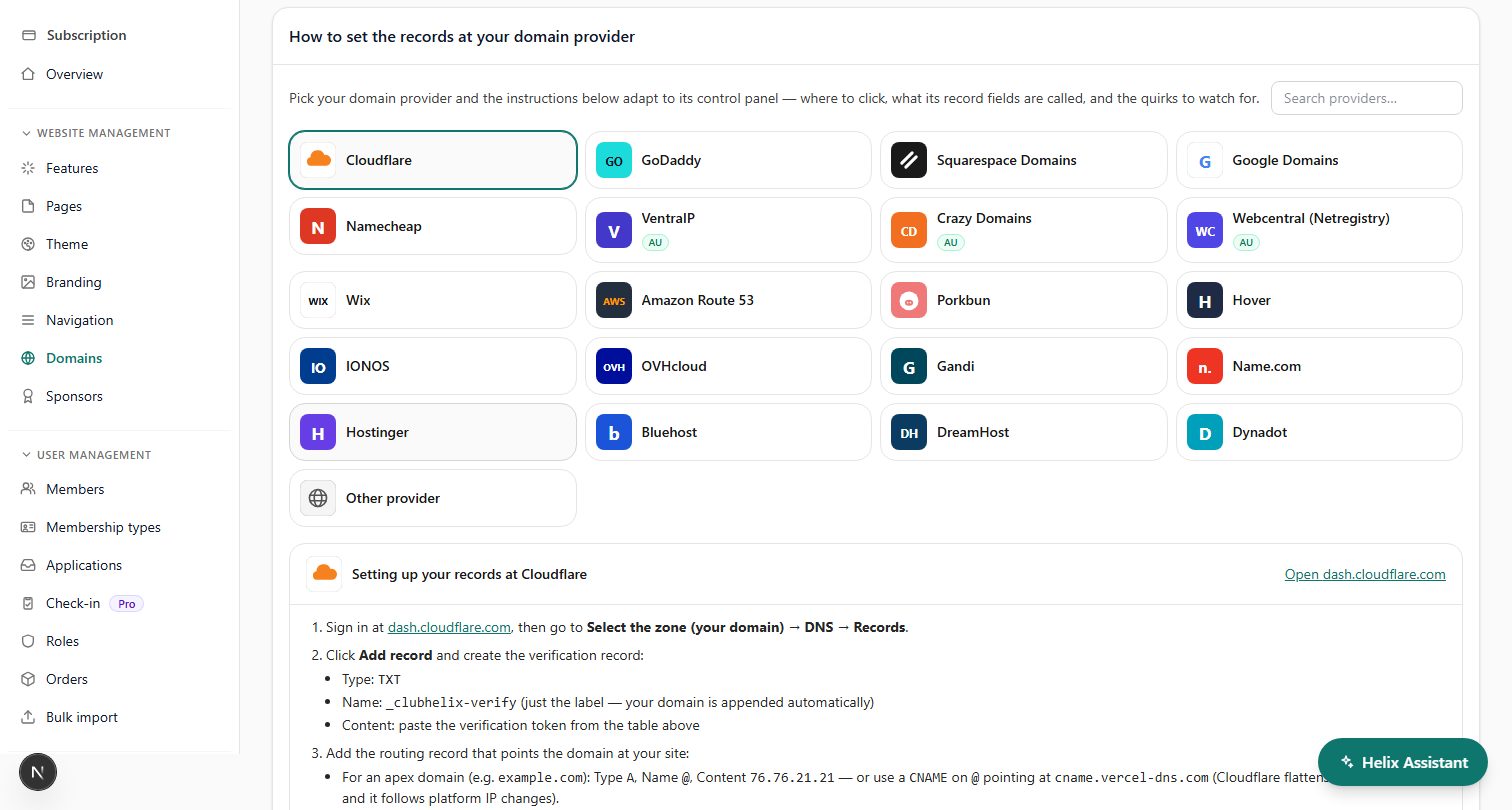
If the ownership audit made anyone at the table uncomfortable, an afternoon will tell you whether the alternative suits. Start free while you build, check the pricing bands before you commit to anything, and note that the whole platform is built and hosted in Australia. Claim your club's site, point your own domain at it, and leave the governing-body platform doing precisely what it does well.
Now where we do not compete, plainly. We hold no governing-body distribution deals, so nobody will ever hand ClubHelix to your club free as part of an affiliation — if your national body funds a platform, that is a genuine economic advantage we cannot match, and we would not pretend it away. We have no sport-specific national league feeds, so official competition data stays wherever your governing body puts it. Our app is installed from the browser rather than downloaded from an app store, which some committees prefer and some do not. And we do not build video streaming or analysis. The website-and-commerce side of this comparison sits in more depth at /compare/pitchero-alternative.
Frequently asked questions
Is a governing-body club website free?
Often, yes, in the sense that there is no subscription. On the published arrangement ClubSpark is free for LTA-registered venues and accredited coaches, with 0.8% added per Stripe transaction and enterprise tiers on request. The cost is not monetary — it is the design, address and portability constraints described above, which are worth understanding before you decide they do not matter.
Can we have our own domain on a governing-body platform?
It depends entirely on the platform and the arrangement, so ask rather than assume. What you can always do is register your club's own domain and control where it points, which is worth doing regardless. Owning the address is the cheapest insurance a club can buy against any platform decision made without it.
Can we run our own website and still use the platform for bookings?
Yes, and it is the most common sensible outcome. Keep bookings, registrations and anything mandated where it works, and run your public site, news, sponsors and commerce on something you control. The one discipline is to link clearly between the two so members never wonder which system to use for what.
What actually happens if the platform provider changes?
Your login, your site's address and your configuration typically change on a timetable set by the governing body, and historical data may or may not migrate cleanly. Clubs that hold their own domain, keep an annual export and communicate from their own email address experience it as an inconvenience. Clubs that do not, experience it as a lost season of records.
Which is better for a tennis club?
If courts and coaching programs are the core of your operation and you are eligible for a governing-body platform, its booking depth is hard to argue with. What it will not do is make your club distinctive to sponsors and new members. Most clubs are best served by keeping the operational rails and owning the public face separately.
Keep reading — how to build a sports club website covers the club-controlled layer in detail, and how to run a tennis club puts booking, coaching and membership in the context of the whole season.


