
What this guide answers
- What should a club volunteer induction cover?
Twenty minutes shared by every role — welcome and purpose, how the club is structured and who their contact is, code of conduct and safeguarding, safety and the incident procedure, and the admin of rosters, access and…
- How long should volunteer induction take?
Thirty minutes for the standard version, delivered before the first shift rather than during it.
- Do club volunteers need background checks?
It depends on the role and on the rules that apply where your club operates.
- How do you keep track of volunteer training and clearances?
Keep one register that records role, induction date, screening type with its reference and expiry, first aid, accreditations and code-of-conduct sign-off, along with an active or retired status.
- How do you turn volunteers into committee members?
Make the ladder visible and shadow every role. Give each coordinator a named deputy who does part of the job during the season, so stepping up is a small extension rather than a leap, and publish position descriptions…
USA edition. This guide is written for volunteer-run clubs in the United States. Where rules differ — grants, tax, incorporation, safeguarding — follow the USA-specific pointers below or check with your national body.
Picture the canteen at ten past eight on a Saturday morning. A parent who said yes at the registration night is handed a float tin, a set of keys and a cheerful "you'll pick it up as you go", and then left alone with a queue, an urn they have never used and a card reader that keeps asking for a passcode nobody wrote down. They get through it. They are polite about it. They do not volunteer again, and when someone asks why, they say they are just a bit busy this season.
That is the shape of most volunteer attrition at community clubs. It is rarely the workload that drives people away — plenty of volunteers happily do far more demanding jobs for years. It is the experience of being made to feel incompetent in public during their first shift, without ever being shown how the thing works. Half an hour of structured induction, delivered before the first shift rather than during it, changes the whole trajectory.
This guide is for whoever owns volunteers at your club — a volunteer coordinator, a secretary, or the president who ended up with it by default. It sets out a thirty-minute induction agenda you can run for any role, the register that keeps track of who has been inducted, screened and trained, how to handle expiries without nagging anyone, and the refresher and upskilling path that turns a Saturday helper into the person who runs the roster in three years.
What a new volunteer actually needs before their first shift
Strip away the good intentions and every new volunteer needs the same four things, in this order:
- To know exactly what they are being asked to do, bounded in time and scope. "Help out at the canteen" is a commitment of unknown size, and unknown is frightening. "Serve at the counter from ten until half past twelve on the eighth, with two other people" is a job someone can say yes to.
- To know who to ask. A named person, present on the day, whose job includes answering questions. Not a group chat.
- To be shown the physical thing. Where the urn is, how the till works, which door locks behind you, where the first-aid kit lives. Words in an email do not transfer this. Standing in the room for six minutes does.
- To know what to do when something goes wrong. Not everything — just the three or four situations that actually arise in that role, and the one number to call.
Everything below is a way of delivering those four things reliably instead of accidentally. If your club is still at the stage of finding people at all, start with how to recruit club volunteers and come back — induction is what makes recruitment stop being an annual emergency.
The thirty-minute induction agenda
Thirty minutes is the design constraint, not an aspiration. Anything longer and people will not attend, which means it does not happen, which means it does not exist. Twenty minutes are the same for every role at your club and can be run for a group; ten minutes are role-specific and happen where the work happens.
The shared twenty minutes
| Minutes | Topic | What you actually cover |
|---|---|---|
| 0–3 | Welcome and why | Who you are, why the club exists, one sentence on what this person's role makes possible |
| 3–7 | How the club is put together | Committee, teams, who runs what, where their role sits, who their point of contact is |
| 7–12 | Behaviour and safeguarding | Code of conduct in plain language, how to raise a concern, who the club's welfare or child-safety contact is |
| 12–17 | Safety and incidents | Emergency exits, first-aid kit location, the incident process, who calls emergency services and who calls parents |
| 17–20 | Admin and access | Roster, how to swap a shift, what login they get, where the documents live, reimbursement process |
Two of those blocks are non-negotiable regardless of role. The safeguarding block matters even for someone who will never be alone with a child, because the point is that every adult at the club knows how to recognise and report a concern. The incident block matters because the person who witnesses an injury is very often the volunteer on the gate rather than the coach.
The role-specific ten minutes
Run this on site, standing in the place the work happens, with the equipment switched on. It is a demonstration and a walk-through, not a briefing.
| Role | The ten minutes covers |
|---|---|
| Canteen or bar | Opening, urn and fryer, card reader and float, allergen questions, closing and cash handling |
| Team manager | Team sheet, availability, wet-weather calls, who tells parents what and when |
| Assistant coach | Session plan, warm-up, injury protocol, what to do if the head coach does not arrive |
| Gate or ticketing | Entry prices, card and cash, concessions, what to do about someone who will not pay |
| Ground or event setup | Where equipment lives, lifting and manual handling, line marking, lock-up sequence |
| First-aid officer | Kit contents and restocking, ice policy, concussion protocol, incident form, escalation |
| Working bee lead | Tools and hazards, who is not allowed to use what, sign-in sheet, sun and hydration |
| Social or events | Alcohol rules, noise and neighbours, licence conditions where they apply, cash handling and reconciliation |
Who runs it and when
The role-specific ten minutes should be run by the person who currently does the job, not by the secretary reading from notes. That is also a small act of recognition — being asked to induct someone is one of the ways a long-standing volunteer is told their expertise is valued.
Schedule inductions in batches. Two sessions in the fortnight before the season, one mid-season for late joiners, and a standing offer of a one-on-one for anyone who missed both. Run them at the club, on an evening when something else is already happening, so people are not making a separate trip.
Pin the batch inductions to the start of the season and to the school term that opens it. For winter codes that means an early-autumn session as term settles, and a second one after the mid-winter break when new families have joined. Run the first session while the evenings are still light enough to walk people around the ground, because the on-site ten minutes is much less useful conducted in a car park in the dark.

The induction pack
Give every volunteer one page, not a folder. A folder is a message that this is going to be complicated. The page contains:
- Their role in three lines, lifted straight from the volunteer position description
- Their named contact, with a mobile number
- The club's emergency procedure summary and the address of the ground in the format an ambulance dispatcher wants
- The welfare or child-safety contact
- How to swap or cancel a shift, and by when
- Where to find the roster, the documents and the club calendar
- How to claim a reimbursement, and what needs a receipt
Everything else — the full code of conduct, the constitution, the safeguarding policy — lives online and is linked, not printed. Keep the pack on your club website so it is always the current version, and so nobody is working from a photocopy of a document that changed two seasons ago.
Tracking induction, screening and training
Somewhere in your club there is a person who knows who has done what. This is a fragile arrangement, because that person's knowledge leaves with them and cannot be audited. What you want instead is a volunteer register that anyone in the committee can read.
What the register holds
| Column | Why it earns its place |
|---|---|
| Name and contact | Obvious, but keep one source rather than three lists |
| Role or roles | People hold more than one, and requirements differ per role |
| Induction date | Proves the shared twenty minutes happened, and when |
| Role-specific sign-off | Who ran the ten minutes, and when |
| Screening or clearance | Type, reference number, issue date and expiry |
| First aid | Qualification level, provider, expiry |
| Coaching or officiating accreditation | Level, governing body, expiry |
| Code of conduct signed | Date, and which version |
| Other training | Safeguarding, food handling, alcohol service, concussion awareness — with expiries |
| Status | Active, on a break, retired — so you stop rostering people who have left |
The column that transforms the register from a list into a system is expiry. Screening clearances, first-aid certificates and most accreditations all lapse, and they lapse quietly. A register that can answer "who has something expiring in the next ninety days" turns compliance from an annual scramble into a monthly five-minute check.
Screening and clearances
Which roles require screening is a question for your governing body. What the club owns is the record — and the shape of that record depends entirely on the scheme the clearance is issued under. Treat the notes below as general information and confirm the current requirements with your governing body and the relevant authority.
In the United States the evidence usually sits in more than one place — a background screening provider, the governing body's compliance portal and any state-mandated training platform — so the practical problem is reconciling them into one club view. Record where each clearance lives, its completion and renewal dates, and who at the club can confirm it. Requirements vary by sport and state, so verify what you must retain.
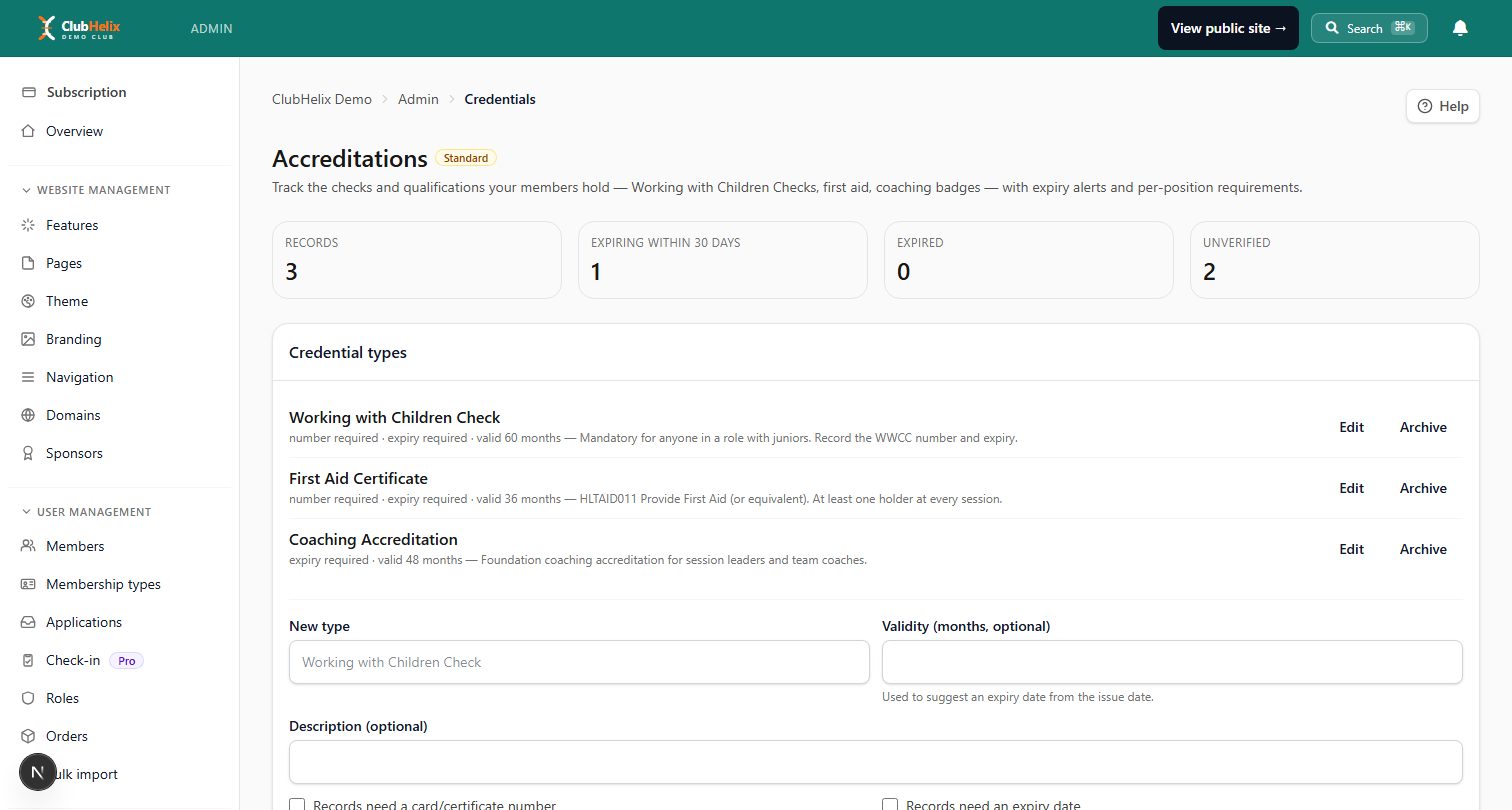
Whatever the regime, the club-side discipline is the same three habits: record the reference number and expiry rather than a tick, keep the record under proper access control because it is sensitive personal information, and never roster someone into a role whose requirement they do not currently meet. Software helps here — ClubHelix tracks accreditations and clearances against each member with expiry dates and reminders, so the register maintains itself rather than depending on one person's memory.
Training beyond induction
Induction gets someone through their first shift. Training is what makes them good, and being good is what makes people stay. Think of it as three tiers.
Tier one, everybody. Safeguarding awareness, the incident and emergency procedure, and the code of conduct. Short, refreshed annually, and expected of every adult with a role.
Tier two, role-critical. First aid for the people who will be the first responder. Food handling for canteen leads. Responsible service training where alcohol is sold. Concussion recognition for anyone on a sideline in a contact sport. These are the ones with expiries and the ones an insurer or governing body will ask about.
Tier three, growth. Coaching accreditation, officiating courses, governance training for committee members, grant-writing, first-time treasurer training. Nobody needs these to start, and they are what turns a helper into a club leader.
In the United States, coaching education and officiating certification generally run through the national governing body for your sport, often with state association delivery, and athlete-safety training is commonly mandated and renewed annually. Local community foundations, service clubs and parks departments are realistic funders for a block of first-aid or coaching certifications.
Whatever you fund, record the hours. Volunteer training hours count towards the in-kind contribution that many grant programs ask for, and clubs routinely undercount them — see tracking volunteer hours for grants.
Refreshers, upskilling and the path to committee
The annual refresher
Once a year, before the season, run a forty-minute refresher for returning volunteers. It is not the induction again. It covers what changed — new rules, new equipment, a new ground, a revised safeguarding policy — plus a five-minute reminder of the emergency procedure and an open question: what made your role harder last season. That last question is the cheapest continuous improvement process a club will ever run, and it consistently surfaces small fixable irritants like a broken lock or a roster that always clashes with junior training.
The pathway
People do not leap from serving chips to running a club. They step, and the steps need to be visible so that stepping looks like an option rather than an imposition.
| Stage | What it looks like | What the club provides |
|---|---|---|
| Helper | Occasional rostered shifts, no ongoing commitment | Induction, a named contact, thanks |
| Role holder | Owns a defined job for the season | Position description, role-specific training, a predecessor to ask |
| Coordinator | Runs a function and the people in it | Access to the systems, a small budget, a committee sponsor |
| Committee member | Shares responsibility for the whole club | Governance induction, papers before meetings, a real portfolio |
| Office bearer | President, secretary, treasurer | Handover, training, and a successor being groomed from day one |
Two practices make the ladder real. Shadowing: every coordinator role has a named deputy who attends and does part of the job, so no role has a single point of failure. Asking directly: nobody promotes themselves in a volunteer organisation, and the single most effective recruitment sentence in club life is a committee member saying "you'd be good at this, would you do it next year". Pair that with club committee roles and responsibilities so the person can see exactly what they are agreeing to.
Where inductions usually fail
| Failure | Fix |
|---|---|
| Induction happens during the first shift | Run it in the fortnight before, on site, with the equipment on |
| Only new committee members get inducted | Every rostered role gets the shared twenty minutes, including one-off helpers |
| The pack is a folder nobody reads | One page printed, everything else linked online |
| Nobody records who was inducted | A register with dates, expiries and status, visible to the committee |
| Training expires unnoticed | Automated reminders at ninety, sixty and thirty days |
| The induction is a monologue | End with "what would make your first shift easier" and act on the answers |
| The same three people run everything | Every coordinator role has a named deputy who does part of the job |
Keeping the whole volunteer picture in one place
The reason induction and training slip is almost never that a committee does not care. It is that the information lives in five places — a spreadsheet of clearances, a shared document of rosters, a group chat where shift swaps happen, a folder of signed forms, and one person's head. ClubHelix pulls it together on your club site with accreditation and clearance tracking that watches expiry dates for you, volunteer rostering where people claim and swap their own shifts, forms for sign-offs and code-of-conduct acknowledgements, and roles and permissions so a new coordinator gets the right access the day they take the job rather than three weeks later.
Try it on the free tier before you commit to anything — every plan and limit sits on the pricing page rather than behind a quote. It is built for community clubs rather than for franchises, so if your pre-season induction night is already booked, create your club site and have the register and the roster ready before the first volunteer walks in.
Frequently asked questions
What should a club volunteer induction cover?
Twenty minutes shared by every role — welcome and purpose, how the club is structured and who their contact is, code of conduct and safeguarding, safety and the incident procedure, and the admin of rosters, access and reimbursements. Then ten minutes on site covering the specific job with the equipment switched on. Keeping it to half an hour is what makes it actually happen.
How long should volunteer induction take?
Thirty minutes for the standard version, delivered before the first shift rather than during it. Roles with legal or safety obligations — first aid, food handling, alcohol service, anything unsupervised with young people — need formal training on top, but that is training, not induction. Do not let the two merge, or the induction becomes long enough that people avoid it.
Do club volunteers need background checks?
It depends on the role and on the rules that apply where your club operates. Adults working with children generally require some form of screening, and requirements vary in who is covered, what exemptions exist and how often checks are renewed. Confirm the current position with your governing body and the relevant authority, record reference numbers and expiry dates rather than a tick, and never roster someone into a role whose requirement they do not currently meet.
How do you keep track of volunteer training and clearances?
Keep one register that records role, induction date, screening type with its reference and expiry, first aid, accreditations and code-of-conduct sign-off, along with an active or retired status. The critical field is expiry — a register that can list everything lapsing in the next ninety days turns compliance into a short monthly check instead of a pre-season panic. Store it under proper access control, since it holds sensitive personal information.
How do you turn volunteers into committee members?
Make the ladder visible and shadow every role. Give each coordinator a named deputy who does part of the job during the season, so stepping up is a small extension rather than a leap, and publish position descriptions so people can see what they would be taking on. Then ask directly — most volunteers step up because a specific person told them they would be good at it, not because a general appeal went out.
Keep reading — how to recruit club volunteers covers filling the roles in the first place, and volunteer appreciation ideas covers keeping the people you have.


