
What this guide answers
- How long should a club keep its records?
It depends on the record. Governing documents, minutes of meetings and annual financial statements are usually kept permanently because they are small and prove how the club has been run.
- Are electronic copies of club records acceptable?
In most cases yes, provided the copy is complete, legible and can be produced when asked.
- What club records should never be kept?
Full payment card details, in any form — those belong with your payment provider, never in a committee folder or on a paper form.
- Who is responsible for club record keeping?
Usually the secretary for governance records, the treasurer for financial records, and the registrar for member data, with the committee collectively accountable for all of it.
- How do we destroy old club records safely?
Work from your retention table once a year, apply a hold to anything touching an active dispute or audit, then shred or securely destroy paper containing personal information and delete digital files from the live…
South Africa edition. This guide is written for volunteer-run clubs in South Africa. Where rules differ — grants, tax, incorporation, safeguarding — follow the South Africa-specific pointers below or check with your national body.
Every club has a version of the same story. Someone opens the storage cupboard behind the changerooms and finds four archive boxes, a hard drive with no cable, and a lever-arch folder labelled "1998 — DO NOT THROW OUT". Nobody knows which of it matters. Nobody wants to be the person who bins the wrong thing. So the boxes go back in the cupboard for another decade, and meanwhile the treasurer's actual financial records live in a personal email account that the club will lose access to the day she stands down.
Record keeping is one of those committee jobs that feels enormous until you split it into three separate questions and answer them one at a time. What are we obliged to keep? What do we want to keep because it makes the club easier to run? And what are we holding that we should never have kept at all, because it is somebody's personal information sitting in a shoebox?
This guide is written for volunteer committees — secretaries, treasurers, registrars and presidents — who want a defensible, boring, workable approach to club records. It covers building a records inventory, a retention table by record type with the questions to put to your own regulator, where records should physically and digitally live so a handover cannot lose them, and how to destroy what you no longer need without creating a privacy problem. It is general information, not legal or tax advice, and the retention periods that bind your club come from your own legislation, your governing body and your funders — always confirm the numbers with them.
Start with an inventory, not a policy
Most clubs try to write a retention policy first and get stuck, because they are guessing at categories they have never actually listed. Do it the other way around. Spend one committee meeting building an inventory of what the club currently holds, and the policy nearly writes itself.
Work through the club role by role rather than cupboard by cupboard, because records follow people. Ask each office-holder three questions: what documents do you create, what documents do you receive, and where do they sit right now? You will find things nobody knew existed — a shared drive from two secretaries ago, a photo library on a phone, a set of signed contractor agreements in someone's garage.
| Record family | Typical owner | Where it usually hides |
|---|---|---|
| Constitution, rules, registration | Secretary | A committee member's inbox, one printed copy |
| Minutes and agendas | Secretary | Personal laptop, a chat thread, sometimes nowhere |
| Financial records | Treasurer | Accounting software, a personal bank login |
| Member and registration data | Registrar | Spreadsheets, paper forms, registration platform |
| Insurance and claims | President or secretary | Broker emails |
| Incident and injury reports | Safety officer | A paper book in the first aid kit |
| Grant agreements and acquittals | Grants officer | The funder's portal, one person's email |
| Contracts, leases, licences | President | A folder nobody has opened in years |
| Photos, results, history | Everyone | Personal phones and social accounts |
Print that inventory, tick what actually exists in a club-controlled location, and you have your first honest picture. The gap between the two columns is your real risk — not the archive boxes.
How long to keep it, and the questions to ask your regulator
Here is the part everyone wants: a retention table. Treat the ranges below as a starting point for a conversation, not as a rule. Retention periods for clubs come from several sources at once — the legislation your club is incorporated or registered under, tax and payroll rules, your insurer's requirements, your governing body's affiliation conditions, and the terms of any grant you have accepted. Where two sources disagree, the longer period wins.
| Record type | Typical retention approach | Why |
|---|---|---|
| Constitution, rules and amendments | Permanently | Proves how the club is governed and when that changed |
| Registration or incorporation certificates | Permanently | Identity documents for the club itself |
| Minutes of general meetings and the committee | Permanently | The legal record of every decision the club has made |
| Register of members and office-holders | Permanently for the register, personal detail pruned | Continuity, life membership, historical claims |
| Financial statements and audit or review reports | Permanently | Small, and endlessly useful for grants and history |
| Ledgers, invoices, receipts, bank statements | A set number of years set by your tax rules | Substantiation if the club is ever reviewed |
| Payroll and contractor records | A set number of years after the engagement ends | Employment and tax obligations outlast the role |
| Insurance policies and certificates | Long term — often permanently | Historical claims can arrive years later |
| Incident, injury and near-miss reports | Long term, longer where children are involved | Limitation periods for injury claims can be very long |
| Waivers, consents and medical declarations | Life of participation plus a defined tail | Evidence that consent was given and what it covered |
| Screening and clearance records for volunteers | While current plus a defined tail | Proves the check was sighted and when it expires |
| Grant agreements and acquittals | Term of the agreement plus the funder's stated period | Funders can audit years later |
| Leases, contracts, sponsorship agreements | Life of the agreement plus a tail | Disputes surface after an agreement ends |
| Routine correspondence and operational email | Short — a season or two | Volume without value; keep decisions, not chatter |
| Draft documents and superseded versions | Delete once final is approved | Ambiguity is a liability, not an asset |
| Card numbers and full payment details | Never store | Your payment provider holds these, not your committee |
Then take five questions to whoever regulates your club and to your governing body, and write the answers into your policy so the next committee is not guessing:
- What is the minimum period we must keep financial records, and does it run from the transaction or from the end of the financial year?
- Are we required to keep a register of members, and what fields must it contain?
- How long must we keep incident and injury records, and does that change for participants who were minors at the time?
- What must we retain to satisfy affiliation, insurance and grant conditions, and who can request it?
- In what form must records be kept — is an electronic copy acceptable in place of the signed original?
Clubs commonly register as non-profit organisations through the Department of Social Development, which brings annual reporting duties and expectations about minutes, financial statements and the constitution. The South African Revenue Service sets retention for tax-relevant records, and clubs with public benefit organisation status carry extra obligations tied to that approval. Where the club holds a liquor licence or a lease from a municipality, those agreements usually specify their own record and inspection requirements — read them rather than assuming.

Where records should live so a handover cannot lose them
The single biggest cause of lost club records is not fire or flood. It is a personal account. A volunteer sets up a free email address or a cloud folder in their own name because it was quick, uses it well for four years, and then moves interstate. Everything in it goes with them, and the club has no legal claim to any of it.
Fix that with one rule that admits no exceptions: club records live in accounts the club owns, under the club's own domain. Personal accounts hold personal things. If a record only exists in someone's personal inbox, phone or drive, it is not a club record yet — it is a favour.
The three tiers
Sort every record family into one of three tiers, and store each tier differently.
Tier one — the permanent core. Constitution, registration certificates, minutes of every general and committee meeting, annual financial statements, leases and major contracts, insurance history, life membership decisions. This is small — often under a gigabyte for a club's entire life. Keep it in a club-owned folder with a rigid naming convention, keep a second copy somewhere independent, and keep one printed set of the truly foundational documents in a fireproof box at the club or with the public officer.
Tier two — the operating record. Current season memberships, payments, rosters, incident reports, event bookings, sponsorship agreements, grant acquittals in progress. This should live in the system that creates it, not in a copy of it. A membership list that exists in the registration system, a spreadsheet emailed to the treasurer, and a printed roster in the canteen is not three backups — it is three versions that disagree.
Tier three — the working clutter. Drafts, chat, photos not yet chosen, the sixteen emails arranging a working bee. Give this a short life and let it go.
Naming and structure that survive a handover
Adopt a convention and enforce it, because a searchable filename beats a clever folder tree every time. A pattern that works:
YYYY-MM-DD_recordtype_subject_version
So 2026-03-11_minutes_committee_final.pdf and 2026-07-01_grant_councilfacilities_acquittal.pdf. Dates first means chronological sort is free. Record type second means every minute file sits together no matter which year folder it is in.
Then build the handover pack once and update it, rather than reconstructing it in a panic each October. The committee handover checklist covers the full transition, but the records half is short: an index of where every tier-one and tier-two record lives, the list of club-owned accounts and who holds access, the current retention table, and the date of the last destruction round. A new secretary who receives that document can start work on day one instead of spending a season on archaeology.
Access, not ownership
Give office-holders access by role, not by person, and remove it when the role changes. Three or four people should be able to reach tier-one records at any moment — typically president, secretary, treasurer and one other — so that a single unavailable volunteer never blocks the club. Everyone else gets what their job needs. That is easier to say than to administer on a pile of personal logins, which is precisely why a platform with proper roles and permissions beats a shared password taped inside a cupboard door. Our guide to what a club secretary does has more on where this responsibility actually sits.
Secure destruction and member privacy
Keeping everything forever feels safe. It is not. Every record you hold about a member is a record you are responsible for protecting, and a club that still holds the home addresses, birth dates and medical notes of players who left eight years ago is carrying a risk with no upside. Deliberate destruction is part of good record keeping, not the opposite of it.
Start by collecting less. The most common privacy problem in community clubs is a registration form that asks for information the club has no use for — a full date of birth where an age bracket would do, a parent's employer, a medical free-text box that becomes a permanent unprotected health record. Review your forms each pre-season and delete every field nobody has used a single time. Our club privacy policy template is a useful companion when you are writing down what you collect and why.
Then set up a destruction routine that a volunteer can actually follow:
- Schedule it. One session a year, straight after the annual accounts are signed off. Put it on the committee calendar as a real agenda item with a named owner.
- Work from the retention table, not from memory. Anything past its period and not subject to a hold goes.
- Apply a hold when you need one. If there is an active or foreseeable dispute, claim, investigation or audit touching a record, freeze it in place and note why. Never destroy something because it is inconvenient.
- Destroy properly. Paper containing personal information is shredded or sent to a secure destruction service, not put in the recycling bin behind the clubrooms. Digital files are deleted from the live system, the archive and the backups on their normal cycle — write down what your backup retention actually is, because that is where "deleted" files quietly persist.
- Log what you destroyed. Not the contents — just record type, date range, volume, method and who authorised it. Two lines in a spreadsheet. That log is the thing that protects the committee if anyone ever asks what happened to a file.
- Handle devices and media. Old laptops, USB sticks, the club phone and the camera SD card all count. Wipe or physically destroy them before they leave the club.
Two categories deserve special care. Records about children — registrations, incident reports, screening records, photographs — often carry longer retention expectations and tighter handling rules than adult records, and the rules differ by jurisdiction, so this is a question for your governing body and the relevant authority rather than a judgement call at a committee meeting. And payment details are simple: your club should never hold full card numbers in any form. If a paper form in your archive has card details written on it, that page is a destruction priority this week, not next year. See sports club risk management for how records fit into the wider risk picture.
The Protection of Personal Information Act sets the framework, and it applies to clubs as much as to businesses. The conditions that matter for records are purpose specification, further processing limitation and retention — personal information may not be kept longer than necessary for the purpose it was collected for, unless a law requires it. The Information Regulator publishes guidance and requires an information officer to be registered, which for most clubs will be the chairperson or an appointed committee member. Note it in your constitution or a committee minute so the appointment is documented.
The records nobody requires and everyone regrets losing
Compliance is only half of record keeping. The other half is the club's memory, and no regulator will ever ask you for it.
Premiership and championship results. Honour boards and their source data. Photographs with names attached while someone still knows the names. Life membership citations that explain what the person actually did. The original grant application that funded the clubroom extension, which is the best possible template for the next one. Committee papers that explain why a fee structure changed, so the next committee does not relitigate it from scratch.
Give one person the "club historian" job, even informally, and give them somewhere club-owned to put things. A single folder per season with results, the annual report, a dozen good photos and a one-page summary of what happened is enough. Twenty years later that folder is the centenary book, the sponsor pitch and the grant evidence all at once. Our guide on how to record your club's history goes deeper, and the end of season report template is a good annual anchor for it.
An annual records routine
Spread the work across the year and it stops being a project. This is a rhythm most committees can sustain.
| When | Task | Owner |
|---|---|---|
| Pre-season | Review registration forms — delete unused fields | Registrar |
| Pre-season | Confirm who holds access to each club-owned account | Secretary |
| Mid-season | Spot-check that minutes and incident reports are being filed | Secretary |
| End of season | Archive the season folder — results, report, photos, key decisions | Historian |
| After accounts are signed | Run the destruction round from the retention table | Treasurer + secretary |
| After the AGM | Update the handover pack and reissue access by role | Secretary |
| Annually | Test that you can actually restore from a backup | Whoever holds it |
That last line is the one clubs skip. A backup nobody has ever restored is a hope, not a control. Once a year, pick a file at random from three years ago and try to open it. If you cannot, you have found the problem while it is still cheap.
Keeping the filing cabinet inside the club site
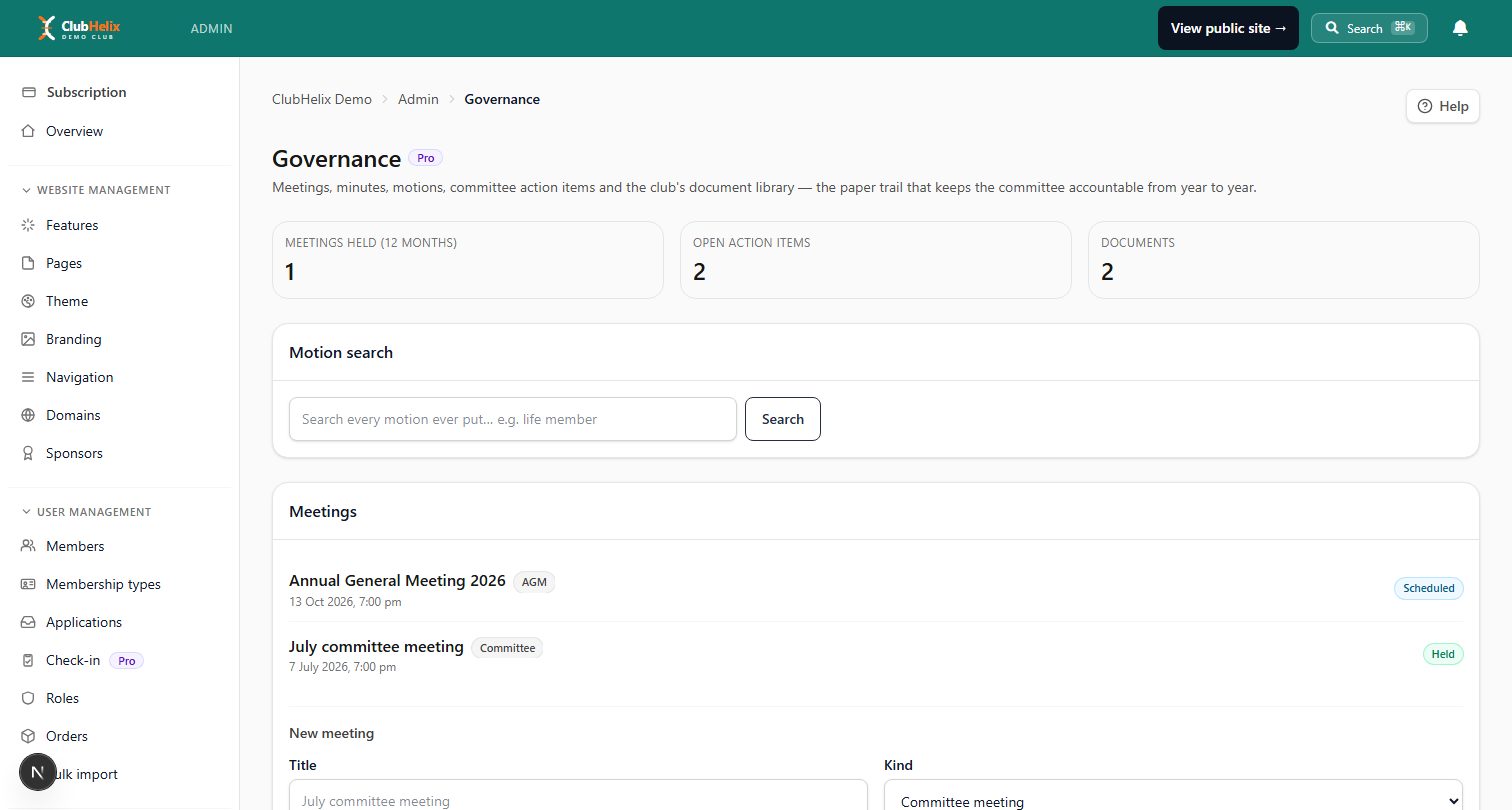
Most of the pain in this guide comes from records being scattered across personal accounts and disconnected tools. When memberships, payments, registrations, incident reports and meeting papers all live in the one club-owned system, the retention question gets far simpler — the record sits with the thing that created it, access is granted by role rather than by password, and nothing walks out the door with a departing volunteer. ClubHelix keeps governance and meeting records alongside the audit log of who changed what, with automated backups running underneath so your permanent core is never one laptop away from disappearing.
If your club's records currently live in three inboxes and a cupboard, that is a fixable afternoon rather than a project. ClubHelix is built for community clubs, there is a free tier you can start on today, the pricing is published in full, and you can create your club site and move your first season of records into it before the next committee meeting.
Frequently asked questions
How long should a club keep its records?
It depends on the record. Governing documents, minutes of meetings and annual financial statements are usually kept permanently because they are small and prove how the club has been run. Financial substantiation records follow the period set by your tax rules, insurance and incident records are usually kept much longer than people expect, and routine correspondence can go after a season or two. Confirm the specific periods with your regulator, governing body and insurer, and write the answers into a one-page retention table.
Are electronic copies of club records acceptable?
In most cases yes, provided the copy is complete, legible and can be produced when asked. Some documents with original signatures or seals are worth keeping in hard copy as well, and a few funders or regulators specify a form, so check before you scan and shred. Whatever you decide, store the electronic copies in an account the club owns rather than a volunteer's personal drive, and make sure more than one office-holder can reach them.
What club records should never be kept?
Full payment card details, in any form — those belong with your payment provider, never in a committee folder or on a paper form. Beyond that, avoid keeping personal information you have no current use for, such as medical free-text notes, contact details for people who left years ago, or fields on a registration form that nobody has ever looked at. Collecting less is the cheapest privacy control a club has.
Who is responsible for club record keeping?
Usually the secretary for governance records, the treasurer for financial records, and the registrar for member data, with the committee collectively accountable for all of it. Name the owner of each record family in writing so responsibility does not evaporate between roles. The important structural point is that the club, not the individual, owns every record — office-holders hold access because of the role they occupy, and lose it when they leave it.
How do we destroy old club records safely?
Work from your retention table once a year, apply a hold to anything touching an active dispute or audit, then shred or securely destroy paper containing personal information and delete digital files from the live system, the archive and your backup cycle. Wipe old devices and memory cards too. Keep a short log of what was destroyed, when, how and on whose authority — the log is what demonstrates the destruction was routine rather than convenient.
Does a small club really need a records retention policy?
Yes, and it can be a single page. The value is not bureaucratic — it is that the next committee inherits decisions rather than guesses, and that nobody has to make a judgement call about a sensitive file in the middle of a stressful week. A short table of record types, retention periods, storage locations and owners does the whole job.
Keep reading — committee handover checklist covers the transition your records have to survive, and the club meeting minutes template gets the most important permanent record right at the source.

