
What this guide answers
- What should a club complaints process include?
At minimum — how to lodge a complaint, who receives it, a published acknowledgement time, a stage where the person complained about receives the allegation in writing and can respond, a decision-maker free of…
- Who should decide a club dispute?
A small panel, ideally three people, none of whom has a personal stake in the outcome or took the original complaint.
- How long should a club keep complaint records?
Long enough to defend the decision and to meet whatever obligations apply to your organisation, then no longer.
- Can a club suspend a member while a complaint is investigated?
Only if your constitution or rules give the committee that power, and only as a protective measure rather than a punishment.
- When should a complaint go outside the club?
Immediately when it involves the safety of a child, possible criminal conduct, or conduct covered by discrimination or harassment law — and whenever the complaint concerns the committee itself, since no panel drawn…
UK edition. This guide is written for volunteer-run clubs in the UK. Where rules differ — grants, tax, incorporation, safeguarding — follow the UK-specific pointers below or check with your national body.
Most complaints do not arrive labelled as complaints. They arrive as a phone call to the president on a Sunday night, a message in a team chat that four people screenshot before it is deleted, or a parent who catches the registrar at the canteen window and opens with "I don't want to make a big thing of this, but…". By the time the committee agrees that yes, this is a complaint, three volunteers have already given three different answers, and one of them has been forwarded to the person being complained about.
That is the moment a club either has a process or discovers it doesn't. A written complaints procedure is not there to make the committee feel official. It exists to protect three separate people at the same time — the person who raised the concern, the person it was raised about, and the volunteers who have to decide. Improvise and you will get all three wrong. The complainant feels ignored, the respondent feels ambushed, and the committee ends up holding a decision it cannot explain six months later when a parent, an insurer or the governing body asks how it was reached.
This guide is general information for volunteer committees, not legal advice. It sets out a staged procedure with realistic timeframes, the record-keeping and conflict-of-interest rules that make a decision defensible, and the point at which a matter stops being yours to resolve. Adapt it to your own rules — and where a complaint touches child safety, criminal conduct, discrimination or employment, take proper advice and follow the reporting obligations that apply to you.
What the process is actually protecting
Before you write a single stage, be clear about who the document serves. Committees that skip this end up writing a procedure that protects only the committee, which is the one thing a complaints process must never do.
| Who | What they need from the process | What improvisation gives them instead |
|---|---|---|
| The complainant | To be heard, told what happens next, and given a date | Silence, then a rumour that it was "dealt with" |
| The person complained about | To know what is alleged, in writing, and to answer it before anyone decides | Learning about it from a teammate, after a decision has been made |
| The committee | A path they can follow under pressure and defend afterwards | Four volunteers, four opinions, and a decision nobody can reconstruct |
| The wider membership | Confidence that concerns go somewhere and that gossip is not the mechanism | A club where everything is discussed and nothing is resolved |
Your starting point is your own rules. For an unincorporated members' club in the United Kingdom the constitution operates as a contract between the members, so a disciplinary or complaints power only exists if the rules create it — and a decision taken outside those rules is open to challenge. Charitable incorporated organisations and companies limited by guarantee have their own governing documents that do the same job. Check what your rules actually authorise the committee to do, and amend them at a general meeting rather than inventing a power on the night.
Sort the complaint before you start
The single biggest cause of botched club complaints is putting every grievance down the same pipe. A dispute about who got picked for the A grade and an allegation of harassment are not the same animal, and treating them identically will either trivialise the second or bureaucratise the first.
| Kind of matter | Typical example | Where it starts | What it must never become |
|---|---|---|---|
| Service or decision complaint | Selection, fees, court allocation, a refund refused | The officer responsible, then the committee | A disciplinary matter about the person who complained |
| Conduct complaint between members | Sideline abuse, a coach's language, a persistent social media pile-on | Written complaint under the procedure below | A committee "quiet word" with no record |
| Safeguarding or serious harm | Any concern involving a child, or alleged criminal conduct | Straight to your safeguarding officer and the relevant authority | An internal investigation that delays a report |
| Employment or contractor grievance | A paid coach, groundskeeper or administrator | Your employment obligations, with advice | A members' disciplinary hearing |
Two rules make this triage work. First, the person receiving the complaint does not get to decide it is "not really a complaint" — they classify it and log it, and someone else decides. Second, safeguarding and criminal matters leave the ordinary pipe immediately. Your job in those cases is to report, preserve information and cooperate, not to investigate. Everything below is written for the middle two rows.
The bottom row deserves its own warning, because it is the one clubs most often get wrong. The moment a complaint concerns someone the club pays — a coach, a groundskeeper, a bar manager, an administrator — a members' disciplinary hearing is the wrong forum, and running one can create liabilities the committee never intended.
In the United Kingdom, a paid coach or administrator has statutory employment rights and a complaint about them belongs in a disciplinary process, not a members' hearing. Acas publishes a code of practice on disciplinary and grievance procedures that employment tribunals take into account, and following it is the cheapest insurance a club committee can buy. Worker status is assessed on substance, so a casual weekend arrangement may still carry obligations the club has not planned for.

A staged procedure with real timeframes
Timeframes are the part committees leave out, and they are the part complainants care about most. A published deadline is a promise you can keep with volunteers; vagueness is a promise you will break. Adopt something close to this and publish it on your website.
| Stage | What happens | Who runs it | Target timeframe |
|---|---|---|---|
| Stage 0 — informal | A conversation, facilitated if needed. No finding, no sanction. | Team manager, coach or the relevant officer | Within 7 days of the concern |
| Stage 1 — written complaint | Complaint lodged on the club form. Acknowledged, classified, respondent notified. | Complaints officer | Acknowledge in 3 days, notify in 5 |
| Stage 2 — response | Respondent replies in writing to the allegations as written | Respondent | 10 days from notification |
| Stage 3 — determination | Panel reviews both accounts, interviews if needed, decides on the balance of probabilities | Complaints panel (three people, none conflicted) | 21 days from the response deadline |
| Stage 4 — outcome | Written outcome to both parties, with reasons and any sanction | Panel chair | 5 days from the decision |
| Stage 5 — appeal | Appeal on defined grounds only — process error, new evidence, disproportionate sanction | Appeal panel with no Stage 3 involvement | Lodge in 14 days, decide in 21 |
Stage 0 is not optional, and it is not a fob-off
Most club friction is solvable by one honest conversation held early, and a procedure that skips straight to formality will generate paperwork for problems that did not need it. Make Stage 0 explicit: what it is, that it produces no finding against anybody, and that the complainant can move to Stage 1 at any time without asking permission. What kills Stage 0 is using it as a delay tactic. If the concern involves alleged harassment, discrimination or anything a reasonable person would find intimidating, go straight to Stage 1.
Put the allegation in writing before anyone answers it
The most common procedural failure in club complaints is that the respondent is asked to explain themselves before they have been told, precisely and in writing, what is alleged. Write the allegation as short numbered particulars — what is said to have happened, when, and where — and send exactly those particulars. Not the complainant's full letter, not a summary written from memory. If you cannot reduce a complaint to particulars, it is not ready to be answered.
Decide on the balance of probabilities, and say so
A club panel is not a court. The standard is what is more likely than not, based on the material in front of you, and the outcome letter should say that in plain words. Record what you accepted, what you did not, and why. A three-line reason that names the evidence beats a page of careful nothing.
Who hears it, and who has to step out
A panel of three works better than a full committee. It is quorate on a weeknight, it can be assembled without conflicts, and it keeps the number of people holding sensitive detail small. Draw it from the committee plus one or two members of standing who are not on it — a past president, a life member, the club's safeguarding officer where appropriate.
Conflicts of interest are where small clubs come unstuck, because in a club of 300 people everyone is somebody's coach, parent or clubmate. The test is not "can I be fair?" — everybody believes they can. The test is whether a reasonable member looking in would think the decision-maker had a stake. Anyone who is a relative, housemate, employer, team-mate in the same side, or who has already offered an opinion on the matter, steps out. So does anyone who took the original complaint.
Write down the recusals. A one-line note — "The vice-president declared her son plays in the same team and did not participate" — is the difference between a decision that survives scrutiny and one that is re-litigated at the annual general meeting. Your committee role descriptions should name who holds the complaints portfolio, and that person should not also be the club's public spokesperson.
Records, confidentiality and the file you hope never to need
Every complaint gets a file, and the file is created on day one, not reconstructed in month three. At a minimum it holds the complaint as lodged, the acknowledgement, the particulars sent to the respondent, the response, notes of any interview signed off by the person interviewed, the panel's decision with reasons, the outcome letters, and any appeal. Date-stamp everything.
Confidentiality means the information goes only to the people who need it to do their part — panel members, the parties, and anyone you are legally required to inform. It does not mean secrecy from the parties themselves, and it does not mean the complainant can be told nothing about the outcome. It also does not survive a mandatory report. Say all of that in your policy so nobody promises a confidentiality you cannot deliver.
Three habits that matter more than they sound:
- One channel, not four. Complaint material that lives across a volunteer's personal email, a chat thread and a shared drive is impossible to secure and impossible to hand over at changeover. Keep it in one place with controlled access.
- Access is a role, not a person. When the complaints officer changes, access should change with the role. Clubs that attach access to individuals end up with a former committee member holding sensitive files years later — the same problem covered in our committee handover checklist.
- Retain deliberately. Keep records long enough to defend a decision and meet any obligations that apply to your club, and no longer. Decide the period, write it into the policy, apply it, and make sure your published privacy commitments describe how complaint records are stored and for how long.
Interim measures while a matter is open
Sometimes you cannot simply wait for Stage 3. If there is a genuine risk to a person, or a risk that evidence or witnesses will be interfered with, the committee can put temporary arrangements in place — a stand-down from a role, a change of training group, an instruction to avoid contact.
Three principles keep an interim measure from becoming an early punishment. It is protective, not punitive, and the letter should say so explicitly. It is proportionate — the least restrictive thing that manages the risk. And it is time-bound and reviewed, with a named date. Never announce an interim measure to the membership; announce only what people need in order to comply, such as a change to who is running Thursday training.
When a matter has to leave the club
Some complaints are not yours to resolve, and the committee's error is almost always holding on too long rather than escalating too fast. Escalate when the matter involves a child's safety, alleged criminal conduct, discrimination or harassment of a kind covered by law, a serious conflict involving the committee itself, or where the respondent holds a role accredited by someone other than you.
In the United Kingdom your first external call is usually the national governing body for your sport, whose safeguarding and disciplinary regulations often reserve certain categories of case to itself — particularly anything involving a child or a licensed coach. Independent dispute resolution services used across sport can hear appeals and disputes where the rules allow. For child-safety concerns, contact your NGB lead safeguarding officer and the statutory services without delay, and take guidance from the child protection unit that supports sport in your nation.
Whatever the route, do not tell a complainant that escalation is available and then handle the referral for them silently. Give them the contact details, tell them what you have reported and when, and keep a copy in the file.
Three templates you can copy
Acknowledgement (send within three days):
Thank you for your complaint received on [date]. It has been recorded and referred to [role]. We will write to you again by [date] to confirm how it will be handled. In the meantime, please direct any further information to [email] rather than to other committee members, so the record stays complete. We will treat the matter confidentially, sharing it only with those who need it to deal with it or where we are required to report it.
Notice of particulars to the respondent:
A complaint has been made about conduct at [event, date]. The particulars are — 1. [allegation]. 2. [allegation]. You are invited to respond in writing to these particulars by [date]. You may bring a support person to any meeting. No finding has been made, and none will be made until your response has been considered.
Outcome letter:
The panel considered the complaint on [date]. Panel members were [names]. [Name] did not participate because [conflict]. On the balance of probabilities the panel found that [finding], based on [what was relied on]. The panel did not accept [claim], because [reason]. The outcome is [outcome]. You may appeal within 14 days on the grounds set out in clause [x] of the club's complaints procedure.
Pair these with a proper incident report form for anything that happened on the ground, and with your player code of conduct, which is what most conduct complaints are ultimately measured against.
Keeping the trail without the paperwork
The reason complaint files get lost is that they are assembled by hand, by volunteers, under stress, across whatever tools happen to be open. ClubHelix keeps the whole chain inside your club's own admin — incident and concern reporting with a date-stamped record and controlled visibility, roles and permissions so only the complaints officer and panel can open a file, an immutable audit log that shows who viewed and changed what, and governance and meeting records so a resolution is minuted where you can find it next season.
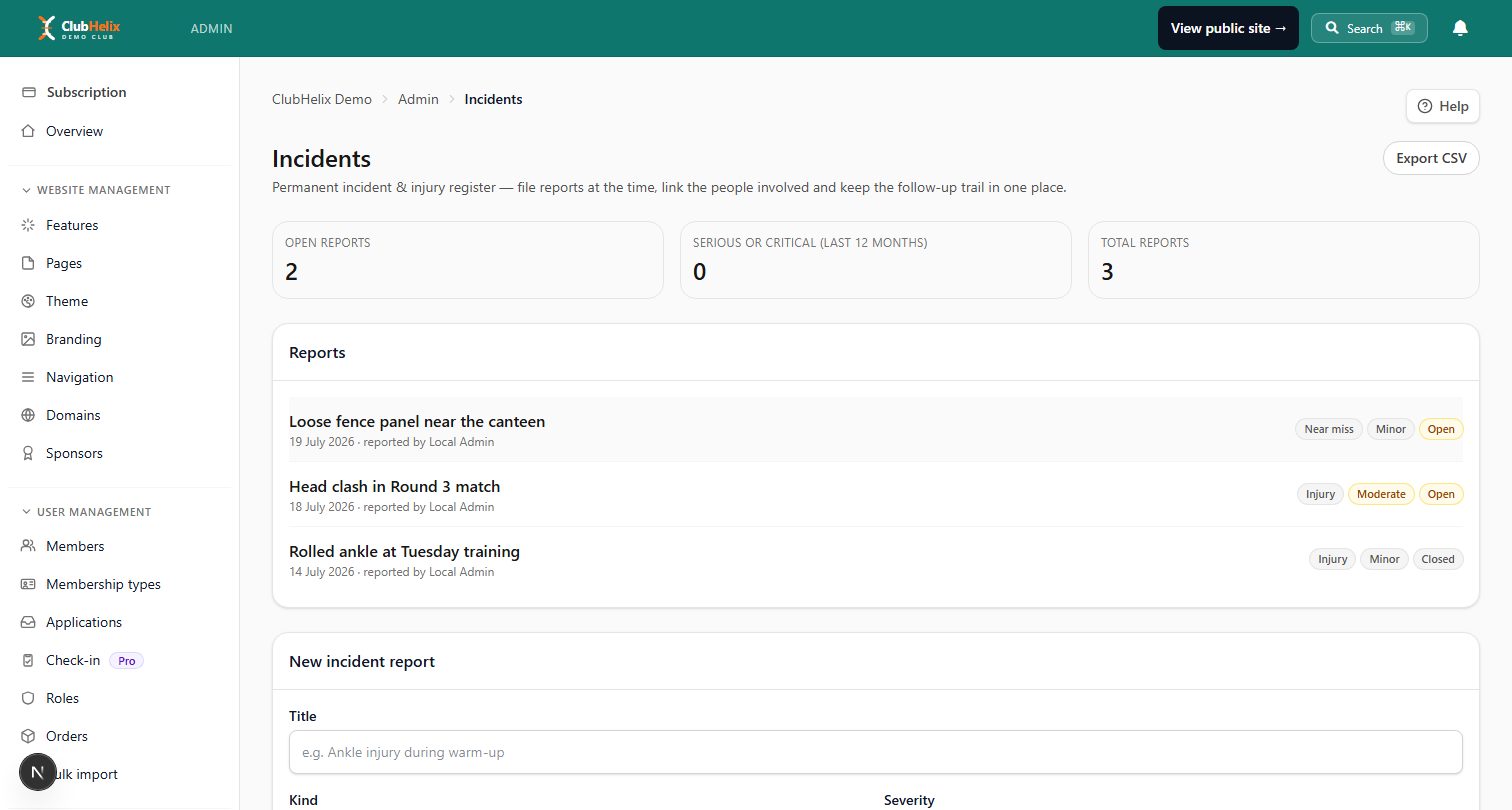
It starts on a free tier, and the pricing is published rather than quoted. If your club's complaint history currently lives in one volunteer's inbox, moving it somewhere with proper access control is an afternoon's work — create your club site and set the complaints portfolio up before you need it.
Frequently asked questions
What should a club complaints process include?
At minimum — how to lodge a complaint, who receives it, a published acknowledgement time, a stage where the person complained about receives the allegation in writing and can respond, a decision-maker free of conflicts, a written outcome with reasons, and an appeal on defined grounds. Timeframes at each stage matter as much as the stages themselves, because they are what a complainant judges you on. Publish the procedure on your website so nobody has to ask for it.
Who should decide a club dispute?
A small panel, ideally three people, none of whom has a personal stake in the outcome or took the original complaint. Anyone related to a party, in the same team, or who has already voiced an opinion should step out, and the recusal should be recorded in writing. Full-committee decisions are slower, harder to keep confidential and more likely to include someone conflicted.
How long should a club keep complaint records?
Long enough to defend the decision and to meet whatever obligations apply to your organisation, then no longer. Set a defined retention period in your policy, apply it consistently, and store the records with access limited to the role that needs them rather than to particular individuals. Records relating to a child or to a matter reported to an external authority usually need to be kept longer, so take advice rather than guessing.
Can a club suspend a member while a complaint is investigated?
Only if your constitution or rules give the committee that power, and only as a protective measure rather than a punishment. Keep it proportionate, put the reason and a review date in writing, and avoid announcing it to the membership. If your rules do not clearly authorise interim measures, that is a gap worth fixing at your next general meeting rather than a power to assume in the moment.
When should a complaint go outside the club?
Immediately when it involves the safety of a child, possible criminal conduct, or conduct covered by discrimination or harassment law — and whenever the complaint concerns the committee itself, since no panel drawn from that committee will look impartial. Your governing body's member protection or integrity policy usually defines the categories it takes on, and affiliation often binds you to it. Escalating early is rarely criticised; holding on too long always is.
Keep reading — player code of conduct template gives you the standard most conduct complaints are measured against, and sports club risk management puts complaints in the wider picture.


