
What this guide answers
- Our committee won't adopt another tool. What's the minimum viable version?
One shared document with four columns, plus two habits: actions captured with owner-date-done at the meeting, and the list read aloud at the top of the next one.
- How do we handle the committee member who never does their tasks?
First, check the system before the person: were their tasks real (owner, date, done-definition), and were they nudged privately before being noticed publicly?
- Should tasks be visible to the whole committee or just the owner?
Whole committee, always. Visibility is what makes the system fair — everyone can see the load is shared (or isn't), duplicated effort surfaces before both people buy a fridge, and the meeting review works from a list…
- What belongs on the committee task list versus a subcommittee's own list?
The committee list holds what the committee must see: decisions it made, deadlines it owns (compliance, grants, insurance, AGM), and the single line each subcommittee reports against ("canteen: rostered through August…
Canada edition. This guide is written for volunteer-run clubs in Canada. Where rules differ — grants, tax, incorporation, safeguarding — follow the Canada-specific pointers below or check with your national body.
Minute 4.3 of last month's meeting records that "Steve will look into the canteen fridge". This month, minute 2.1 records that the fridge was discussed again, and Steve — who is a good person, employed full-time, coaching the under-12s — will look into it. The fridge will appear in a third set of minutes before someone buys one in a panic the week of the season launch, at retail price, in the wrong size.
Nothing about this is a Steve problem. Committees are groups of busy volunteers who meet monthly, and a decision made in a meeting evaporates unless it lands somewhere that survives the drive home. Most clubs have no such place — actions live in the minutes (which nobody re-reads until the next meeting), in the group chat (where they scroll away), and in people's heads (which are full). The gap between "we agreed" and "it happened" is where club momentum quietly dies, and closing it is a systems problem with a genuinely small solution.
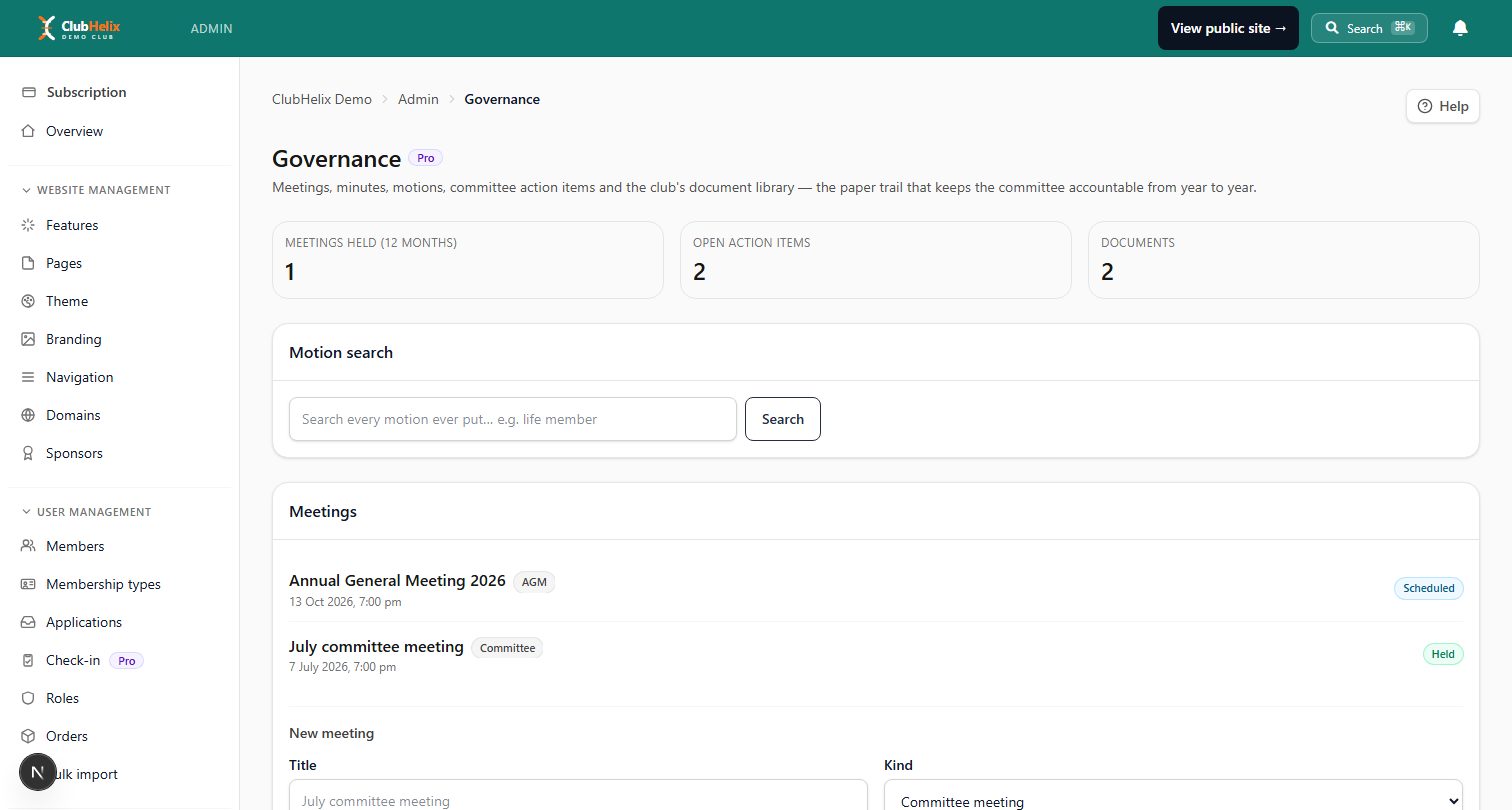
This guide is that system: how to capture actions so they can actually be done, the one-list rule, a chasing rhythm that doesn't feel like nagging, and the annual handover — the moment most clubs lose a year of institutional memory. It pairs with our meeting agenda template and minutes template, which cover the meeting itself; this is about what happens between meetings, which is where the actual club runs.
An action item has three parts or it isn't one
"Look into the fridge" fails as a task before anyone fails to do it. A committee action only exists when it has:
- One owner. A name, singular. "Steve and Maria will…" means each assumes the other has it; "the social committee will…" means nobody has it. If a job genuinely needs two people, it is two tasks or it is Steve's task with Maria helping — but the item has one name on it.
- A date. Not "before the season" — a date. Volunteers are excellent at meeting deadlines and terrible at meeting vibes. The date can be generous; it cannot be absent.
- A definition of done. "Get two quotes for a commercial fridge under $1,500 and put them in the next agenda" is done or not done, no discussion needed. "Look into the fridge" can be 90% of the way to done forever.
The chairperson's job at the meeting is to refuse to move on from a decision until those three parts are spoken aloud and written down. It feels pedantic for about two meetings, at which point the committee notices that things have started happening, and never goes back.
Capture at the moment of decision, not from memory afterwards. Whoever takes the minutes records the action — owner, date, done-definition — as it is agreed, and the action list is extracted from the minutes that night, while it still means something. An action list compiled on Sunday from Tuesday's memory is fiction with dates attached.
The one-list rule
Everything from our guide to tracking who has paid applies to tasks with the nouns changed: the failure mode is multiple lists. The president's notebook, the secretary's minutes, the group chat, a whiteboard in the clubrooms — four partial truths that no volunteer will ever reconcile.
Pick one place where committee tasks live, visible to the whole committee, and be pragmatic about what it is. The genuine options:
- A shared document or spreadsheet — free, familiar, works. One tab, columns for task / owner / due / status / notes. Its weakness is that documents don't remind anyone of anything, so it depends entirely on the review rhythm below.
- A generic task app — better than a document if (and only if) the whole committee actually adopts it. The graveyard of club task systems is full of tools one enthusiast set up and used alone. The adoption test: would the least digital member of your committee open it weekly? If not, it is that person's tasks that will silently vanish.
- Task tracking inside the club's own platform — the strongest option when your club already runs its admin in one place, because the tasks live where the committee already logs in for members, money and minutes, rather than in a fifth system with a sixth password. ClubHelix builds this into its committee task board: a kanban board or a due-date list, whichever way your committee thinks, with every card carrying an owner and a date — sitting beside the meetings whose minutes created half of them.
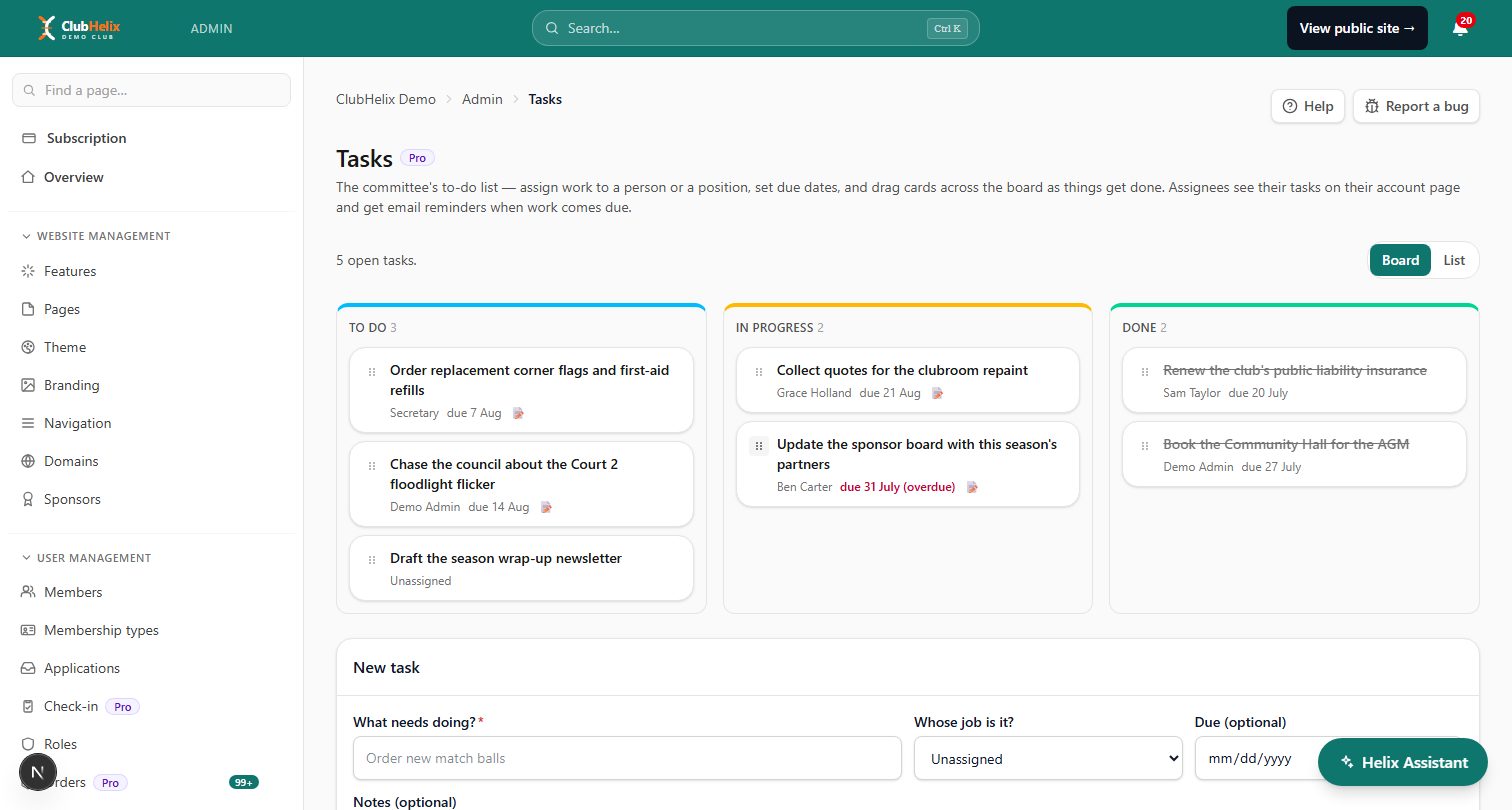
Whichever home you choose, the list itself stays ruthlessly simple. Task, owner, date, status — not priority matrices, not swimlanes, not tags. A community club committee runs perhaps fifteen to thirty open actions; the system's entire job is to make sure none of them is forgotten, and every field beyond the essential four is friction that erodes adoption.
The rhythm: how tasks get chased without anyone nagging
A list nobody looks at between meetings is just minutes in a different font. The rhythm that keeps it alive costs two people about fifteen minutes a week:
- Weekly sweep (secretary or president, 10 minutes). Scan the list once a week. Anything due in the next fortnight gets a friendly, individual nudge — "hey, the fridge quotes are due before the next meeting, all good?" — sent person to person, not broadcast to the group. Public chasing embarrasses; private chasing helps.
- The meeting opens with the list. The first substantive agenda item at every meeting is the action list from the previous one — each item: done, in progress with a new honest date, or consciously dropped. This single habit does more than everything else combined, because volunteers complete tasks they know will be read out. (The agenda template has this slot built in.)
- Dates move honestly. Life happens to volunteers; the sin is not slipping, it is silence. A task whose date has quietly passed twice is either misassigned (give it a new owner without ceremony) or doesn't matter (drop it, on the record). A list carrying ten zombie tasks teaches everyone that the list is aspirational — cull it and it regains its force.
- Overdue is visible, not punitive. Whatever your system, the state "past its date" should be impossible to miss when the list is opened — that visibility, not any confrontation, is what makes dates real. The follow-up is always the same kind question: "does this need a hand, a new date, or the bin?"
Write the recurring year down once, outside anyone's head. Half a committee's workload is the same every year — the pre-season checklist, the AGM sequence, the grant acquittal, the presentation night. Be clear-eyed about what a task board does here: ours has no templates and no recurring tasks, so nothing copies itself forward and next season's jobs do not appear on their own. Keep the year's standing work in a document the committee owns — the pre-season checklist above is exactly that shape — and have the secretary enter those jobs on the board when the season turns. Fifteen minutes once a year is what stops a club depending on the one person who remembers October's obligations.
Handover: the annual memory-loss event
Every AGM, some portion of the committee changes, and with the notebook-and-group-chat approach, the outgoing officers' open loops leave in their pockets. The new secretary discovers in February which renewals, bookings and promises January silently dropped.
A live task list transforms the committee handover, and the trick is to assign the job to the position rather than the person — Secretary, Registrar, Grounds Officer. Do that and the open work simply belongs to whoever holds the position next, dates intact, with no reassignment step and nobody's day-one inbox to trawl. Tasks named to an individual still have to be moved across by hand, which is its own argument for naming the role wherever the job really belongs to the role. The handover conversation stops being "try to remember everything you were doing" and becomes a walk through an actual list. Pair it with role-scoped access to the club's systems (so the new treasurer sees the money and the old one stops), and the changeover that usually costs a club a quarter of momentum costs it an afternoon.
Frequently asked questions
Our committee won't adopt another tool. What's the minimum viable version?
One shared document with four columns, plus two habits: actions captured with owner-date-done at the meeting, and the list read aloud at the top of the next one. That is the whole floor, it costs nothing, and it beats an unadopted app by a mile. Most committees that start there discover within a season that the missing piece is reminders — nobody re-opens the document mid-month — which is the point at which moving the list into the platform the committee already logs into (rather than adding a new tool) tends to stick.
How do we handle the committee member who never does their tasks?
First, check the system before the person: were their tasks real (owner, date, done-definition), and were they nudged privately before being noticed publicly? Most "unreliable" volunteers are overloaded ones — the under-12s coach who is also the registrar should hand tasks back, and a good chair offers that exit explicitly ("want me to find this one another home?"). If the pattern persists with fair tasks and kind chasing, that is a conversation about capacity and role, held privately by the president — covered honestly in how to run a club with no time. The task list's role is only to make the pattern visible early and factually, instead of erupting at the AGM.
Should tasks be visible to the whole committee or just the owner?
Whole committee, always. Visibility is what makes the system fair — everyone can see the load is shared (or isn't), duplicated effort surfaces before both people buy a fridge, and the meeting review works from a list everyone has already seen. The exceptions are genuinely sensitive matters — a disciplinary process, a hardship arrangement — which belong in the appropriate officers' hands and are simply recorded on the list as "with the president", no detail.
What belongs on the committee task list versus a subcommittee's own list?
The committee list holds what the committee must see: decisions it made, deadlines it owns (compliance, grants, insurance, AGM), and the single line each subcommittee reports against ("canteen: rostered through August — on track"). The social subcommittee's forty-item quiz-night run sheet lives with the social subcommittee. The boundary rule: if it would be read aloud at the committee meeting, it is on the committee list; if it would bore the meeting, it is detail belonging one level down. Committees that pull everything up drown; committees that track nothing discover the quiz night has no raffle licence.


