For tenpin bowling leagues and clubs
Averages, handicaps and standings — published before the shoes go back.
A bowling club owns no lanes and no building — its assets are a league, an averages register and a prize fund. ClubHelix keeps all three straight: sign-ups and sanction dues collected online, schedules and standings that publish themselves, and the weekly bulletin out the same night.
Fall-to-spring season · weekly league night · Updated 11 Aug 2026

Why committees of tenpin bowling leagues and clubs come to us
The same problems show up in every committee meeting. ClubHelix is built to retire each one for good.
- Averages and standings live in one person’s spreadsheet, and nobody else can answer a query about them.
- Weekly fees taken in cash at the desk, with lineage, prize fund and sanction dues never itemised for the bowlers paying them.
- Handicap arguments that run for a fortnight because nothing shows what was entered, by whom, or when.
- A team bowls a vacancy score for a month because there is no live substitutes list captains can search.
- The lane-closure call and the results sheet reaching half the league by group text and the other half not at all.
What ClubHelix does for tenpin bowling leagues and clubs
The platform mapped onto the moments your season actually runs on.
Season sign-up
Teams and individual bowlers register online for the division they want, with season fees and sanction dues collected by card in the same flow — so the league secretary starts week one with one clean roster instead of a cash tin, a clipboard and four unread texts.
Schedule and standings
Every division runs as its own competition with a published season schedule, position rounds at the weeks your rules set, and a points table that recalculates the moment a result is saved — live before the last bowler has handed back their shoes.
Averages and handicaps
Keep the averages register on the club site rather than one laptop: entering averages carried from last season, current averages once the game minimum is passed, handicap on your published basis and percentage, and absentee and vacancy scores applied in the open.
Roll-off and finals
Seed the top-four roll-off or finals bracket straight from the final ladder positions, so nobody argues about who qualified — and sell presentation-night seats through the site as a ticketed event while the season is still fresh in the room.
The weekly bulletin
Standings, averages, honour scores and the prize fund balance go out as one broadcast from the club’s own address after league night, with urgent lane closures and oil-pattern changes sent by SMS or pushed to bowlers who have installed the club app.
Substitutes and short teams
Registered subs sign up online with a verified average and appear on a published substitutes list captains can search themselves — a team fills a spot in one message instead of ringing the secretary at six o’clock and bowling a vacancy score.
Fees and the prize fund
Weekly and season money settles into the club’s own Stripe account, and reports separate lineage paid to the centre from prize fund, sanction dues and awards — so the treasurer can itemise the weekly fee for any bowler who asks what it buys.
Season close
Season close is the league secretary’s paperwork: final averages submitted so every bowler carries a verified figure into next year, sanction dues counted per bowler including subs past the nominated game count, honour scores lodged before awards lapse, and the prize fund reconciled so it distributes in full on presentation night.
What is tenpin bowling club management software?
Tenpin bowling club management software runs the parts of a league that a spreadsheet and a group text handle badly: the weekly schedule, the averages register, sanction dues, the prize fund and the bulletin that goes out after Tuesday night. In ClubHelix that means team and bowler registration with payment attached, divisions, schedules and standings that publish themselves, a finals bracket seeded from the final table, treasurer reports that separate lineage from prize money, and broadcasts that reach every bowler on the roster instead of only the ones still in the chat.
A bowling club is built differently from a club with a ground. You own no lanes, no pinsetters, no bar and no parking lot — you hire a block of lanes from someone else's business for three hours a week. Strip the venue out and what remains is the club: a schedule, an averages register, a prize fund and a room of people who have been signing the same sheet for years. Software for a bowling league has to protect those four things, not manage a facility.
League night, divisions and the season schedule
Set the league up once and let it run itself. Each division — scratch, handicap, the Thursday mixed, the short-season block — is its own competition with its own teams, schedule and points table, all on the one league site. Publish the full season in advance so captains know their pair and their opponent in week nineteen, drop in position rounds at the weeks your rules specify, and let the standings recalculate the moment the league secretary saves a result. The table that used to be retyped, photocopied and taped to the desk is live before anyone has handed back their shoes.
When the season narrows to a roll-off or a top-four playoff, the finals series seeds straight from the ladder, so nobody argues about who qualified. Sweepers, doubles nights, the mid-season handicap tournament and the invitational all run as ticketed events with paid entry, and the presentation night that re-signs your league sells its seats the same way.
Averages, handicaps and numbers bowlers trust
Almost every serious dispute in a bowling league is a maths dispute wearing a social costume — an entering average that looks stale, an absentee score somebody thinks is generous, a re-rating rule nobody remembers adopting. The cure is publishing the numbers weekly and being able to show where each one came from.
Keep the averages register on the club site rather than one laptop: entering averages carried in from last season, current averages once a bowler passes the game minimum your rules set, and handicap applied on the published basis and percentage. Absentee and vacancy scores stay visible instead of being applied invisibly. When a captain queries a figure at the desk, the audit log shows exactly what was entered, by whom and when — a query gets answered with a record rather than an opinion, which is the difference between a two-minute conversation and a fortnight.
Who may touch a score matters as much as the score. Give the league secretary and the recorder entry rights, give captains their own view, and keep the treasurer out of the scoresheet entirely with roles and permissions. Splitting the person who runs the standings from the person who holds the prize fund is basic league governance, and it should be enforced by the system rather than by trust.
Weekly fees, sanction dues and the prize fund
The weekly fee is a bundle — lineage to the centre, prize fund, sanction and membership amortised, awards and trophies — and leagues that never itemise it struggle to explain it to a new bowler. Collect season fees and sanction dues at sign-up with card payment attached, so your membership officer is ticking a list instead of reconciling envelopes and a cash tin. Subs who bowl more than the nominated number of games register the same way and land on a published substitutes list with their verified average, so a short team can fill a spot in one message instead of ringing the secretary at six o'clock.
On the money side, reports give the treasurer income by source, outstanding fees by bowler and a season position they can reconcile in an afternoon — including the prize fund balance you publish alongside the standings every week. Fees settle into the club's own Stripe account, so the fund you distribute in full on presentation night is money the league has actually held, in its own bank, all season. Receipts go out automatically as transactional email from your own club address.
The weekly bulletin and keeping teams full
Bowling churn is quiet. A team of four loses one bowler to a shift change, carries a vacancy score for a month, stops enjoying it, and does not come back next season — one departure becomes four. The counter is a league that visibly stays alive between rounds.
Send the weekly bulletin — standings, averages, honour scores, the prize fund balance and a line about the night — as a single broadcast from the club's address. A lane closure, an oil-pattern change or a rescheduled week reaches everyone before they drive over, as SMS when it's urgent, or as a push notification for bowlers who have installed the club app on their phone. Captains chase a fourth in the members chat instead of three separate group texts.
A bowling club website new bowlers can find
Plenty of leagues fold for want of a front door rather than a want of bowlers — nobody in town knows they exist. Build a public site with the page editor: league night and start time, the centre and its address, divisions and current standings, the short-season block you use as a beginners' entry point, and a join button that takes a registration and a payment. Start from the template gallery, or look through the live demo to see what a curious walk-up finds when they search for a bowling league near them.
Free bowling league software to start
Every ClubHelix club starts on the free plan — no time limit and no expiry, which suits a single-division league running one night a week. When you want the paid features, such as online fee collection or a custom domain, paid plans carry a 14-day free trial, bill on a 28-day cycle and can be cancelled any time; current tiers are set out on the pricing page. Money settles directly to the club's own Stripe account — ClubHelix never holds your funds, and the platform fee is never surcharged to your bowlers.
ClubHelix runs bowling leagues and clubs in the US, Canada, Australia, New Zealand, the UK, Ireland and South Africa — wherever a league books a block of lanes on a quiet weeknight. Other league sports have their own pages under solutions, and the full feature list covers what every plan includes.
Off the spreadsheet before week one
The moment to switch is pre-season, while the schedule is still being drawn. Open registration online, load your divisions and teams, carry last season's final averages across, and brief your captains on where results go — most leagues are off the shared spreadsheet within a round or two. If you'd like a hand setting it up, talk to us — and for the wider picture, from the centre agreement and lineage to re-rating rules, prize fund discipline and presentation night, read the full guide to running a tenpin bowling club.
Features in your plan
Every plan starts free and includes the whole platform below — browse all features or compare plans.
Canvas page editor
A no-code, drag-and-drop club website editor with 45 section types and real sidebars. Your page, exactly as it publishes: click a section to edit it, drag to reorder, add new ones right where you want them.
Self-registration
Club membership software that handles the joining for you: online registration and season sign-ups on your own branded site, with email verification and optional admin approval.
Events
A club events calendar with one-off and recurring events — and ticket sales built in, so you never send members off to an external ticketing site.
Competitions
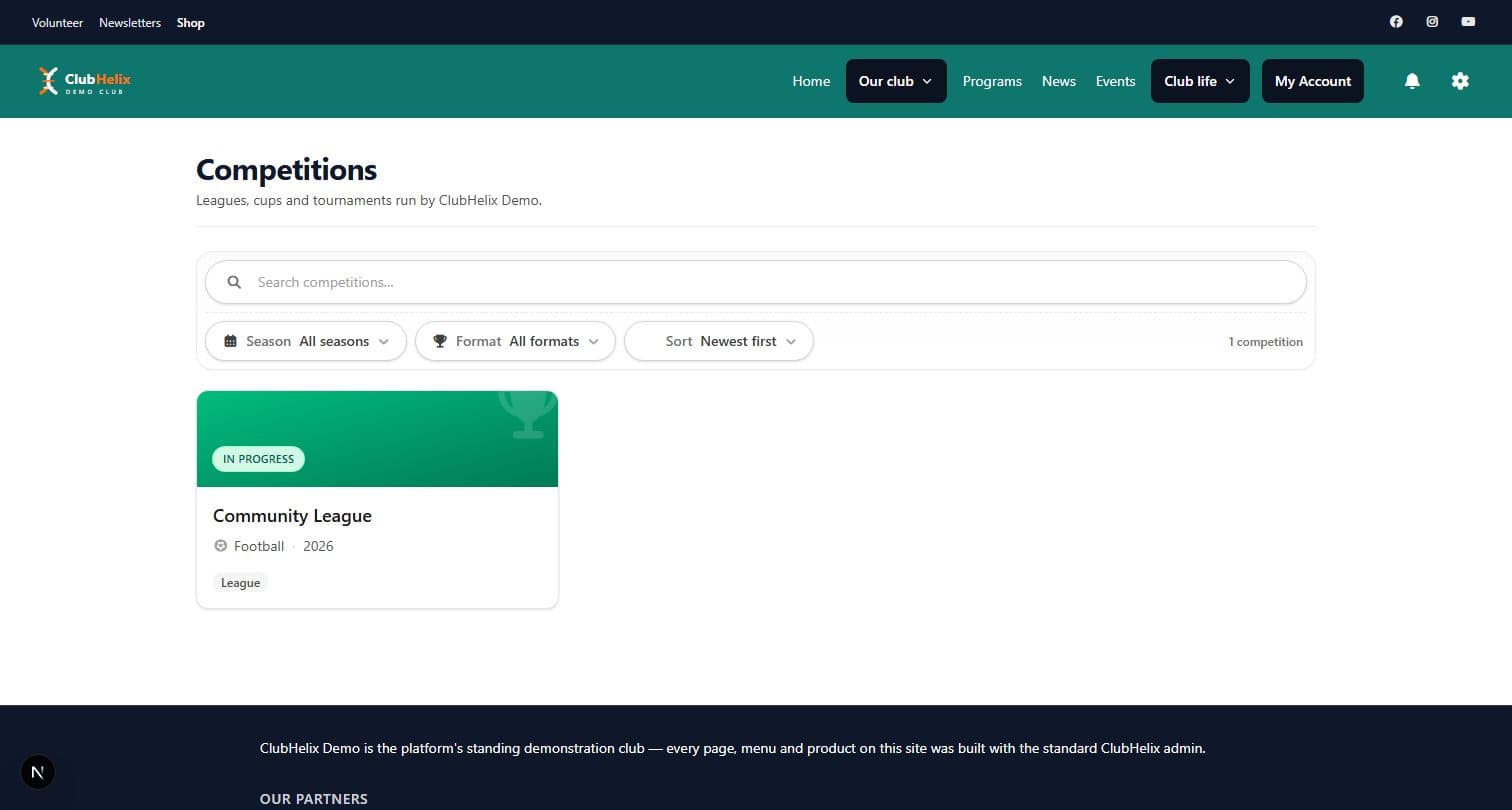
Leagues and divisions with published fixtures and game schedules, entered-once results, and ladders (standings) that compute themselves.
Team management
Team rosters with captains and jersey numbers, training sessions and practices with availability, and scoped access for coaches.
Broadcasts
Send a message to everyone, a role, or a custom segment of members.
Club shop
Run a club shop or team store: take uniform, kit and spirit wear orders online with variants, carts and order management — with GST handled properly on every sale.
Mobile app
A club app of your own — install-to-home-screen with your branding, push notifications and digital membership cards, no app store required.
Frequently asked questions
The questions tenpin bowling club committees ask before signing up.
- Yes. Each division is its own competition with its own teams, schedule, points system and table, all published on the one league site — so a scratch division, a handicap division and a short-season block can run on different nights without anything being retyped.
- The averages register lives on the club site rather than one laptop: entering averages carried in from last season, current averages once a bowler passes your game minimum, and handicap applied on the basis and percentage published in your league rules. Absentee and vacancy scores stay visible instead of being applied invisibly.
- You choose. Give the league secretary and recorder entry rights, captains their own view, and keep the treasurer out of the scoresheet entirely. Every entry is logged with who made it and when, so an average query is answered with a record instead of an opinion.
- Yes. Registration takes the season fee and sanction dues by card in the same flow, and the money settles into the club’s own Stripe account — ClubHelix never holds your funds, and the platform fee is never surcharged to your bowlers.
- Registered subs sign up online with a verified average and appear on a published substitutes list captains can search themselves, so a short team fills its spot in one message rather than carrying a vacancy score for weeks.
Can we run scratch and handicap divisions side by side?
How are averages and handicaps handled?
Who can enter results, and can we see what changed?
Can we collect season fees and sanction dues online?
Does it handle substitutes?
Bring your tenpin bowling club online in under 30 minutes.
Start on the free plan, then take a 14-day free trial of paid features when you're ready — nothing to pay today, cancel any time before the trial ends.