
What this guide answers
- Is there an API to check working with children checks automatically?
No. No Australian scheme publishes a programmatic verification interface for ordinary organisations — Queensland confirmed in writing in January 2025 that it has no current plans to publish an API endpoint for blue…
- Why isn't an expiry date enough?
Because a clearance can be cancelled, suspended or restricted long before it expires, and none of that changes the expiry date your register is watching.
- What does it mean to link a worker to our organisation?
It means the scheme records that this person works or volunteers for your club, which is what allows the regulator to notify you if their status later changes.
- How often should a club re-verify a clearance?
Set an interval that does not depend on the expiry date — annually, or before each season, is the usual answer, with a shorter cycle for roles involving sustained one-to-one contact.
- What should the register record beyond the card number?
Who verified it, when they verified it, which system they verified it against, which jurisdiction issued it, whether the club is linked in the scheme, when it should be re-checked, and whether it has been revoked.
Ask a club secretary how they track working with children checks and you will usually be shown a spreadsheet: name, card number, expiry date, and a column that turns amber a month out. It is a reasonable-looking artefact. It is also the wrong control, and the reason is uncomfortable enough that it is worth stating in the first paragraph.
A clearance can be cancelled, suspended or made subject to an interim bar long before it expires. When that happens, nothing on your spreadsheet changes. The card number is the same. The expiry is still in the future. No reminder fires. Your register cheerfully reports that the coach taking under-12s training on Tuesday is current — and it is wrong in exactly the case the register exists to catch.
This guide is about closing that gap. It assumes you already know who at your club needs a check; if you do not, start with working with children check requirements for clubs, which covers each state and territory scheme and who is typically caught by it.
General information only. This article is general information for community clubs, not legal advice, and it does not make your club compliant with anything. Working with children schemes are run separately by each state and territory, the obligations on an organisation differ between them, and they change. Check the current requirements with your own scheme — NSW Office of the Children's Guardian, Victorian Working with Children Check, Queensland Blue Card Services, Screening Unit SA, WA Working with Children Screening, Tasmania Registration to Work with Vulnerable People, Access Canberra or NT Ochre Card — and with your governing body, which may impose its own requirements on top.
You cannot verify a card from your own software
The obvious fix — have the club's system ask the regulator each night whether every card is still valid — does not exist. There is no programmatic verification interface published for ordinary organisations by any Australian scheme, and this is a deliberate position rather than a gap waiting to be filled.
Queensland has said so in writing. In response to a request for machine-readable blue card validation, Blue Card Services confirmed there are no current plans to publish an API endpoint for blue card validation (published on the Queensland open data portal, 9 January 2025). The rest of the country offers variations on manual checking: Victoria alone provides a bulk check by spreadsheet upload, capped at fifteen hundred rows at a time, and the ACT's mechanism is emailing a list of staff to a government address.
So if any vendor tells you their system "checks your clearances automatically", ask them precisely which regulator they are querying and how. The honest answer, for every product on the market, is that the verification is done by a person.
The control that actually works is the link, not the lookup
Here is the part most clubs have never been told, and it changes how you should think about the whole exercise.
The schemes are not designed around you re-checking a card. They are designed around your organisation being linked to the person inside the regulator's own system — and once that link exists, the regulator monitors the status and tells you when it changes.
Queensland puts it on a poster: No Card. No Link. No Start. The organisation links the person to itself, and having done so, it will then be notified of any change to that card holder's status. New South Wales says the same thing in different words: verifying the worker is what creates the link, and if that worker becomes barred in the future, the regulator will let the organisation know immediately.
Read that again, because it inverts the usual advice. The monitoring you were planning to build with reminders and spreadsheets is already being run by the regulator — but only for people your organisation has actually linked itself to. A club that photocopies cards and files them has no link, no monitoring, and no idea when something changes. A club that verifies properly gets told.
Which makes the practical rules straightforward:
- Verify through the scheme's own channel, every time. Not the photo of the card the volunteer sent on Saturday.
- Do it as the organisation, with the club's own details, so the link is recorded against the club.
- Do it before the person starts, because an unverified volunteer is unmonitored no matter how confident everyone is.
- Remove the link when they leave. A club still linked to fifty former volunteers gets notifications it cannot act on and gives the regulator a picture of its workforce that is years out of date.
What the register is actually for
If the regulator runs the monitoring, why keep a register at all? Two reasons, and both matter.
Evidence. An organisation is generally expected to be able to show what it checked and when — the record of the verification it carried out, not a photocopy of somebody's card. New South Wales and Victoria both work on that basis, and it is the document that answers the only question that gets asked after an incident: what did the club know, and when did it know it?
Operations. The regulator tells you about a status change. It does not tell your team manager that Saturday's coach can no longer coach, work out who else is affected, or notice that the first-aid certificate expired too. That is the club's job, and it needs a list.
The columns a register actually needs
A date-and-number spreadsheet is the version that fails. A register that holds up looks more like this:
| Field | Why it is there |
|---|---|
| Person | Linked to the real member record, not a free-typed name |
| Credential type | Working with children check, first aid, coaching accreditation, driver check |
| Jurisdiction | Which state or territory scheme issued it — the rules differ and so do the numbers |
| Identifier | The card or application number as issued |
| Expiry | Still needed, just no longer sufficient on its own |
| Verified by | The name of the person at the club who did the check |
| Verified on | The date they did it |
| Verified against | Which system or channel they used |
| Linked to the organisation? | Whether the club is recorded as an employer or engaging organisation in the scheme |
| Re-verify every | How often the club re-checks, independent of expiry |
| Status | Current, pending, expired — or revoked, with the date and the reason |
| Role requirement | Which positions at the club require this credential |
The three that most registers lack are the ones doing the work: verified by, verified against, and revoked. Without the first two you cannot evidence anything. Without the third, your register has no way to represent the exact event it is supposed to catch.

Re-verification: the interval that catches what expiry cannot
Since a clearance can change mid-term, set a re-verification interval that is shorter than the card's life and independent of it. Annually is the common choice; before each season is the natural rhythm for most clubs, and half-yearly is reasonable for anyone in sustained one-to-one contact with children.
Trigger a re-check whenever:
- the person takes on a new role, especially one with more contact or more autonomy;
- they return after a season away;
- the club is notified of anything, by anyone — a regulator, a governing body, another club;
- your governing body's own rules say so.
Re-verification is cheap. It is one person, a short session, and a set of dated rows. It is dramatically cheaper than the alternative.
What to do when a status changes
Write this down before it happens, because the day it happens is not the day to be designing a process.
- Stand the person down from the relevant role immediately, pending nothing. This is not a finding about them; it is what the scheme requires.
- Record it in the register — status, date, what you were told and by whom. Keep the detail minimal and factual.
- Tell only the people who must act: the president or the child safety officer, and whoever needs to cover the role.
- Do not discuss it in a team chat, a committee meeting minute or a newsletter. A cancelled clearance is sensitive information about an individual, and the club's duty of confidentiality does not pause because the news is alarming.
- Follow the scheme's instructions for organisations, and your governing body's, in that order.
- Check the knock-ons — other roles that person holds, other clubs you share volunteers with, and any bookings or camps in the next fortnight.
A club that has rehearsed those six steps handles the worst morning of its year in about an hour. A club that has not will spend a fortnight on it and still get it wrong.
Doing this in ClubHelix
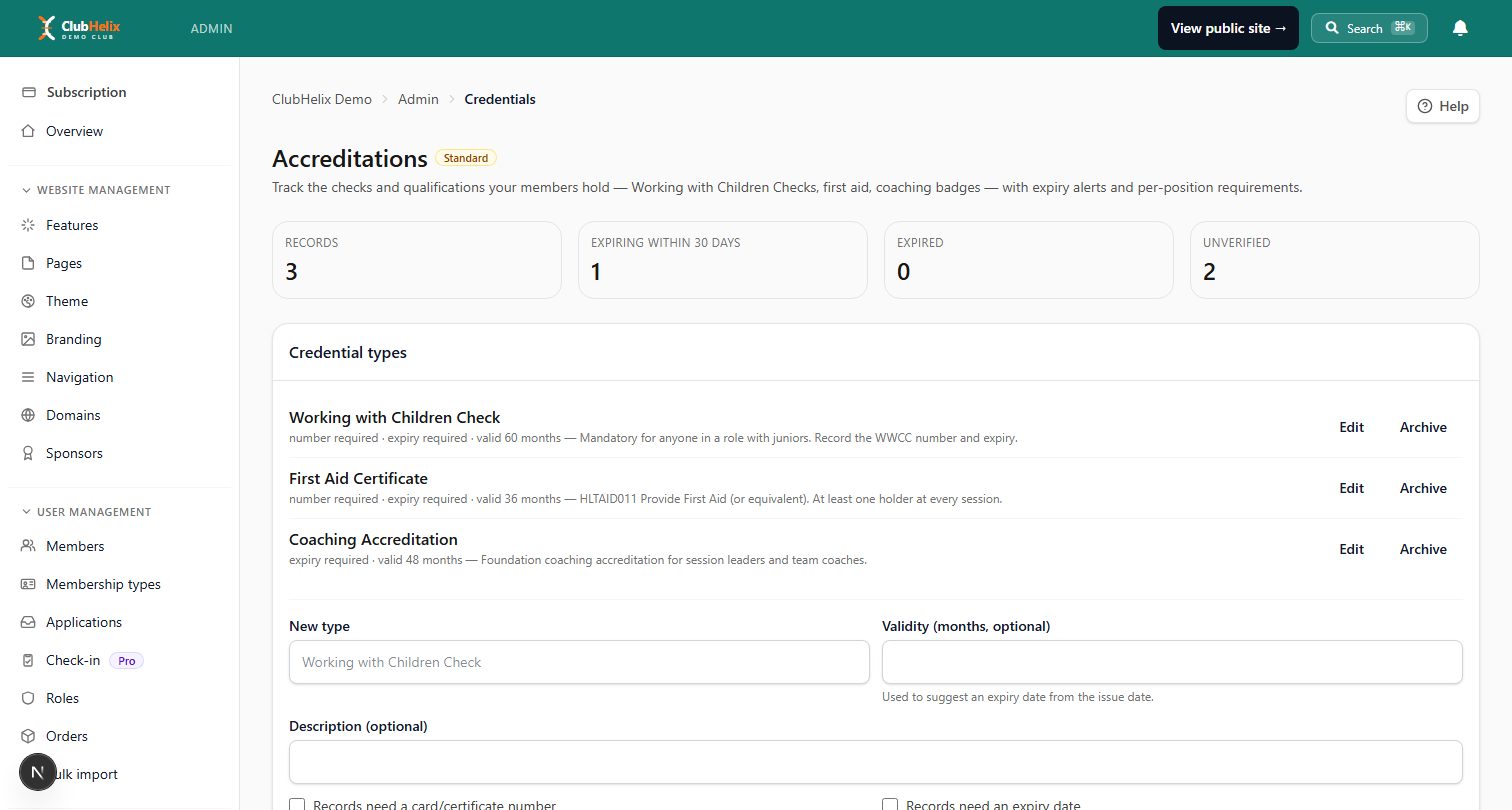
The accreditations module is built for exactly this shape. Credentials are tracked against real member records with expiry reminders, so the routine half happens without anybody watching a spreadsheet — and credential requirements can be attached to positions, so the club can see who holds a role they are not currently cleared for.
Beyond the date, the record carries the part that matters: the jurisdiction the credential belongs to, how it was verified and against which system, the name of the person who verified it and when, whether the club is linked to that person in the regulator's system, how often it should be re-verified, and whether it has been revoked — with the date and reason kept separately from the expiry, so a revocation reads as a revocation rather than quietly hiding behind a future date.
None of that makes your club compliant; compliance is what your committee does, and the scheme's rules are the source of truth. What it does is make the record complete, keep it out of one volunteer's laptop, and put it beside the volunteer roster where the decisions are actually made.
Frequently asked questions
Is there an API to check working with children checks automatically?
No. No Australian scheme publishes a programmatic verification interface for ordinary organisations — Queensland confirmed in writing in January 2025 that it has no current plans to publish an API endpoint for blue card validation, and the closest thing available anywhere is Victoria's bulk spreadsheet check, capped at fifteen hundred rows. Any product claiming automatic clearance checking is describing reminders, not verification.
Why isn't an expiry date enough?
Because a clearance can be cancelled, suspended or restricted long before it expires, and none of that changes the expiry date your register is watching. A date-only register reports a revoked clearance as current until the card would have run out anyway — potentially years. That is the single failure mode the register exists to prevent.
What does it mean to link a worker to our organisation?
It means the scheme records that this person works or volunteers for your club, which is what allows the regulator to notify you if their status later changes. Queensland's rule is often summarised as "No Card. No Link. No Start", and New South Wales describes verification as the step that creates the link and triggers future notifications. It is the closest thing to automatic monitoring that exists, and you only get it by verifying properly, as the organisation, before the person starts.
How often should a club re-verify a clearance?
Set an interval that does not depend on the expiry date — annually, or before each season, is the usual answer, with a shorter cycle for roles involving sustained one-to-one contact. Re-verify as well whenever someone changes role, returns after time away, or the club is told anything that raises a question.
What should the register record beyond the card number?
Who verified it, when they verified it, which system they verified it against, which jurisdiction issued it, whether the club is linked in the scheme, when it should be re-checked, and whether it has been revoked. Those fields are what turn a list of numbers into evidence the club can actually rely on.
Track checks, expiries and verification records against real member records with ClubHelix accreditations. Next: working with children check requirements for clubs and child safe standards for sports clubs.


