
What this guide answers
- Is Join It a replacement for Wild Apricot?
For some organisations, yes — if all you need is signup, renewals, payments and membership cards, Join It covers that ground with much less setup.
- Which is cheaper, contact-based or member-based pricing?
It depends entirely on the ratio between your total contacts and your paying members.
- Does either one give my club a website?
One does and one does not. A full association suite includes a website builder with member-aware pages, which is a genuine advantage if you have no site at all.
- Can these handle junior members and families?
Both can, with configuration, but this is the question to test hardest on a demo.
- What should a sports club use instead?
If your club has teams, a season, match-day roles and merchandise, look at platforms built for clubs rather than associations — the test is whether teams, fixtures and roles are first-class concepts or something you…
Open your club's contact list and count two numbers. The first is how many people pay you something each year. The second is how many people are in the list at all — lapsed members, parents and guardians, newsletter subscribers, sponsors, life members, the four committees' worth of people who helped once in 2019. At most clubs the second number is three or four times the first, and that gap is the single most useful thing to hold in your head while comparing Wild Apricot with Join It, because the two products charge you on opposite sides of it.
This comparison is for the secretary, registrar or membership officer who has decided the spreadsheet has to go and is now looking at two very different answers. Wild Apricot is a full association suite with a database, a website builder, events and payments in one place. Join It is a deliberately narrow membership layer that sits on top of what you already have. We will cover how each is priced and what that does to your bill, what happens to your website under each, and the awkward question neither product's marketing will answer for you — whether a sports club is really the customer either was designed for.
Our stake, declared before anyone's whistle. ClubHelix, the platform we build, competes with both of these in the loosest sense, so treat us as an interested party who has chosen accuracy over flattery. Facts here are public information current as at July 2026, with Wild Apricot's pricing re-read on its own pricing page in October 2026. Where a figure was not verifiable against a source we trust, the number is simply absent rather than borrowed from a round-up. Confirm anything critical with the vendor, and flag anything we have wrong.
What each one actually is
Wild Apricot (Toronto, part of Personify) is the long-standing default for membership and association management across the North American market — a member database, a website builder, event registration and payments in a single suite, with well over a decade of association workflows baked in. Its depth is real. Member portals, event registration, payments and a very large integration directory are the kind of depth that accumulates when thousands of associations spend a decade and a half asking for things. Its natural customer is a professional body, an alumni association, a nonprofit or a special-interest society with a formal membership structure.
Join It (San Francisco) is the opposite instinct. It does memberships — signup, renewal, digital membership cards, payments through Stripe — and it deliberately does not do much else. It is not a website builder, so it assumes you already have a site somewhere and plugs the join-and-renew flow into it. It integrates outward through Zapier rather than trying to be the whole system. That narrowness is the product, not a gap in it, and organisations that want one job done cleanly tend to like it a great deal.
So the honest framing is not "which is better". It is depth versus scope. Wild Apricot wants to be the place your organisation lives. Join It wants to be a good component in a stack you assemble yourself.
Depth versus scope, line by line
Public information as at July 2026, with Wild Apricot's pricing re-checked October 2026. Where a figure was not verifiable, the cell says so rather than guessing.
| Area | Wild Apricot | Join It |
|---|---|---|
| Shape | Full association suite | Membership layer only |
| Pricing basis | Tiers by contact count | Sliding scale by total member count |
| Published entry | No free plan; 60-day trial, then US$66/month at 100 contacts | From US$29 per month |
| Figures we verified | Entry tier, on its pricing page (Oct 2026); higher tiers not | Entry price and sliding basis, per their support centre |
| Website builder | Yes, built in | No — sits on the site you already run |
| Member database | Deep, with member portals and levels | Focused on members and renewals |
| Events | Event registration built in | Not the product's job |
| Payments | Built in | Through Stripe |
| Digital member cards | Not its calling card | A polished part of the product |
| Integrations | Large integration directory | Zapier-centred |
| Home market | Toronto — associations across the United States and Canada | San Francisco — membership organisations, United States |
A note on Wild Apricot's numbers. Its pricing model is consistent in shape: you pay by how many contacts sit in the database, stepping up as that count grows. When we read its pricing page in October 2026 there was no free plan. You get a 60-day free trial with no setup fee, and then 100 contacts cost US$66 a month, or US$59.40 a month if you pre-pay a year (US$56.10 for two years). We could not read the higher contact tiers, so none appear here. The page also says you can use its integrated Personify Payments or another payment system "for an additional fee" without stating the fee, and older figures you may see in round-ups, including a free tier, are out of date. Ask for the current tier table, in writing, with your own contact count in it, and ask what changes if you process payments through a provider of your own choosing.

What the meter counts — contacts or members
Go back to those two numbers. Say your club has 380 paying members and 1,400 people in the database. Under contact-based pricing, you are billed on the 1,400. Under member-count pricing, you are billed on the 380. On the surface that looks like an easy win for the second model, and for many clubs it is — but it comes with a consequence people miss.
If you are only paying for members, the other 1,020 people have to live somewhere else. In practice that means an email tool, a spreadsheet, or nowhere at all, and "nowhere at all" is how clubs lose touch with the exact people most likely to come back — last season's lapsed juniors, the parents whose kids aged out, the volunteers between roles. A contact-based system charges you to keep those people, which is annoying, but it does keep them in the same place as your members, which is where re-engagement campaigns actually come from. Our guide on retaining club members leans heavily on that lapsed list, so think twice before designing it out of your system.
Four questions to settle before you compare any two quotes:
- Who counts as a contact? Ask explicitly whether lapsed members, unsubscribed contacts, event attendees who never joined, guardians attached to a junior, and archived records count toward the tier. The answers differ, and they move you a whole band.
- Who counts as a member? On a sliding member scale, ask whether a family membership is one member or four, and whether a junior with a guardian record counts once or twice. Junior clubs get this wrong constantly.
- What happens at the band edge? If you sign 20 more members in a good season, does the bill step up mid-term or at renewal, and is the step announced in advance?
- What is the exit? Confirm you can export members, renewal history and payment records in a usable format, and whether your member-facing pages survive the cancellation.
A worked example, purely illustrative. Two clubs both have 380 members. Club A runs a big public newsletter and keeps 1,400 contacts. Club B deletes everyone who has not paid for a year and keeps 420. On a contact meter, Club A pays substantially more than Club B for exactly the same membership. On a member meter they pay the same. Neither pricing model is wrong; they simply reward different behaviours, and you should pick the one that rewards the behaviour you actually want. If you want more people in your orbit than in your ledger — which most community clubs should — contact-based pricing is a tax on the right instinct, and you need to price it honestly rather than resent it later.
The website question
This is where the two products part company completely, and where clubs most often make an expensive assumption.
With a suite, the site comes with the database. Wild Apricot includes a website builder, so member-only pages, event listings, the join form and the member directory are all natively aware of who is logged in and what they have paid. That coherence is genuinely valuable — there is no seam between "the website" and "the system", and no volunteer has to remember to update two things. The trade-off, and this is our biased view stated as a view, is that built-in builders inside long-established suites tend to lag the design standard people expect from a modern site, and organisations end up with something functional rather than something they are proud to send a sponsor. It is also worth checking which search-optimisation controls are available on the plan you are considering, because on some suites those sit above the entry tier.
With a layer, the site is your problem. Join It plugs a join-and-renew flow into whatever site you already run. If your site is good, this is elegant — you keep the design you like and bolt on the membership machinery. If your site is a neglected page someone built four years ago, the layer does nothing to fix it, and you now have two systems whose branding, logins and navigation have to be kept in agreement by hand. Members notice the seam. They click "join", land on a differently styled page, and half of them hesitate.
The practical test is simple. Open your club's website on a phone and try to join as a stranger would. Count the clicks, count the moments where the design changes, and count the times you have to explain something out loud. If the answer is embarrassing, the membership tool is not your first problem, and our cost guide to club websites is a better starting point than either product page.
Where a sports club stops looking like an association
Both of these products were built for organisations whose membership year is a single, tidy thing. A sports club is messier, and it is worth being blunt about the parts neither was designed for.
| Club reality | How an association-shaped tool handles it |
|---|---|
| Teams, squads and grades that change every season | Not a native concept — becomes tags or custom fields |
| Fixtures, ladders, results | Out of scope entirely |
| Match-day roles — coaches, managers, officials, canteen | Modelled as members, not as roles with permissions |
| Junior members with guardians who are not members | Needs careful setup, and affects your member count |
| Uniform and merchandise sales | Out of scope — an order form and a spreadsheet |
| Waivers, consent and clearance records | Custom fields at best, an external tool at worst |
| A registration spike in the fortnight before season one | Fine, provided your payment setup is already tested |
| Seasonal renewals rather than rolling anniversaries | Depends on the renewal model — test it before you buy |
That last row is the one that catches clubs out. Association tools often assume each member renews on the anniversary of their own join date, which is perfect for a professional body and slightly wrong for a club whose entire membership starts and ends with the season. Ask both vendors to demonstrate a fixed season-based renewal, not a rolling one, and see how much configuration it takes. If you are still designing your fee structure, how much club membership should cost is worth reading first, because the renewal model and the fee structure are the same decision.
So which one, and for whom?
- Pick Wild Apricot if you are genuinely association-shaped — formal membership levels, an approval process, a member directory that matters, events with paid registration types, and a preference for one vendor holding the whole thing. Its depth exists for a reason and a lighter tool will frustrate you inside a year.
- Pick Join It if memberships are the only job and you already have a website you are happy with. It is priced transparently from US$29 per month on a sliding member scale, it does renewals and digital cards cleanly, and it does not ask you to migrate your whole organisation to get started.
- Pick neither if what you actually have is a sports club with teams, a season, match-day roles and merchandise. Both will hold your members. Neither will run your Saturday, and you will end up buying a second and third system to cover the gap.
When the member list is only half the job
Our own position, stated plainly. ClubHelix starts from the club rather than the membership register, so the member record, the public website and the money are the same system. Member registration and payments feed a database that already understands teams, seasons and roles; the canvas page editor builds the public site on your own domain, so there is no seam between "join" and "the rest of the website"; and reports give the treasurer and the committee the same numbers without an export. Members get an installable web app rather than another login they will forget.
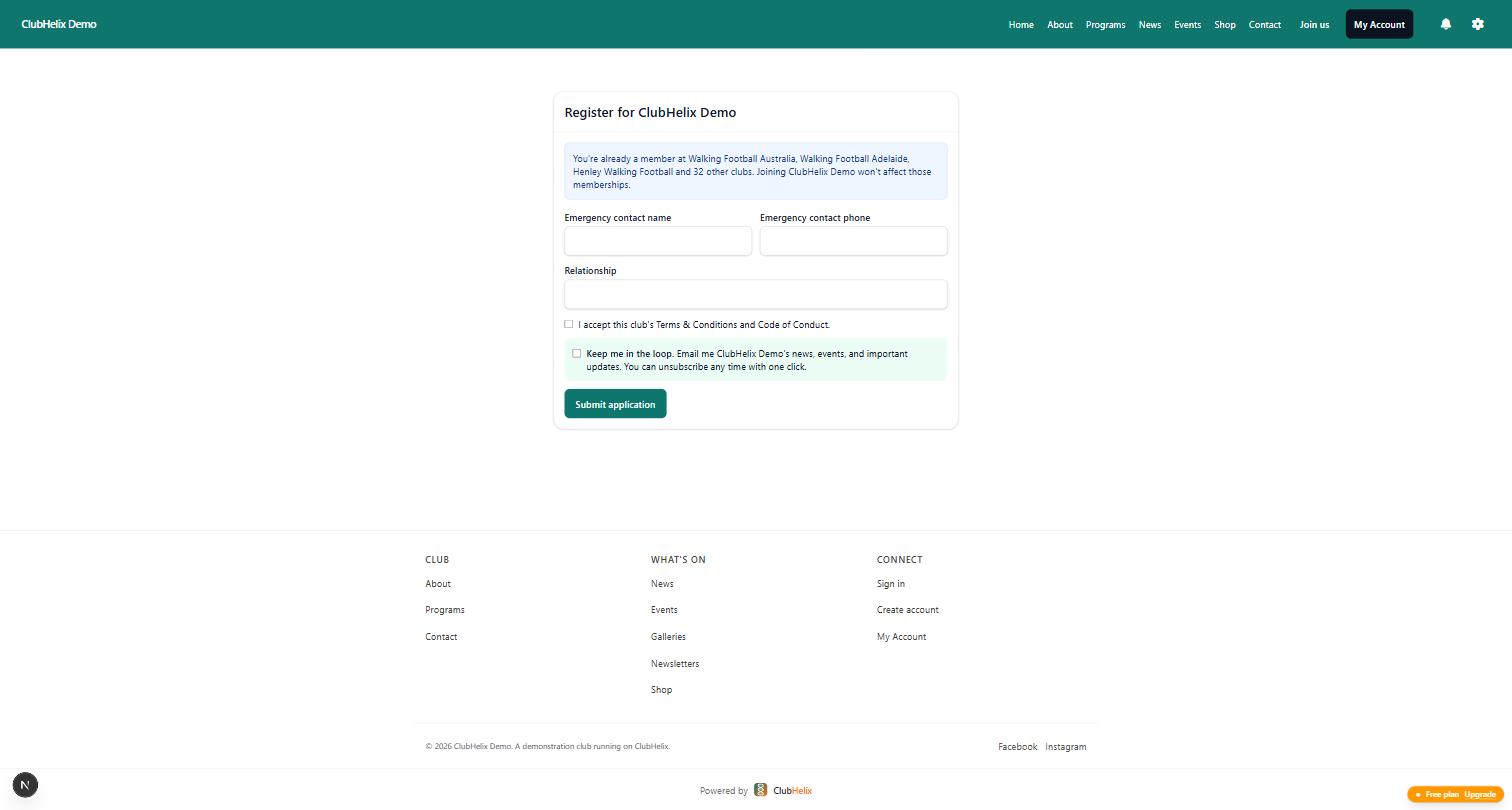
There is a free tier if you want to load your list and see how it feels, pricing published on the page rather than behind a quote, and Australian hosting behind the whole thing. Most committees have a working site and open registrations within an afternoon of signing up. Where we do not compete, in fairness — we do not carry a decade of association-specific workflows like formal membership approval chains and directory publishing, we have no Zapier connector, and if your organisation is an association rather than a club, one of the two products above is probably a better fit than we are. The longer write-up is at /compare. If TidyHQ is also on your list, TidyHQ vs Wild Apricot covers that pairing.
Frequently asked questions
Is Join It a replacement for Wild Apricot?
For some organisations, yes — if all you need is signup, renewals, payments and membership cards, Join It covers that ground with much less setup. It is not a like-for-like replacement, because it has no website builder and no event-registration suite, so an organisation using those parts of a full suite would be replacing one product with two or three. Map the features you actually use, not the ones you are paying for.
Which is cheaper, contact-based or member-based pricing?
It depends entirely on the ratio between your total contacts and your paying members. Member-based pricing is usually cheaper for organisations with a long tail of lapsed contacts, and contact-based pricing can work out better for organisations that keep a tight list and use every feature of the suite. Work out both numbers for your own database before comparing headline prices, and ask each vendor exactly which records count.
Does either one give my club a website?
One does and one does not. A full association suite includes a website builder with member-aware pages, which is a genuine advantage if you have no site at all. A membership layer assumes you already have a site and adds a join-and-renew flow to it, which is elegant when the site is good and useless when it is not. Decide which of those describes you before you compare anything else.
Can these handle junior members and families?
Both can, with configuration, but this is the question to test hardest on a demo. Ask how a guardian who is not a member is stored, whether a family membership counts as one member or several on your bill, and how consent and medical information is captured and kept private. Clubs with juniors routinely discover the answer after the invoice arrives, when the member count is not what they expected.
What should a sports club use instead?
If your club has teams, a season, match-day roles and merchandise, look at platforms built for clubs rather than associations — the test is whether teams, fixtures and roles are first-class concepts or something you improvise with custom fields. That is not automatically us; it is a category. But do apply the test, because retrofitting a season onto an association database is the kind of decision that quietly costs a volunteer several hours a month for years.
Next in this series — Join It vs TidyHQ puts the same lightweight layer against a full committee toolkit, and how to collect club membership fees online covers the payment plumbing underneath both. Corrections welcome via contact.


