
What this guide answers
- We were told a bug was fixed, but it happened again the same day. Were we misled?
Probably not. Often the reason is timing: the fix was made but hadn't reached the version you were using.
- Does a bug coming back mean the vendor is careless?
Not on its own. Regressions happen in all software, including well-run products.
- Will ClubHelix notice a returning problem if nobody reports it?
For failures the platform captures automatically, that is what the reopen rules are designed for.
- How can we tell whether a problem came back or someone changed a setting?
Check who changed what before you report. On ClubHelix the audit log records admin and settings changes, so an admin can see whether a setting was altered around the time the problem reappeared.
- Should we keep testing a fixed bug to make sure it stays fixed?
No. Check it the next time you would naturally use that part of the software, and otherwise leave it alone.
Canada edition. This guide is written for volunteer-run clubs in Canada. Where rules differ — grants, tax, incorporation, safeguarding — follow the Canada-specific pointers below or check with your national body.
Three weeks ago the registrar reported that the renewal form was skipping the second child in a family. A few days later the answer came back: fixed. Tonight a parent has messaged the club to say the form took one child and stopped.
So the same volunteer goes through it all again. They notice the problem, work out that it's the same one, find the old email, report it a second time and chase the reply. The bug itself might take an engineer an afternoon. The real cost lands on the club: a volunteer's evening, a family who now wonders whether the club can run a form, and a committee that stops believing the word "fixed".
Every club that relies on software has lived some version of this. This guide explains, in plain language, why fixed bugs come back, what "fixed" ought to mean, how a platform can reopen a returning problem itself instead of waiting for a second complaint, and what your committee can reasonably expect and ask.
Why fixed bugs come back
A bug that returns after a fix is common, and it rarely means anyone was dishonest. Most jobs in software can be reached by several routes, and a bug report usually describes one trip down one of them. Four explanations cover most of what clubs run into.
The fix covered one path, and the problem had others
A family can renew from the club website, from a link in an email or from their account page. They might be on a phone or a laptop, joining for the first time or coming back. Each of those routes can run through slightly different code. If the report described the email link on a phone, the fix may have repaired exactly that, while the same fault sat untouched on the account-page route. From the club's side, the problem came back. From the engineer's side, a second copy of it has just turned up.
The fix wasn't live yet
A fix is written, checked and then released as part of an update. Between "we've fixed it" and "the update has reached everyone" there is a gap, and the old version keeps running during that gap. If the treasurer tries again that afternoon, they may still be using the version with the bug in it. They see the same failure and reasonably conclude that the fix didn't work. Often it did. It just hadn't arrived.
A later change undid it
Software keeps changing. A new feature, a tidy-up of old code or a fix for a different problem can touch the same part of the product and quietly reopen an old fault. Engineers call this a regression. It is one of the most ordinary failures in software, and it's the reason a good process keeps watching after a fix goes out.
Sometimes the later change isn't in the software at all. A new committee member adjusts a setting, and something that looks exactly like the old bug appears. That is worth ruling out first. On ClubHelix, admins can check the audit log, which records admin and settings changes, so "did the software change, or did one of us?" has an answer.
The report described a symptom with more than one cause
"Payments aren't working" is a symptom. Behind it there might be a checkout that fails on one browser, a payment that goes through but never shows as paid, and a receipt email that doesn't send. Those are three separate problems sharing one description. Fixing the one the engineer could reproduce is real progress, and the next time one of the other two happens, the original report reads as true all over again. This is why a precise report matters so much. Our guide on how to report a bug in your club software covers what to include.
What "fixed" should mean
When a vendor says "fixed", a committee hears "this won't happen again". Engineers often mean something narrower: "we changed the code that caused what we saw". Both are reasonable, and the frustration lives in the gap between them.
A useful definition has three parts:
- The cause was found and changed. Something was actually repaired. A workaround or a friendlier error message is a different thing, and it's fine to be told which one you got.
- The fix is live. It has reached the version people are really using.
- The problem has stopped happening. Someone has confirmed, from real use, that the failure is no longer occurring, and keeps confirming it for a while afterwards.
The third part is the one most processes skip. A ticket closed on the day the code changed is a statement of intent. A ticket that stays closed because the failure has genuinely stopped is evidence. The difference only shows when a fix doesn't hold, and those are the days a club remembers.
How ClubHelix watches a fix after it ships
We'll use our own process as the worked example, because it's the one we can describe honestly. It starts from one fact: on ClubHelix, failures report themselves. A page crash, a request that fails behind the scenes or a background job that falls over is captured automatically and grouped into a ticket for our team, whether or not anyone writes in. A platform can only notice a problem coming back if it was noticing the problem in the first place.
Here is what happens once one of those tickets has been fixed.
A fix is marked resolved for the next release
When our team fixes a problem, its ticket is marked resolved for the next release, instead of resolved on the spot. That sounds like a technicality, and it deals with the "fix wasn't live yet" problem above. Until the update goes out, the old version is still running and will still hit the old bug. Those repeats are expected, so while the update is on its way they don't raise false alarms.
If it happens again on a newer release, the ticket reopens itself
Once the update is out, the rules tighten. If the same problem turns up on a newer release, its ticket reopens by itself, marked as having come back, and our team is alerted. That doesn't wait for anyone at the club to spot the failure, recognise it as the old problem, dig out the original email or argue that it isn't new.
If it's still happening a day later, it reopens regardless
There is a second rule, because the first one has a gap. An old failure can keep arriving without ever showing up on a newer release. So if a problem marked fixed is still happening a day after it was marked fixed, the ticket reopens anyway, whichever release the failure came from. A fix that didn't work can't sit behind a closed ticket.
The rule errs on the side of caution. If an update genuinely takes longer than a day to go out, a correct fix may reopen too. It then goes back on the open list and gets an outcome like any other open ticket. We would rather look twice at a good fix than miss a bad one.
Tickets keep a record of the decision
Each ticket keeps a history of what was decided about it, and every open ticket is worked through to one of four outcomes: fixed, already fixed, noise, or a configuration change. When a problem comes back, whoever picks it up can read what was decided last time instead of starting from nothing.
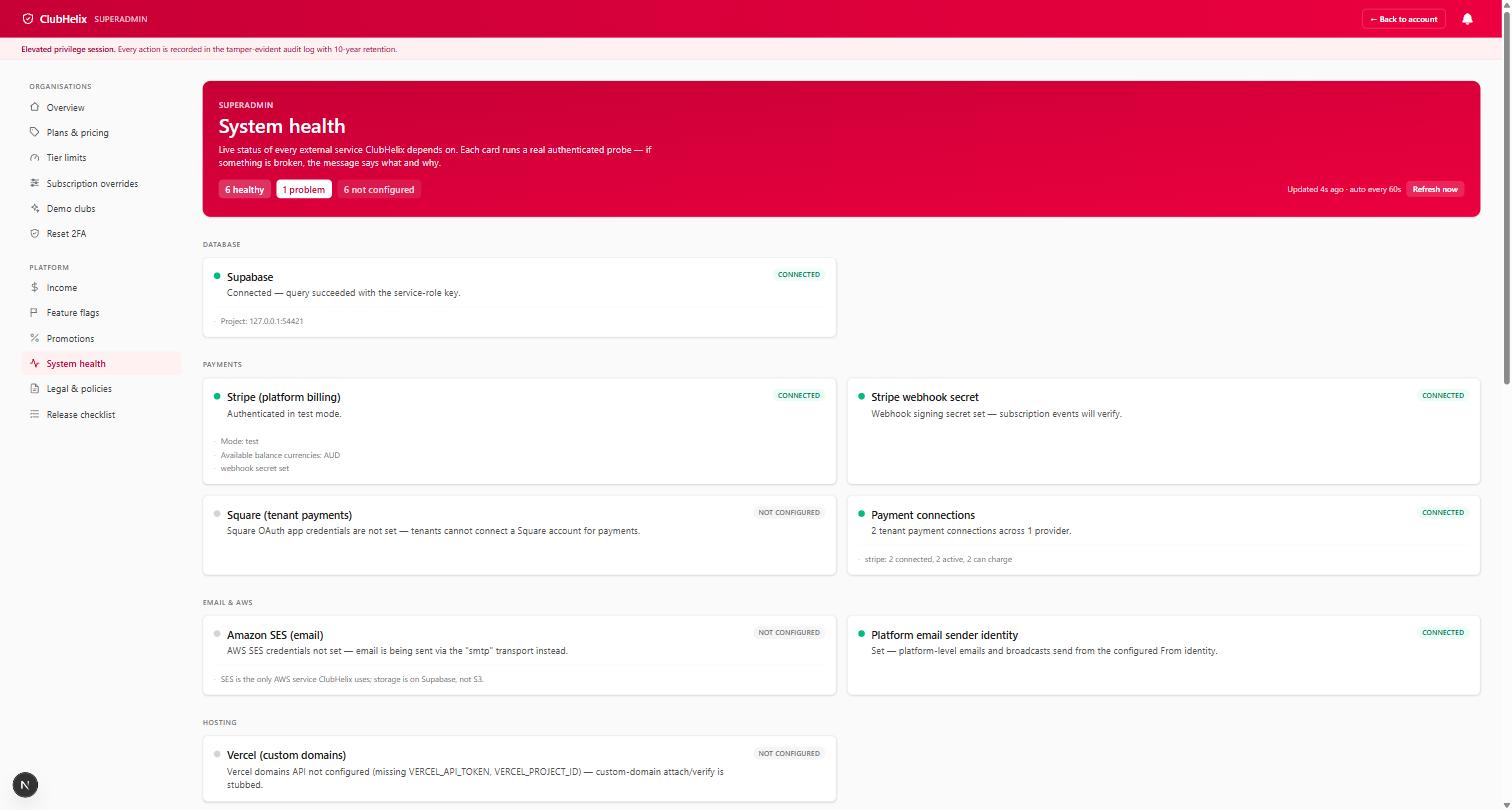
Configuration is on that list for a reason. Some problems that look like returning bugs are really a service the platform depends on being set up wrongly. Changing code won't fix those, so they are recorded as what they are.
A report from the error screen joins the same ticket
People are still the safety net. When a page breaks, the error screen says the issue has been reported to our team, shows a reference, and offers Try again and Tell us what happened, which opens the bug report form. A signed-in person who sends a report from that screen has it joined to the same ticket as the crash it describes, and is shown a reference to quote. So if someone at your club reports a problem that has come back, their words land on the ticket that already holds its history, and nobody has to connect a fresh case to an old one by hand.
What this doesn't promise
No process makes software bug-free, and ours is no exception. It can't stop a bug from ever coming back. It is built so that a returning problem goes back on our team's list by itself, without waiting for your committee to notice. Problems are fixed as quickly as we can, and watched until they stay fixed. How our team finds and fixes problems is on our bug fixing page, and the rest of our reliability approach, from monitoring to the public status page, is on our security and trust page.
What your committee should expect
From any platform, a committee can reasonably expect three things once a fix is announced.
A straight answer about whether it's live. "Fixed, and live now" and "fixed, and in the next update" are both fine answers. They tell you different things about whether to try again tonight. If all you're told is "fixed", ask which one it is.
No penalty for reporting it twice. If a problem you were told was fixed happens again, report it again and say it's a repeat. Quote the reference from the first time if you have one. A good vendor treats "it's back" as useful information, and saying so should never feel like an accusation.
Not being the alarm. Your committee shouldn't be the vendor's regression test. A platform that captures its own failures ought to learn that something came back from its own records, ideally before anyone at the club does. When a vendor's process depends on a volunteer spotting a returning bug and complaining a second time, the club is doing unpaid quality control.
Questions to ask any vendor
These belong in any software evaluation, alongside the rest of our guide to choosing club management software. None of them needs technical knowledge to ask.
- "How do you know a fix worked?" Listen for something that happens after the release. "We tested it" is a good start. "We watch whether the failure stops happening" is the answer you want.
- "What happens if it comes back?" The strong answer is that the original ticket reopens by itself and someone is alerted. The weak answer is "let us know and we'll look into it", which puts the club back in charge of noticing.
- "When you tell us something is fixed, is it live?" A vendor who separates "fixed" from "released" understands why fixes sometimes seem not to work.
- "If we report a problem that has come back, does it start from scratch?" You want to hear that a repeat report joins the original history.
- "How do you record what you decided about a problem?" Whether it was fixed, turned out to be a setting or was judged not to be a fault, someone should be able to read the decision back.
Ask them during your demo of each product, and treat vague answers as data. Every vendor has had a fix that didn't hold. What you're judging is whether they find out from their own systems or from you.
Tracking it without making it a volunteer's job
The worst response to one returning bug is a committee that appoints someone to re-test the software every week. That turns a vendor's problem into a standing volunteer role, and it's work a good platform should already be doing.
A lighter approach works better:
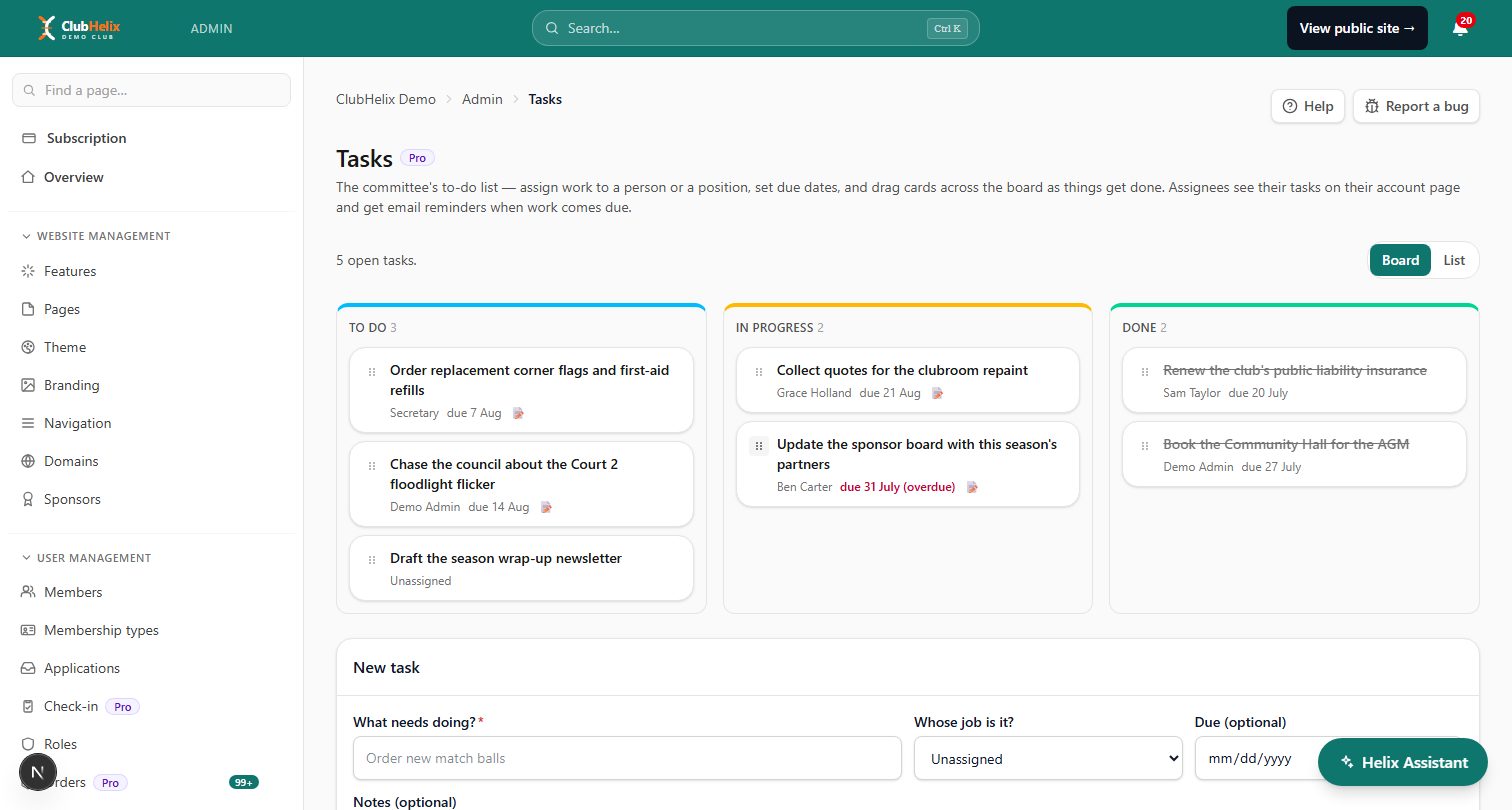
- Keep one line per reported problem, somewhere the committee already looks. Note the date, a short description, the reference if you were given one, and what you were told ("fixed, next update"). If your club uses committee tasks, a single task with a due date a few weeks out does the job, and nobody needs a separate spreadsheet.
- Check on the next natural occasion. If the bug was in registrations, the next registration night is the test. Nobody needs to go looking for it in between.
- If it's back, report it from where it broke. On ClubHelix that means the Report a bug button beside Help in the admin area or on the account page, or Tell us what happened on the error screen. The report carries the page address and recent errors from that page automatically, so a sentence or two from you is enough.
- Bring the list to your renewal review. One returning bug in a year says little. The same few coming back again and again, each one discovered by a volunteer, says a lot about the vendor's process.
Frequently asked questions
We were told a bug was fixed, but it happened again the same day. Were we misled?
Probably not. Often the reason is timing: the fix was made but hadn't reached the version you were using. Another common reason is that the fix repaired one route to the problem and you took a different one. Report it again, say it's a repeat, and ask whether the fix is live yet. On ClubHelix, a fix is marked resolved for the next release so that repeats from the old version, before the update arrives, are expected instead of being mistaken for a failed fix.
Does a bug coming back mean the vendor is careless?
Not on its own. Regressions happen in all software, including well-run products. What separates vendors is how they find out and what they do next. A platform that reopens its own tickets when a failure returns is watching its fixes. One that needs you to rediscover and re-argue every returning fault is leaving that job to you.
Will ClubHelix notice a returning problem if nobody reports it?
For failures the platform captures automatically, that is what the reopen rules are designed for. If the same failure happens again on a newer release, its ticket reopens by itself and our team is alerted. If a problem marked fixed is still happening a day later, it reopens regardless. Reports from people still matter for anything the platform can't see for itself, which is why signed-in people can report a bug from the admin area, from the account page, and from the error screen, where the button reads Tell us what happened.
How can we tell whether a problem came back or someone changed a setting?
Check who changed what before you report. On ClubHelix the audit log records admin and settings changes, so an admin can see whether a setting was altered around the time the problem reappeared. If nothing changed on your side, report it as a repeat.
Should we keep testing a fixed bug to make sure it stays fixed?
No. Check it the next time you would naturally use that part of the software, and otherwise leave it alone. Watching a fix over time is the vendor's job, and on a platform that captures its own failures, most of that watching happens without anyone at the club doing anything.
Where can we see how ClubHelix handles reliability?
The security and trust page sets out how failures are noticed, reported and fixed, and links to the live service status page. If you'd like a platform that watches its own fixes so your committee doesn't have to, you can set up your club on ClubHelix whenever you're ready.


